5 rupees 1938
Market Prices
10 salesAbout This Note
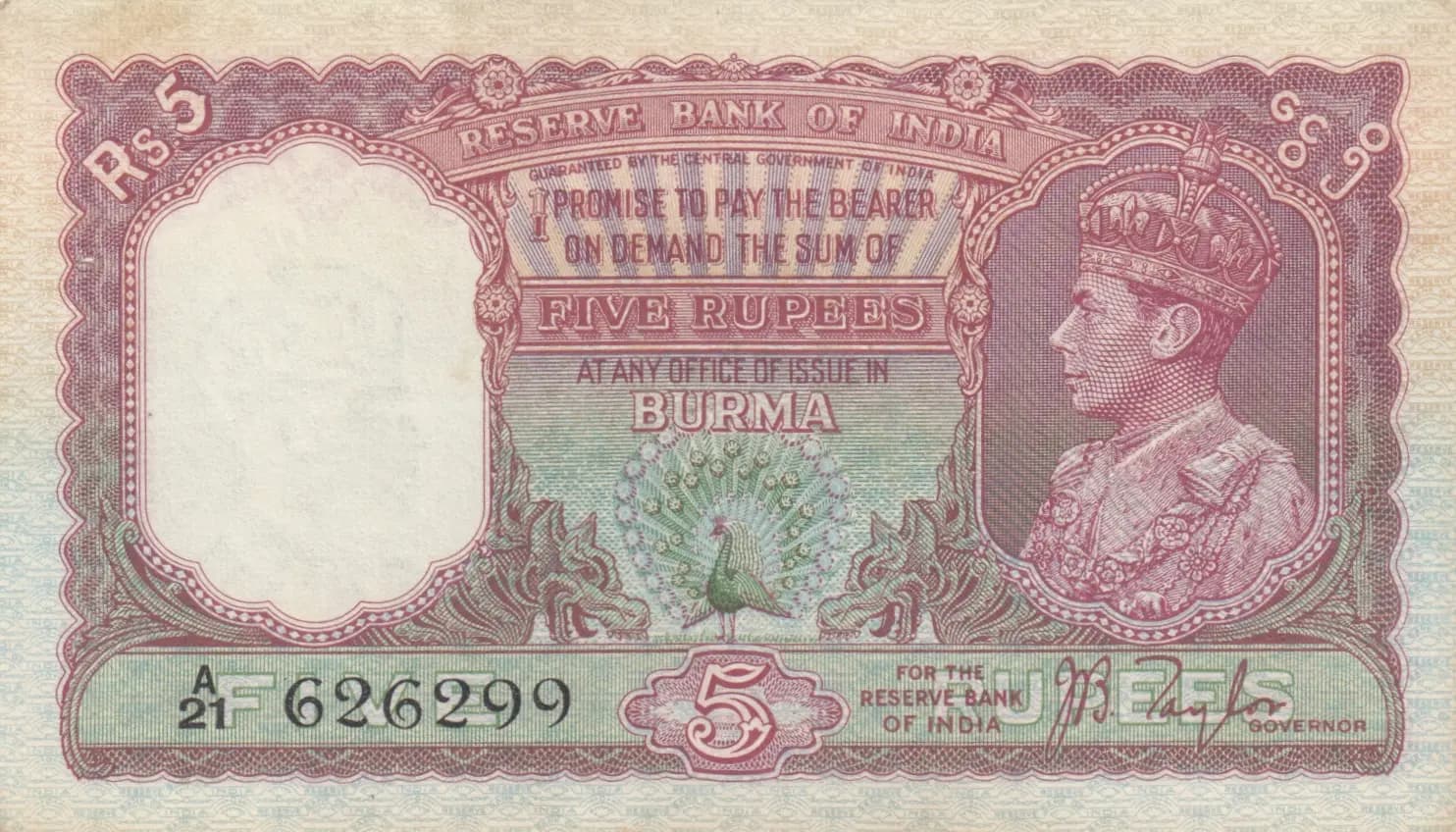
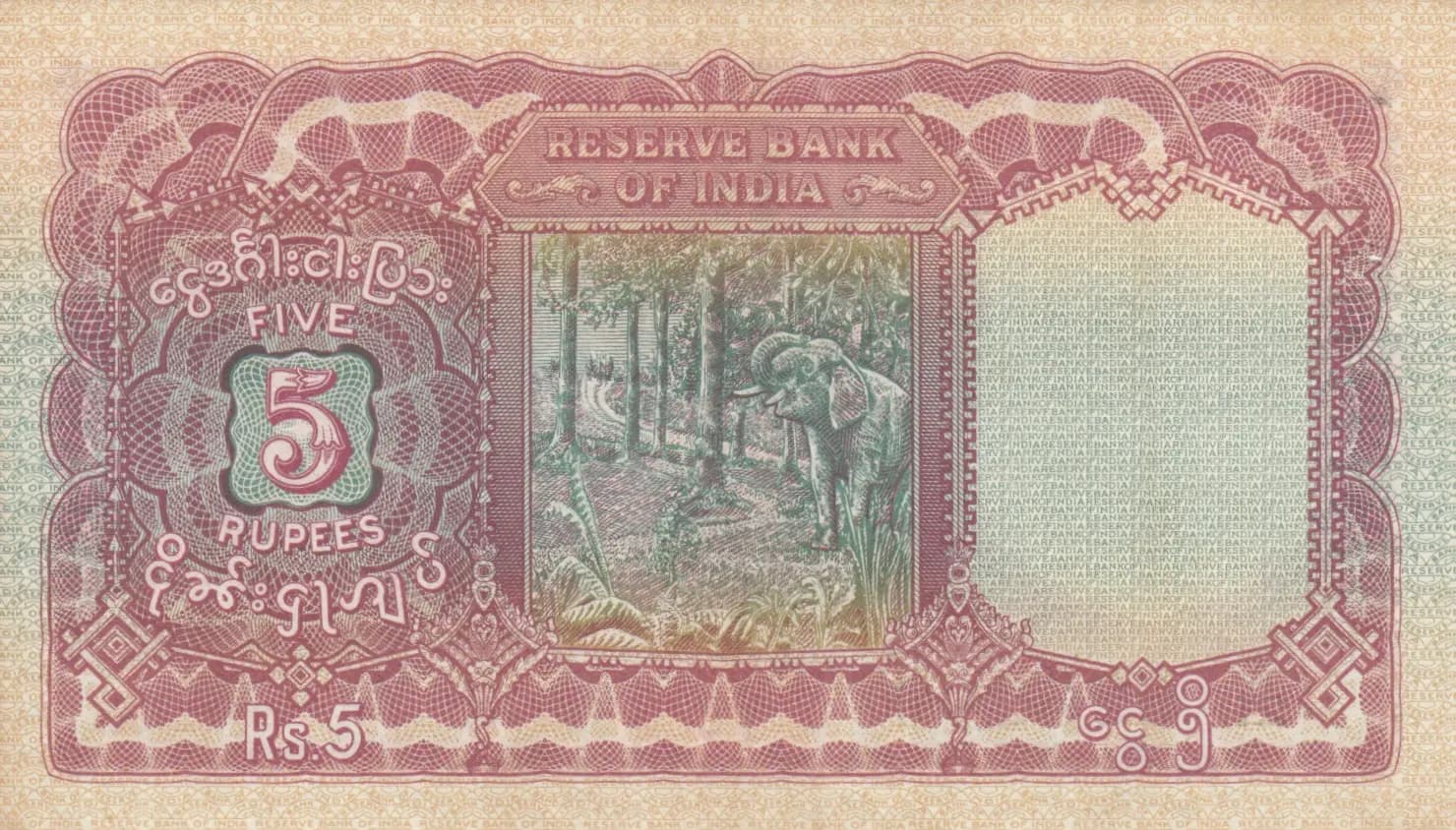
This is a Reserve Bank of India 5 Rupees banknote from 1938 (Pick P-4), specifically the Burma issue, presenting in exceptional condition with sharp, crisp printing and no visible signs of circulation. The note features an elegant design combining a regal portrait of King George VI in military uniform on the obverse with a symbolic peacock at center, while the reverse depicts a worker in a jungle scene—reflecting Burma's colonial economic context. The mauve and green color scheme, combined with intricate guilloche security patterns and ornate cartouches, exemplifies the high-quality intaglio engraving standards of pre-war Reserve Bank notes.
Common. The eBay price tracking data shows this denomination in VF condition has sold multiple times in the $30–$136 range over the past decade, with recent 2024 sales at approximately $30. The presence of frequent sales at modest prices, combined with the standard nature of this regular-issue note from a major issuer with presumably substantial print runs, indicates this is a commonly available note in numismatic markets. While it represents an interesting historical piece, it does not command the premium prices characteristic of truly scarce issues.
Issued during the final decade of British colonial rule in Burma, this 1938 note represents the Reserve Bank of India's monetary authority over the Burma administration. The portrait of King George VI in military dress reinforces the British Imperial presence, while the peacock—a symbol deeply rooted in South and Southeast Asian iconography—and the jungle labor scene on the reverse reflect the colonial economic structure centered on natural resource extraction and agricultural labor. This note was issued just before World War II would dramatically alter the region's political and monetary landscape.
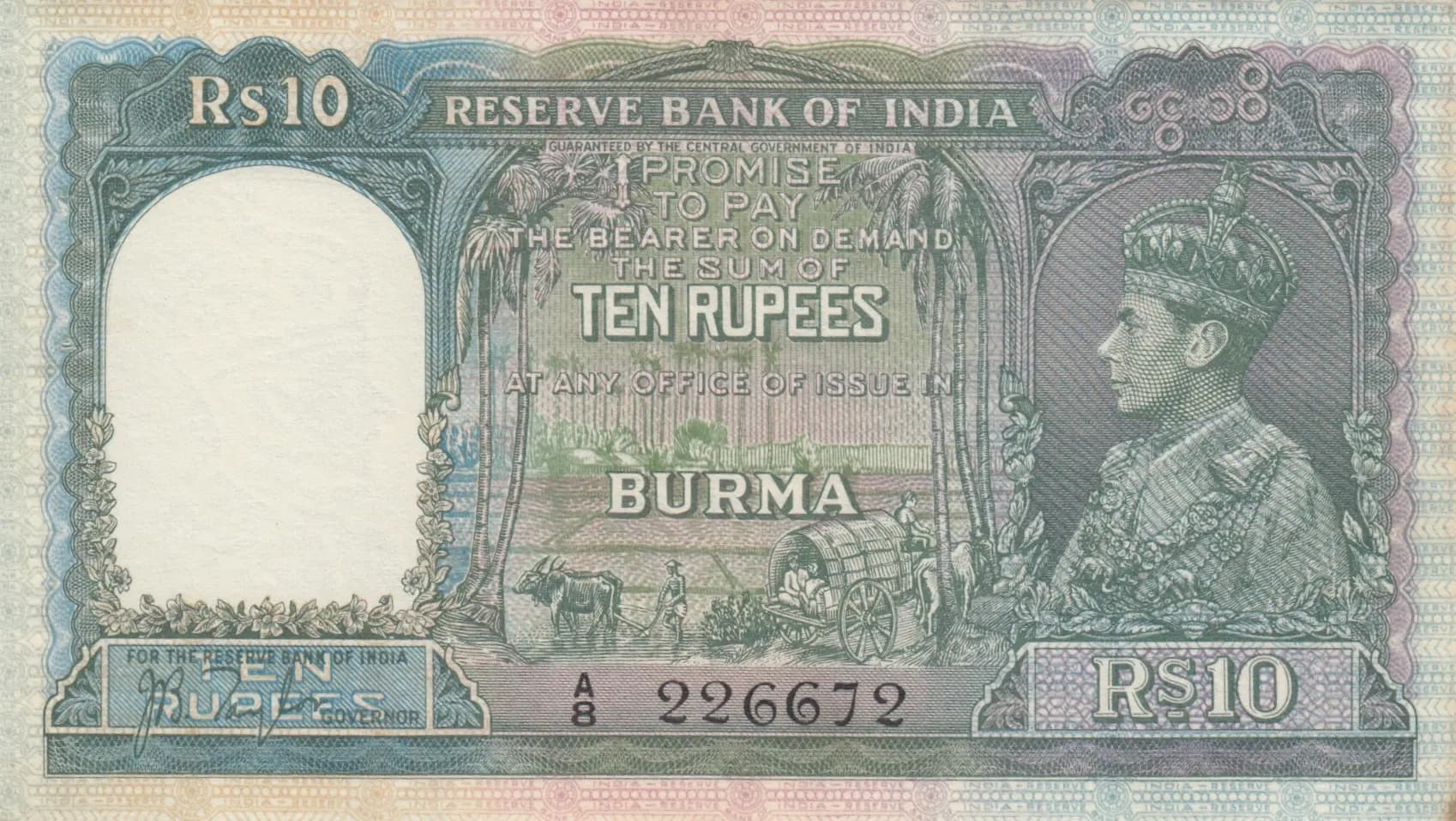
The obverse features a left-facing profile portrait of King George VI wearing military uniform and crown, positioned on the right side of the note, signifying British sovereignty. The center-lower portion displays an elaborate peacock with fully spread tail feathers, a symbol of majesty and wealth in Asian traditions. The reverse depicts a detailed engraved scene of a figure engaged in labor within a tropical forest setting with dense vegetation and trees, likely representing rubber tapping, logging, or other extractive industries central to Burma's colonial economy. Both sides are framed by ornate cartouches and bordered with intricate floral and geometric patterns characteristic of high-security currency design.
Front side: 'RESERVE BANK OF INDIA' (issuing authority); 'I PROMISE TO PAY THE BEARER ON DEMAND THE SUM OF' (standard currency promise); 'FIVE RUPEES' (denomination); 'AT ANY OFFICE OF ISSUE IN BURMA' (geographic limitation); 'FOR THE RESERVE BANK OF INDIA' and 'GOVERNOR' (signature line); Serial number 'A2-626299'. Back side: 'RESERVE BANK OF INDIA' (issuer); 'FIVE RUPEES' (denomination in English with Burmese script equivalent); 'R.S. 5' (abbreviated denomination); Printing marks 'C C' (engraver's or printer's initials).
This note was produced using intaglio (engraved steel plate) printing, evidenced by the deep, detailed line work visible throughout—particularly in the guilloche patterns, cross-hatching for shading, and the finely rendered portrait and landscape scene. The crisp impression and sharp detail are hallmarks of quality intaglio work typical of Reserve Bank of India notes from this period. The printer was De La Rue & Company, the British security printer responsible for colonial Indian currency.
This example bears the serial number prefix 'A2-626299', identifying it as part of the standard A-series printing run. The signature block for the Governor is visible but not clearly legible in the visual analysis. Known varieties of the Burma 5 Rupees may include different signature combinations corresponding to different Governors' tenures, though the 1938 date narrows this to the governorship period of the late 1930s. The mauve/purple and green color scheme is consistent with the standard design for this Pick number; color variations between printings may exist but require comparison with multiple examples to establish definitive varieties.