10 kyats 1958
Market Prices
26 salesAbout This Note
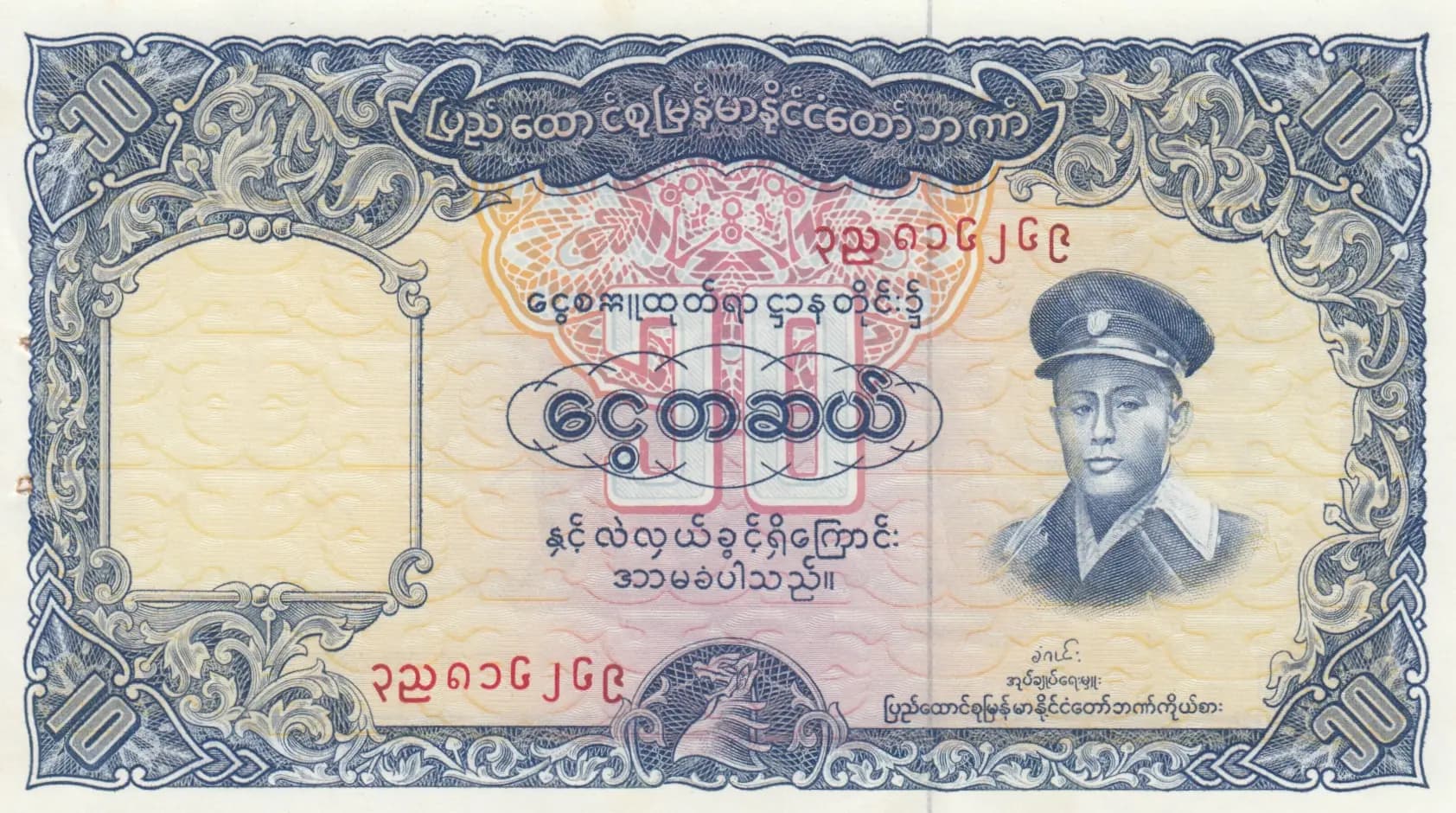
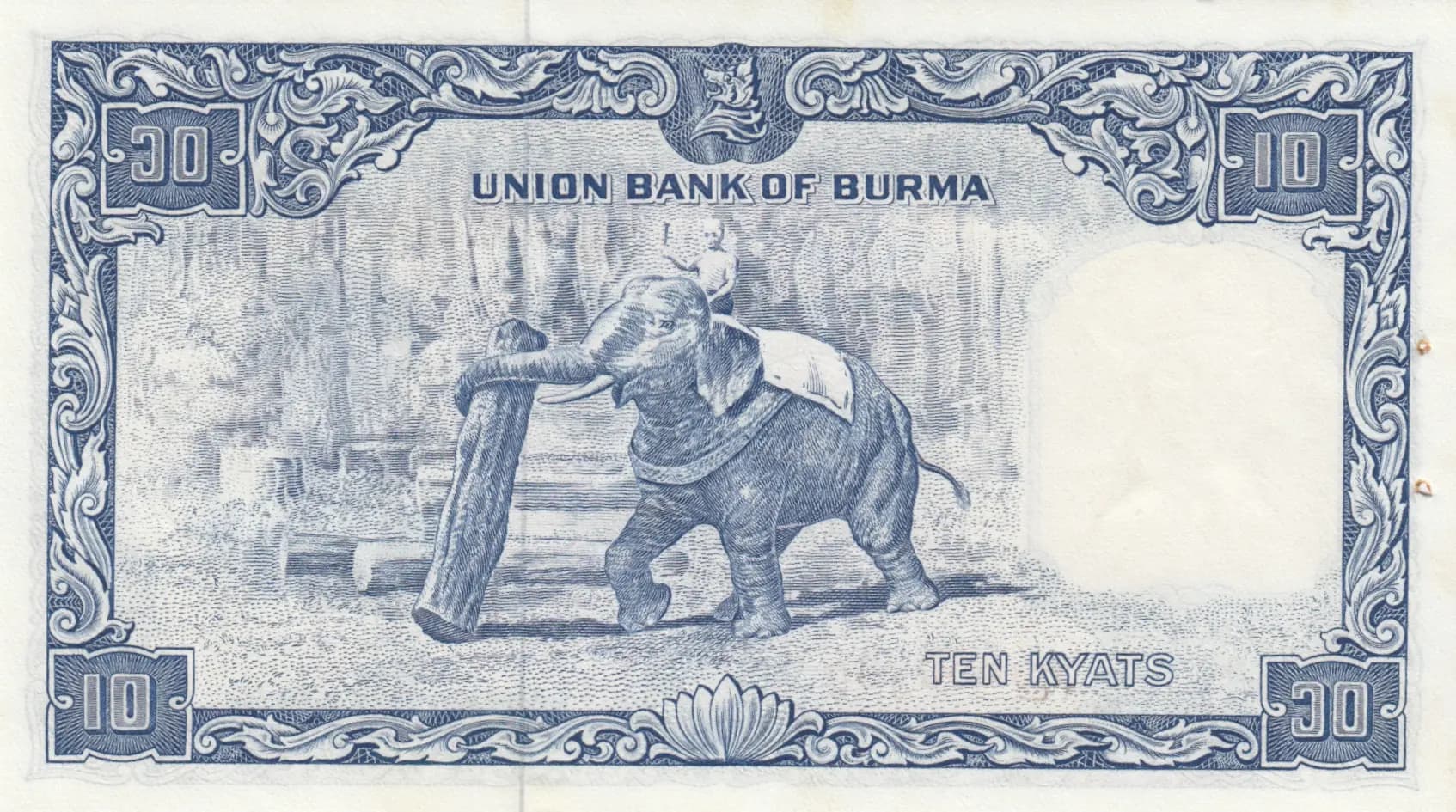
This is a 1958 Union Bank of Burma 10 kyats note (Pick 48) in circulated condition, featuring General Aung San in military cap on the obverse and a working elephant scene on the reverse. The note exhibits visible horizontal fold creases, light foxing, and age-related discoloration consistent with circulation from the 1950s era, though the engraved details and ornate blue borders remain clearly legible. The classical engraved design and historical imagery make this a representative example of early post-independence Burmese currency.
Common. The eBay sales data demonstrates consistent availability with numerous sales across multiple condition grades from 2012 to 2026, with UNC examples selling for $2.49–$2.99 in 2012 and VF examples for $2–$4 in recent years. Catalog values from 2016 list UNC at only $4, and PMG-graded examples (64–65) typically realize $15–$40, consistent with common-grade notes from a moderate print run. The steady supply and low market pricing confirm this is a readily available note.
Issued in 1958 by the Union Bank of Burma during the early years following Burma's independence from British rule in 1948, this note reflects the nation's sovereignty through the prominent depiction of General Aung San, the independence leader and founder of the Burmese armed forces. The reverse vignette of an elephant engaged in logging work symbolizes Burma's economic reliance on timber resources and agricultural labor during this period. The bilingual design (Burmese and English) represents the transitional period when English remained in official use alongside Burmese script in post-colonial Burma.
The obverse features an ornately engraved border in blue with intricate scrollwork and geometric patterns framing a cream-colored central field. A portrait bust of General Aung San wearing a military-style cap is positioned on the right side, rendered in black engraving. The design includes decorative cloud-like cartouches containing the denomination and circular emblems in corners bearing the numeral 10. The reverse depicts a classical engraved vignette of an elephant lifting or carrying a large log, with a handler/worker figure, centered within the same ornate blue scrollwork border design. Both sides employ fine-line engraving as the primary decorative element, with the color scheme of blue, cream, and black creating a formal, authoritative appearance characteristic of 1950s Commonwealth-influenced currency design.
FRONT SIDE: Burmese numerals '၁၀' (10); Burmese text 'ပြည်သူ့လူမိုင်းရေးပါတီ' (Union of Burma/People's Socialist Republic designation); 'ဗြိတိသျှ' (Burma); 'ငွေစက်' (Kyat/Currency). BACK SIDE: English text 'UNION BANK OF BURMA' at top center; 'TEN KYATS' at bottom right of central vignette; Arabic numerals '10' in corner cartouches.
Intaglio engraving (line engraving) on wove paper, with color printing in blue for borders and decorative elements. The fine detail work on both the portrait and the elephant vignette, combined with the crisp line work in the borders, indicates professional security printing typical of notes produced by established currency printers of the era. The note was likely produced by a British security printer given Burma's recent Commonwealth ties and the English-language inscriptions.
Pick 48 represents the standard 1958 issue without noted major varieties in the primary references. The visual analysis does not reveal date variations, signature varieties, or significant overprints that would distinguish this as a specific sub-variety. However, the specific printer and any printer's mark should be noted if visible on the original note; such details would classify this within the standard 1958 issue family.