1 cent 1942
Market Prices
26 salesAbout This Note
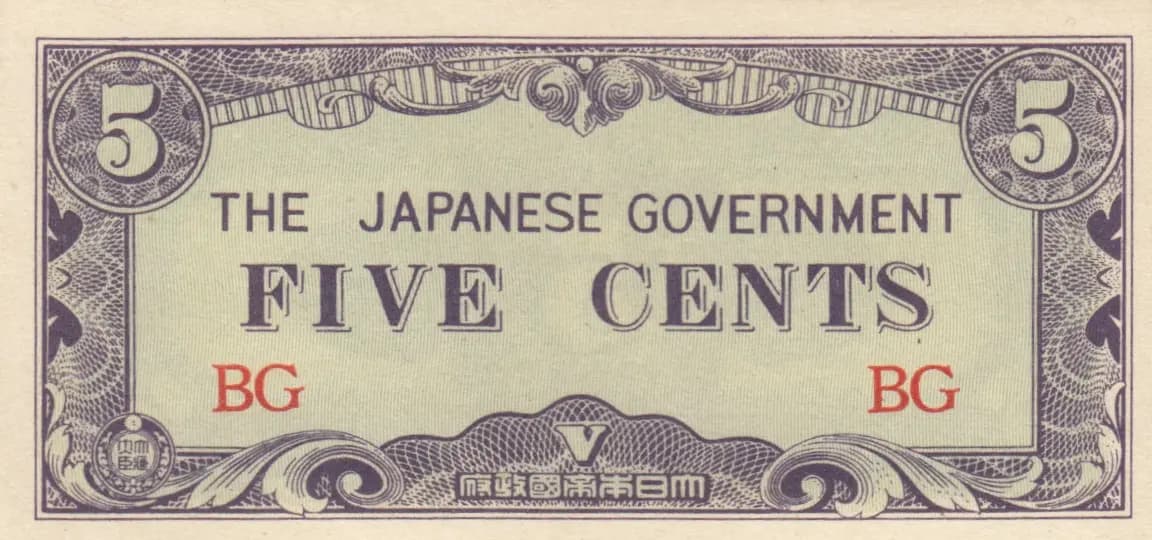
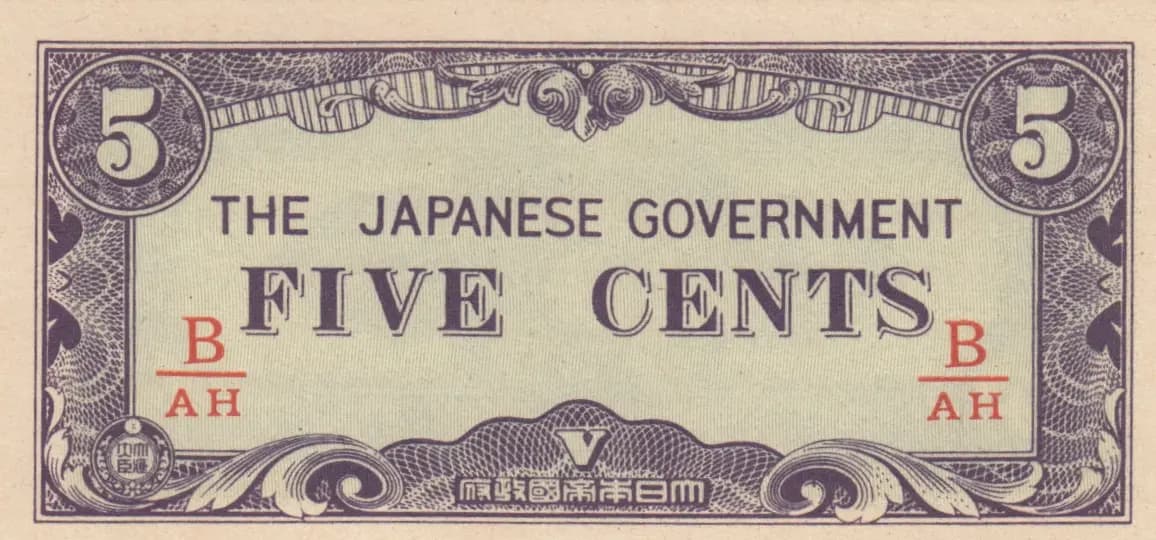
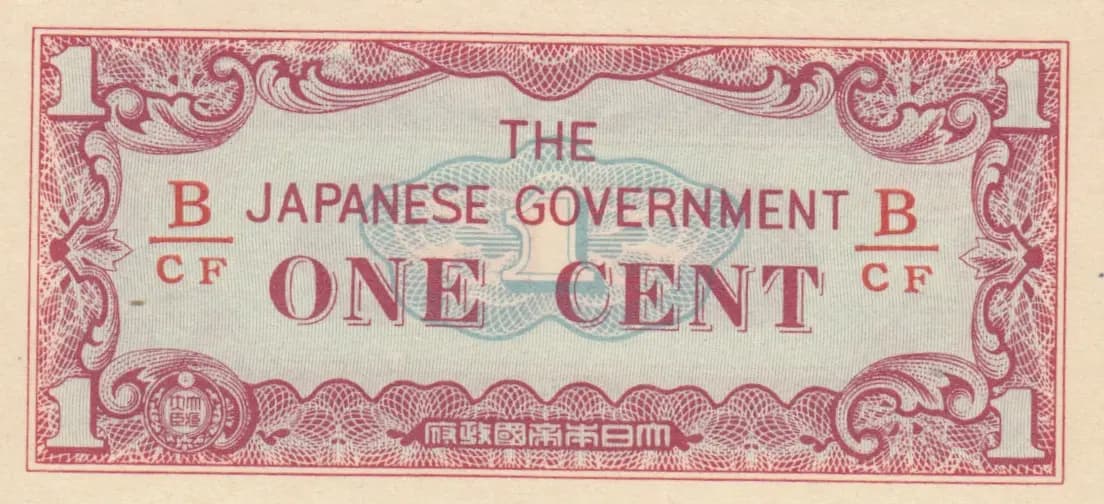
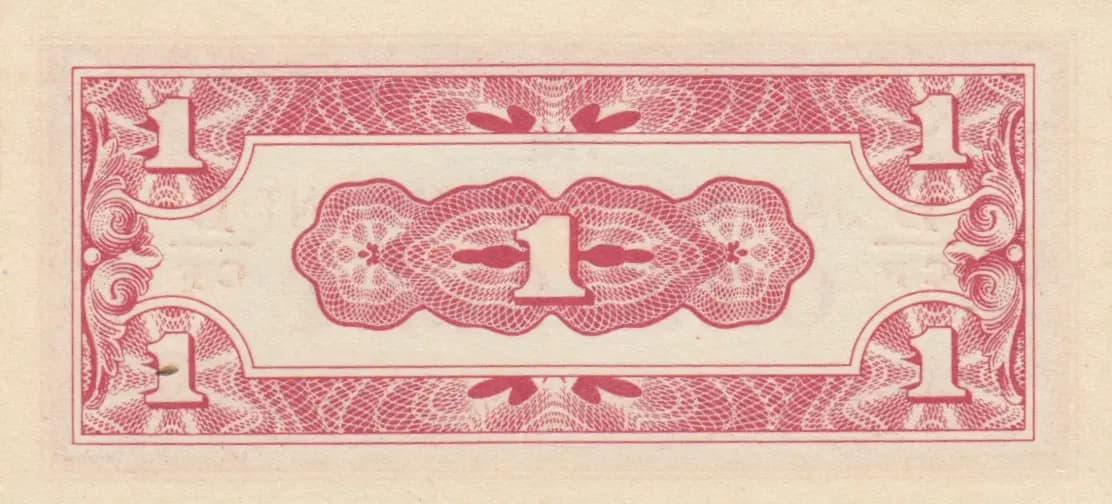
This is a Japanese Government occupation currency note from Burma, 1 Cent denomination (Pick P-9b), presented in uncirculated condition with crisp, pristine surfaces and sharp detail throughout. The note displays the characteristic maroon/burgundy and cream color scheme typical of Japanese occupation currency, featuring ornamental corner flourishes, fine line engraving, and a prominent central numeral on the reverse. As an occupation currency from WWII-era Burma, this represents an important piece of numismatic history documenting Japanese administration of Southeast Asian territories.
Common. This note falls into the common category despite its historical significance as occupation currency. The eBay market data shows consistent sales in the $1-$7 range for UNC examples, with only exceptional graded specimens (PMG 67) commanding higher prices in the $10-$40 range. The 2016 catalogue value of $0.75 for UNC condition and the high frequency of sales at modest prices indicate substantial surviving circulation. Japanese occupation currency from Burma was printed in significant quantities, and this low denomination saw extensive production.
This 1 Cent note was issued by the Japanese Government during its occupation and administration of Burma in 1942, following Japan's conquest of Southeast Asia. The English-language text and simplified denomination system reflect Japan's attempts to establish a functional monetary system in occupied territories, replacing previous currency regimes. The ornamental design and fine engraving represent Japanese monetary authority's effort to create legitimate-appearing currency that would be accepted by local populations under occupation.
The note features a symmetrical, text-dominant design characteristic of Japanese occupation currency. The obverse displays ornamental corner flourishes with delicate scrollwork in all four corners, a circular government seal or emblem in the lower left, and fine geometric and floral pattern hatching throughout creating texture and anti-counterfeiting detail. The reverse presents a more dramatically simplified design, dominated by a large numeral '1' centered within an ornamental scalloped cartouche with matching corner numerals. The entire design employs fine line engraving with intricate geometric hatching patterns, creating a visually complex surface that would be difficult to counterfeit with period technology. The color scheme of maroon/burgundy red and beige/cream white is consistent throughout both sides.
Front Side: 'THE JAPANESE GOVERNMENT' (English, top center), 'ONE CENT' (English, center denomination), 'B CF' (printer or series identifier mark), Japanese characters in decorative arrangement (text orientation makes precise translation difficult but represents issuing authority designation). Back Side: '1' (numeral appearing in central ornamental cartouche and repeated in all four corners as denomination indicator).
The note was produced using intaglio/engraved printing techniques, evidenced by the fine line work, detailed geometric hatching patterns, and the precise, sharp detail visible throughout the design. The consistent ink coverage and the depth of the ornamental patterns indicate traditional steel plate engraving. For this specific Pick number (P-9b), the printer mark 'B CF' suggests involvement of Japanese government printing facilities or contracted security printers, though the exact facility is not definitively identified from the visible marks alone.
The Pick P-9b designation specifically identifies the 1 Cent denomination in the Japanese occupation series for Burma. The observed 'B CF' marking on the examined specimen appears to be a standard printer identifier. Varieties within this issue may be identified by printer marks, serial number prefixes, or subtle design variations, though the visual analysis provided does not reveal serial numbers or multiple printer variants. The 'P-9b' cataloging (rather than P-9a or P-9c) suggests this is the established variety, likely distinguished by specific printer or series characteristics documented in the Pick catalogue.