5 cents 1942
Market Prices
7 salesAbout This Note
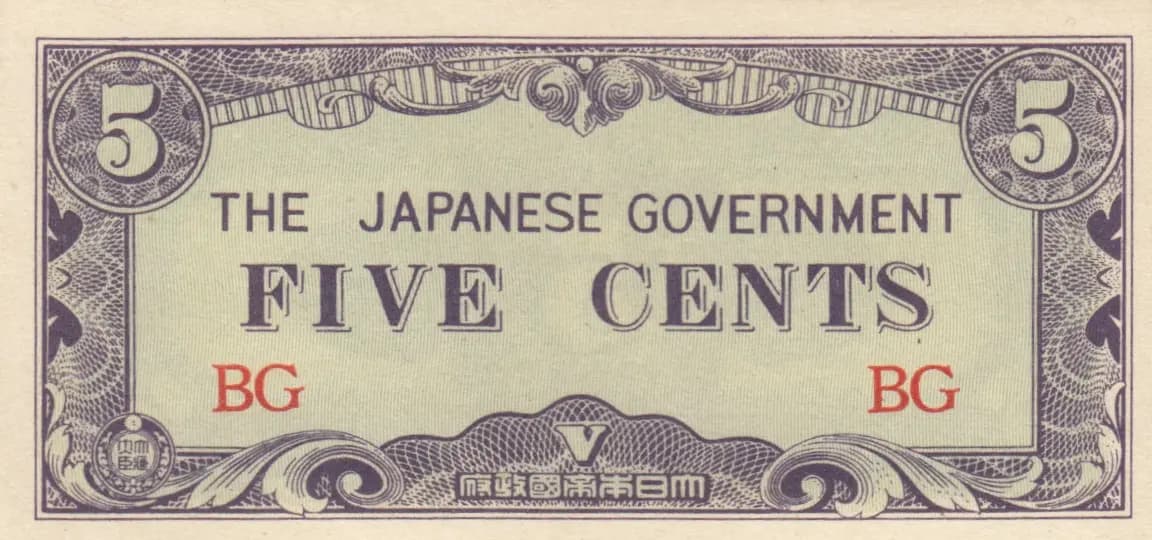
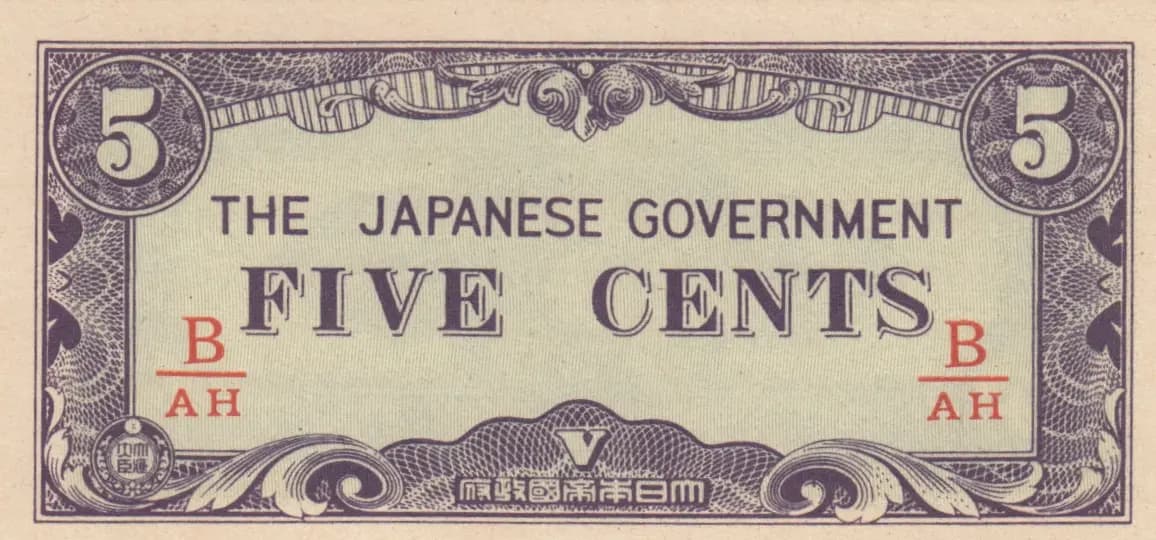
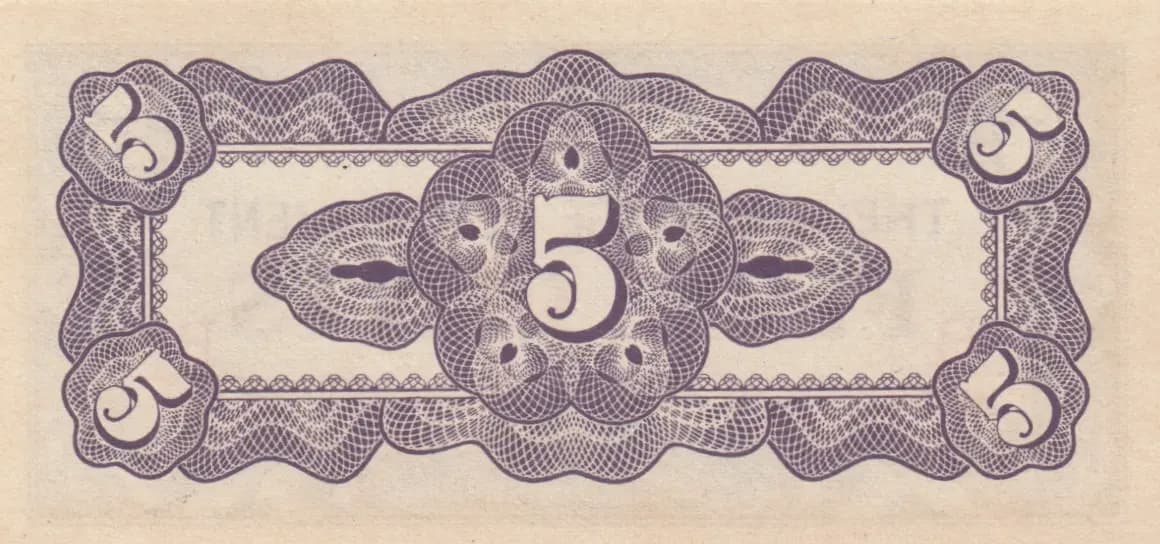
This is a Japanese Government 5 Cents banknote from 1942 (Pick P-10b), issued during Japan's occupation of Burma. The note exhibits exceptional condition with sharp, clear printing on aged cream-colored paper, featuring elegant purple and dark blue ornamental designs with intricate scrollwork borders on both sides. The pristine state and fine-line engraving work make this an excellent example of Japanese Occupation currency from this historically significant period.
Common. The eBay market data provided shows multiple sales across various conditions, with UNC examples selling for $4.80 to $12.50 in recent transactions. The 2016 catalog value of $0.50 for UNC condition, combined with the consistent availability of sales data spanning over a decade, indicates steady supply and demand at modest price points. This is characteristic of commonly issued Japanese Occupation currency that saw relatively large production runs. While historically significant, this note does not demonstrate scarcity in the numismatic market.
This note was issued by the Japanese Government during its occupation of Burma in World War II, representing the military administration's monetary system in occupied territories. The English-language inscriptions ('THE JAPANESE GOVERNMENT' and 'FIVE CENTS') reflect Japan's attempt to maintain administrative legitimacy in occupied regions through familiar currency denominations. The ornate Japanese seal and characters visible in the center of the front design underscore the imperial authority behind this occupation currency.
This denomination features a symmetrical, highly decorative design characteristic of Japanese Occupation currency. The front displays a light cream field with purple and dark blue printing, flanked by ornate scrollwork borders containing floral and geometric patterns. Circular denomination indicators in all four corners reinforce the '5 Cents' value. The central composition emphasizes 'THE JAPANESE GOVERNMENT' and 'FIVE CENTS' in clear English capitals, with a formal Japanese seal in an ornamental shield at the bottom center. The reverse side showcases an elaborate scalloped-edge border featuring large interlocking petal or leaf-like shapes, with a prominent ornamental rosette or flower medallion dominating the center field and displaying the numeral '5'. The overall aesthetic prioritizes formal, intricate engraving work over figurative elements (portraits or landmarks), reflecting the military and administrative nature of occupation currency.
Front side: 'THE JAPANESE GOVERNMENT' (English, top center); 'FIVE CENTS' (English, center); '5' (numeral, upper left and right corners in circular frames); 'B' and 'AH' (red letters/syllables, left and right sides, likely indicating series or printing marks). Back side: '5' (numeral, four corners in circular frames and prominently in the center rosette design). The Japanese characters visible in the ornamental shield at the bottom center of the front remain unspecified in the visual analysis but represent official government seals.
Intaglio (line engraving) printing, evidenced by the fine-line precision, complex ornamental borders, and detailed security patterns visible throughout both sides. The sharp registration of colors (cream field, purple/dark blue text and designs, red accent elements) and the crisp presentation of geometric and floral patterns indicate professional security printing typical of government banknote production. The specific printer is not documented in the provided catalog data, though Japanese occupation currency was typically produced by Japan's government printing facilities.
The Pick catalog designation P-10b indicates this is a specific variety within the 5 Cents Japanese Government series for Burma. The red letters 'B' and 'AH' appearing on both sides of the front may indicate series designation or printing batch information, though the visual analysis does not provide sufficient detail to determine if these represent a documented variety distinction. Without access to the full range of P-10 varieties (P-10a, P-10c, etc.), the specific distinguishing characteristics of the 'b' variety cannot be definitively stated from the visual evidence alone, though the design elements observed are consistent with standard Burma occupation currency issues.