5 kyats 1965 replacement
About This Note
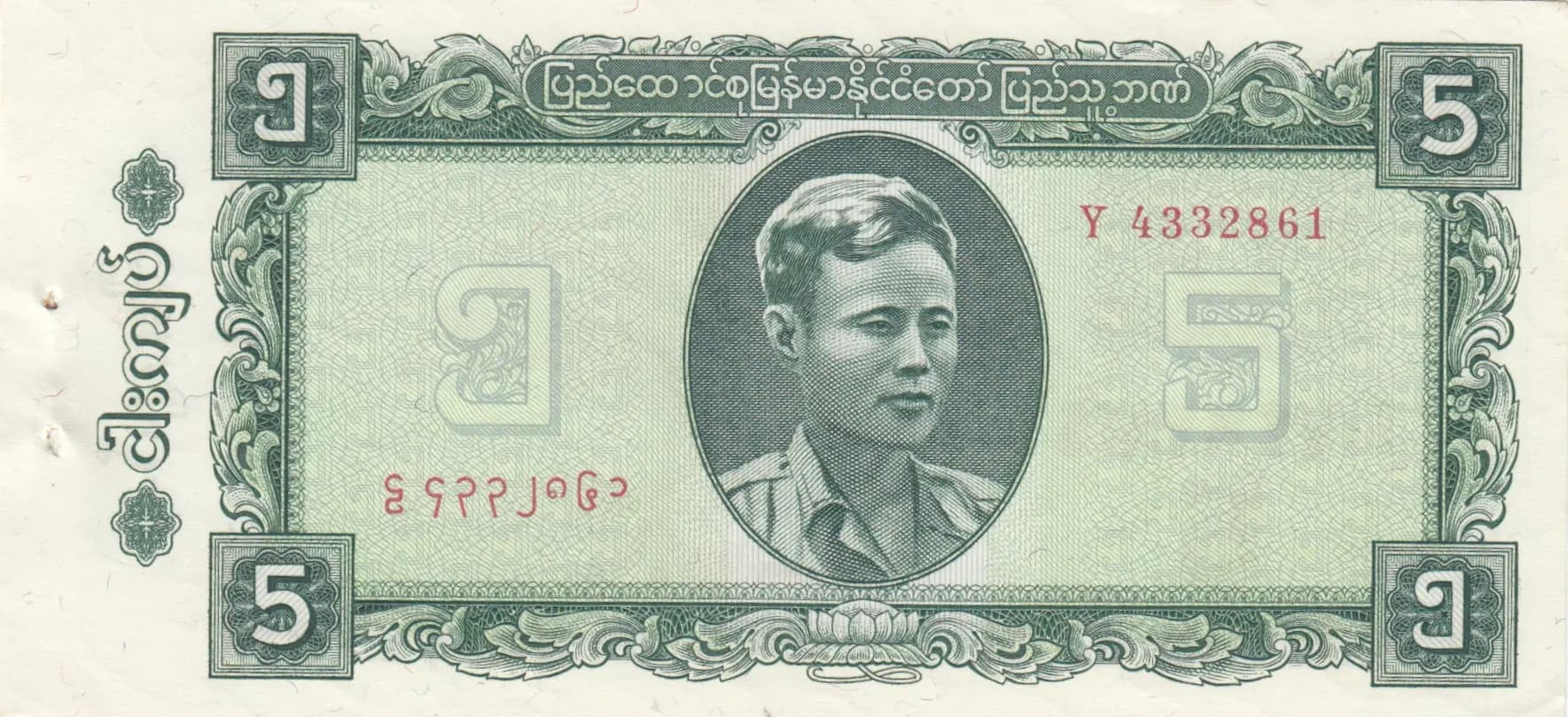
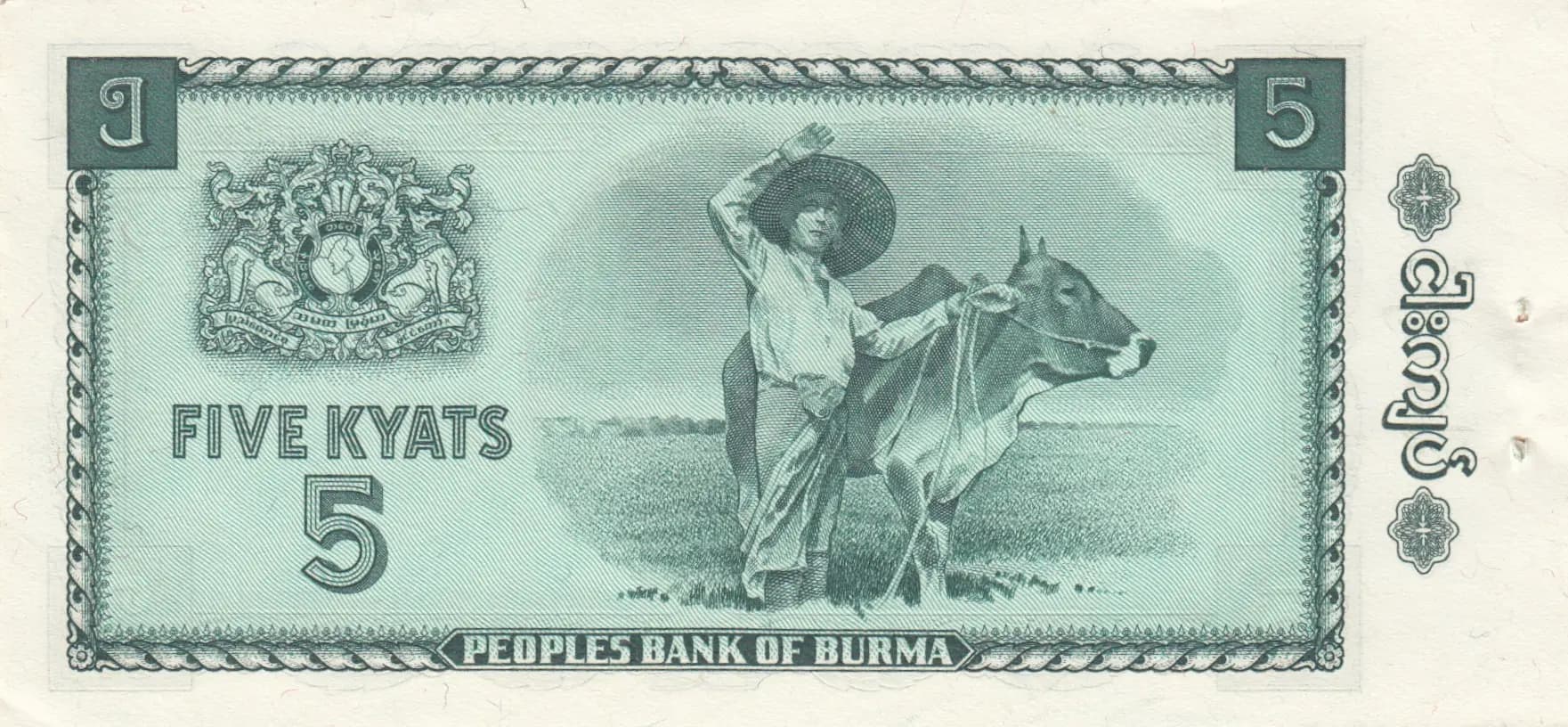
This is a 5 kyats banknote from Burma dated 1965, issued by the Peoples Bank of Burma, graded in AU (Almost Uncirculated) condition despite some age-related spotting and minor creasing visible in the images. The note features a striking portrait of General Aung San on the obverse in fine engraving, with the reverse depicting a rural farmer working with oxen—imagery that reflects Burma's agricultural heritage during the early socialist period. The asterisk (*) in the Pick designation (P-53*) indicates this is a replacement note, making it a notable variant for collectors of Burmese currency.
Common. The 5 kyats denomination from 1965 represents a standard circulation note from Burma's early socialist period with no evidence of a restricted print run, early recall, or short-lived issue. Replacement notes (indicated by the asterisk designation) are typically printed in quantities proportional to the base issue, and the AU condition grade does not substantially increase rarity. Without evidence of exceptional scarcity in the numismatic market or known catalog restrictions, this note should be assessed as commonly encountered among Burmese banknote collections.
This note was issued during the early years of Burma's Socialist Republic, following General Ne Win's 1962 coup that established military rule and socialist policies. The imagery directly reflects the regime's ideology: General Aung San, the revered independence hero and father of modern Burma, appears on the obverse, while the reverse celebrates agricultural labor with its depiction of a farmer and oxen—emphasizing the People's Socialist Republic's focus on rural development and collective economic effort. The inscription 'ပြည်သူ့သမ္မတမြန်မာနိုင်ငံတော်' (People's Socialist Republic of the Union of Burma) reinforces the political messaging of this period.
The obverse features an oval portrait of General Aung San facing left in formal military attire, rendered in detailed engraving within an ornate oval cartouche. The portrait is surrounded by elaborate scrollwork and floral decorative borders in green, with denomination boxes containing the numeral 5 positioned at all four corners. Four-petaled flower symbols appear as corner ornaments. The reverse showcases a carefully engraved rural scene on the right side depicting a Burmese farmer wearing the traditional conical hat (htauk kyaung) working with a pair of oxen in a agricultural field—a powerful symbol of the nation's agrarian economy and socialist ideology. The left side of the reverse features an ornate heraldic coat of arms with crown and shield design. A rope-pattern decorative border frames the entire reverse, with denomination boxes repeated at top corners. Both sides employ bilingual text in Burmese script and English.
FRONT SIDE: Burmese numeral '၅' (5); 'ပြည်သူ့သမ္မတမြန်မာနိုင်ငံတော်' (People's Socialist Republic of the Union of Burma); Serial number 'Y 4332861'; Burmese year '၁၉၆၅' (1965); English numeral '5'. BACK SIDE: English numerals '5' (top corners); Burmese numeral '၅' (5); 'FIVE KYATS'; 'PEOPLES BANK OF BURMA'.
Intaglio engraving (line engraving) throughout, which is evident from the fine line work, detailed portrait rendering, and complex decorative borders visible in the visual analysis. The printing exhibits the characteristic deep impression and crisp detail typical of high-security banknote engraving from this period. For Burmese notes of this era, production was likely handled by a British security printer, consistent with the quality and style observed, though specific attribution would require additional documentation.
This note is designated as P-53* in the Pick catalog, with the asterisk indicating it is a replacement note. The serial number Y 4332861 is a specific example but does not denote a catalogued variety. Replacement notes from this issue may exist with different serial number prefixes; researchers should note any variations in prefix letters (such as X, Y, Z) as these may indicate different replacement printing runs. No other major varieties (such as signature variations or significant overprints) are apparent from the visual analysis provided.