100 kyats 1958
Market Prices
41 salesAbout This Note
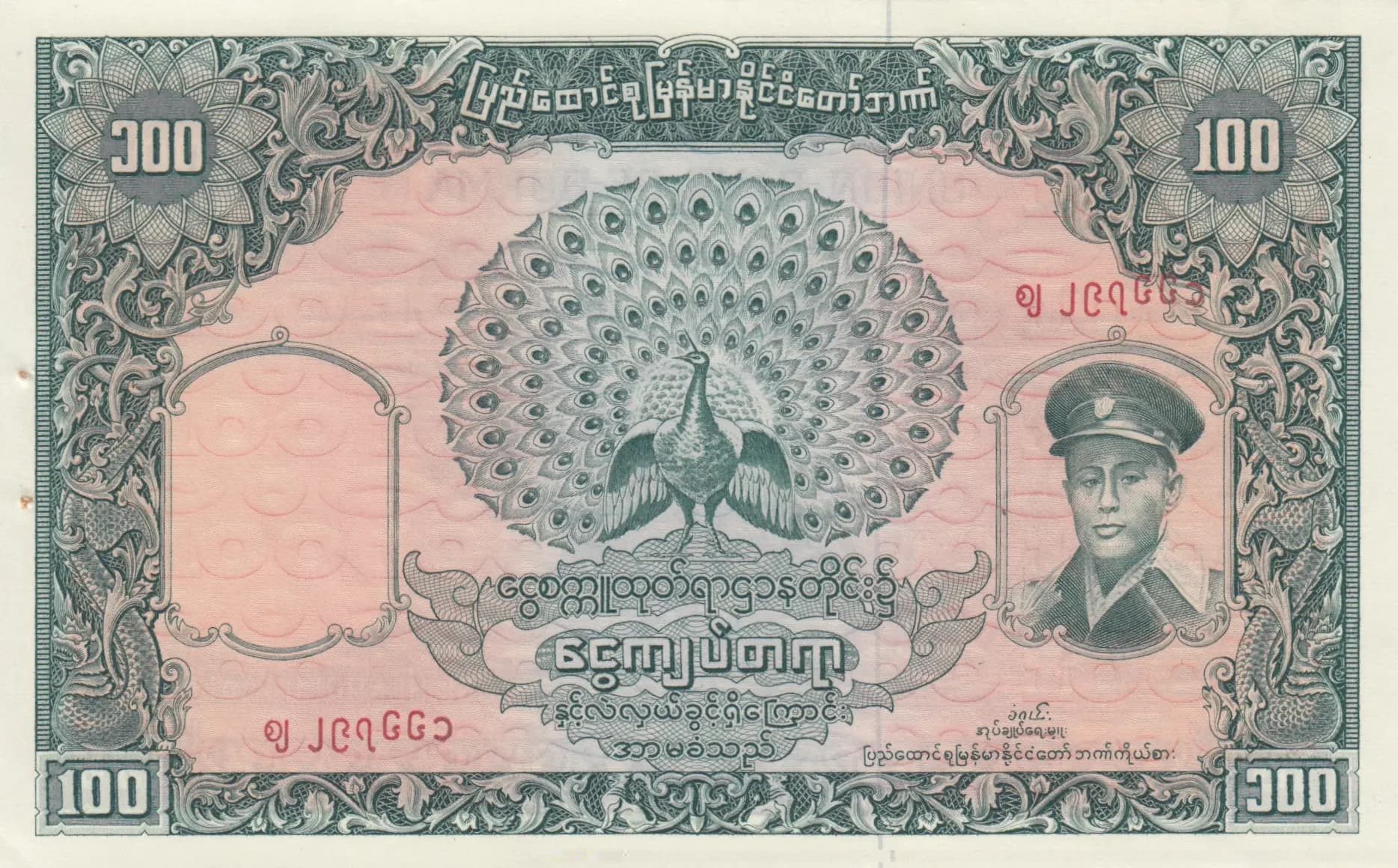
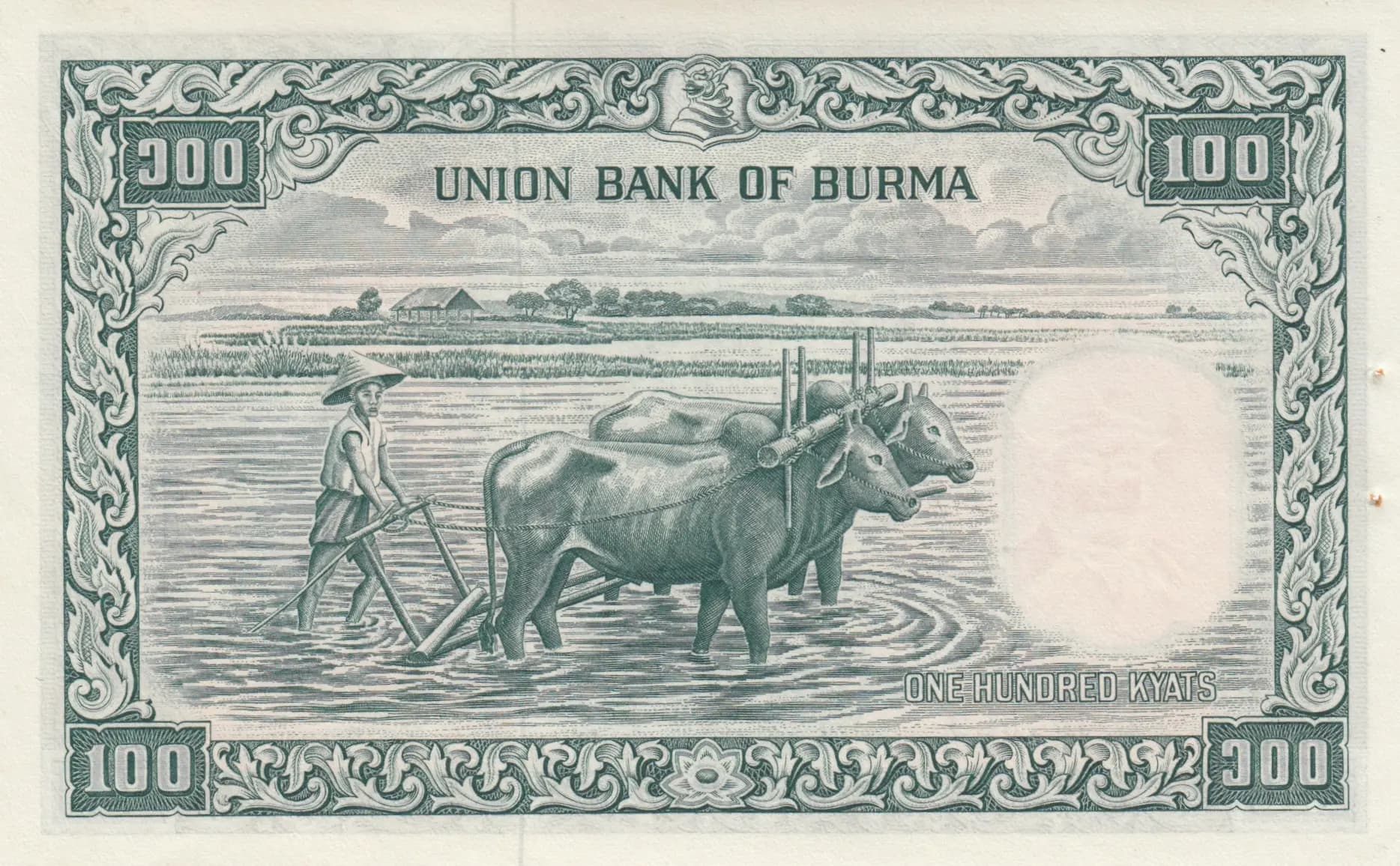
This 1958 Union Bank of Burma 100 kyats note presents a striking example of mid-20th century Burmese currency design, featuring the national peacock symbol prominently displayed on the obverse alongside a portrait of General Aung San. The reverse depicts a traditional rice paddy scene with a farmer and oxen, reflecting Burma's agrarian economy. In UNC condition, this note shows minimal wear with only light age-related discoloration and foxing in the margins—an exceptional state of preservation for a banknote nearly seven decades old.
Common. Despite its age, eBay market data shows consistent availability with numerous sales spanning from 2013 to 2023, and realized prices typically ranging from $3–$50 depending on condition grade. UNC examples have sold in the $10–$26 range in recent years, indicating steady collector demand but ample supply. The 1958 100 kyats is not reported as a short-run issue, and catalog values (2016: $5 UNC) reflect standard market pricing for common early-independence Burmese notes.
Issued in 1958 by the Union Bank of Burma during the early years of the independent Burmese state, this note reflects the post-colonial nation's identity through its choice of national symbols: the peacock (a traditional Burmese emblem of royalty and nationalism) and General Aung San (the founding father of Burmese independence, assassinated in 1947). The agricultural imagery on the reverse—the farmer with oxen in a rice paddy—underscores the centrality of rice cultivation to Burma's economy and national character during this period of nation-building.
The obverse features an ornate green and multicolor design with elaborate floral and geometric border patterns. The central focus is a large peacock with fully displayed tail feathers in the upper-middle portion—a potent national symbol in Burmese culture. To the right is a portrait of General Aung San in military dress uniform and cap, shown in profile. The background displays a salmon-pink field with subtle circular watermark patterns. The reverse showcases green-dominated engraving with similar ornamental scrollwork borders, depicting a traditional agricultural scene: a farmer in a hat operating a wooden plow pulled by two oxen through a flooded rice paddy. The background reveals a pastoral landscape with rice fields and traditional structures, emphasizing the agrarian foundation of the Burmese economy.
Front side: 'ပြည်ထောင်စုမြန်မာ' (Union of Burma), 'ဗမာငွေ' (Burmese currency), 'ရာ' (hundred), 'မြန်မာ' (Myanmar/Burma), with '100' in Arabic numerals in all four corners. Back side: 'UNION BANK OF BURMA' and 'ONE HUNDRED KYATS' in English, with '100' in Arabic numerals in all four corners.
This note was produced using traditional intaglio (engraved) printing, evidenced by the fine line detail, crisp registration, and the characteristic depth and quality of the engraved borders and central imagery. The multi-color printing was applied in successive passes. The Union Bank of Burma's regular issues of this period were typically printed by established security printers; detailed attribution would require cross-reference with archival records, though the technical quality suggests a capable central bank printer.
No specific varieties (signature, date, or serial number prefix variations) are apparent from the visual analysis provided. The note appears to be a standard regular-issue 1958 100 kyats. Detailed variety identification would require examination of signatures and serial numbering, which are not clearly legible in the provided images. This Pick-51 note is often cited as similar to Pick-45 in design language and printing technique, reflecting continuity in Union Bank of Burma's design philosophy across denominations in this era.