1 rupee 1942
Market Prices
5 salesAbout This Note
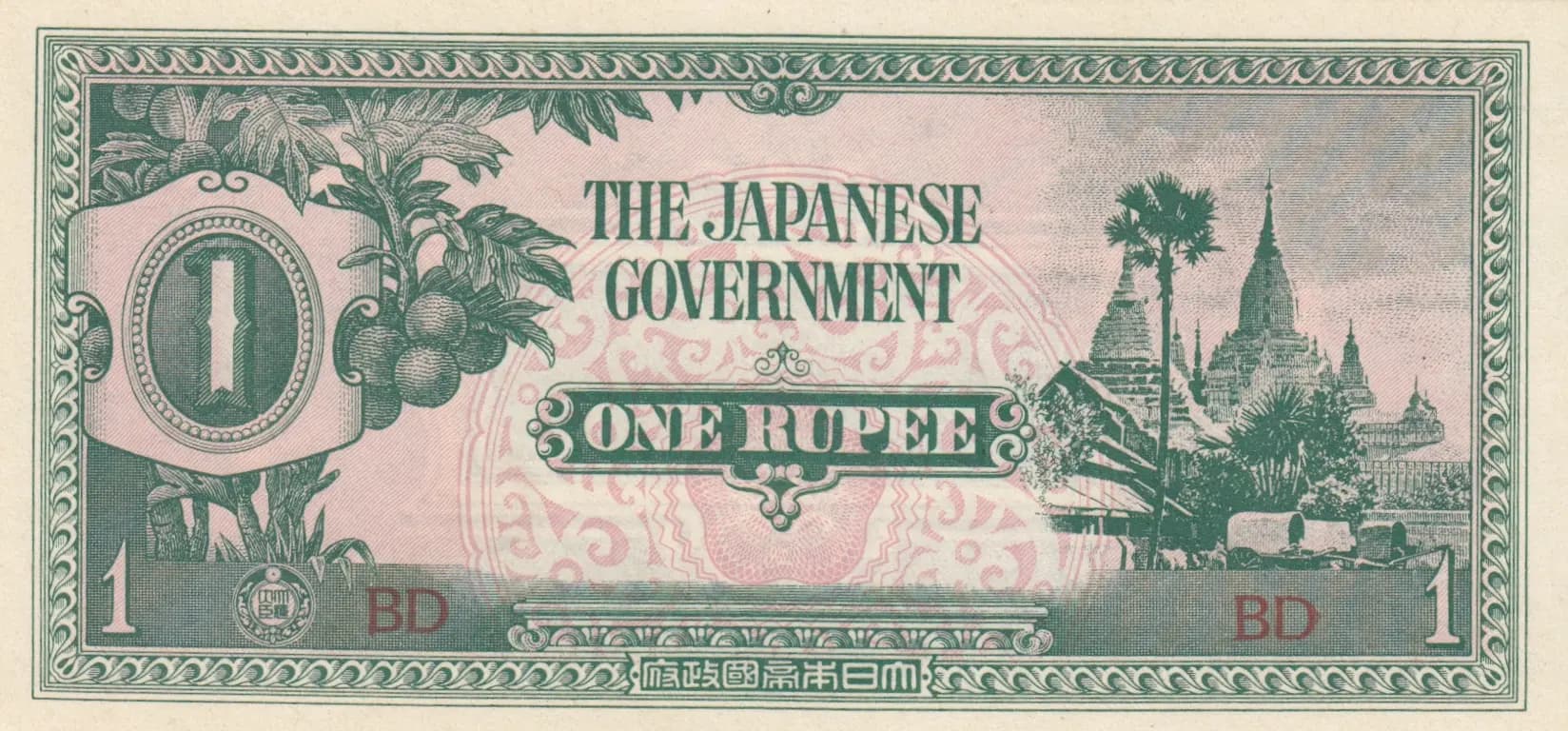
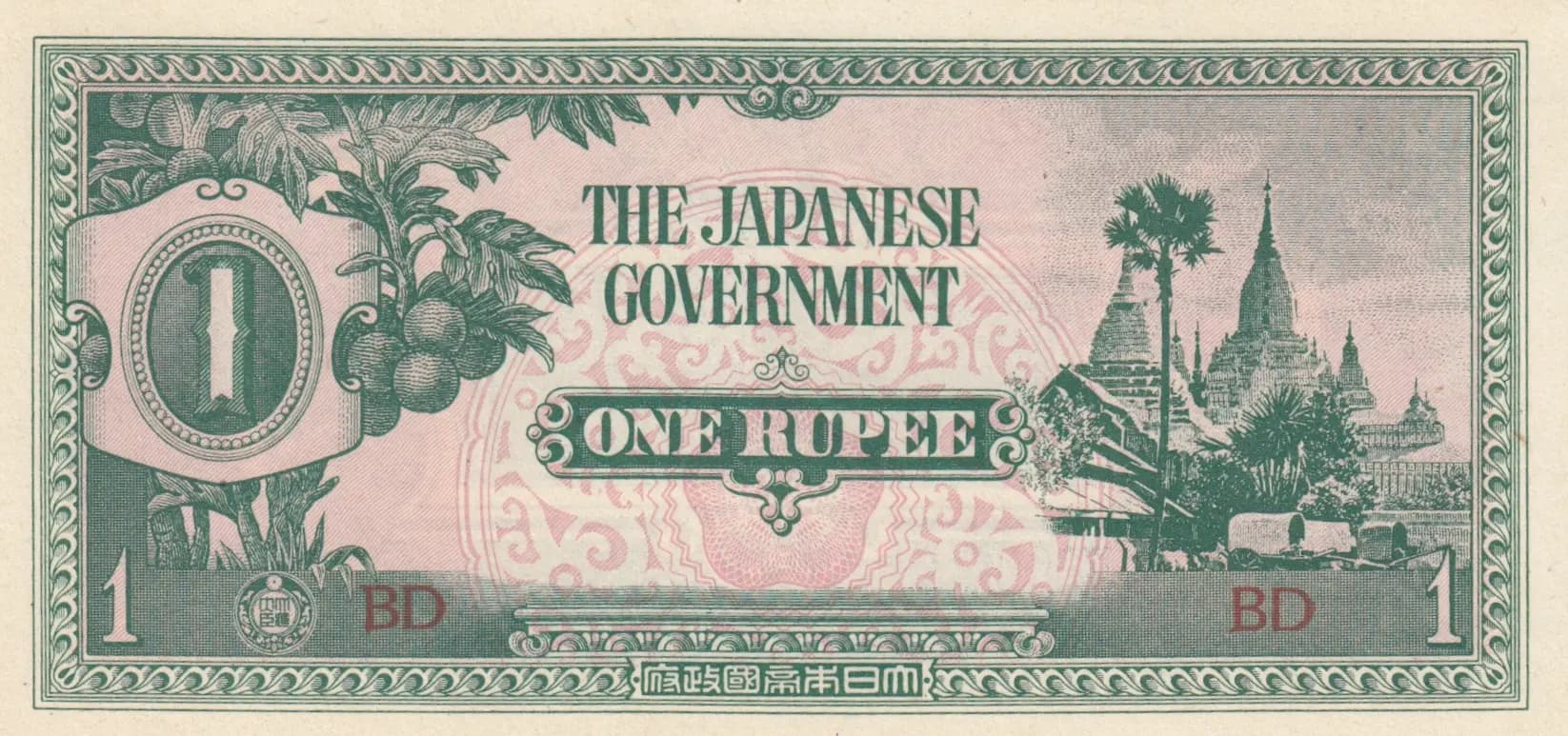
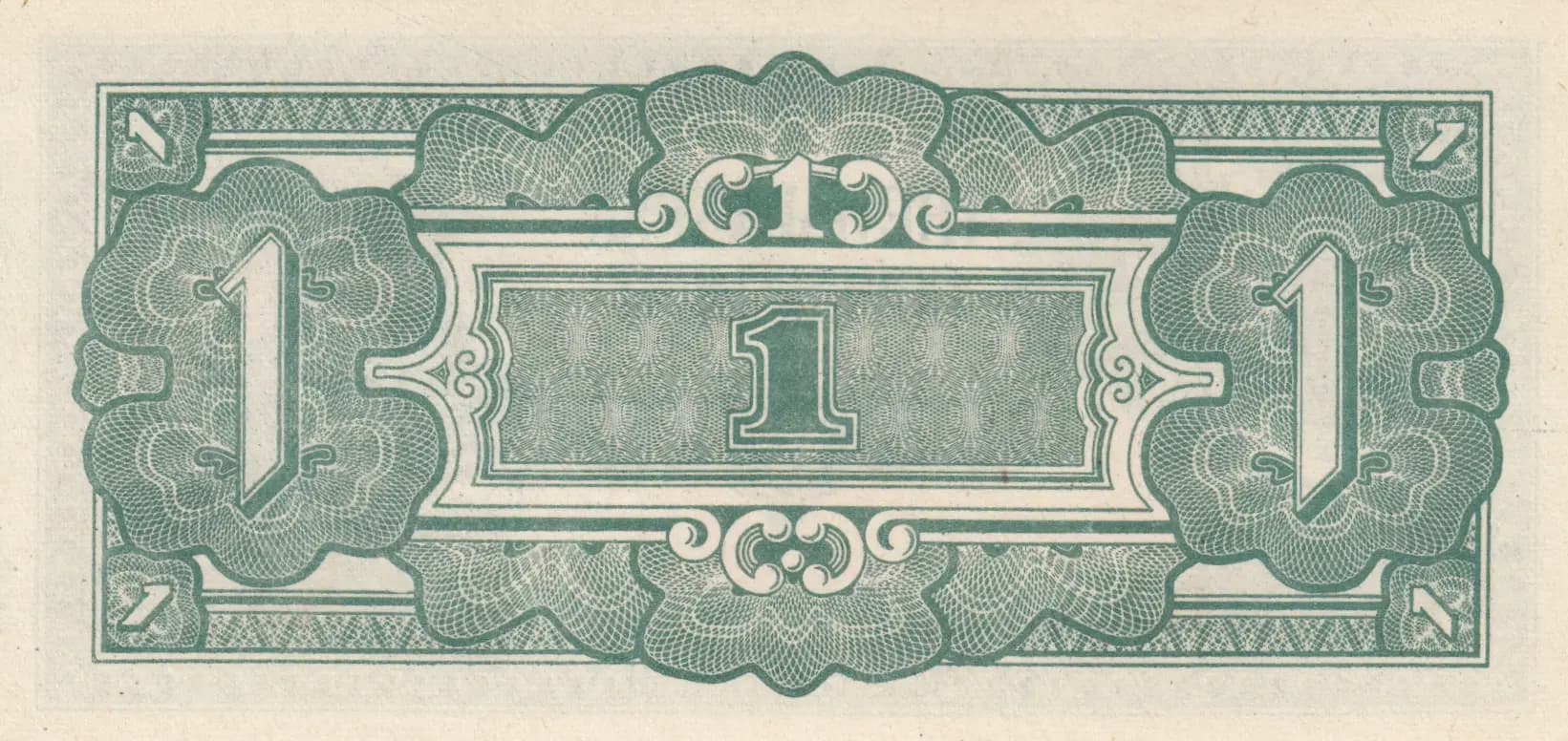
This is an uncirculated example of the 1942 Japanese Government 1 Rupee note for Burma (Pick P-14a), featuring exceptional preservation with no visible wear, creases, or damage. The note showcases the classic design elements of Japanese occupation currency: an ornate front depicting the Ananda Temple at Pagan with vibrant green and pink/beige coloring, complemented by an elaborate back design dominated by a large central numeral 1 within intricate decorative frames. As part of the Japanese occupation currency for Burma, this note represents an important chapter in numismatic history and remains highly desirable to collectors of WWII-era and Asian banknotes.
Common. While this is an occupation-era banknote from a specific historical period, the eBay sales data provided indicates consistent market pricing well below $30 even for premium grades (PMG 66 at $29.99), with most examples selling for under $2. The catalog value for UNC condition is listed at only $4 (2016 data), and recent eBay activity shows minimal collector demand at any price point. Japanese occupation currency for Burma was produced in quantity for administrative purposes, and examples remain readily available in the modern collector market. The denomination (1 Rupee) and condition alone do not command premium pricing.
This 1 Rupee note was issued by the Japanese Government during its occupation of Burma in 1942, specifically dated January of Showa 17 (1942) as shown in the Japanese characters on the front. The prominent depiction of the Ananda Temple—one of Burma's most sacred Buddhist landmarks located in Pagan—served both practical and symbolic purposes, legitimizing Japanese rule by respecting local cultural and religious heritage. The dual-language inscriptions in English and Japanese reflect the occupation administration's approach to establishing currency and administrative authority in the newly conquered territory.
The front features the iconic Ananda Temple of Pagan, depicted with multiple ornate spires characteristic of Burmese Buddhist architecture, accompanied by a palm tree in the foreground—imagery chosen to appeal to the local Burmese population while asserting Japanese administrative control. The left side displays a large numeral '1' enclosed in an ornate oval medallion with elaborate decorative scrollwork, while the center banner clearly identifies the issuing authority in English. The reverse exhibits a geometric composition centered on a large numeral '1' framed by nested decorative cartouches with scalloped edges and symmetrical floral and scrollwork patterns, employing fine parallel line work to create textured backgrounds throughout. Both sides utilize a predominantly green color scheme with pink/beige accents, creating a visually distinctive note that stands apart from contemporary currency of other nations.
Front side: 'THE JAPANESE GOVERNMENT' (English) and 'ONE RUPEE' (English) appear on the central banner. Japanese inscription reads '日本國政府昭和十七年一月' (Nihon-koku Seifu Showa 17-nen Ichigatsu), translating to 'Japanese Government, January of Showa Year 17' (1942). Denomination indicators '1' and 'BD' appear in corners. Back side: Large central numeral '1' representing the one rupee denomination, with corner numerals '1' completing the design.
This note was produced using traditional intaglio engraving (line engraving), evidenced by the fine parallel line work, intricate detail in the decorative borders with repeating wave patterns, and the precision of the central medallion and cartouche designs. The printing characteristics indicate professional security printing appropriate to Japanese occupation currency production. The complexity of the ornamental elements and fine detail suggests production by Japanese Government security printers, typical of the occupation issue notes for Burma.
This note is identified as Pick P-14a, indicating it is the primary variety of the 1942 Japanese Government 1 Rupee Burma issue. The Japanese date inscription '昭和十七年一月' (January, Showa 17/1942) is the standard issue date for this type. No variant issues, overprints, or signature variations are evident in the visual analysis. The 'BD' designation appearing in the corner represents the Burmese District identifier. The consistency of design elements and printing suggests this represents the standard production issue without known major varieties in circulation.