20 shillings 1948
Market Prices
13 salesAbout This Note
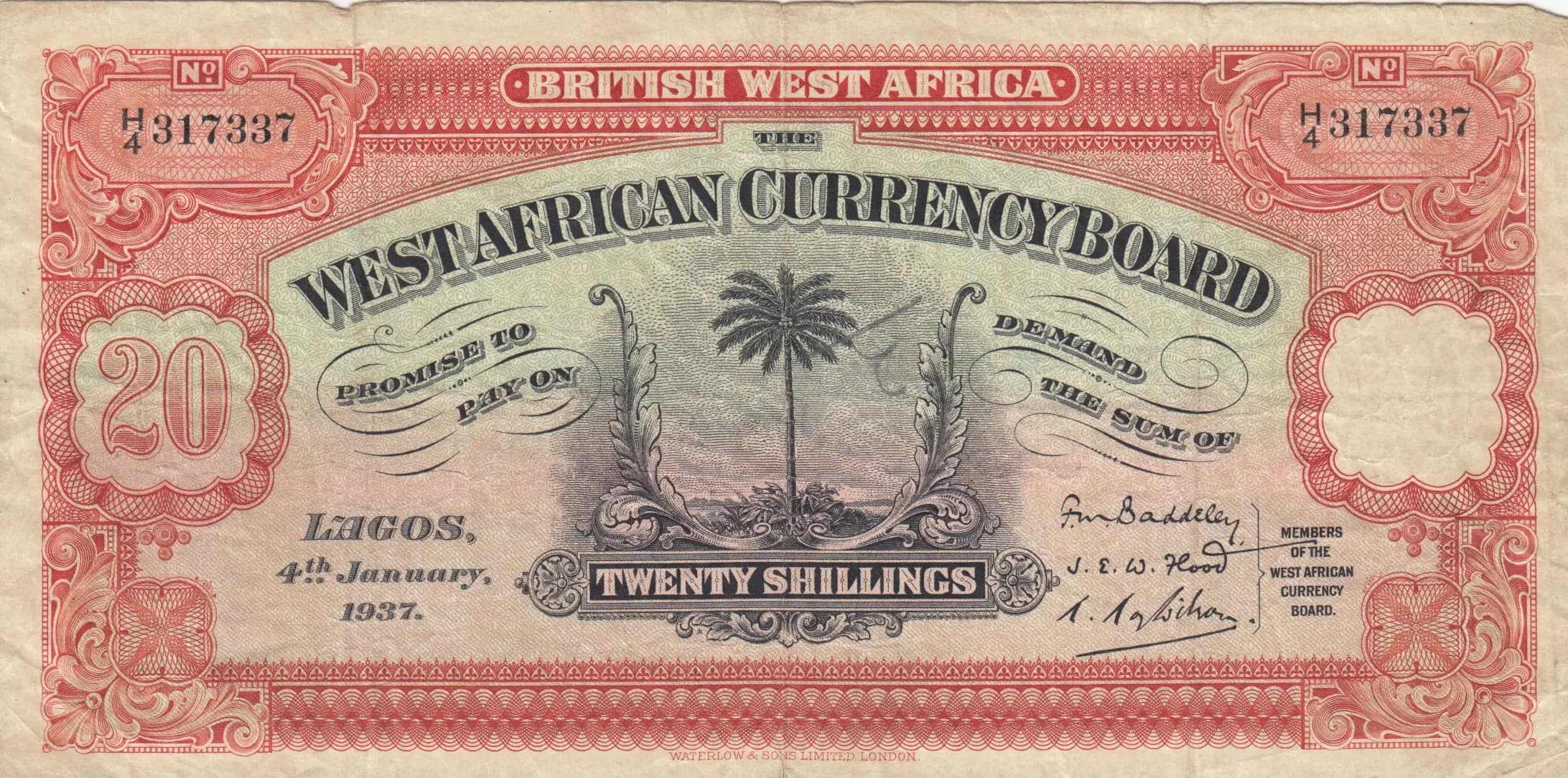
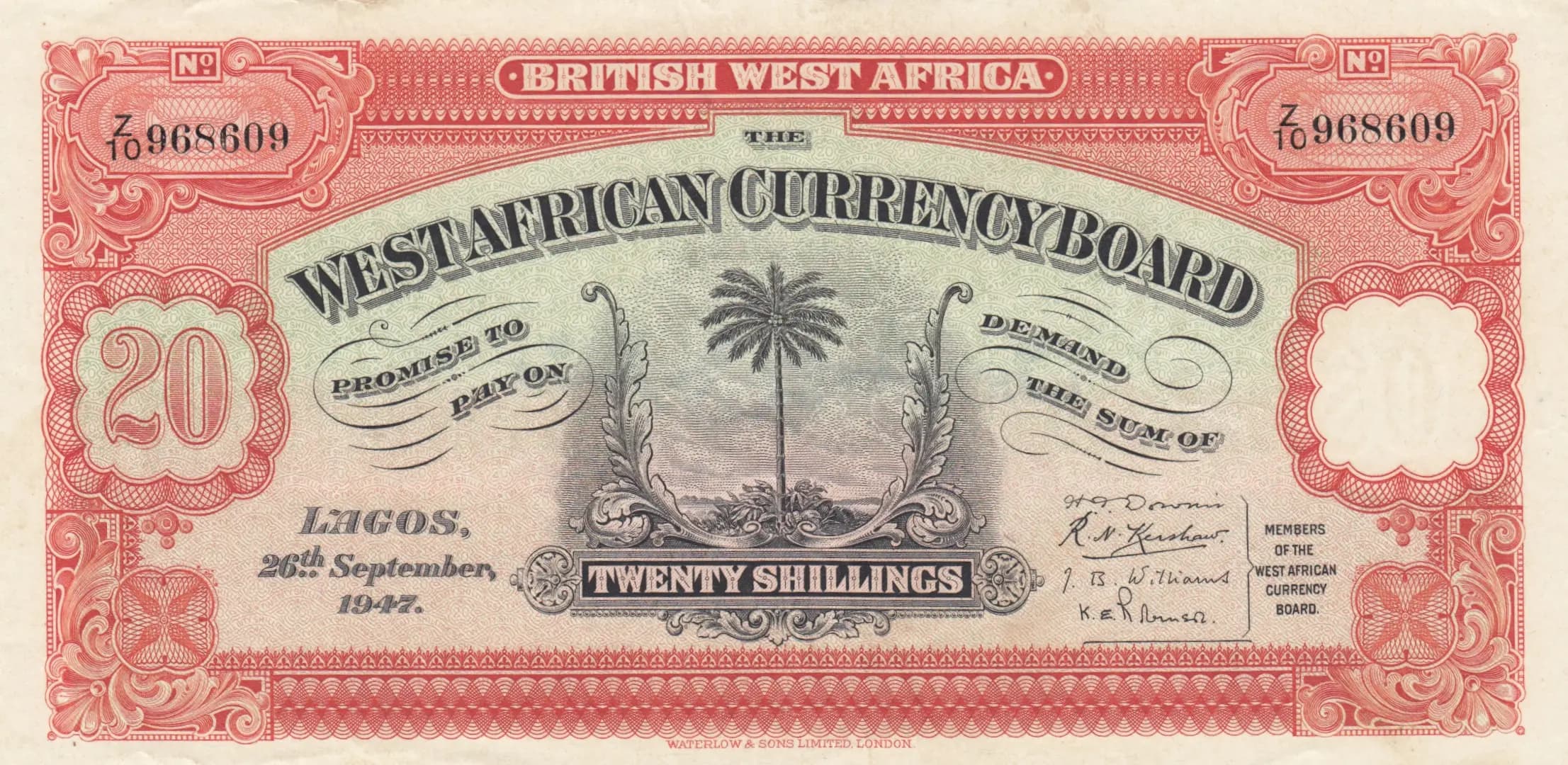
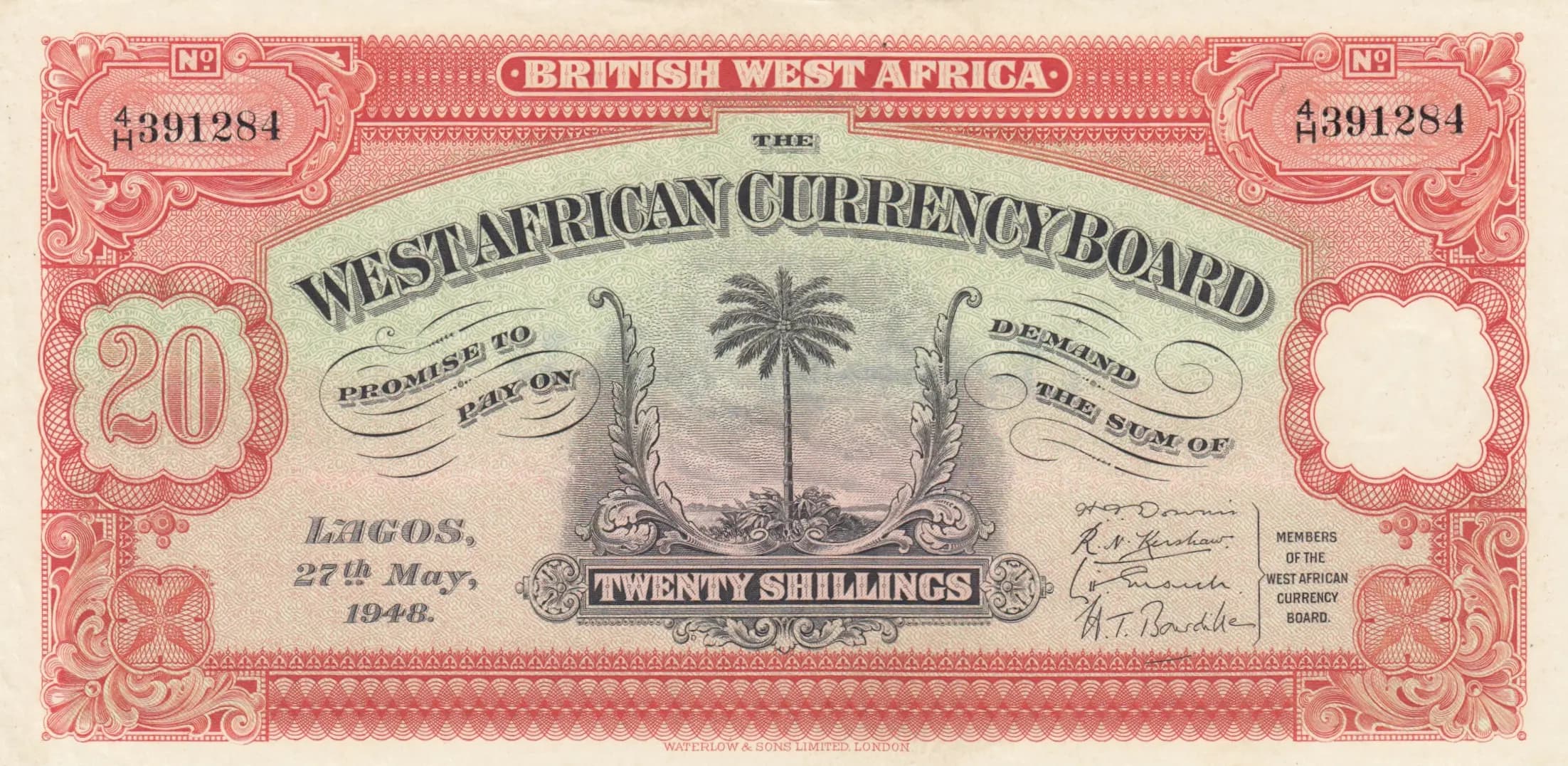
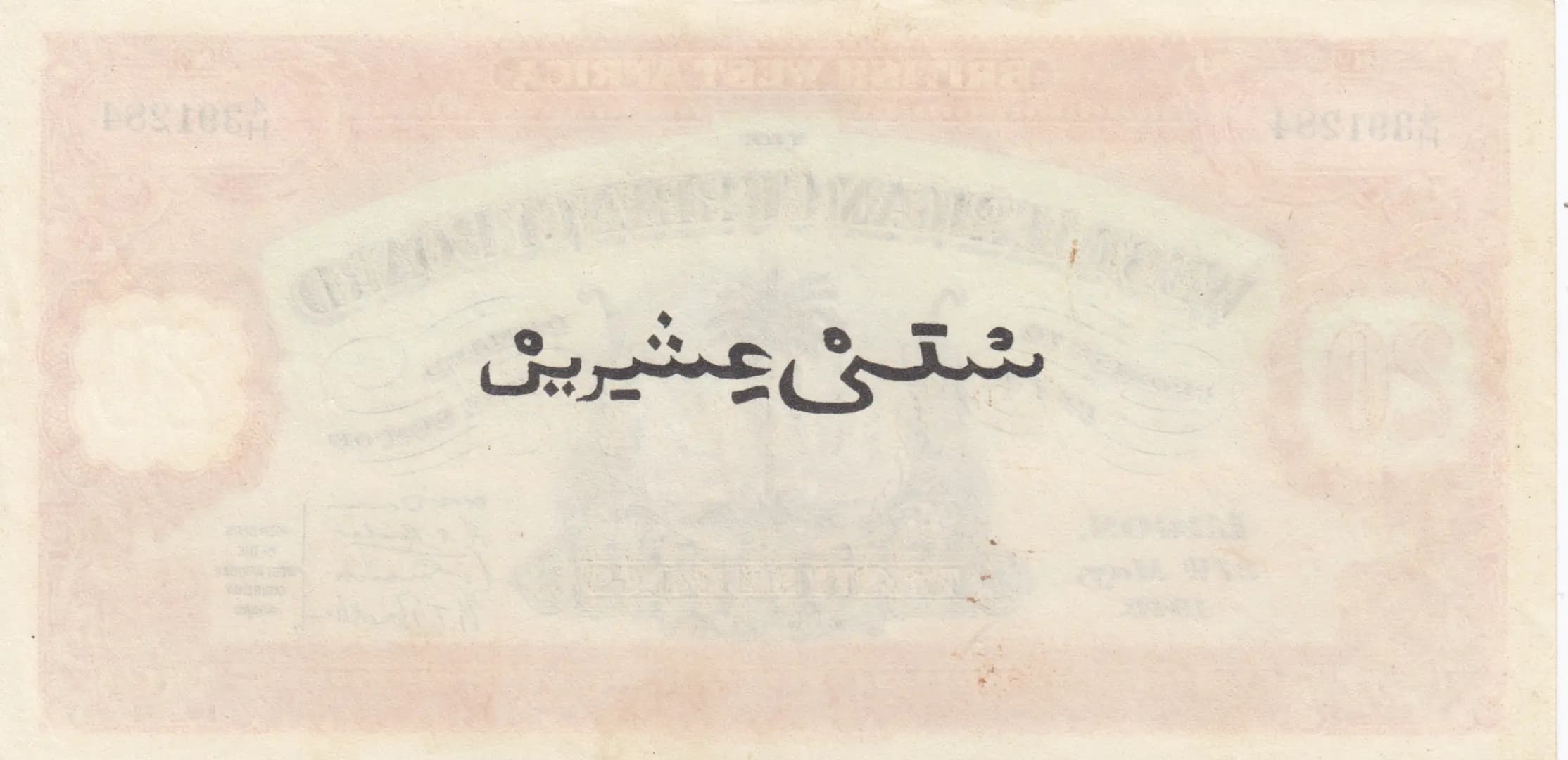
This is an exceptional example of the West African Currency Board's 20 Shillings note dated 27 May 1948, featuring the iconic central palm tree motif rendered in fine detail against ornate pink and cream decorative borders. The note exhibits pristine uncirculated condition with vibrant colors, sharp printing definition, and no signs of circulation, handling, or aging—a premium specimen of this historically significant colonial-era currency. The presence of bilingual inscriptions (English and Urdu/Arabic script) reflects the cosmopolitan nature of British West African commerce during the late colonial period.
Common. The West African Currency Board issued these notes in substantial quantities across the 1928–1951 period, and the 20 Shillings denomination was a standard mid-range value in circulation throughout British West Africa. The eBay market data provided shows regular trading activity with Fine and VF examples consistently selling in the $45–$89 range (2010–2021), and 2016 catalogue values showing EF at $300. While UNC examples command premium prices (PMG 55 at $345 in 2020), the note itself is not scarce—the high catalogue value reflects condition premiums and collector demand rather than inherent rarity. No print-run restrictions, short-issue period, or recall status applies to P-8b, and the relative abundance of surviving examples confirms widespread original circulation.
Issued just three years before the independence of Ghana (1951) and during the final phase of British colonial administration in West Africa, this 1948 note represents the West African Currency Board's role in establishing a unified monetary system across the region's British territories. The palm tree depicted at the center symbolizes the agricultural wealth and tropical character of the West African colonies, while the dual-language inscriptions (English and Arabic script reading 'Shilin Ashirin'/Twenty Shillings) acknowledge the significant Muslim and Arab trading communities that were integral to West African commerce. This transitional period note bridges the formal imperial currency system with the emerging independent African economies that would soon follow.
The obverse features a symmetrical, formally composed design centered on a stylized palm tree with an ornamental base and decorative foliate flourishes on either side, rendered in black line engraving against the primary color palette of pink/red and cream. Classical decorative elements dominate the frame: laurel wreaths or formal scrollwork flank the central palm motif, ornamental corner devices in the engraved tradition embellish all four corners, and an intricate linear border pattern in pink encloses the composition. The denomination '20' appears within a decorative square cartouche at the left margin, while serial numbers are housed in ornate oval frames at top left and right. The reverse is predominantly pale pink/cream with minimal design visibility, dominated by the bold central Urdu/Arabic script inscription 'Shilin Ashirin.' The overall aesthetic reflects high Victorian-Edwardian engraving standards characteristic of Waterlow & Sons' security printing tradition.
FRONT: 'BRITISH WEST AFRICA' (header); 'WEST AFRICAN CURRENCY BOARD' (issuing authority); 'PROMISE TO PAY ON DEMAND THE SUM OF' (legal tender declaration); 'TWENTY SHILLINGS' (denomination in English); 'LAGOS, 27th May, 1948' (place and date of issue); Serial number '4391284' (appears twice, left and right in oval frames); '20' (denomination numeral in left margin frame); 'MEMBERS OF THE WEST AFRICAN CURRENCY BOARD' (authority listing); 'WATERLOW & SONS LIMITED LONDON' (printer identification). BACK: 'شنتی عشرین' (Urdu/Arabic script: 'Shilin Ashirin' = 'Twenty Shillings').
Intaglio engraving (line engraving/recess printing), the signature security printing method of Waterlow & Sons Limited, London. The fine detail visible throughout—the intricate decorative borders, the precision of the palm tree rendering, the ornamental frames and scrollwork—are hallmarks of steel plate intaglio work. The sharp, crisp impression and the tactile quality evident in the image confirm traditional engraved banknote production. Waterlow & Sons' printer credit appears on the obverse.
This note is catalogued as Pick P-8b, a variant within the broader 20 Shillings issue (Pick base number 8). The PMG population report identifies six variants: P-8a, P-8as, P-8ax, P-8b, P-8bs, and P-8cts, all printed by W&S (Waterlow & Sons). The 'b' designation in P-8b likely indicates a specific date, signature, or serial number range variant within the 1948 printing. Visual inspection confirms this as a Waterlow & Sons product (W&S printer mark visible), dated 27 May 1948, with serial number 4391284. No overprints, color varieties, or signature variations are evident from the image analysis.