20 shillings 1937
Market Prices
13 salesAbout This Note
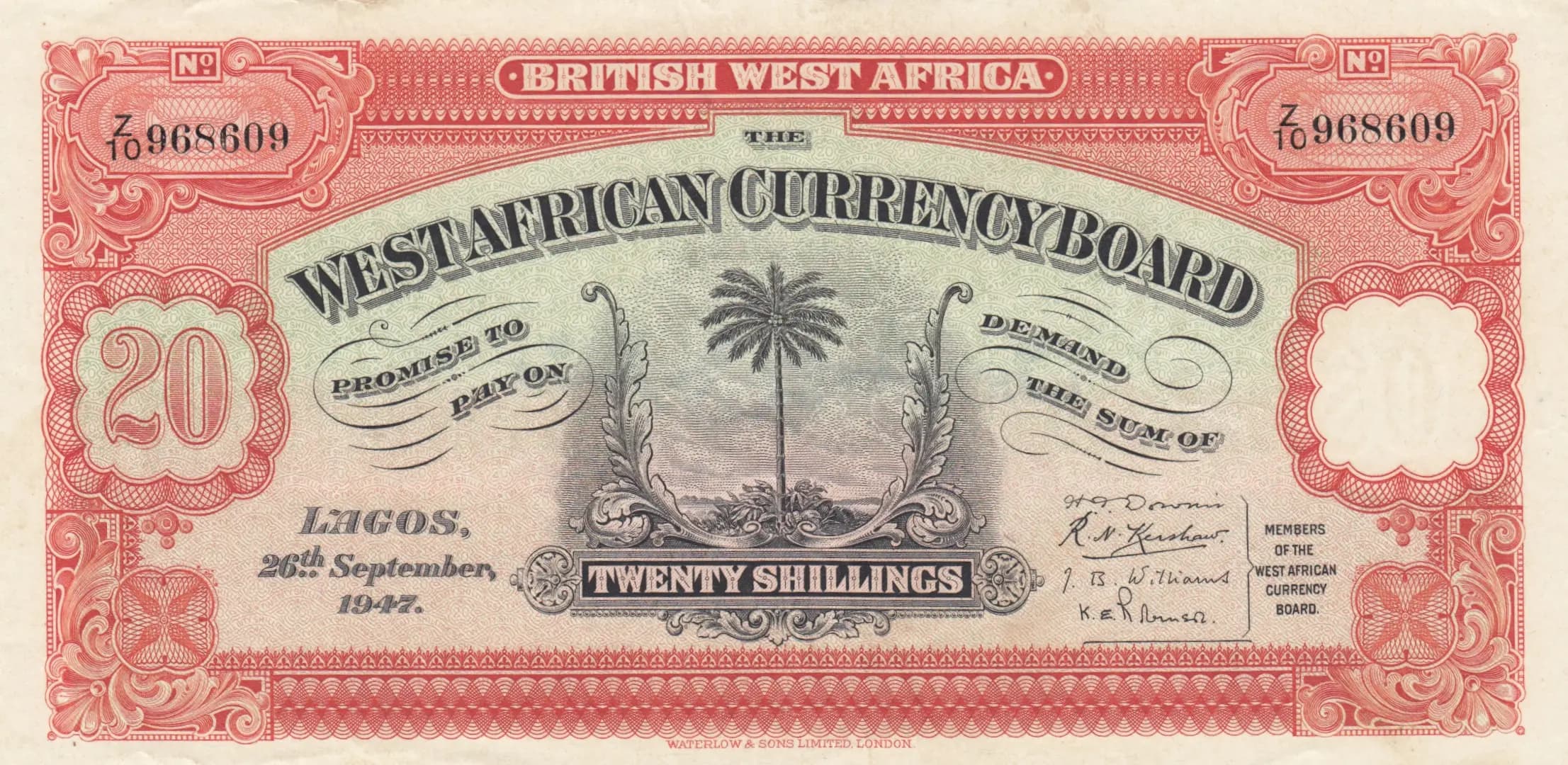
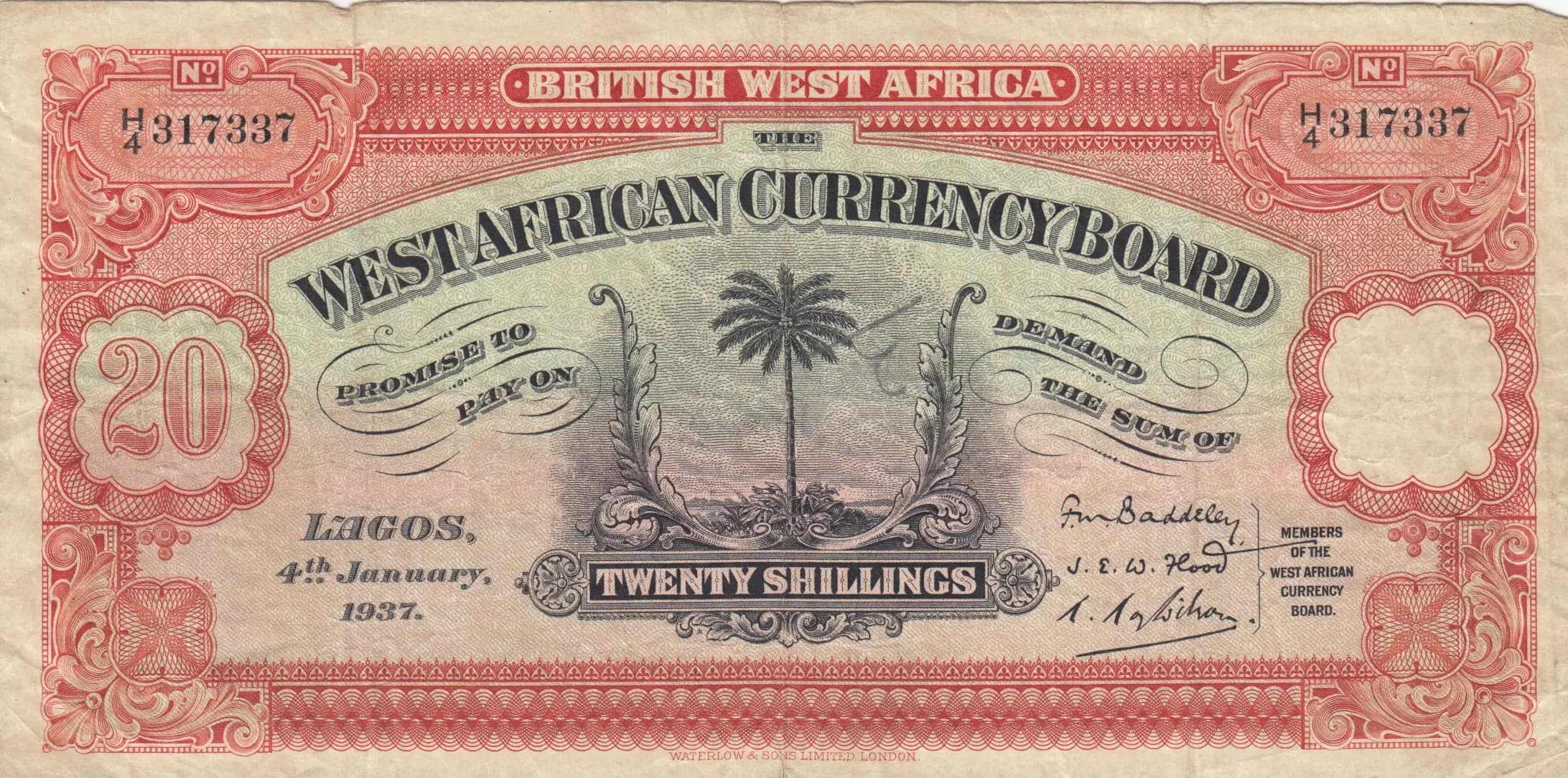
A fine condition example of the West African Currency Board's 20 shillings note from 1937, featuring the iconic central palm tree vignette with laurel wreaths rendered in red and cream tones. The note displays the characteristic ornate border work and decorative elements typical of Waterlow & Sons' production, with visible aging including creasing, foxing, and a center vertical fold consistent with historical circulation. This P-8b variety represents an important early issue from the British West African colonial monetary system.
Common. The 20 shillings denomination from the 1937-1951 series was a regular issue with substantial circulation throughout British West Africa. eBay market data shows consistent pricing in the $28-$89 range for Fine condition examples across multiple sales from 2012-2021, with catalog valuations at $50 for the F grade. The 1937 date represents the beginning of the series' circulation period, and no documented print run restrictions or recalls exist for P-8b. The proliferation of PMG-graded variants and the note's presence in general circulation indicate substantial original mintage.
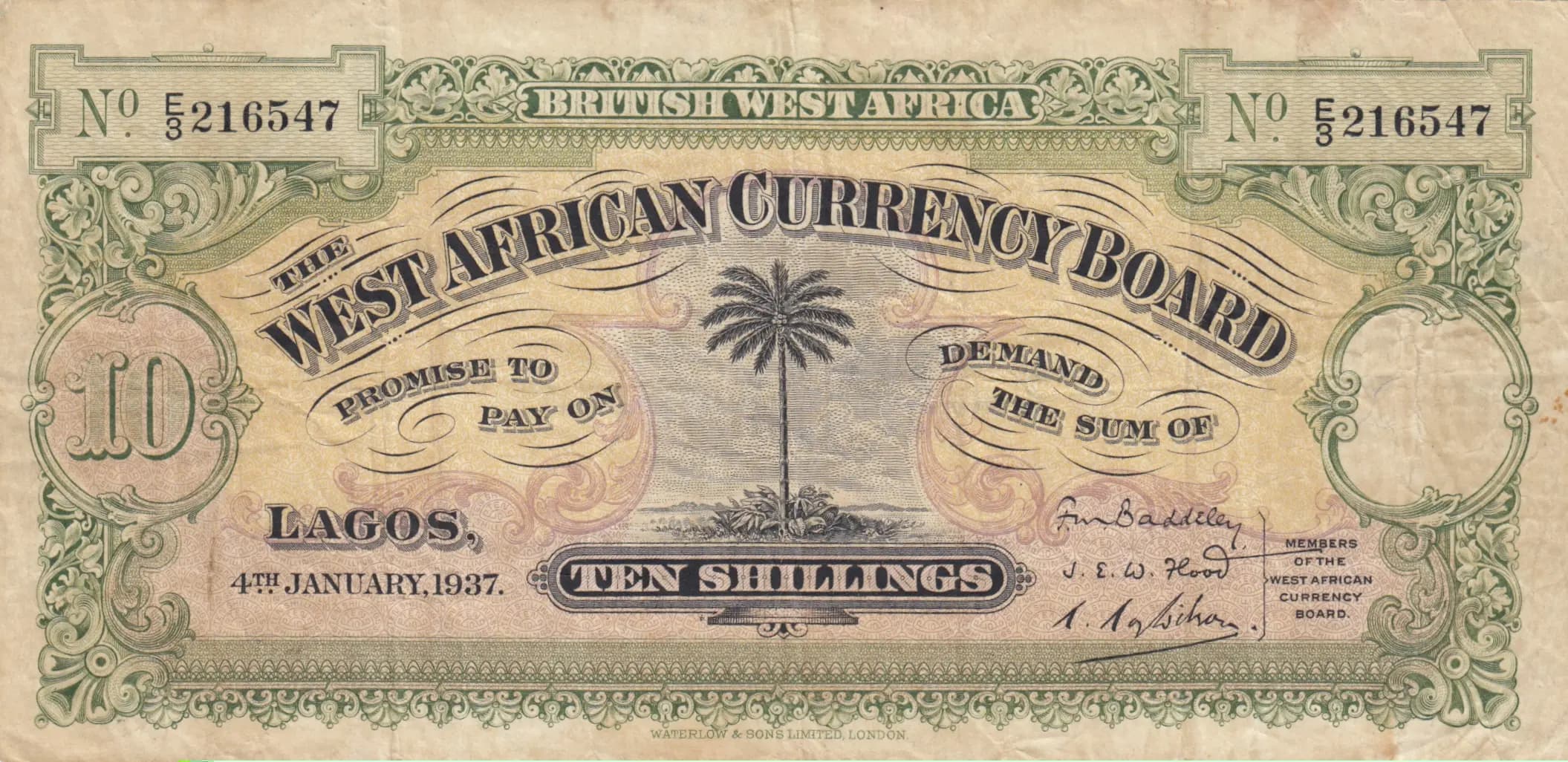
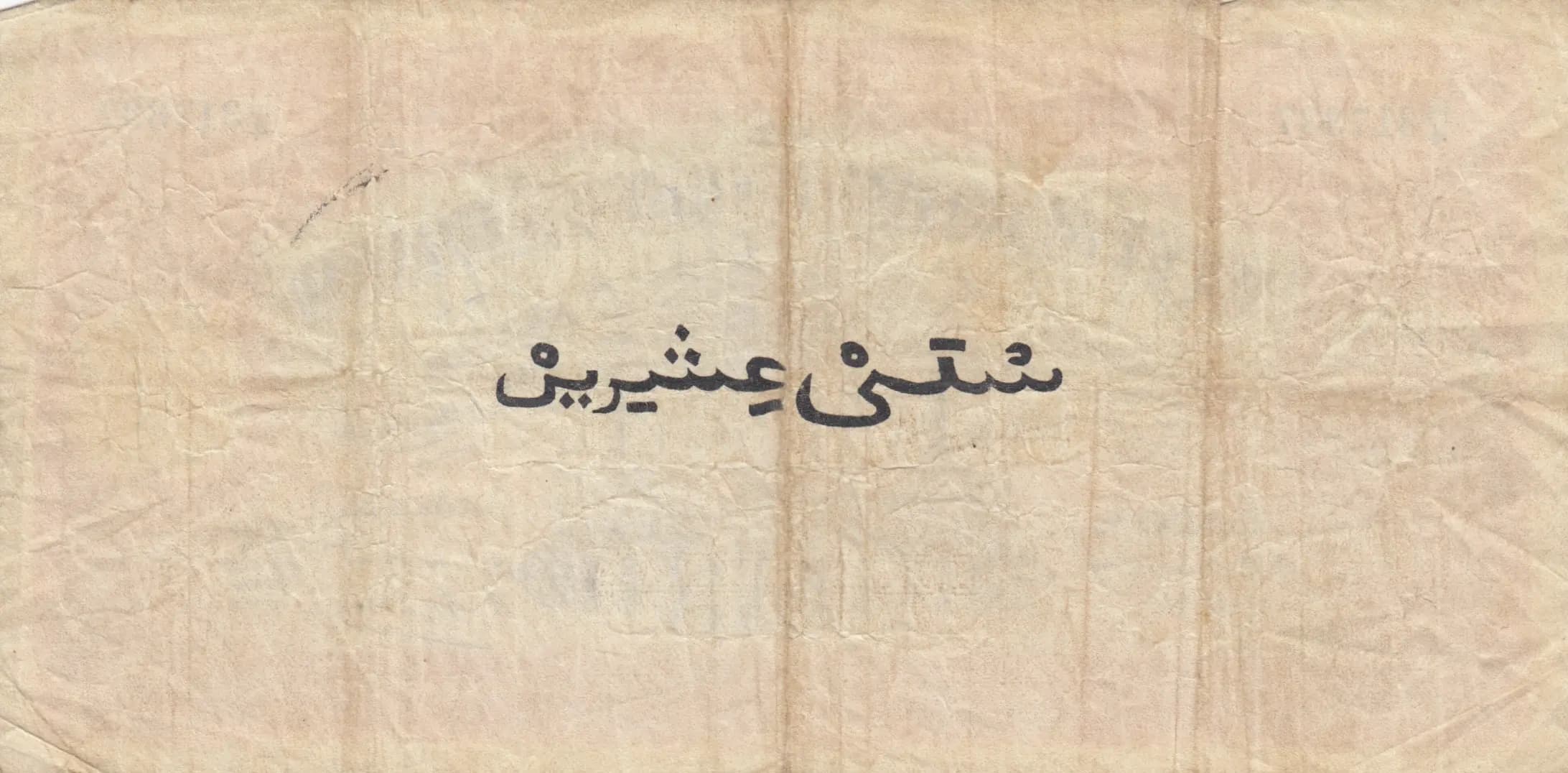
Issued by the West African Currency Board on 4 January 1937, this banknote reflects the colonial monetary infrastructure of British West Africa during the late 1930s. The palm tree central vignette symbolizes the region's primary economic resource and colonial identity, while the bilingual design—incorporating Arabic script on the reverse reading 'عشرة وعشرون' (Twenty)—acknowledges the significant Muslim populations across the territory. The Lagos dateline and board members' identification underscore the centralized currency control exercised from the colonial administrative center.
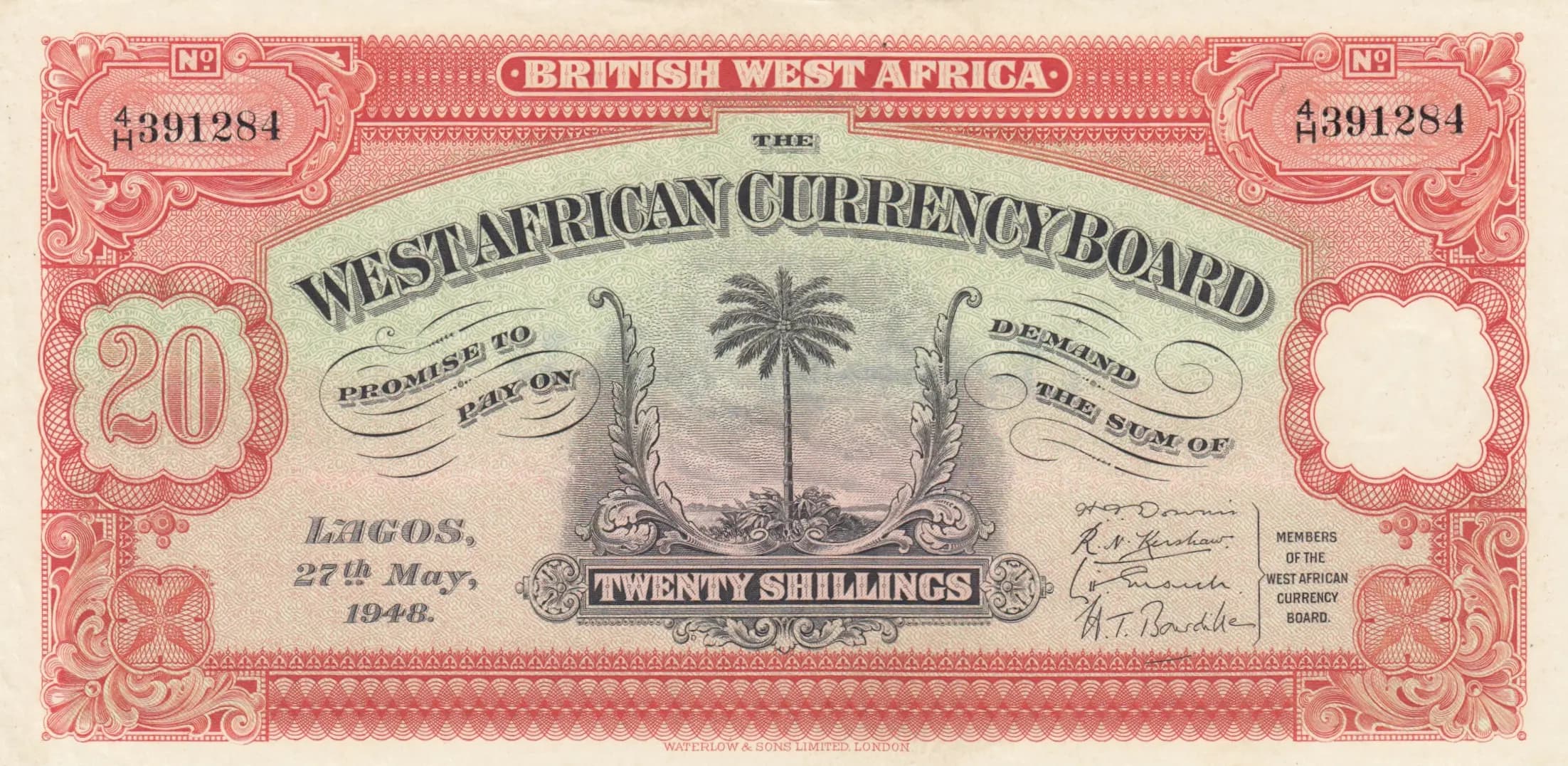
The obverse features a formal colonial banknote design centered on a palm tree vignette—a symbolic representation of West African commerce and colonial wealth—flanked by symmetrical laurel wreaths denoting authority and permanence. The denomination '20' appears at the left side, with elaborate decorative borders incorporating geometric patterns and rosettes characteristic of early 20th-century security printing. An ornamental seal or coat of arms is positioned at bottom center, flanked by two signatures of board authority. The color scheme of red and cream on light green and pink underprint creates visual distinction and anti-counterfeiting utility. The reverse presents a minimalist design with the denomination rendered entirely in Arabic script, reflecting the multicultural composition of British West Africa.
FRONT: 'BRITISH WEST AFRICA' (header); 'WEST AFRICAN CURRENCY BOARD' (issuing authority); 'PROMISE TO PAY ON DEMAND THE SUM OF' (promise clause); 'TWENTY SHILLINGS' (denomination in words); 'LAGOS.' (place of issue); '4th January, 1937.' (issue date); 'H817337' (serial number); '20' (denomination numeral); 'MEMBERS OF THE WEST AFRICAN CURRENCY BOARD' (identification); 'WATERLOW & SONS LIMITED LONDON' (printer attribution). BACK: 'عشرة وعشرون' (Arabic: 'Twenty' or 'Twenty Shillings').
Intaglio engraving by Waterlow & Sons Limited, London (identified on the note as printer). The intricate border patterns, fine line work in the palm tree vignette, and detailed rosette elements are consistent with high-security banknote intaglio production methods characteristic of this security printer. The multi-color printing employing red, black, and colored underprints indicates multiple passes through the press—a standard technique for creating visual complexity that deterred contemporary counterfeiting.
This note is cataloged as Pick P-8b, identifying it as a variant within the 20 shillings series. The visual analysis confirms the Waterlow & Sons (W&S) printer attribution consistent with P-8b specifications. The serial number H817337 and date of 4 January 1937 are consistent with the series' inaugural year. No overprints, replacement markings, or other distinguishing features are evident in the images that would indicate a sub-variety (such as the 's' or 'x' variants noted in the PMG population report for P-8as, P-8ax, P-8bs, and P-8cts). The note represents a standard P-8b issue.