10 shillings 1937
Market Prices
17 salesAbout This Note
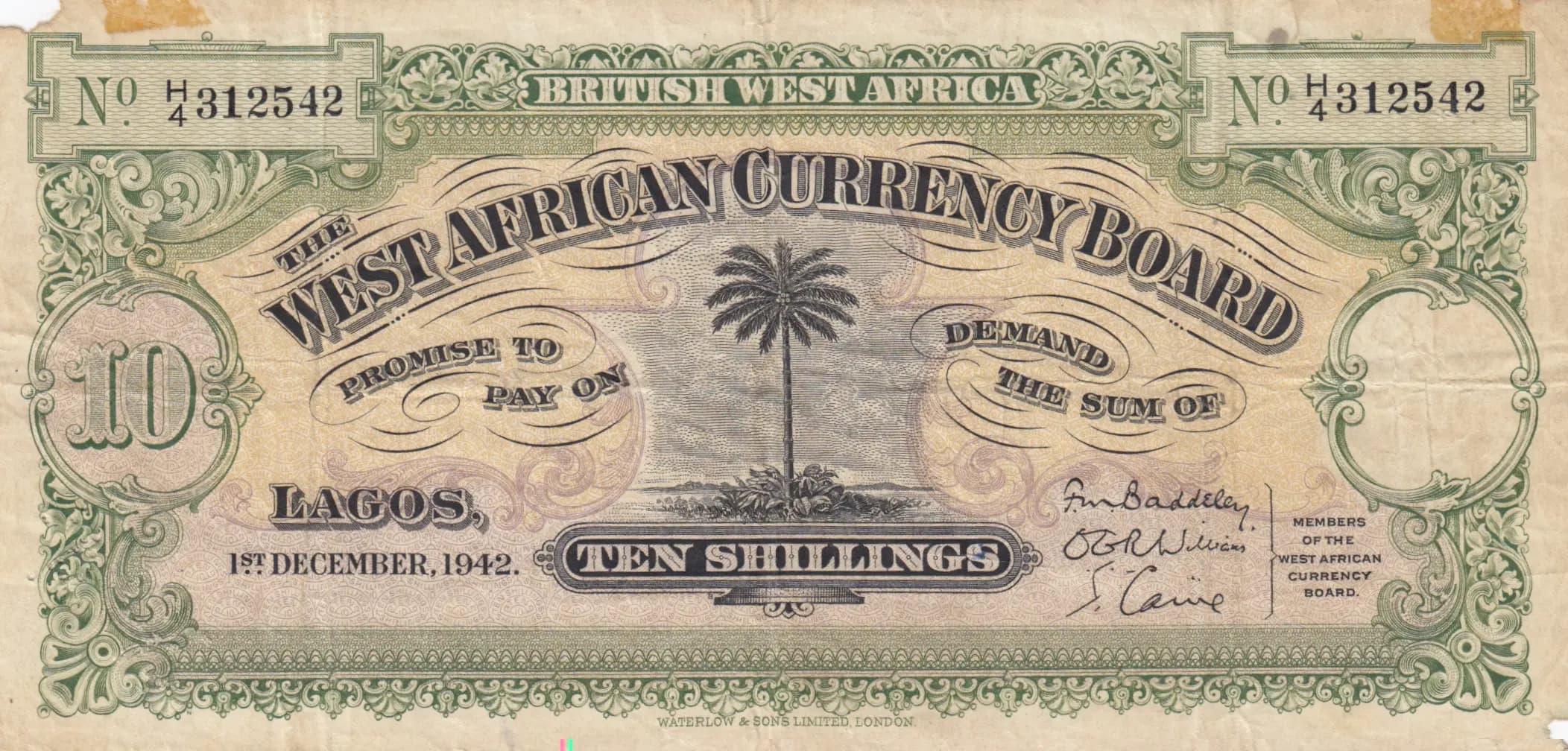
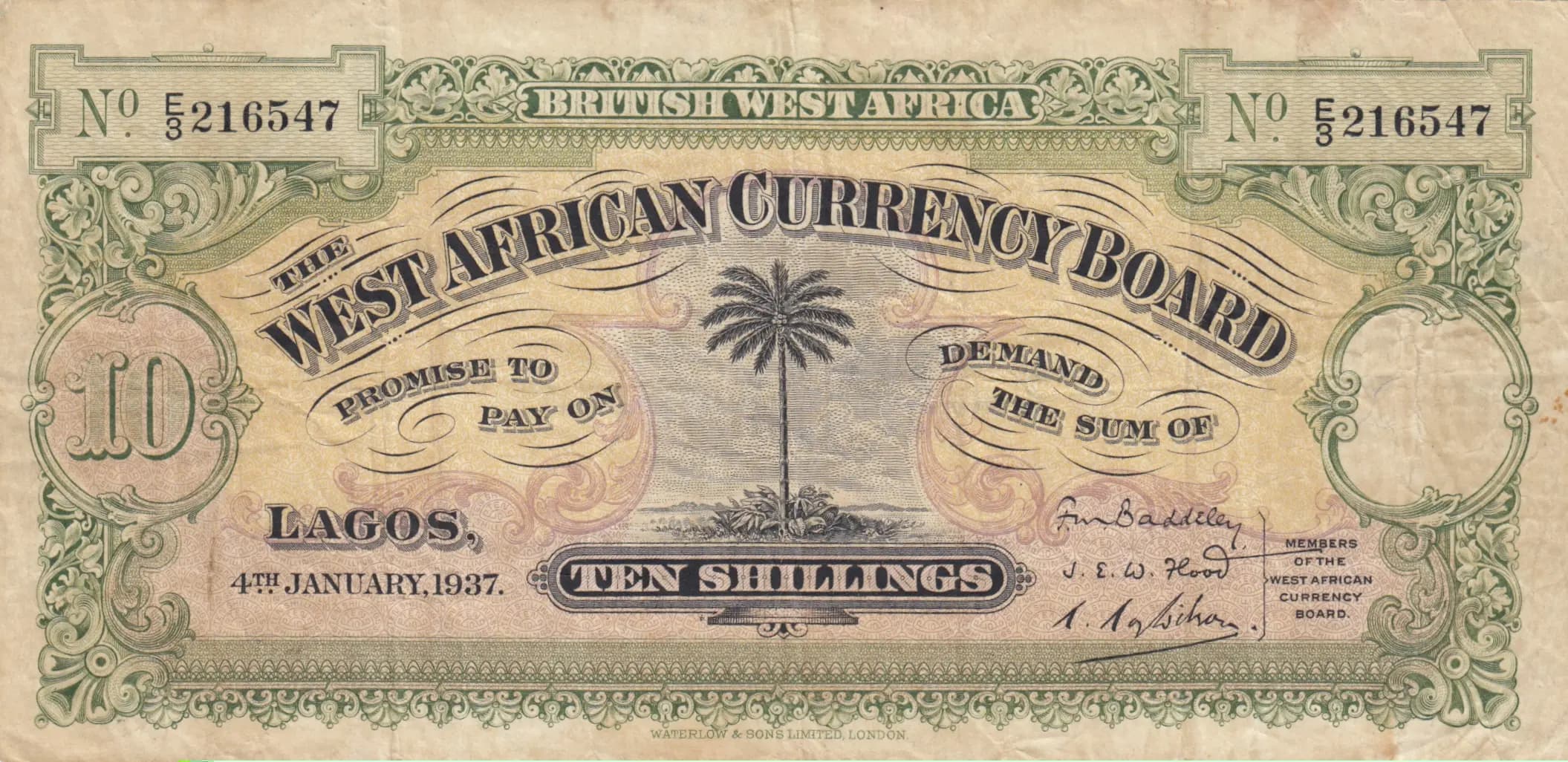
A circulated 1937 British West Africa 10 Shillings note issued by the West African Currency Board, printed by Waterlow & Sons Limited in London. The note displays the iconic central palm tree design in green and beige with ornate classical engraving, characteristic of early-20th century currency design. In Fine condition, this well-handled example exhibits expected creasing, foxing, and age-related discoloration consistent with 85+ years of circulation, with handwritten signatures visible on the obverse.
Common. This is a regular issue note from a widely-circulated currency series (P-7b) with an extended issuance period (1928-1950). eBay market data confirms common status: F-grade examples have consistently sold in the $40-$89 range over the past 15 years, with the 2016 catalog value for F-grade being $100. Print runs for West African Currency Board notes were substantial across British West African territories. The lack of any premium pricing and consistent market availability indicate this is a standard, commonly encountered date and variety.
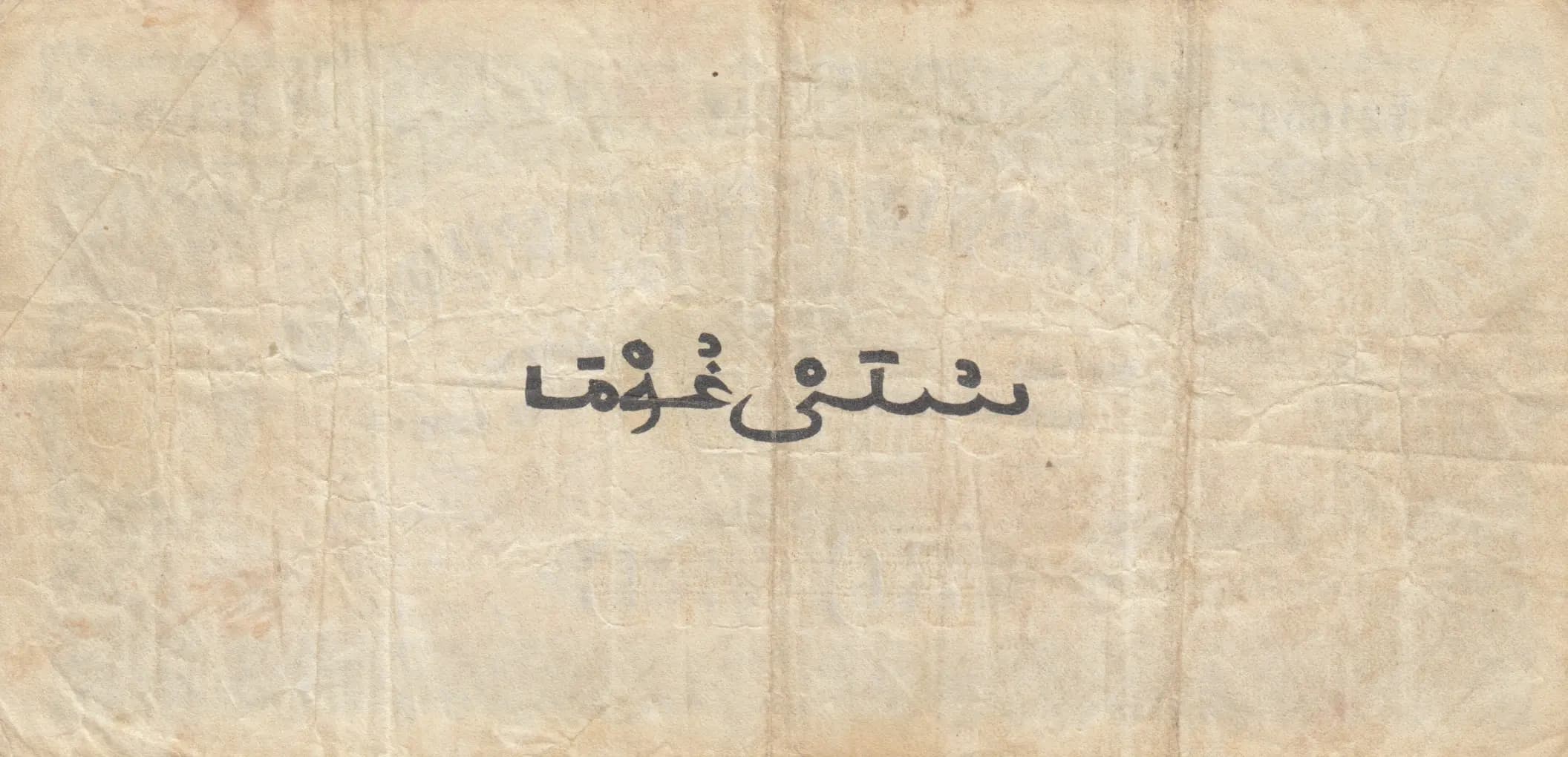
Issued on 4 January 1937 from Lagos, this note represents the West African Currency Board's efforts to establish a unified currency across British West African territories during the height of British colonial administration. The prominent palm tree imagery reflects the economic importance of palm oil and tropical agriculture to the region's colonial export economy. The dual-language presentation—English on the obverse and Arabic script on the reverse—reflects the diverse linguistic and religious composition of the currency union's member territories.
The obverse features a tall, naturalistic palm tree depicted in the center of the composition, symbolizing the tropical wealth of British West Africa. The design employs ornate classical engraving with elaborate scrollwork and corner ornamental panels in a beige and green color scheme. The denomination '10' appears in a prominent circular ornamental frame on the left side. Two handwritten signatures appear on the right side, typical of currency board authorization. The reverse is predominantly blank except for the handwritten Arabic annotation, which is characteristic of some historical banknotes that were annotated in the field. Serial number 5216547 appears in both upper corners, with an additional watermark reference to '10' on the right.
FRONT: 'BRITISH WEST AFRICA' / 'THE WEST AFRICAN CURRENCY BOARD' / 'PROMISE TO PAY ON DEMAND THE SUM OF' / 'LAGOS,' / '4TH JANUARY, 1937.' / 'TEN SHILLINGS' / 'MEMBERS OF THE WEST AFRICAN CURRENCY BOARD.' / 'WATERLOW & SONS LIMITED, LONDON' / Serial number: 'No 5216547'. BACK: Arabic inscription 'شيخ غولا' (Sheikh Gola or similar transliteration)—this appears to be a handwritten annotation added after issuance, possibly a personal inscription or ownership mark.
Intaglio (steel engraving) by Waterlow & Sons Limited, London, as credited on the note. The fine line work, intricate scrollwork, and engraved security patterns visible throughout are characteristic of high-quality intaglio currency printing. The detailed botanical rendering of the palm tree and ornamental border work demonstrate the sophisticated engraving capabilities of this renowned security printer.
This is identified as Pick P-7b, one of four known variants catalogued by PMG (P-7a, P-7as, P-7b, P-7bs). The variants appear to relate to printer designations (W&S for Waterlow & Sons). This specific example carries the 4 January 1937 issue date from Lagos and serial number 5216547. The presence of handwritten signatures is standard for this issue type. The handwritten Arabic annotation on the reverse appears to be post-issuance and may indicate a local ownership or personal inscription rather than a printer's variety marking.