10 shillings 1942
Market Prices
17 salesAbout This Note
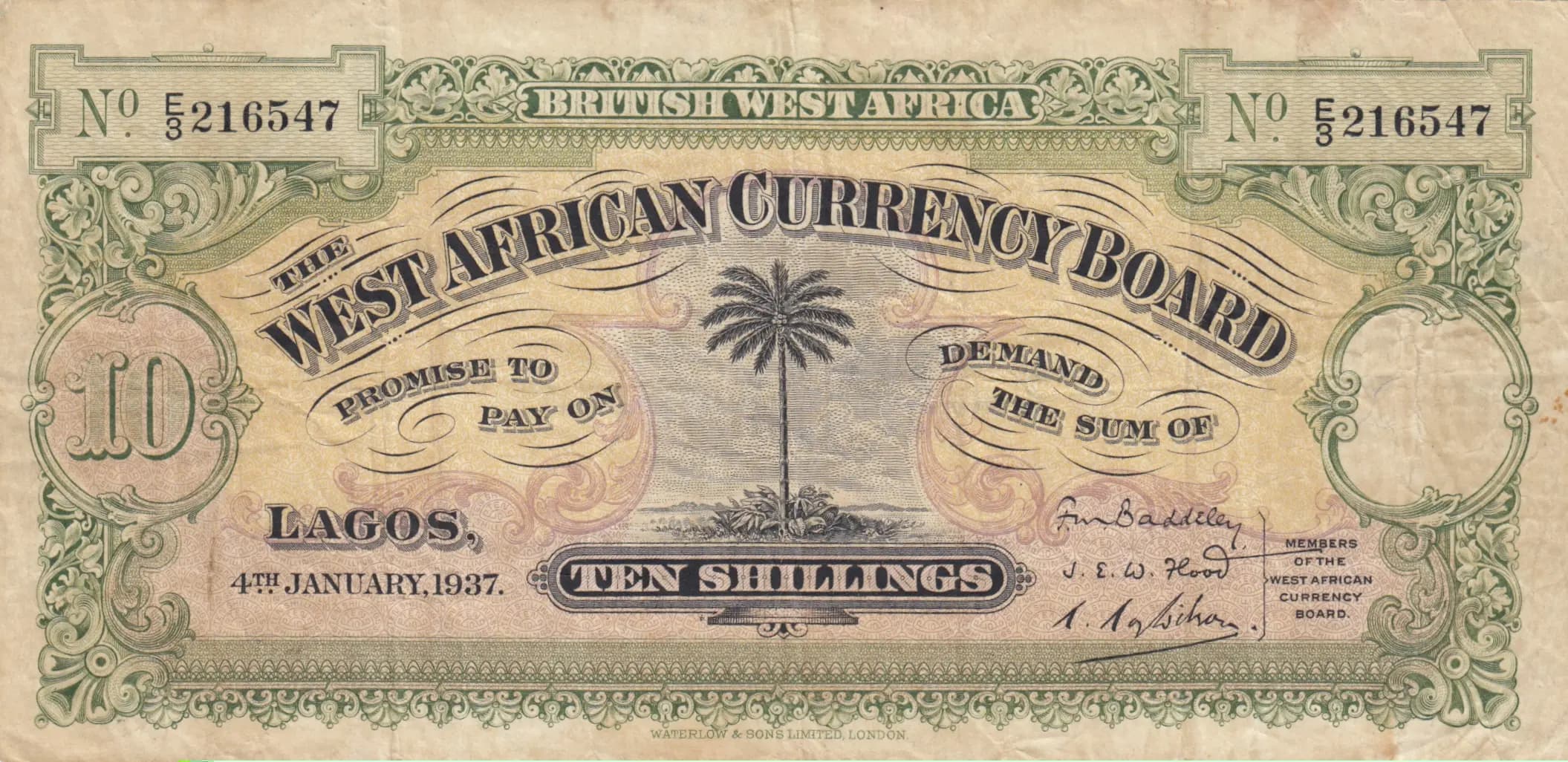
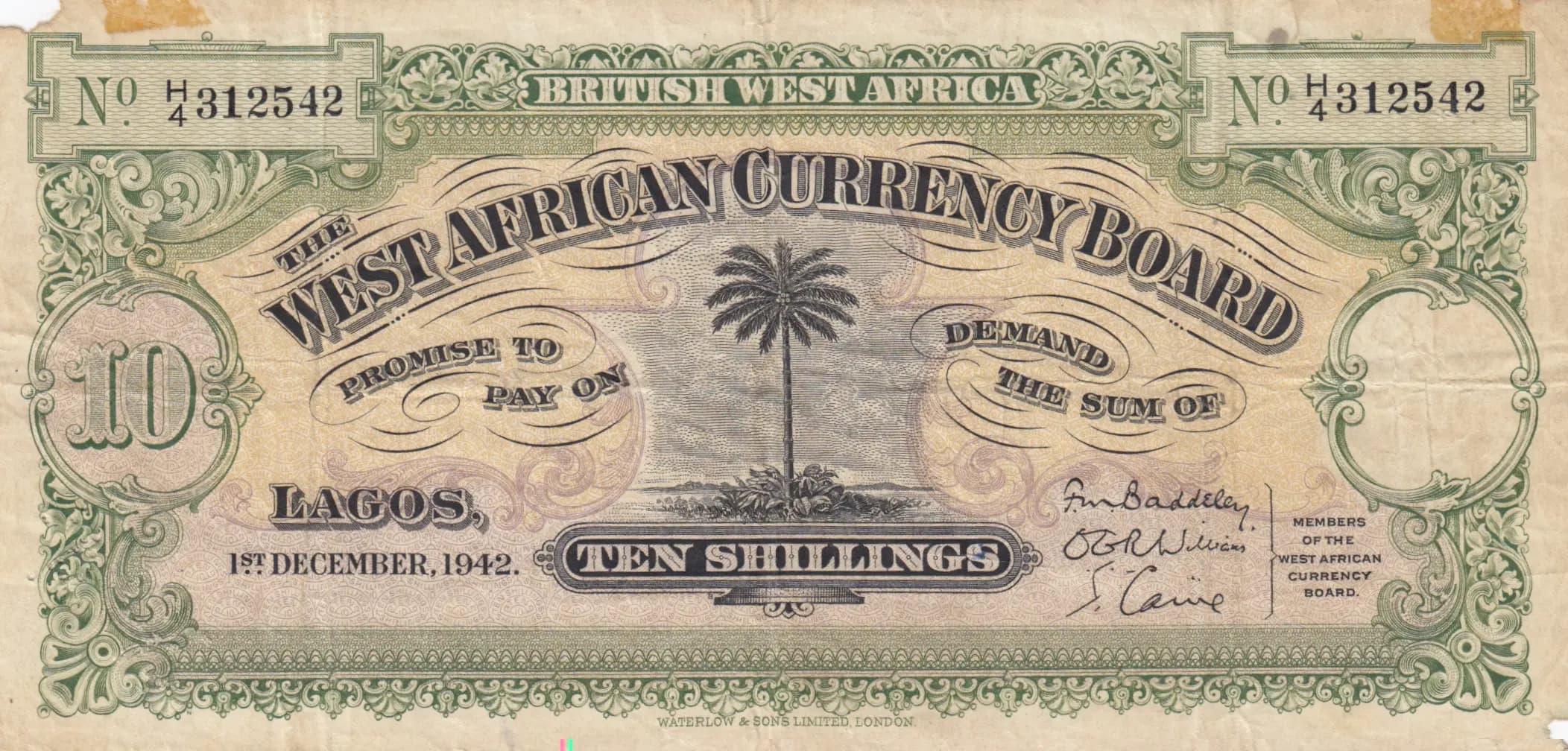
This is a British West Africa 10 Shillings note dated 1st December 1942, issued by the West African Currency Board and printed by Waterlow & Sons Limited. The note features a striking central palm tree engraving on a green background with ornate decorative borders, displaying the serial number NO H312542. In VG (Very Good) condition, the note shows appropriate aging characteristics including foxing, creasing, and yellowing consistent with an 80+ year old circulated note, making it a solid example of wartime British colonial currency.
Common. While this is a specific wartime issue from 1942, the West African Currency Board issued these notes across multiple years (1928-1950) with substantial print runs to serve colonial currency needs across multiple territories. The eBay price history provided shows consistent market activity with notes in similar grades (VG-F) selling in the $50-80 range over the past decade, and even lower prices ($11.60-$40) for well-circulated examples, indicating a readily available note. The 2016 catalog value for this grade is approximately $25-100, confirming standard market availability. No evidence of scarcity, recall, or limited production exists for P-7b.
This note was issued during World War II by the West African Currency Board, reflecting Britain's colonial administration in West Africa during a critical period of imperial finance. The central palm tree symbolizes the tropical wealth and natural resources of British West Africa, while the Lagos dateline and formal promise-to-pay language reflect the formal monetary authority of the currency board established to manage colonial currency across multiple West African territories. The 1942 date places this within the later stages of WWII, when colonial currency systems remained essential to British imperial economic control.
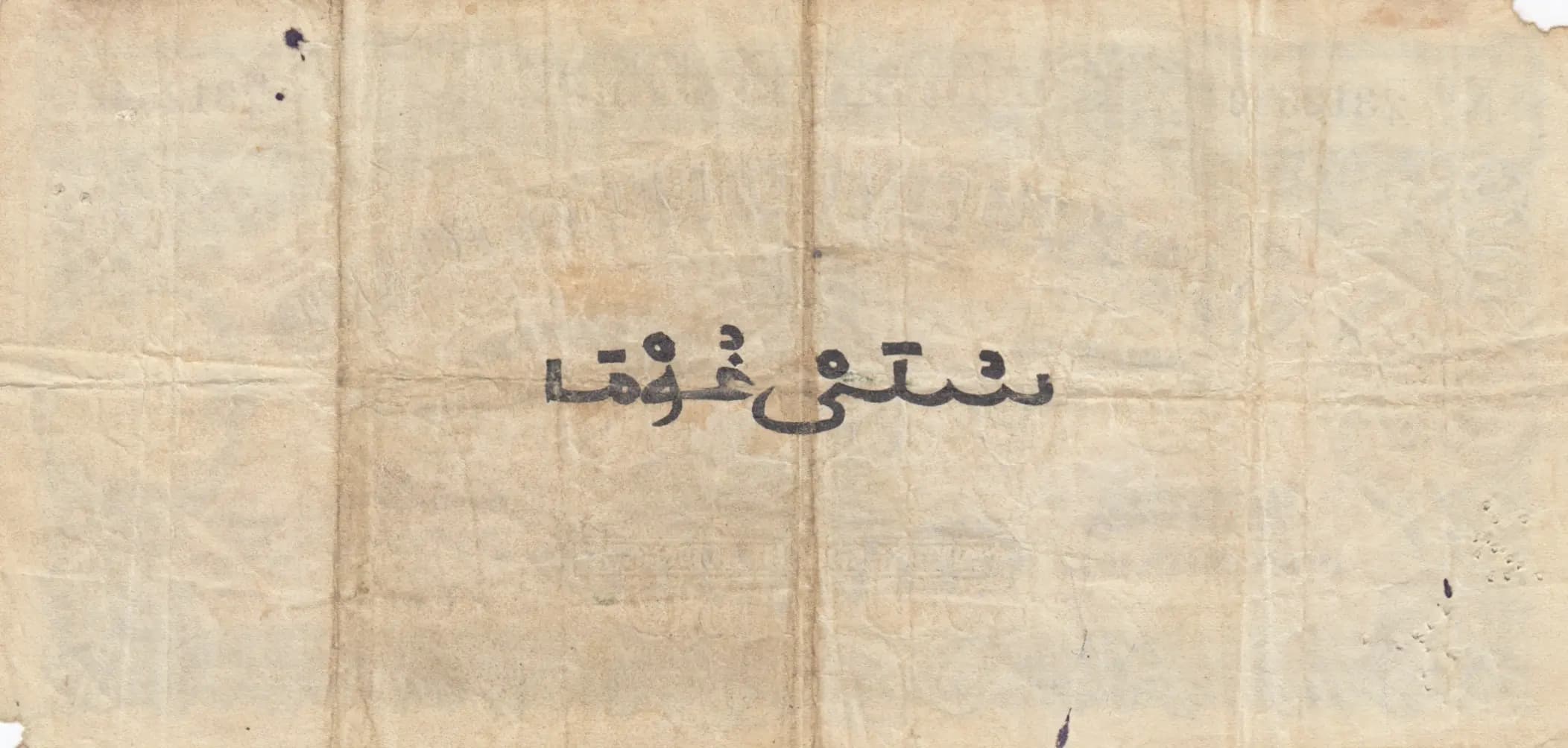
The obverse features a classical engraved design centered on a solitary palm tree rendered in fine detail against a landscape background, symbolizing the natural resources and tropical character of British West Africa. The design is framed by elaborate ornamental borders composed of interlocking scrollwork, floral motifs, and geometric patterns in the Art Deco/classical revival style typical of 1940s currency design. Large ornate denomination numerals '10' appear in decorative corner medallions at upper left and right. The denomination 'TEN SHILLINGS' is spelled out in text. The West African Currency Board seal/emblem is positioned in the lower right. Three official signatures appear below the main text, authenticating the note. The reverse is blank, showing only the aged paper with natural creasing and discoloration from circulation. The predominant color is green with cream and black elements, a standard choice for colonial currency of the period.
FRONT: 'BRITISH WEST AFRICA' (top center); 'THE WEST AFRICAN CURRENCY BOARD' (main title); 'PROMISE TO PAY ON DEMAND THE SUM OF' (currency promise); 'TEN SHILLINGS' (denomination); 'LAGOS,' (issuing city); '1ST DECEMBER, 1942.' (issue date); 'MEMBERS OF THE WEST AFRICAN CURRENCY BOARD' (authority statement); 'WATERLOW & SONS LIMITED LONDON' (printer identification); Serial number 'NO H312542' (appearing at top left and right); Three handwritten signatures (authority representatives). BACK: Largely blank with aged, creased paper. Handwritten marking in Arabic/Urdu script visible (appears to be collector's notation or post-issue marking, not official inscription).
This note was produced using intaglio (engraved) printing by Waterlow & Sons Limited, London, a renowned security printer. The intricate ornamental borders, fine line work throughout the design, and the detailed palm tree illustration are characteristic of high-security intaglio engraving. The fine line patterns and ornamental elements visible in the visual analysis are typical of the anti-counterfeiting measures employed in intaglio printing, where the design is carved into steel plates and printed under pressure to create distinctly tactile and difficult-to-replicate designs.
This note is catalogued as Pick P-7b (10 Shillings, Waterlow & Sons printer variant). The PMG population report indicates four catalogued varieties for this base Pick number: P-7a, P-7as, P-7b, and P-7bs, indicating printer variants and potentially different signature combinations or minor design variations. This specific note bears the date 1st December 1942 and serial number H312542. The 'b' designation likely distinguishes this from P-7a based on subtle design or printing differences (possibly signature configurations or printer marks). The 's' suffix in related varieties typically indicates specimens or special marking variants. This example appears to be a standard circulation note of the P-7b variety rather than a specimen or special issue.