20 shillings 1947
Market Prices
13 salesAbout This Note
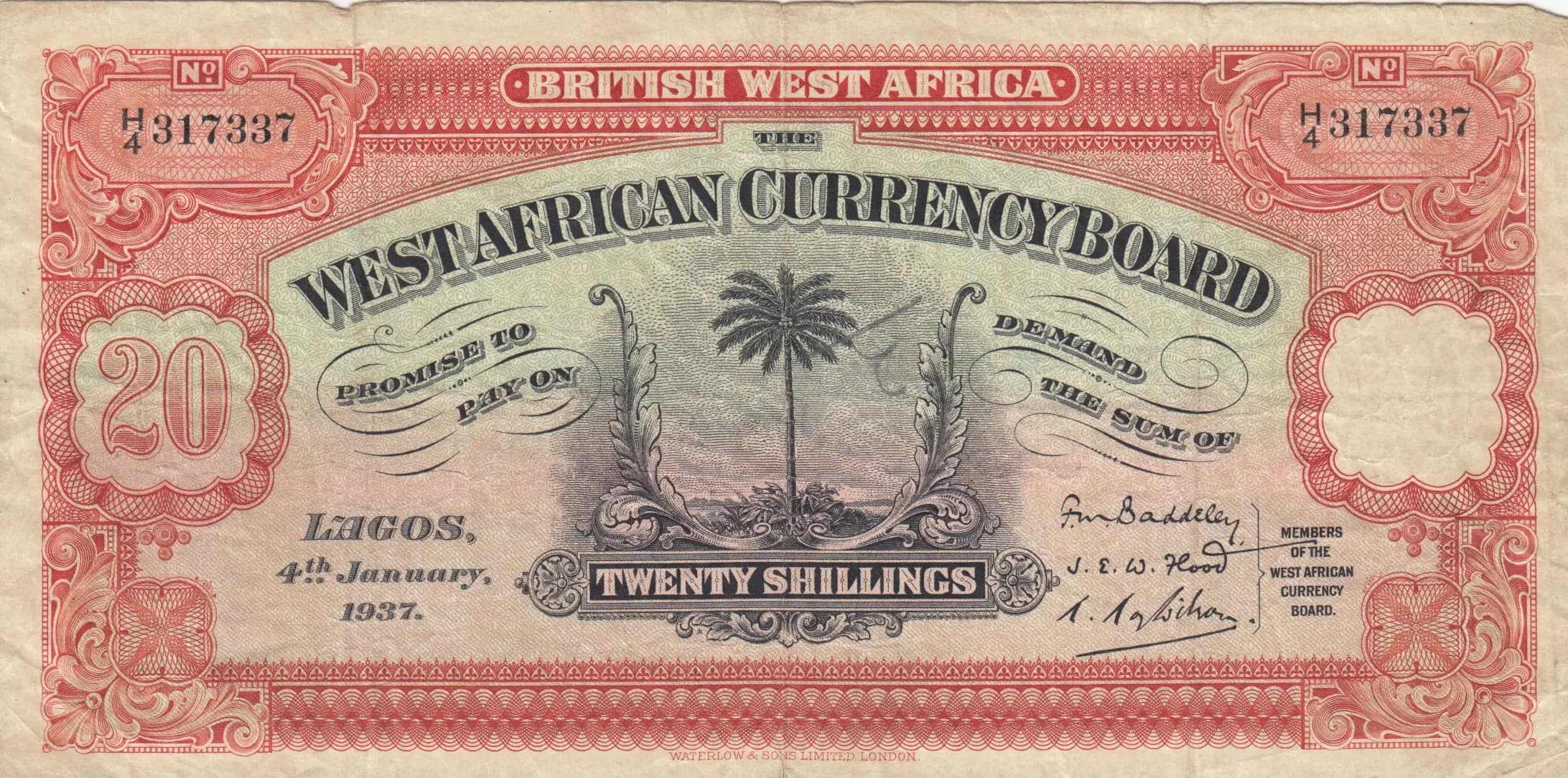
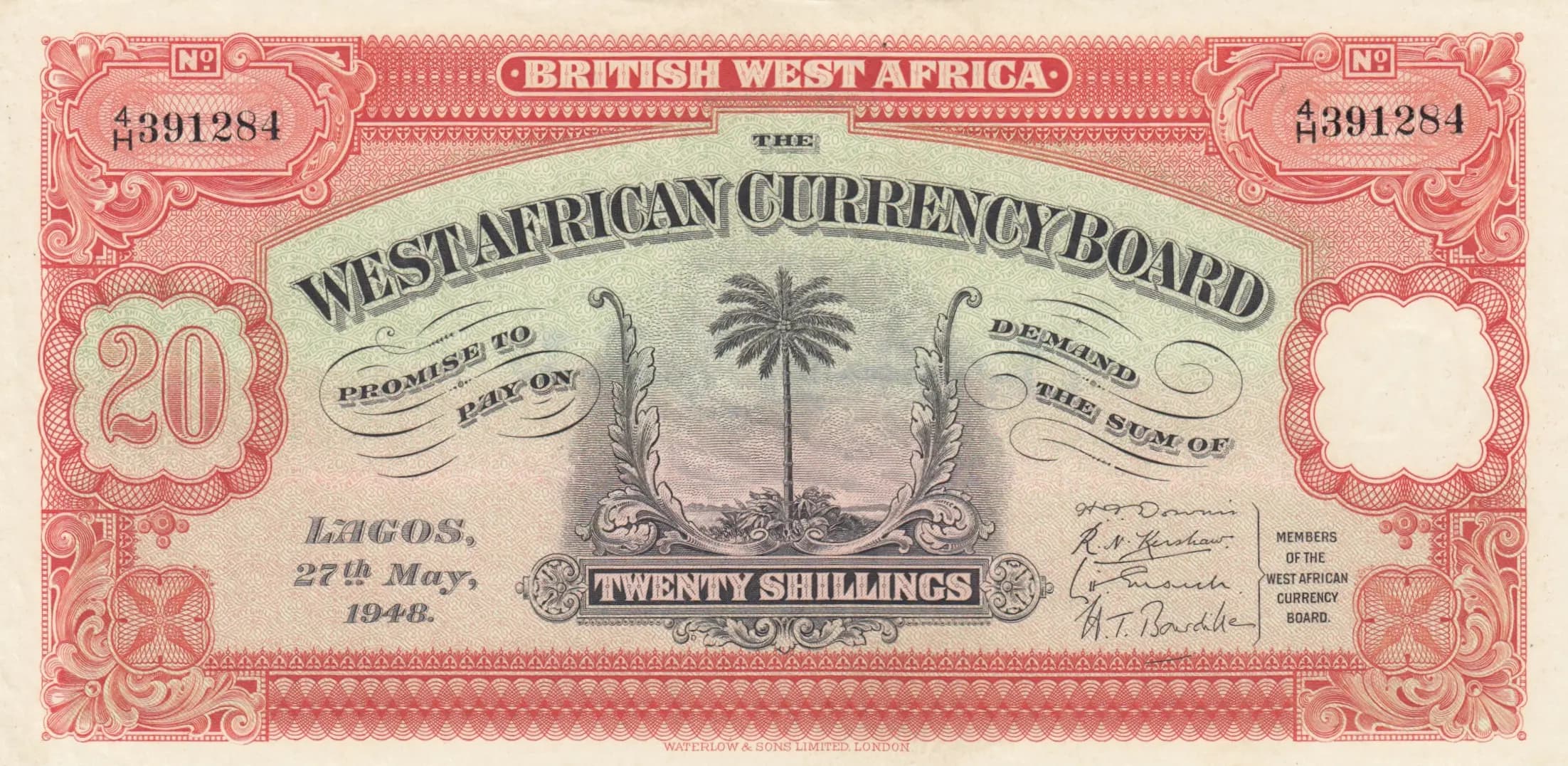
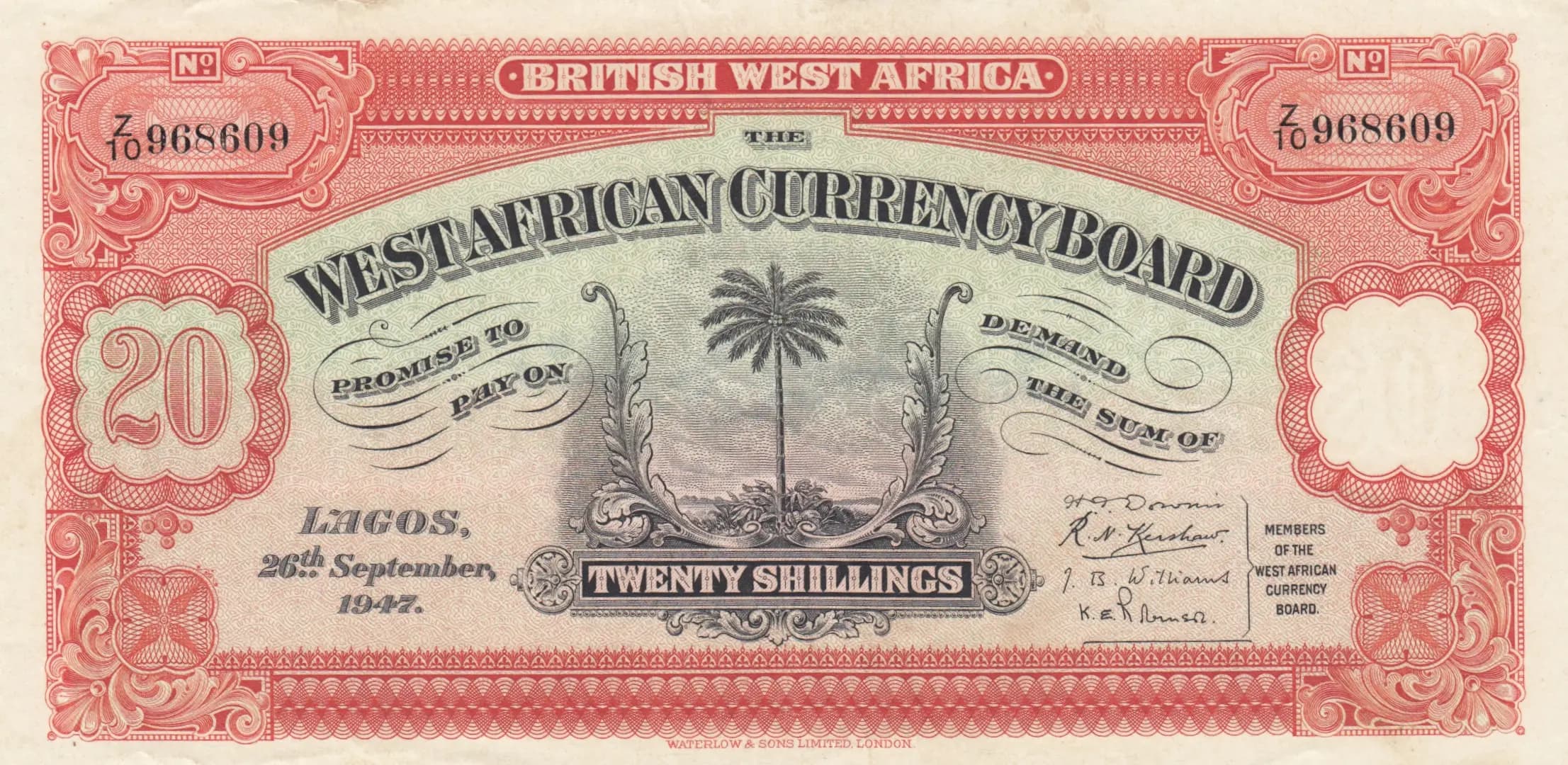
A vibrant coral-pink 20 shillings banknote from British West Africa dated 20th September 1947, issued by the West African Currency Board and printed by Waterlow & Sons. The note features a striking central palm tree surrounded by ornate decorative foliage and maintains excellent condition with crisp printing, vibrant coloring, and no visible wear—exemplifying the VF grade assessment. This is a notable issue from the immediate post-WWII period and represents the aesthetic pinnacle of the WACB's design philosophy, combining classical British security printing techniques with colonial African imagery.
Common. eBay market data shows consistent sales in the $45-$89 range for Fine condition notes, with VF examples selling for $78-$84 in recent years (2010-2021). The 2016 catalogue value for VF is $300, but actual market performance indicates the note trades significantly below catalogue, suggesting substantial print runs during the 1947-1951 issuance period. The West African Currency Board issued notes across four territories over a 14-year span (1928-1951), and the 20 shillings denomination was a standard circulating note that saw heavy use. No evidence of short print runs, early recall, or scarcity factors applies to this Pick-8b variety.
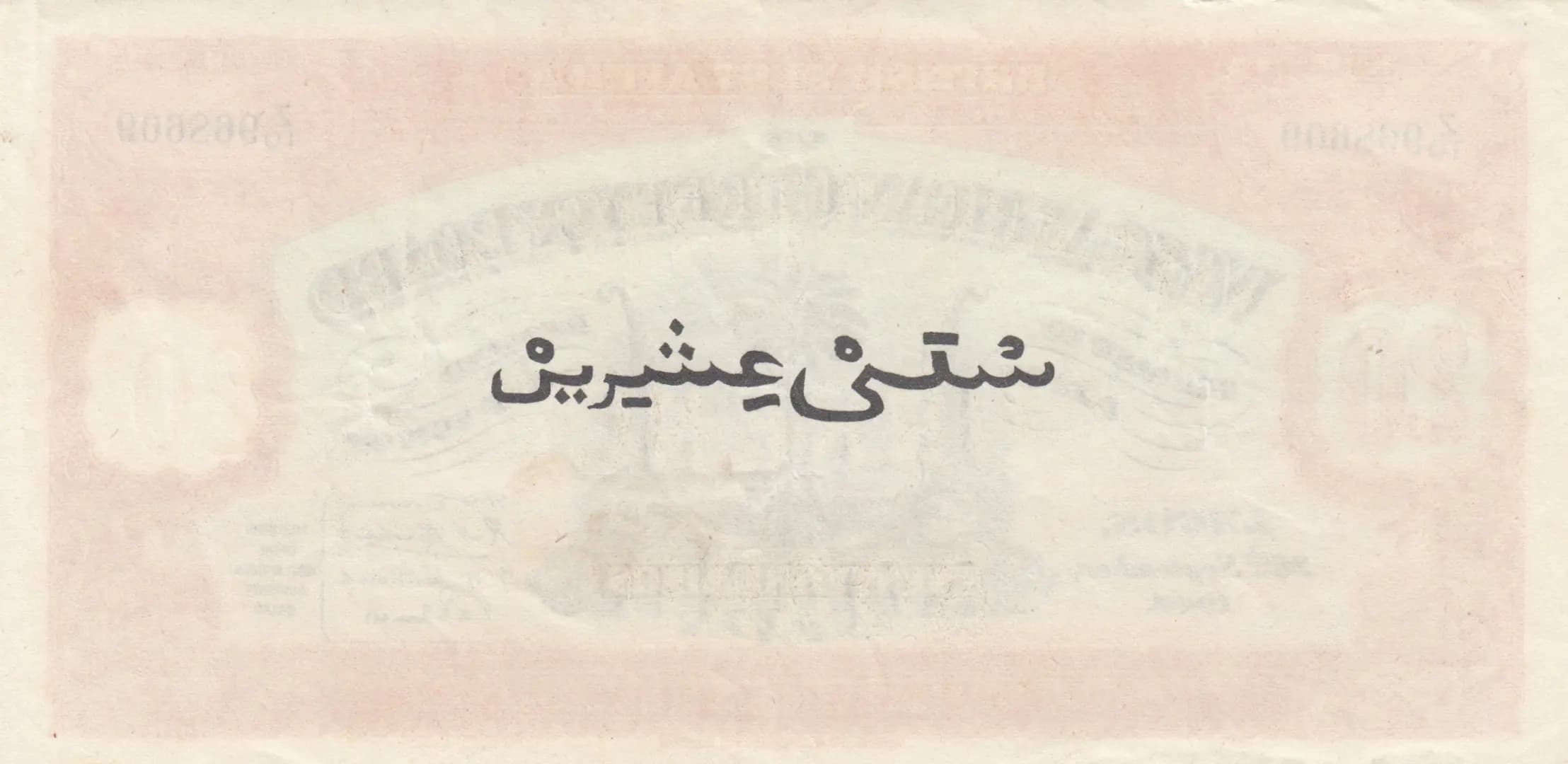
This note was issued during a transitional period in British West African colonial administration, just two years before the first territorial movements toward independence. The choice of the palm tree as the central motif reflects the economic importance of palm products to the colonial economy, while the Arabic script on the reverse acknowledges the significant Muslim populations across the WACB territories (Gold Coast, Nigeria, Sierra Leone, and Gambia). The promise-to-pay clause and formal banker signatures underscore the Currency Board's role in maintaining monetary stability across these diverse colonial territories.
The obverse features a naturalistic but ornately framed palm tree as the central design element, flanked by decorative scrollwork and floral motifs typical of Edwardian-era British currency design. The palm tree (Phoenix dactylifera or similar species) serves as the primary numismatic emblem, representing the colonial territory's primary agricultural export commodity. The design employs a two-color printing scheme of coral-pink and black on a cream-colored base with subtle light green and pink underprinting visible in background areas. Serial numbers are housed in ornate rectangular cartouches at the top corners. The reverse presents a more minimalist design with prominent Arabic script 'شيلن عشرين' (Twenty Shillings) centered on the reverse field, accompanied by watermark security features and subtle background patterning. The overall composition reflects high-grade security printing with complex background engraving throughout to deter counterfeiting.
FRONT SIDE: 'British West Africa' (top), 'The West African Currency Board' (issuing authority), 'The Promise to Pay on Demand the Sum of Twenty Shillings' (denomination promise), 'Lagos' (issuing location), '20th September, 1947' (date of issue), Serial number 'Z/o 968609' (appears twice, in decorative boxes at corners), 'No 9' (plate or issue number), 'Members of the West African Currency Board' (header for signatures), followed by signatures of 'K. Kirkham', 'I.B. Williams', and 'K.E. Bennet' (authorized signatories), 'Waterlow & Sons Limited, London' (printer identification). BACK SIDE: 'شيلن عشرين' (Arabic script meaning 'Twenty Shillings').
Intaglio engraving (line engraving and steel die work) combined with multi-color lithographic underprinting, executed by Waterlow & Sons Limited of London. The security features include intricate background pattern work, complex geometric designs, fine-line engraving in the decorative borders, and strategically positioned watermarks. The two-color printing on the obverse (coral-pink and black) was applied via traditional currency printing presses, with the subtle underprinting in light green and pink requiring separate plate work. This represents the pinnacle of mid-20th-century British security printing standards for colonial currency.
This note is catalogued as Pick-8b (Waterlow & Sons printer variant). The PMG population report indicates six known varieties for the base Pick number (P-8a, P-8as, P-8ax, P-8b, P-8bs, P-8cts), suggesting variations in printing, signature combinations, or plate numbers. The observed example displays serial number Z/o 968609 with signatures of K. Kirkham, I.B. Williams, and K.E. Bennet, dated 20th September 1947, issued from Lagos. The 'Z/o' prefix in the serial number may indicate a specific printing series or geographical allocation. The specific plate number 'No 9' visible on the note may help distinguish this printing run from other contemporary issues within the P-8b variety.