20 shillings 1953
Market Prices
22 salesAbout This Note
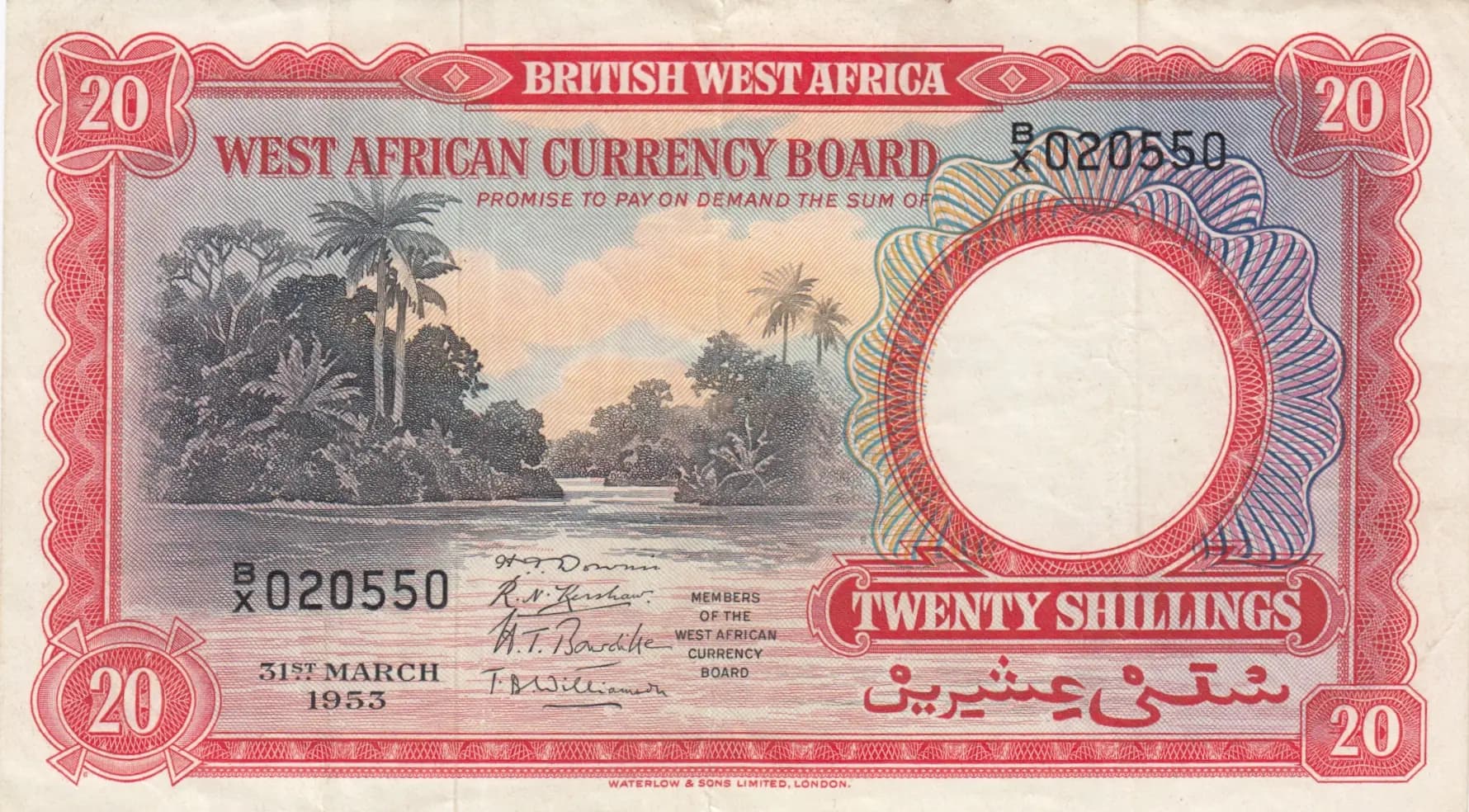
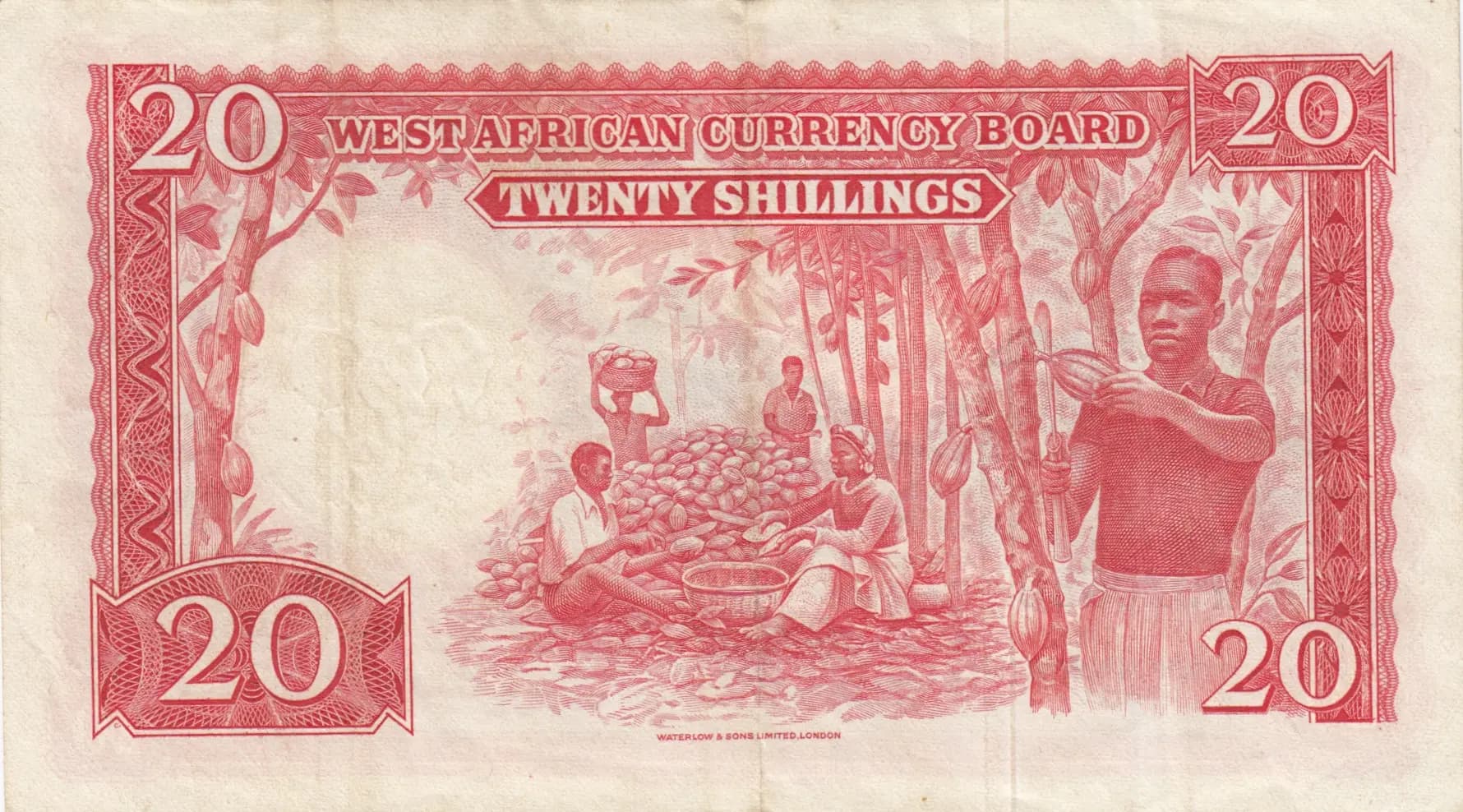
This is a VF-grade 20 Shillings banknote from the West African Currency Board, issued on 31st March 1953 and printed by Waterlow & Sons Limited in London. The note displays the characteristic design elements of the 1953 series with a river landscape vignette on the obverse and a cocoa harvest agricultural scene on the reverse, both rendered in fine engraved detail. Despite visible signs of circulation including creasing, foxing, and age-related discoloration, the note retains good overall eye appeal with clear impressions of the ornate red and pink borders and the intricate geometric decorative patterns, making it a solid mid-grade example of this historically important colonial currency.
Common. This is a regular-issue note from the West African Currency Board's standard 1953 series with a substantial print run. The eBay sales data provided demonstrates consistent market availability at moderate prices typical of common colonial currency—most VF examples selling in the $39–$77 range in recent years, with the 2024–2025 sales showing $48–$50 for VF grades. While this specific Pick number (P-10) is part of a three-variant catalog grouping (P-10a, P-10cts, P-10s) representing different printer or security printing variations, the 1953 20 Shillings denomination itself was produced in quantities sufficient to support an active secondary market without significant scarcity premiums. The 2016 catalog value of $75 for VF and the consistent sub-$80 secondary market pricing confirm this assessment.
The West African Currency Board issued this note during the twilight years of British colonial administration in West Africa, specifically dated to 1953 when decolonization movements were gaining momentum across the continent. The obverse vignette depicting a tropical river with palm trees and the reverse showing cocoa harvest labor symbolized the economic foundation of British West African colonies—agriculture and natural resources—while the denomination in shillings reflects the monetary system imposed through British colonial governance. This 1953 date is significant as it represents one of the early issues in the WACB's final decade before the currency was replaced by independent national currencies following decolonization in the late 1950s and early 1960s.
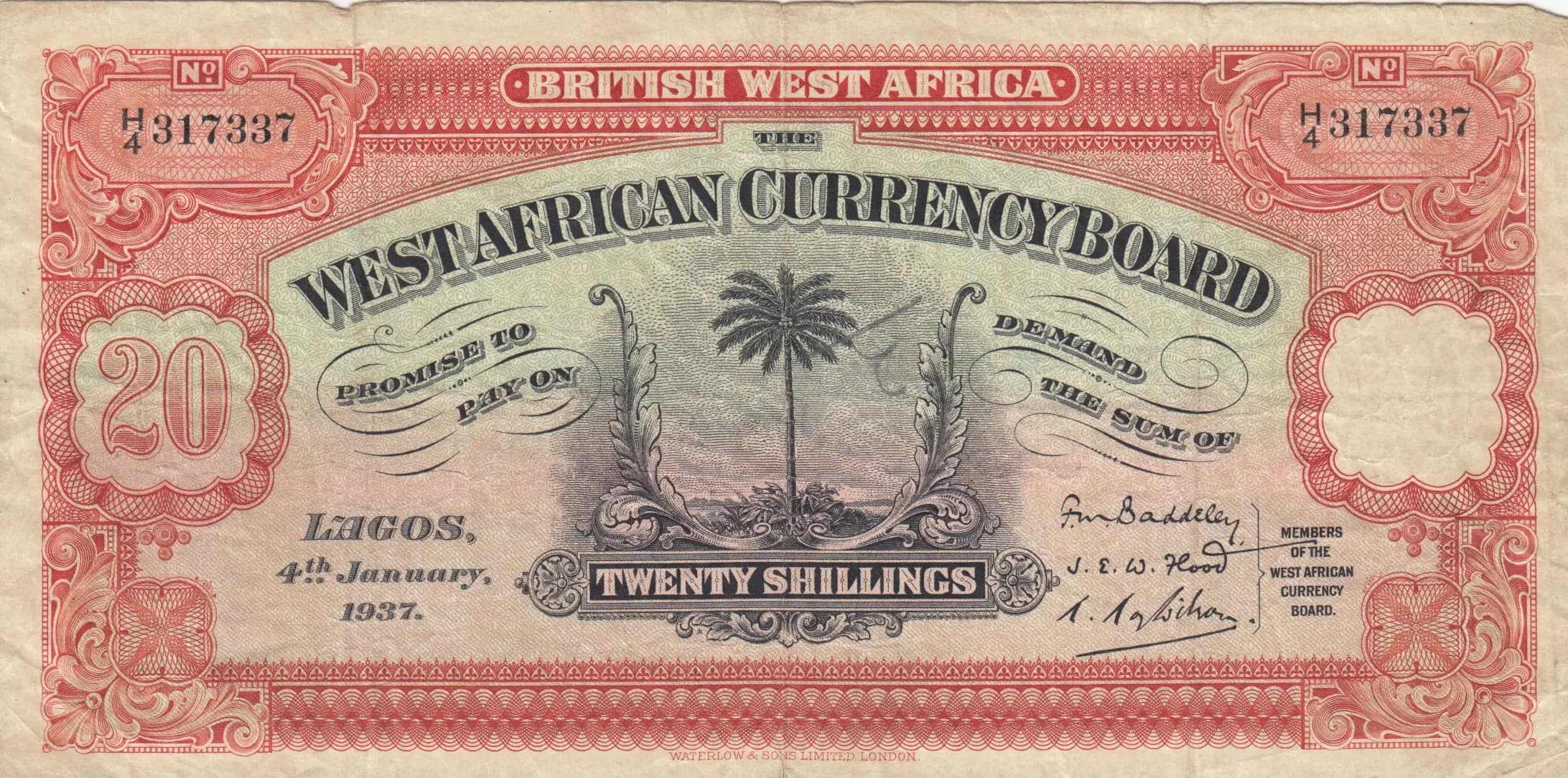
The obverse features a finely engraved landscape vignette in the center-left depicting a West African river scene with tropical vegetation, palm trees, and dense foliage rendered in grayscale/black and white intaglio engraving. To the right is an ornamental circular frame in red and blue with intricate geometric patterning, designed to accommodate a portrait or coat of arms (appearing blank on this impression). The entire design is framed by an ornate red and pink border with complex geometric and floral motifs typical of Edwardian-era British currency design. Denomination '20' appears in all four corners within ornamental cartouches. The reverse depicts a cocoa harvest scene—the economic lifeblood of the British West African colonies—showing multiple workers engaged in harvesting, processing, or handling cocoa beneath a shelter structure with vertical posts, with tropical vegetation including banana or plantain plants visible in the composition. The same ornamental corner designs and red/pink border frame are maintained on the reverse, creating a cohesive bilateral design.
FRONT: 'BRITISH WEST AFRICA' / 'WEST AFRICAN CURRENCY BOARD' / 'PROMISE TO PAY ON DEMAND THE SUM OF' / 'TWENTY SHILLINGS' / '20' (in four corners) / 'B020550' and 'X020550' (serial numbers) / '31ST MARCH 1953' (issue date) / 'MEMBERS OF THE WEST AFRICAN CURRENCY BOARD' / 'WATERLOW & SONS LIMITED, LONDON' (printer attribution). BACK: 'WEST AFRICAN CURRENCY BOARD' / 'TWENTY SHILLINGS' / '20' (in four corners) / 'WATERLOW & SONS LIMITED, LONDON'. The Arabic inscription noted in the front visual analysis ('شرق غربي') appears to be decorative rather than substantive text and is not part of the standard inscriptions for this issue.
This note was produced using traditional intaglio engraving (also known as copperplate or steel-plate engraving) by Waterlow & Sons Limited, the renowned London-based security printer. The visual characteristics observed—fine line work, the precise rendering of the landscape vignettes, the intricate geometric borders, and the sharp detail of the agricultural scene—are hallmarks of intaglio printing, which was the standard high-security technique for banknote production during this era. The multiple color passes (red, pink, black, blue, yellow/gold accents) indicate that separate plates were used for different color separations, a common practice in mid-20th century banknote printing.
This note exhibits characteristics consistent with the P-10 base catalog number with Waterlow & Sons printing attribution. The visual analysis reveals serial numbers 'B020550' and 'X020550,' indicating this may be a note from a specific print batch or block. The PMG population report identifies three cataloged variants: P-10a, P-10cts, and P-10s—all printed by W&S—suggesting distinctions based on security printing features, overprints, or signature varieties. Without access to the original visual inspection that distinguished these variants, precise variant classification cannot be determined from the images alone; however, the note's standard appearance and consistent design suggest it aligns with the primary P-10 printing. Collectors should note multiple handwritten signatures visible on the front, which is consistent with the formal currency board authorization practices of the era.