10 shillings 1957
Market Prices
4 salesAbout This Note
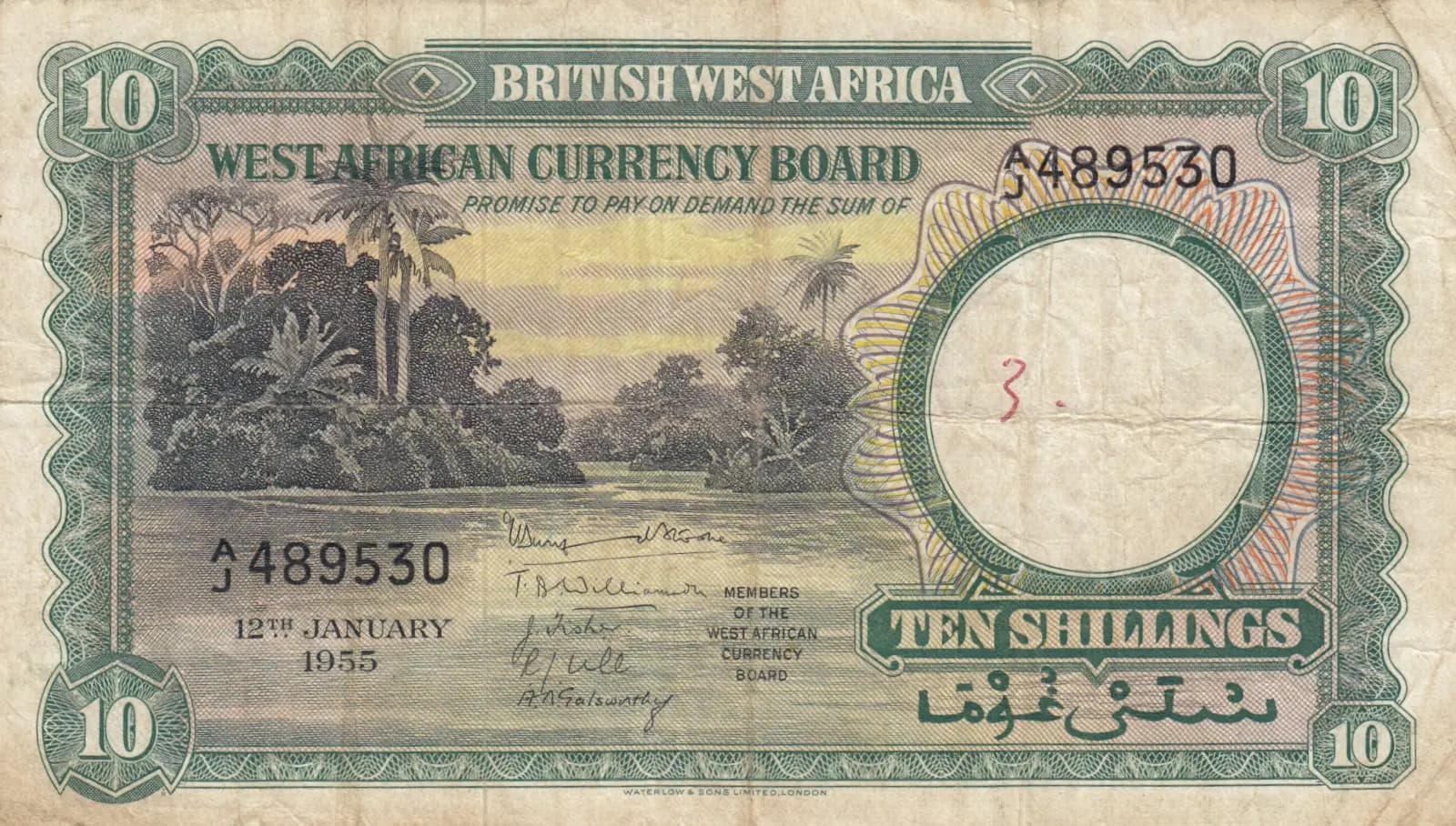
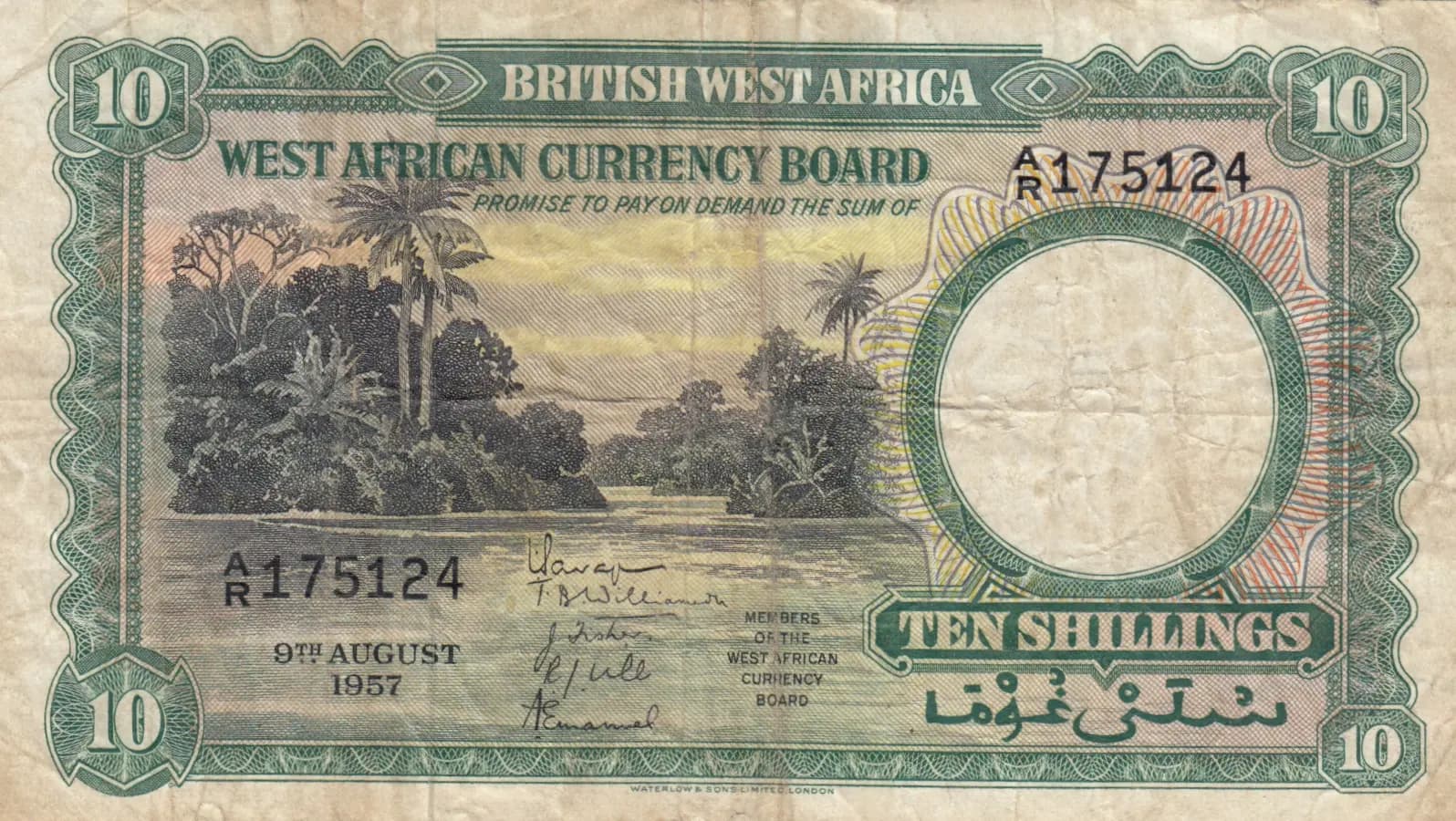
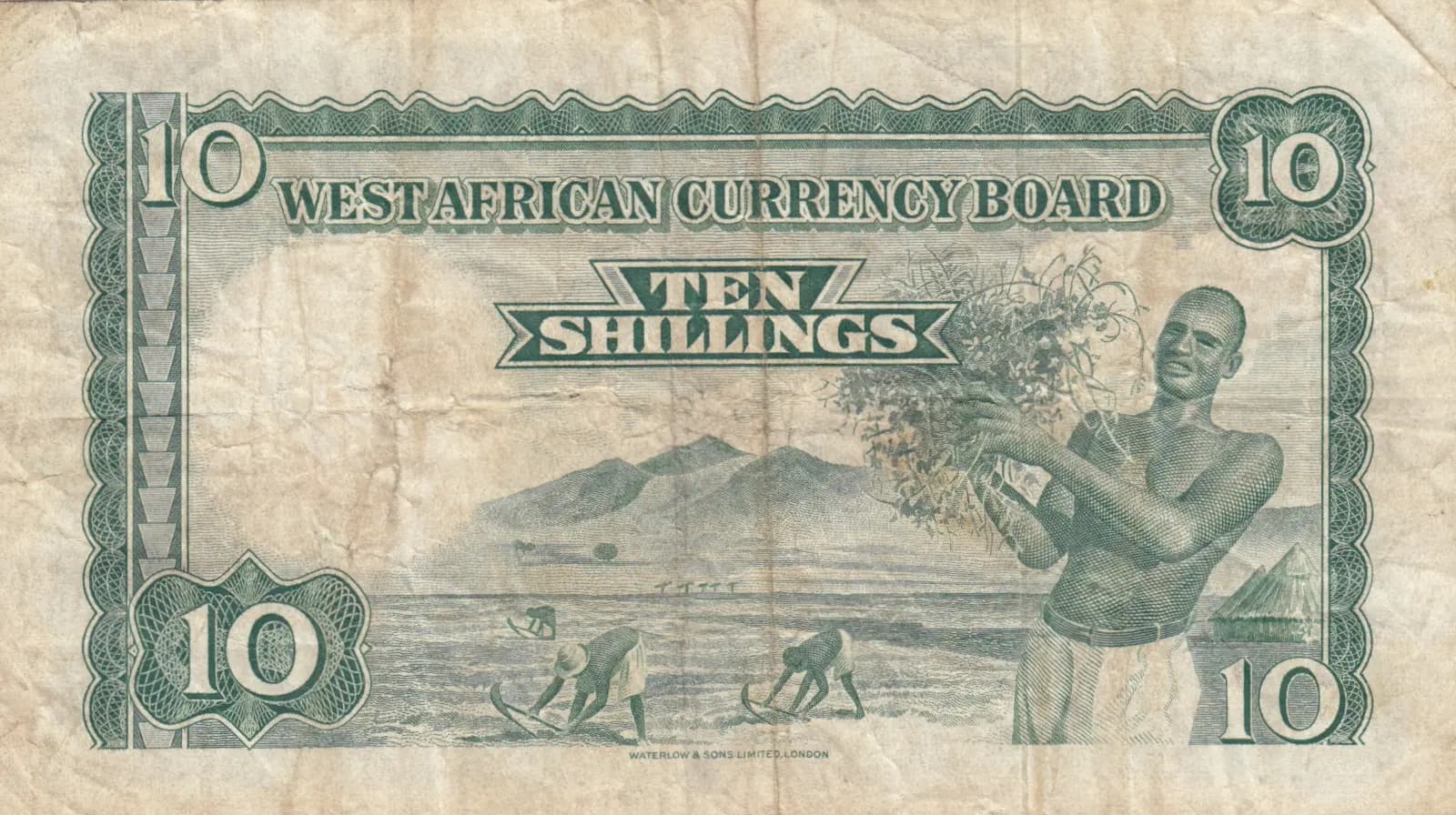
This is a 1957 West African Currency Board 10 Shillings note (Pick P-9), printed by Waterlow & Sons Limited, London. The note displays the characteristic green and cream color scheme with a river landscape vignette on the obverse and a detailed labor scene on the reverse depicting West African workers engaged in agricultural or fishing activities. In Fair (F) condition, the note exhibits heavy circulation wear including multiple creases, foxing, and age-related discoloration, with visible pen markings; such circulated examples typically command modest prices in the $35-75 range on the secondary market.
Common. While the West African Currency Board operated for only five years (1953-1958), this denomination was part of a regular series with substantial print runs across multiple years. eBay market data shows examples in Fair condition selling for approximately $35-74, well below the typical threshold for scarce notes. The 2016 catalogue value of $15 (VG) to $450 (UNC) reflects normal progression for common circulated currency, with condition being the primary price driver rather than inherent rarity. The broad availability of this issue across multiple variants (P-9a and P-9s documented) further supports a common classification.
Issued during the final years of the West African Currency Board's operation (1953-1958), this note represents the colonial-era monetary system serving British West African territories. The obverse's river landscape symbolizes the region's agricultural heritage and water-based commerce, while the reverse vignette depicting bare-chested laborers engaged in farming or fishing work directly represents the economic foundation of the colonial territories—manual labor in resource extraction and primary production. The bilingual inclusion of Arabic script reflects the multicultural composition of the currency board's member territories.
The obverse features an ornate decorative border in green tones framing the composition. On the left is a landscape vignette depicting a tropical river scene with palm trees and lush vegetation along the water's banks, symbolizing West Africa's natural resources and waterways. The right side contains a large circular empty medallion frame with elaborate decorative borders and scrollwork—notably devoid of any portrait, suggesting this design predates or exists independent of personage imagery. Denomination numerals '10' appear in all four corners with ornamental designs. The reverse displays a detailed engraved labor scene showing a bare-chested man in the foreground (right side) wielding what appears to be a farming or fishing implement, with multiple background figures engaged in similar labor activities. A mountain peak and water body feature in the distant background, establishing the West African landscape. This vignette emphasizes the economic activities and human labor that comprised the colonial economy.
FRONT: 'BRITISH WEST AFRICA' / 'WEST AFRICAN CURRENCY BOARD' / 'PROMISE TO PAY ON DEMAND THE SUM OF' / '10' / 'TEN SHILLINGS' / Serial numbers 'A/1 175124' and 'R175124' / Date: '9TH AUGUST 1957' / 'MEMBERS OF THE WEST AFRICAN CURRENCY BOARD' / Arabic: 'نعشر شلنج' (Ten Shillings) / 'WATERLOW & SONS LIMITED, LONDON'. BACK: 'WEST AFRICAN CURRENCY BOARD' / 'TEN SHILLINGS' / '10' / 'WATERLOW & SONS LIMITED, LONDON'
Intaglio engraving (line engraving) executed by Waterlow & Sons Limited, London—the premier British security printer of the era. The complexity of the decorative borders, fine-line detail work in the landscape and labor vignettes, and the precision of the ornamental scrollwork are characteristic of high-quality intaglio production. Security features include the intricate decorative border patterns and fine line engraving throughout, which served as anti-counterfeiting measures standard to currency of this period.
This note is identified as Pick P-9 (base catalog number), with PMG records indicating two variants exist: P-9a and P-9s, both printed by W&S (Waterlow & Sons). The observed specimen's serial numbers (A/1 175124 and R175124) and specific date of 9th August 1957 are consistent with the regular issue series. The presence of dual serial number formats and the dated series structure (the issue date range spans 1953-1958) suggests this represents a standard variety within the P-9 classification, though definitive variety attribution would require comparison with the specific PMG variant definitions.