10 shillings 1955
Market Prices
4 salesAbout This Note
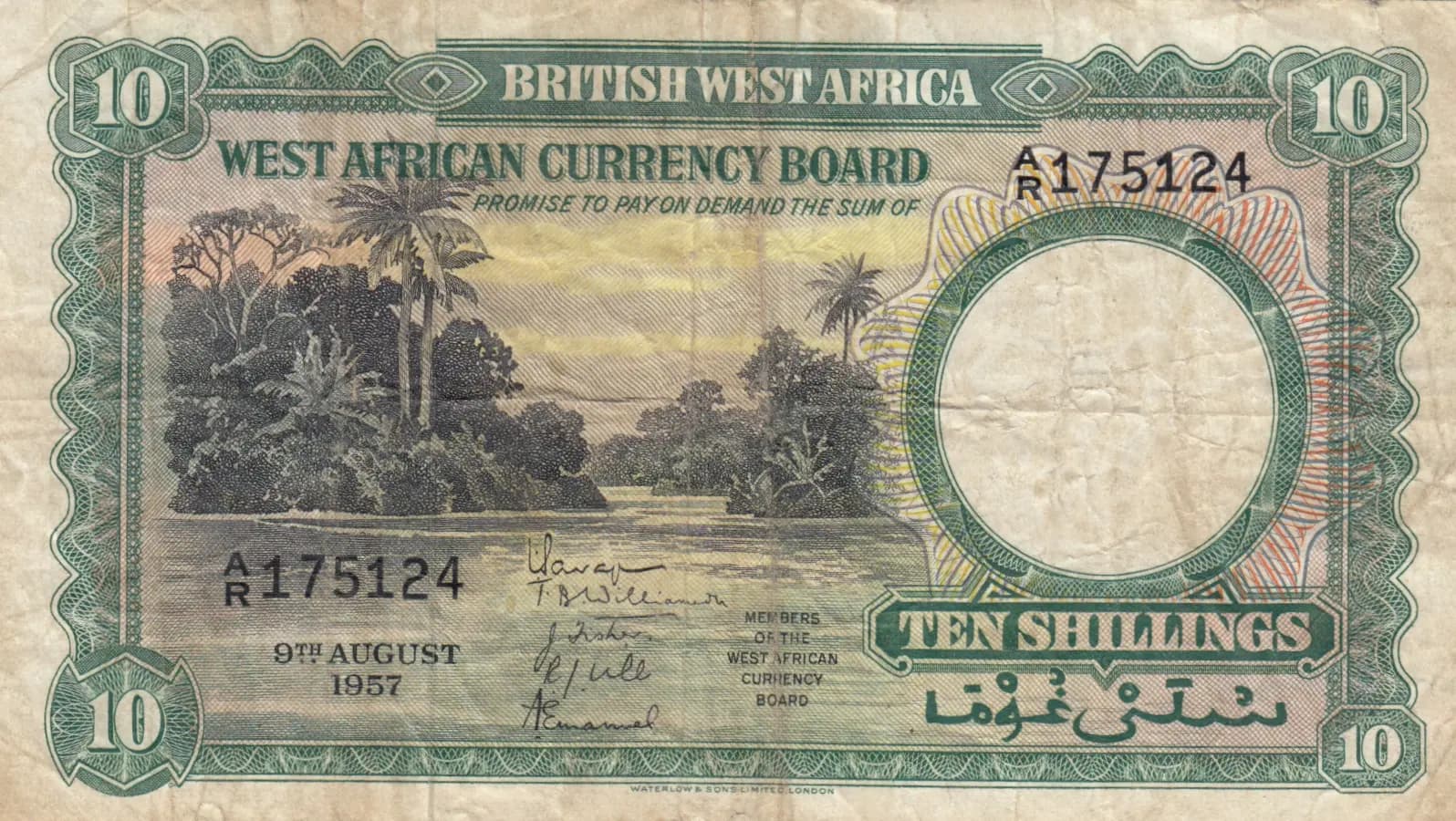
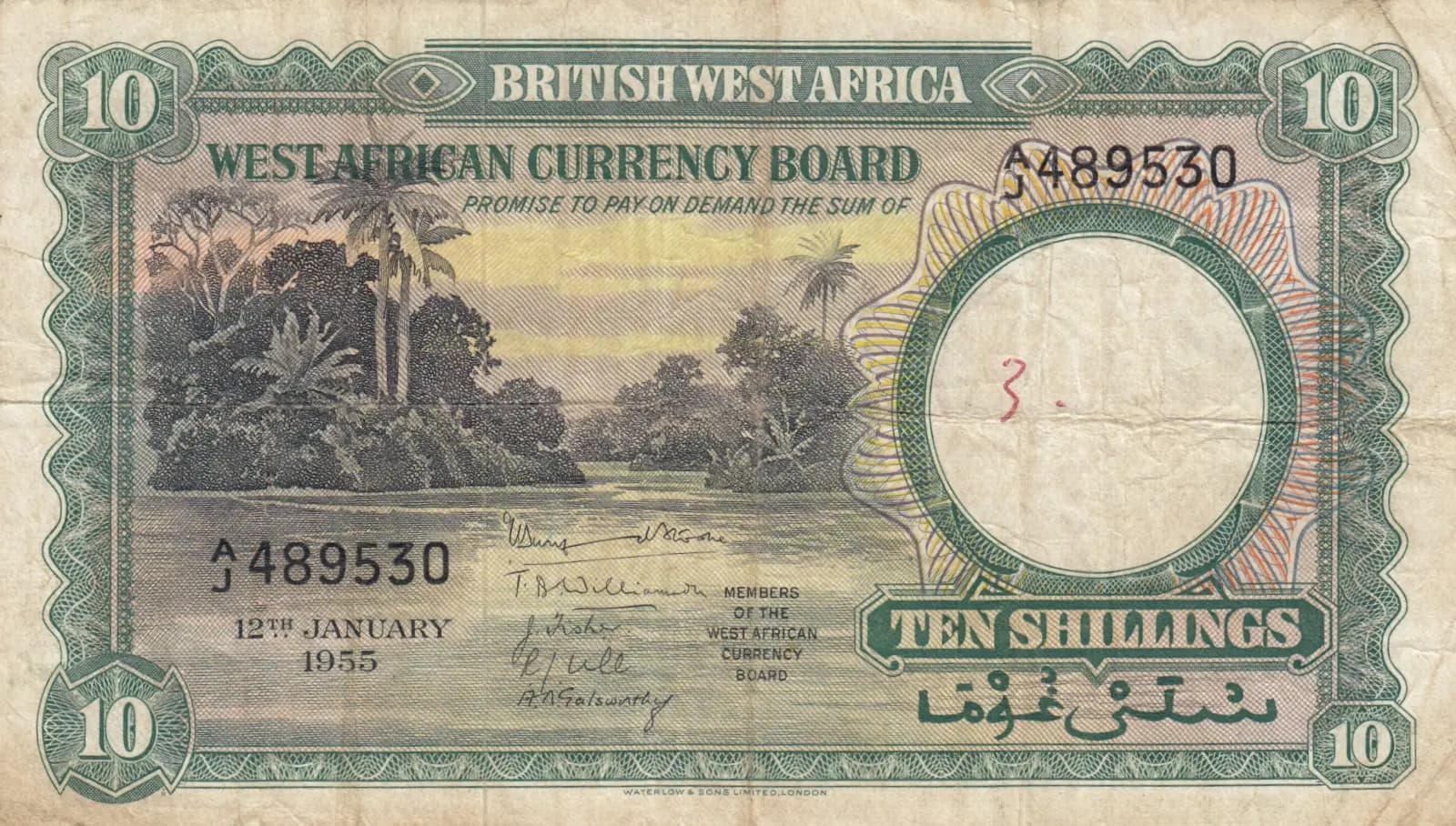
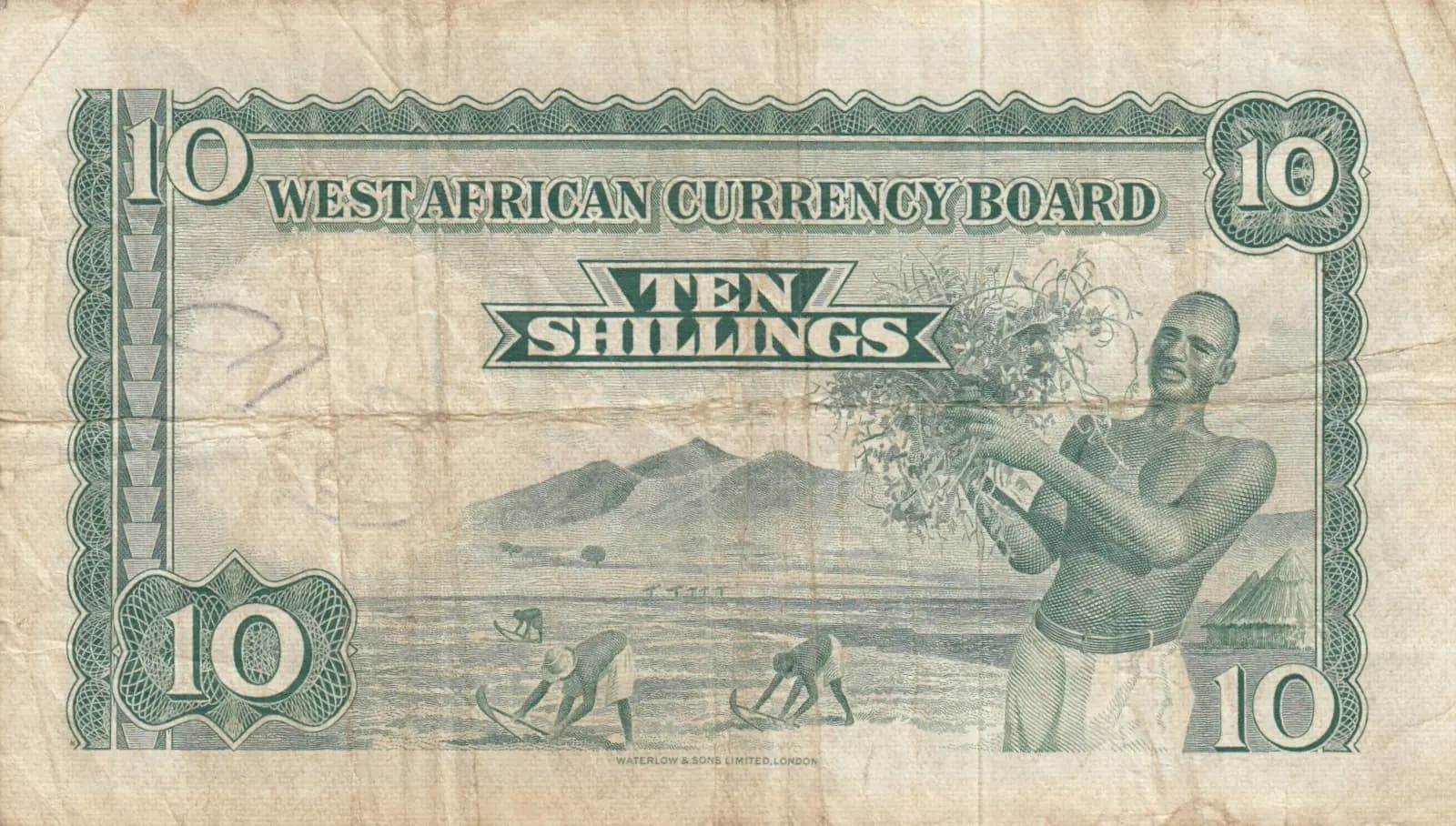
This is a 1955 West African Currency Board 10 Shillings note (Pick-9) in Fair condition, displaying the characteristic tropical imagery and bilingual English/Arabic inscriptions typical of British colonial currency in West Africa. The note exhibits significant age-related wear including multiple creases, foxing, and tan/brown patination throughout both sides, consistent with seven decades of circulation. The front features an evocative tropical landscape with palm trees reflected in water, while the reverse depicts West African laborers engaged in agricultural work, making this a historically significant example of mid-20th century colonial monetary design.
Common. The West African Currency Board 10 Shillings notes from the 1953-1958 issue period were produced in substantial quantities for circulation across four major British territories. Market data from realbanknotes.com indicates Fair-condition examples sold for approximately $73.85 as recently as 2012, and ungraded VG examples for $34 in 2015, well below the threshold that would indicate scarcity. While higher grades (PMG 65-66) command prices in the $500-600 range, the abundance of circulated examples in lower grades confirms this as a common note in the collector market.
Issued by the West African Currency Board between 1953-1958, this note represents a transitional period in British West African monetary policy, issued just before the region's independence movements gained momentum. The bilingual English and Arabic inscriptions reflect the multilingual nature of the colonial territories served (Gold Coast, Nigeria, Sierra Leone, and Gambia). The reverse design celebrating local agricultural labor—specifically what appears to be groundnut or crop harvesting—emphasizes the resource wealth of these territories that underpinned the colonial economy, while the tropical landscape on the obverse celebrates the geographic distinctiveness of the region.
This banknote exemplifies the decorative colonial currency design of the 1950s. The obverse features an ornately bordered tropical landscape scene with coconut palms and vegetation reflected in still water, symbolizing the natural wealth of British West Africa; the large empty circular medallion on the right was likely designed to accommodate a portrait or additional security element in higher denominations. Corner medallions in all four corners contain the numeral '10' within radiating line patterns. The reverse depicts the economic foundation of the colonies through a carefully composed scene of West African agricultural labor: a bare-chested male laborer in the foreground handling what appears to be groundnuts or similar crops, with additional workers visible in the background, set against a mountainous landscape. The scalloped decorative borders frame both sides uniformly, and the bilingual inscription (English and Arabic) underscores the multicultural composition of the currency union.
FRONT SIDE: 'British West Africa' (English); 'West African Currency Board' (English); 'Promise to Pay on Demand the Sum of' (English); 'Ten Shillings' (English); 'نح شيلنج' (Arabic: 'Ten Shillings'); 'Members of West African Currency Board' (English); Serial number 'A489530' (English); Issue date '12th January 1955' (English); Denominal numeral '10' (English). BACK SIDE: 'West African Currency Board' (English); 'Ten Shillings' (English); 'Waterlow & Sons Limited, London' (English, printer attribution); Denominal numeral '10' (English).
This note was produced using traditional intaglio (engraved) printing by Waterlow & Sons Limited of London, one of the premier security printers of the era. The fine line work, detailed crosshatching visible in portrait shading, intricate border patterns, and the crisp definition of the agricultural scene are characteristic of intaglio engraving. The multi-stage decorative printing visible in the ornamental borders and the precision of the corner medallions demonstrate the high-security printing standards applied to colonial currency of this period.
This specific note bears the date '12th January 1955' printed on the obverse, placing it within the first year of the 1953-1958 series issue window. The serial number prefix 'A' with the sequence '489530' is consistent with standard cataloging for this Pick number. PMG records indicate two cataloged variants (P-9a and P-9s), both attributed to printer W&S (Waterlow & Sons); this note's clear attribution to 'Waterlow & Sons Limited, London' on the reverse confirms it as a standard W&S printing. The visual analysis reveals no overprints, stamps, or anomalies that would indicate a special or commemorative variety—this appears to be a regular-issue circulating note from the early years of the series.