5 dollars 1962
Market Prices
5 salesAbout This Note
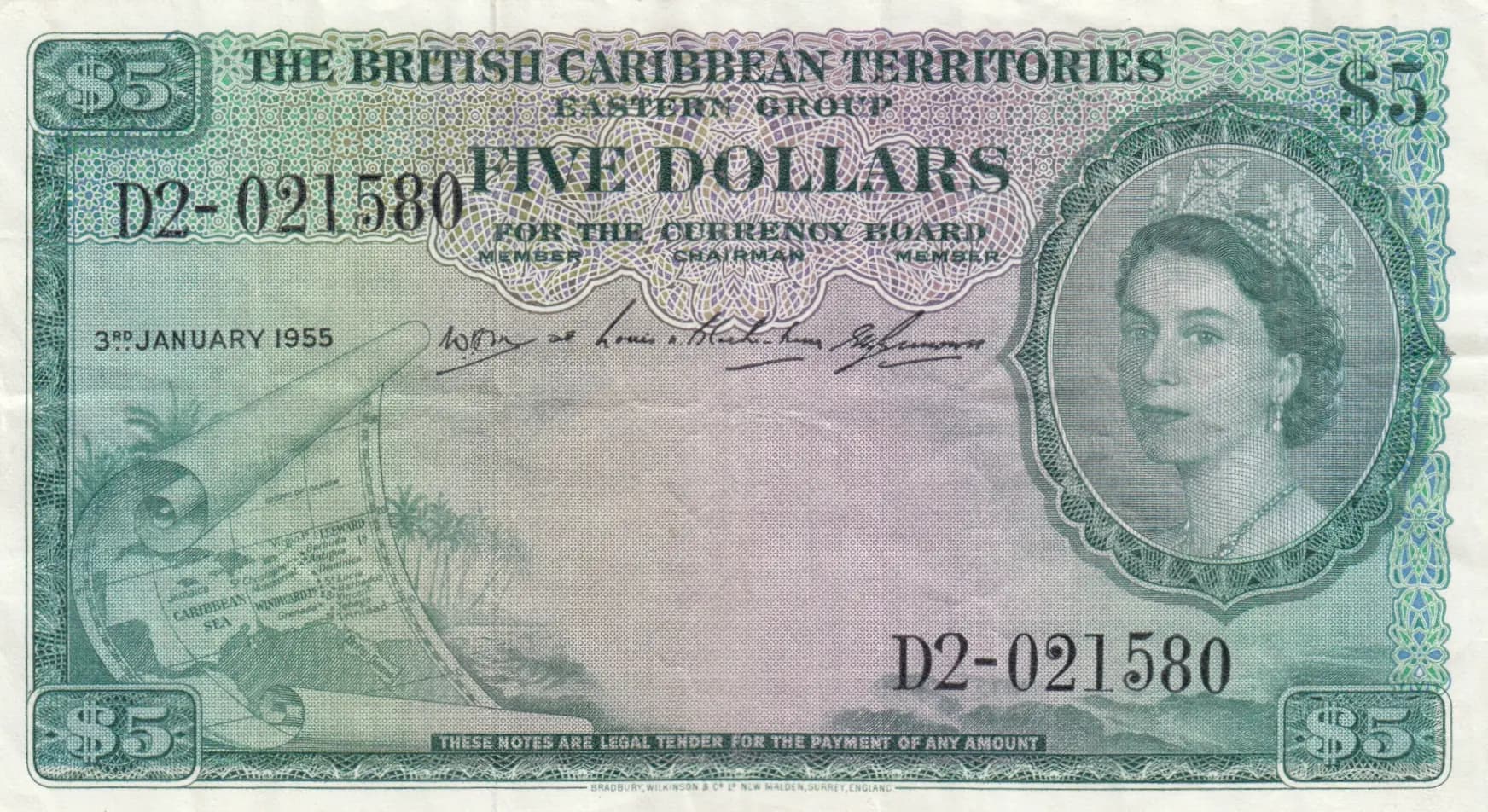
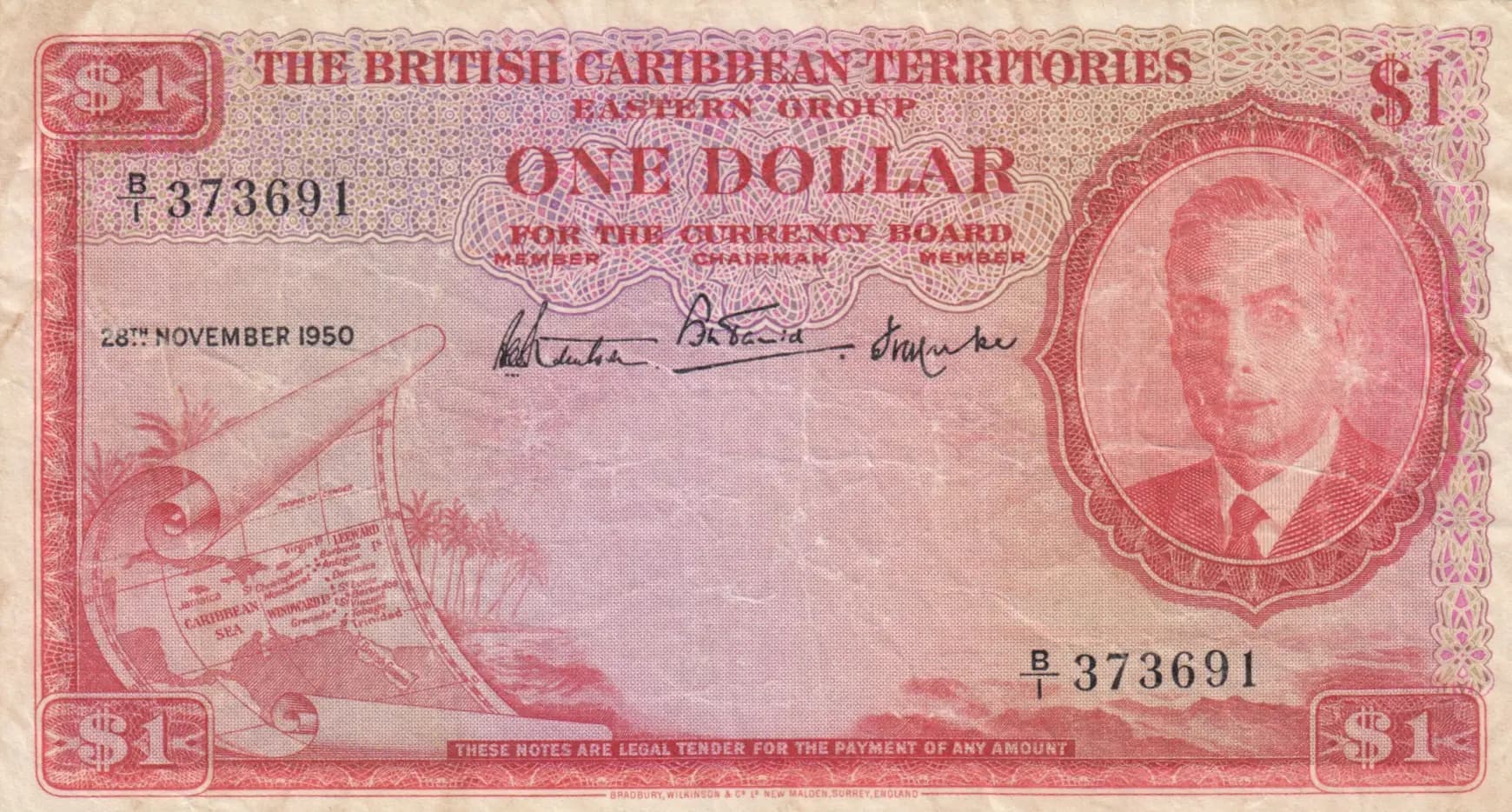
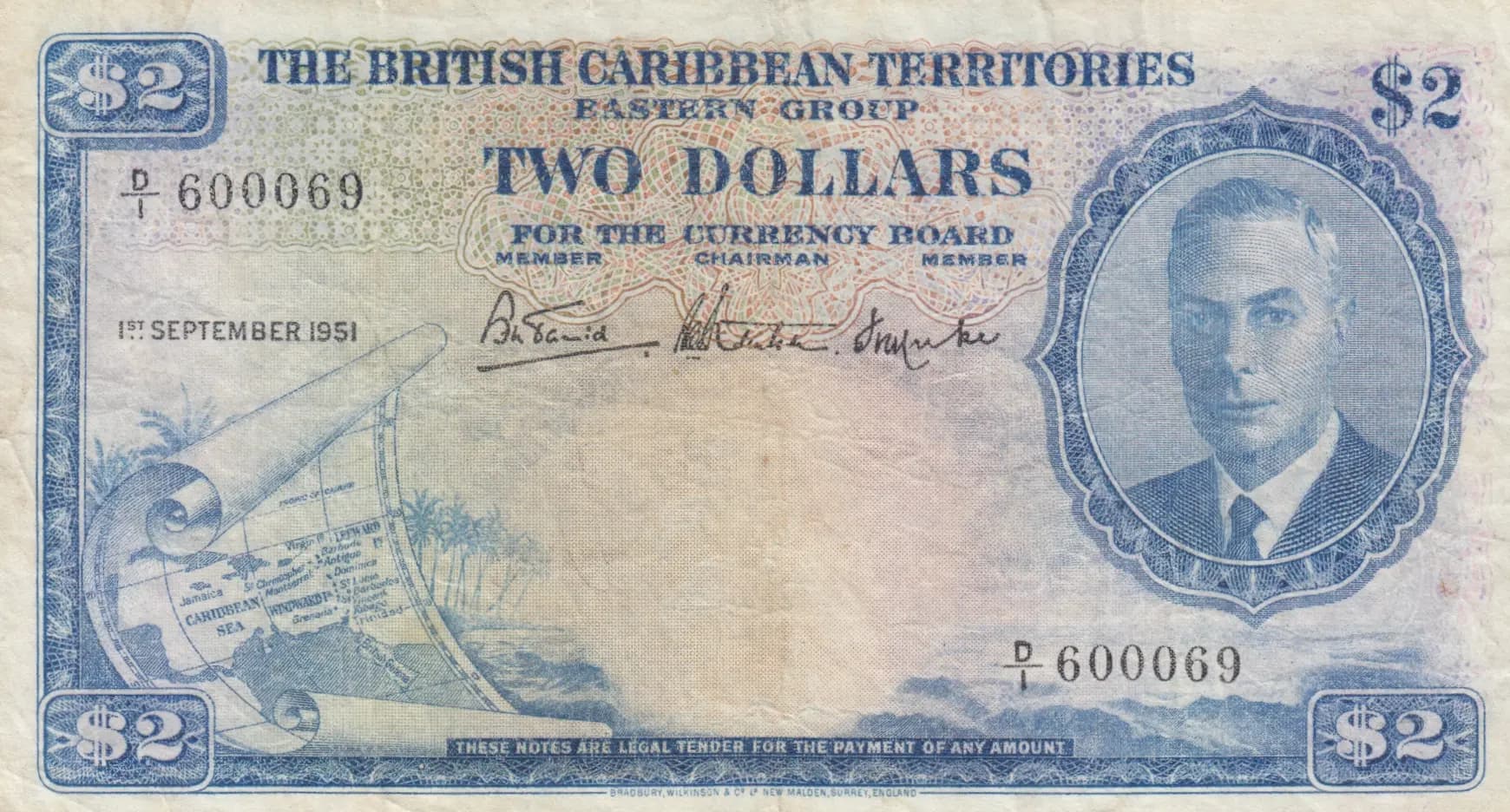
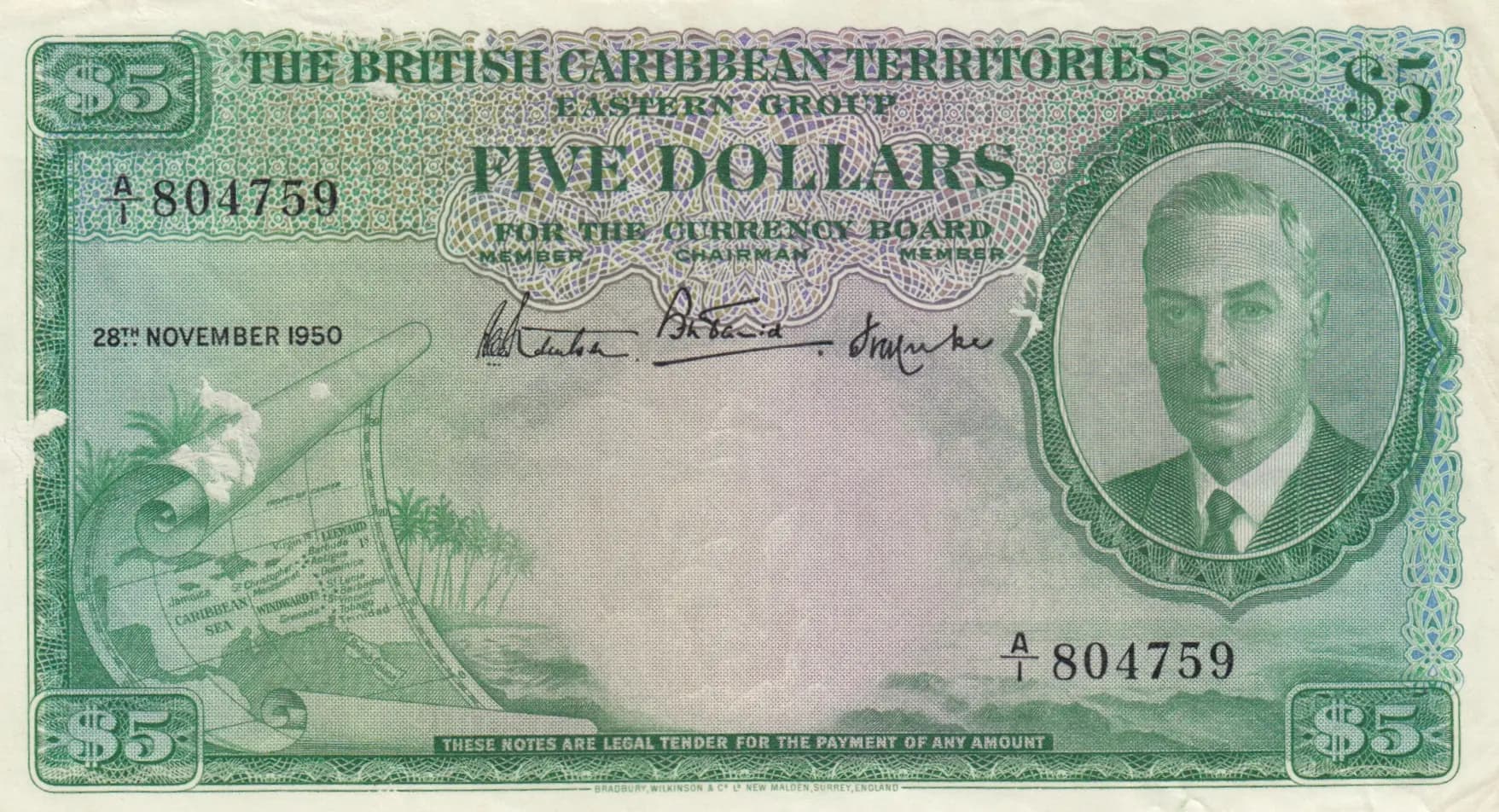
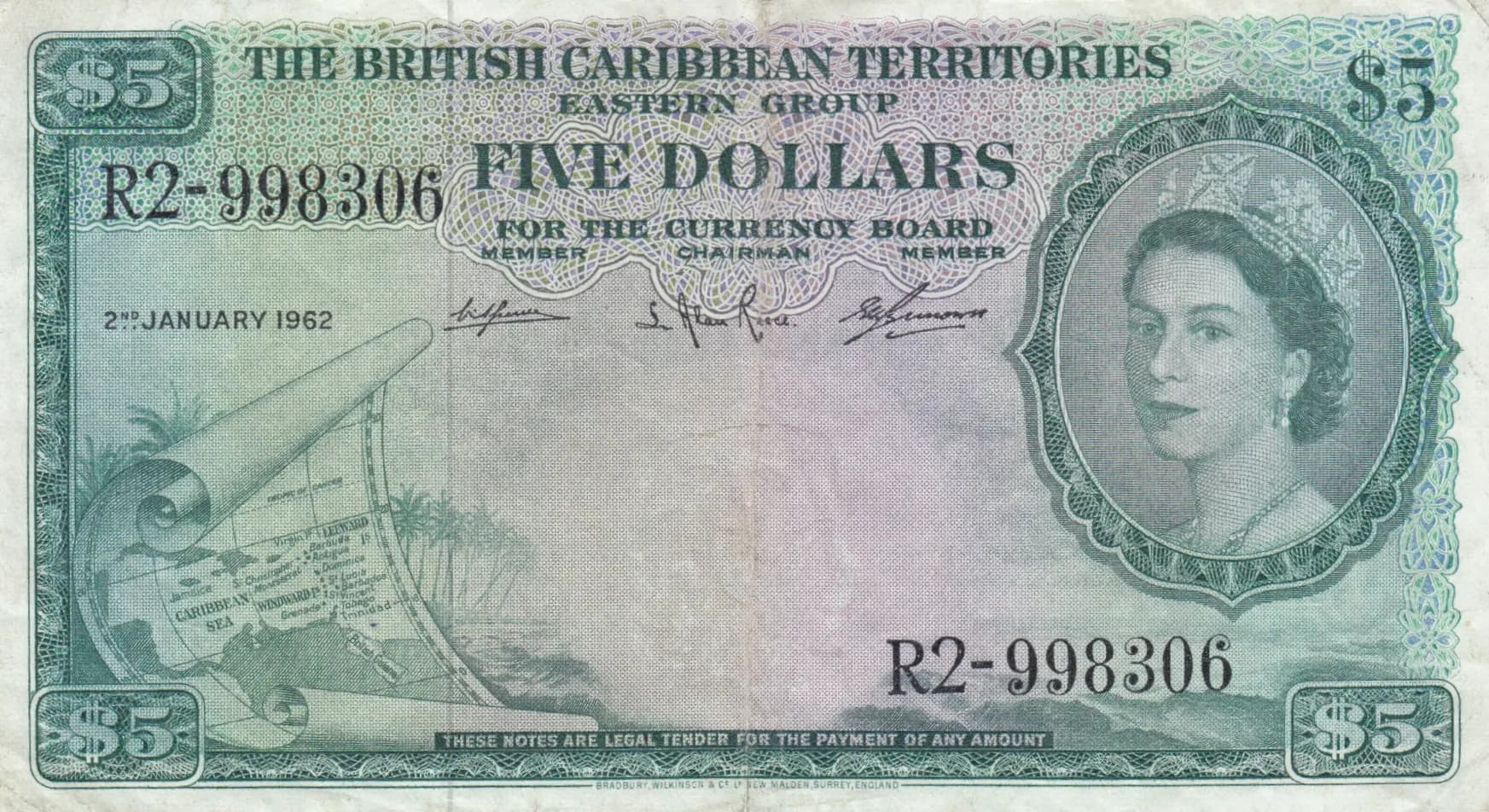
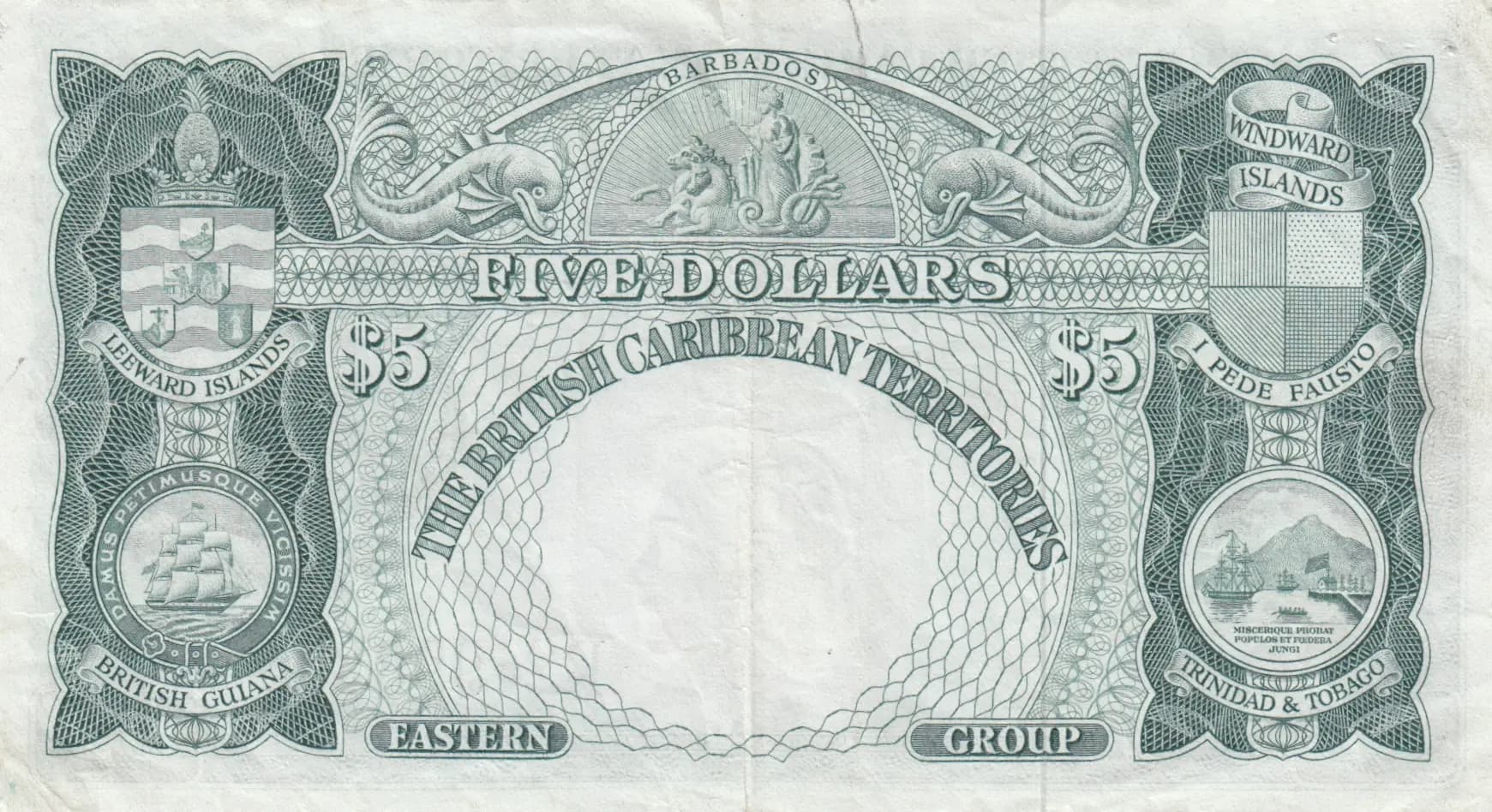
This is a VF-grade 5 Dollar note from the British Caribbean Territories Currency Board, issued in 1962 for the Eastern Group territories. The note features an elegant design with Queen Elizabeth II in profile on the obverse and the coats of arms of four Caribbean territories (Leeward Islands, Windward Islands, British Guiana, and Trinidad & Tobago) on the reverse. The example shows typical circulation wear with visible creasing, fold marks, and age-related foxing, particularly evident on the reverse side, consistent with its VF grade and 60+ year age.
Common. The catalog value of $100 in VF condition and the relatively frequent eBay sales history (with VF examples selling around $100-$102 range in 2011-2020) indicate this is a standard circulation issue rather than a scarce or rare variety. The note was issued over a three-year period (1961-1964), suggesting a substantial print run for the Eastern Group territories. The availability of multiple variants (P-9a through P-9cts) in PMG records further confirms this was a widely circulated series rather than a limited edition.
This currency was issued by the British Caribbean Territory Currency Board during the early years of post-war Caribbean administration, dated 2nd January 1962. The reverse design incorporating the coats of arms of the Leeward Islands, Windward Islands, British Guiana, and Trinidad & Tobago reflects the political organization of British Caribbean territories during the late colonial period. The prominent depiction of Queen Elizabeth II and classical maritime imagery underscore Britain's colonial governance and the region's economic reliance on sea trade during this transitional era.
The obverse features a portrait of Queen Elizabeth II in profile facing left, enclosed within an ornate circular frame positioned on the right side of the note. The left side displays a detailed engraving of a historical sailing ship with Caribbean tropical landscape elements including palm trees and coastal scenery, representing the maritime heritage of the territories. The reverse showcases a classical design with heraldic coats of arms positioned in all four corners: the Leeward Islands (top left), British Guiana (bottom left), Windward Islands (top right), and Trinidad & Tobago (bottom right). The central area features classical figures and horses in an ornamental design, with sailing ship emblems in circular medallions. The dominant color scheme on the obverse is green with multicolored underprinting in teal, purple/lavender, black, and cream tones. The reverse is predominantly black and white/cream with gray tones. Both sides feature intricate ornate borders and decorative filigree throughout.
OBVERSE: '$5' and 'FIVE DOLLARS' (denomination); 'THE BRITISH CARIBBEAN TERRITORIES' and 'EASTERN GROUP' (issuing authority); 'FOR THE CURRENCY BOARD' (authorization); 'MEMBER CHAIRMAN MEMBER' (board signatures); '2ND JANUARY 1962' (issue date); 'R2-998306' (serial number); 'THESE NOTES ARE LEGAL TENDER FOR THE PAYMENT OF ANY AMOUNT' (legal tender declaration); 'BRADBURY WILKINSON & CO LTD ENGRAVERS SURREY ENGLAND' (printer identification). REVERSE: 'FIVE DOLLARS' and '$5' (denomination); 'BRITISH CARIBBEAN TERRITORIES' and 'EASTERN GROUP' (issuing authority); 'LEEWARD ISLANDS', 'WINDWARD ISLANDS', 'BRITISH GUIANA', 'TRINIDAD & TOBAGO' (constituent territories); 'PEDE FAUSTO' in Latin meaning 'With firm foot' (heraldic motto).
Intaglio engraving (line engraving), which is evident from the fine detailed line work, intricate crosshatching, and ornamental filigree patterns visible throughout both sides of the note. The printer was Bradbury Wilkinson & Co Ltd, Surrey, England, as noted in the printer's imprint on the obverse. Bradbury Wilkinson was a premier security printer of the period known for high-quality intaglio work on banknotes and stamps.
This example is cataloged as Pick P-9c, specifically the Eastern Group variant. The visual analysis identifies the date as '2ND JANUARY 1962' on the obverse. The serial number visible is 'R2-998306', with the 'R2' prefix potentially indicating a printing batch designation. Within the P-9 base number, seven distinct variants are recorded by PMG (P-9a, P-9b, P-9bs, P-9c, P-9cs, P-9cts, and P-9s), likely representing different signatures, serial number ranges, or printing runs. The specific 'c' designation of this note may represent a particular signature combination or printing sequence, though without access to full Pick catalog specifications, the exact distinguishing feature cannot be definitively stated from the visual analysis alone.