2 dollars 1951
Market Prices
5 salesAbout This Note
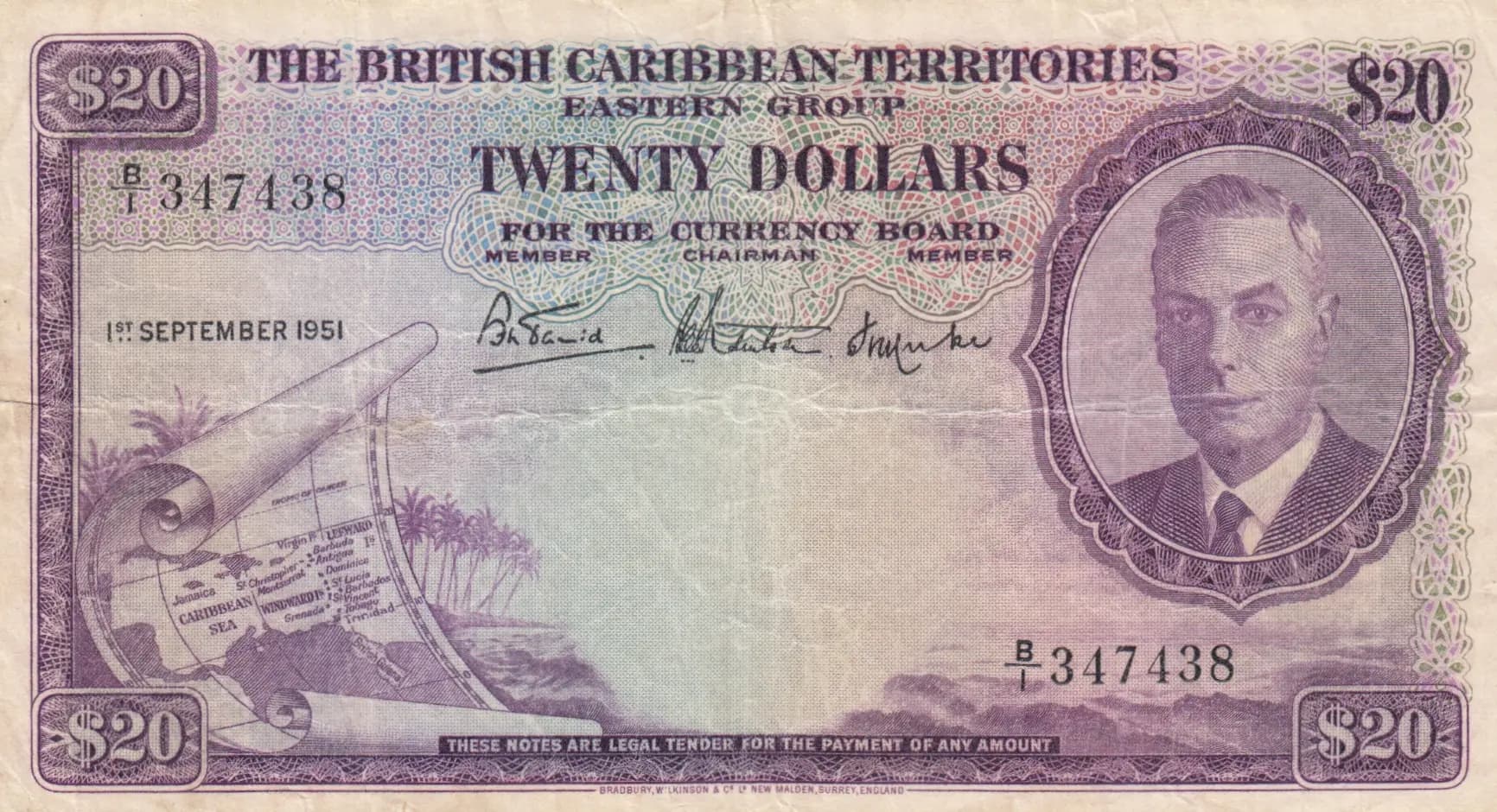
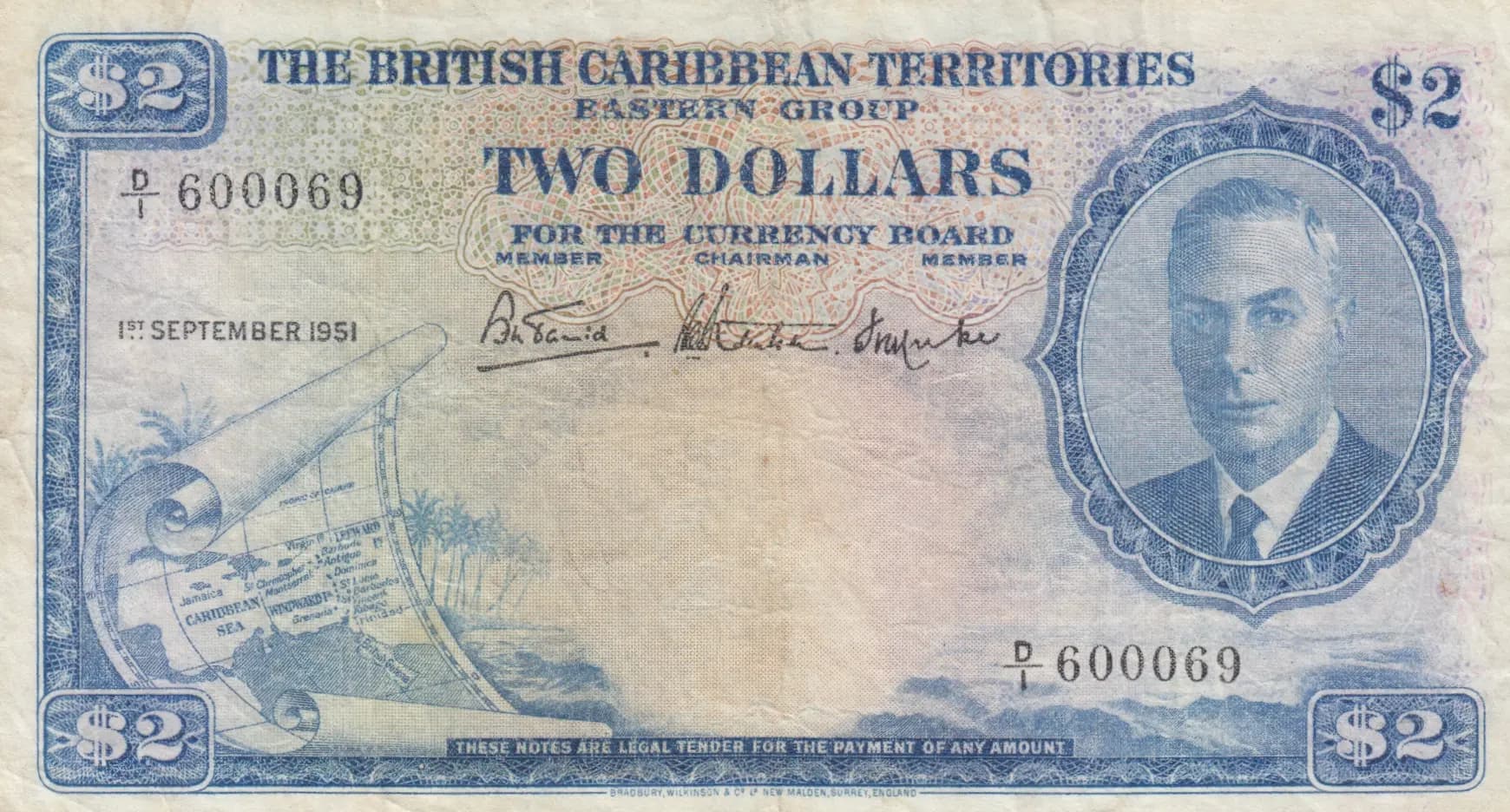
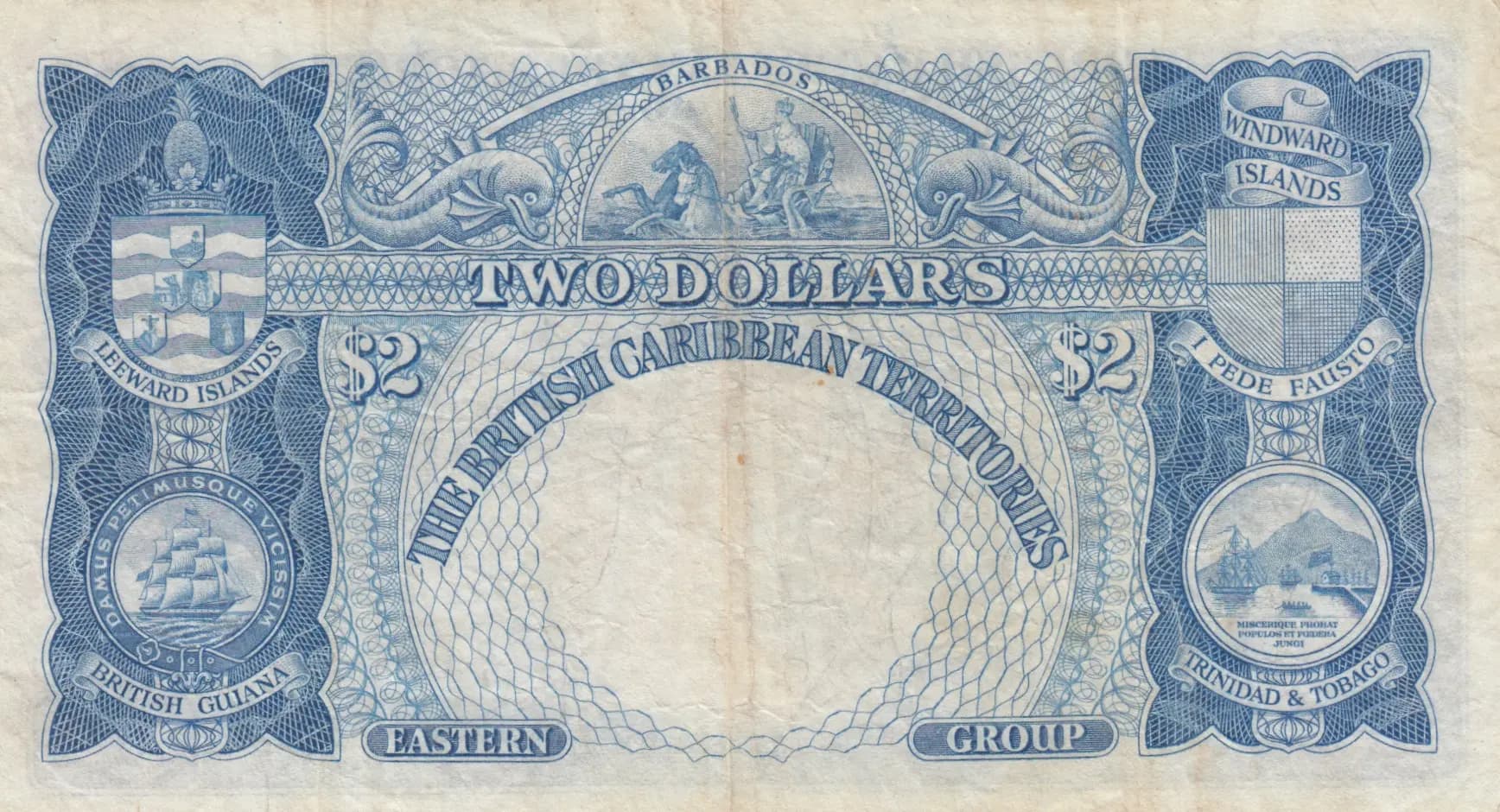
This is a 1951 British Caribbean Territories Eastern Group 2 Dollar note in Fine condition, representing an early Commonwealth currency issue from the post-WWII period. The obverse features a formal portrait of King George VI in profile within an ornate oval frame, complemented by a detailed map of the Caribbean region in the lower left. The reverse displays four territorial coats of arms (representing Barbados, British Guiana, Windward Islands, Leeward Islands, and Trinidad & Tobago) arranged around a classical allegorical scene, exemplifying the multi-territorial nature of this currency board issue. The note shows expected circulation wear with visible creases, folds, and age-related yellowing, consistent with its 70+ year provenance.
Common. While the 1951 British Caribbean Territories currency is historically significant, this Pick 2 note in Fine condition is a regular issue with substantial print runs. The eBay price history provided clearly demonstrates common-date pricing: a Fine specimen sold for $76 in 2018, and VG examples have sold for under $10. Current catalog values (2016) position Fine notes at approximately $76-$125 range, consistent with common-grade pricing for established Commonwealth issues of this period. The Eastern Group variant is not exceptionally scarce, and circulation examples are readily available to collectors.
Issued on 1st September 1951 by the British Caribbean Territory Currency Board, this note represents a significant moment in post-colonial Caribbean monetary history, following World War II and preceding full independence for most of these territories. The reverse's territorial emblems—British Guiana, Trinidad & Tobago, Windward Islands, and Leeward Islands—reflect the political geography of the Eastern Group under British administration, while the allegorical central scene depicting commerce and trade emphasizes the economic union these territories attempted to maintain. The inscription 'OPEDE FAUSIO' and other Latin mottos underscore the formal, Empire-era design conventions employed by security printer Bradbury, Wilkinson & Co, one of the world's premier banknote manufacturers.
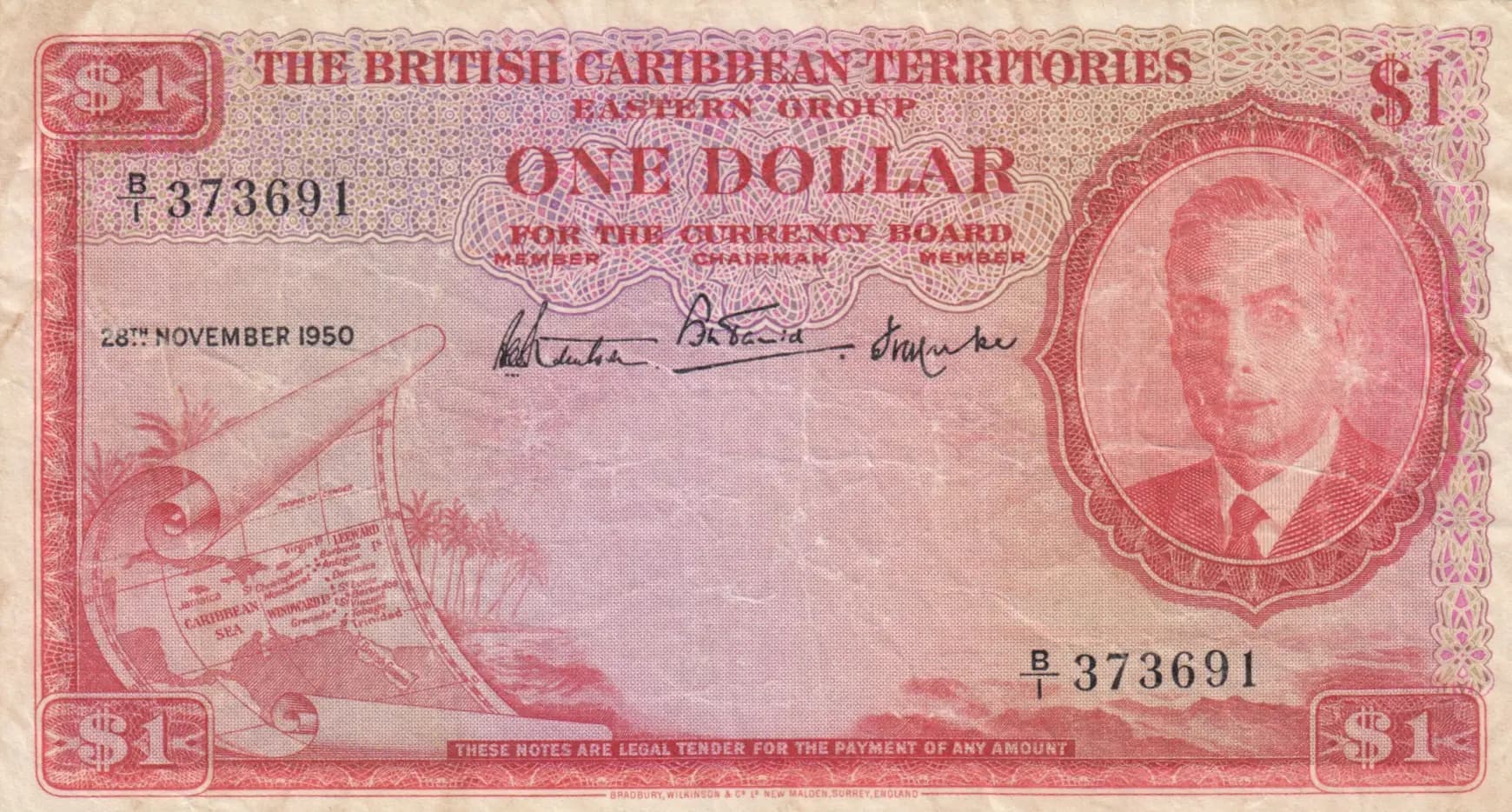
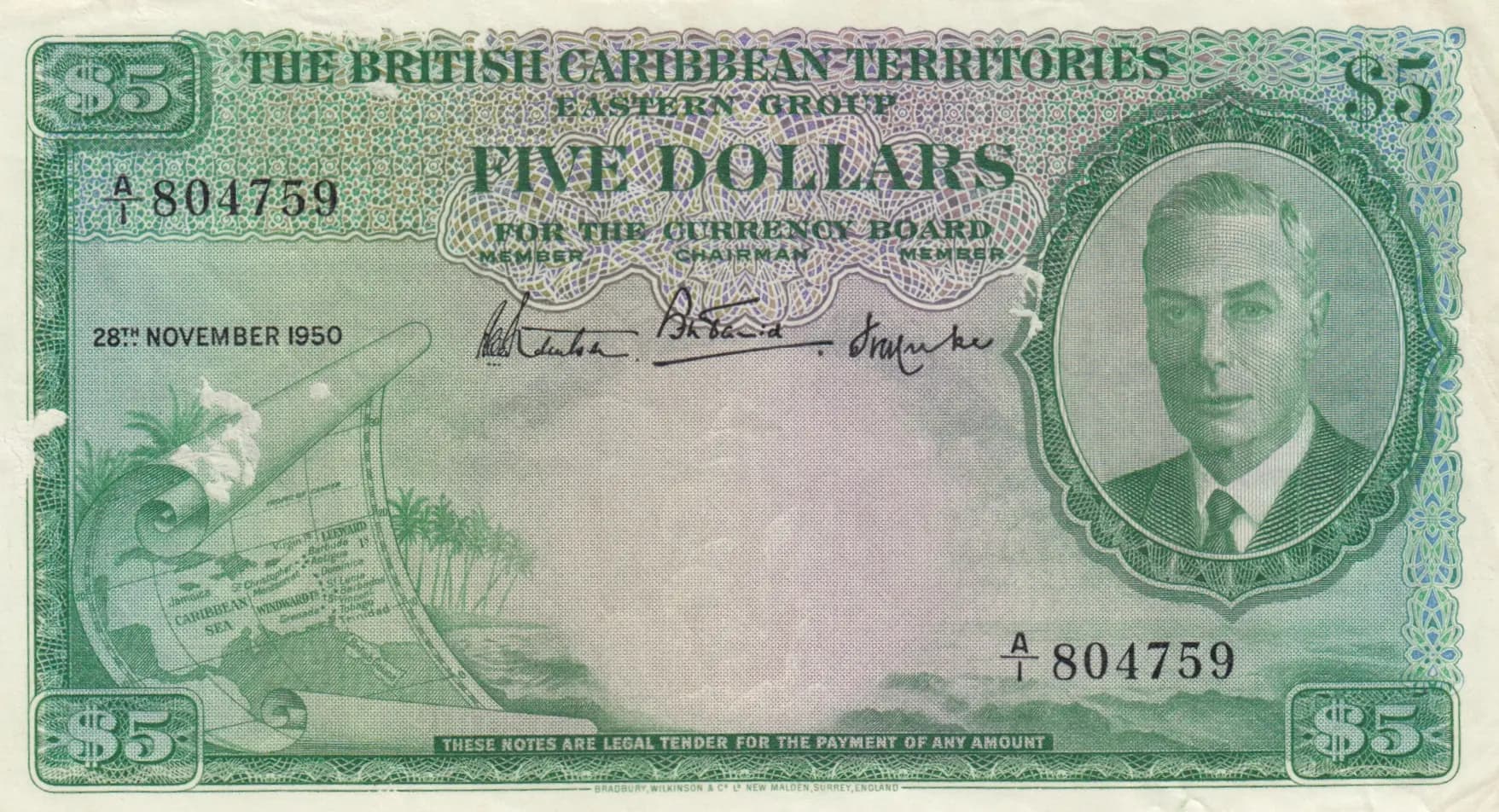
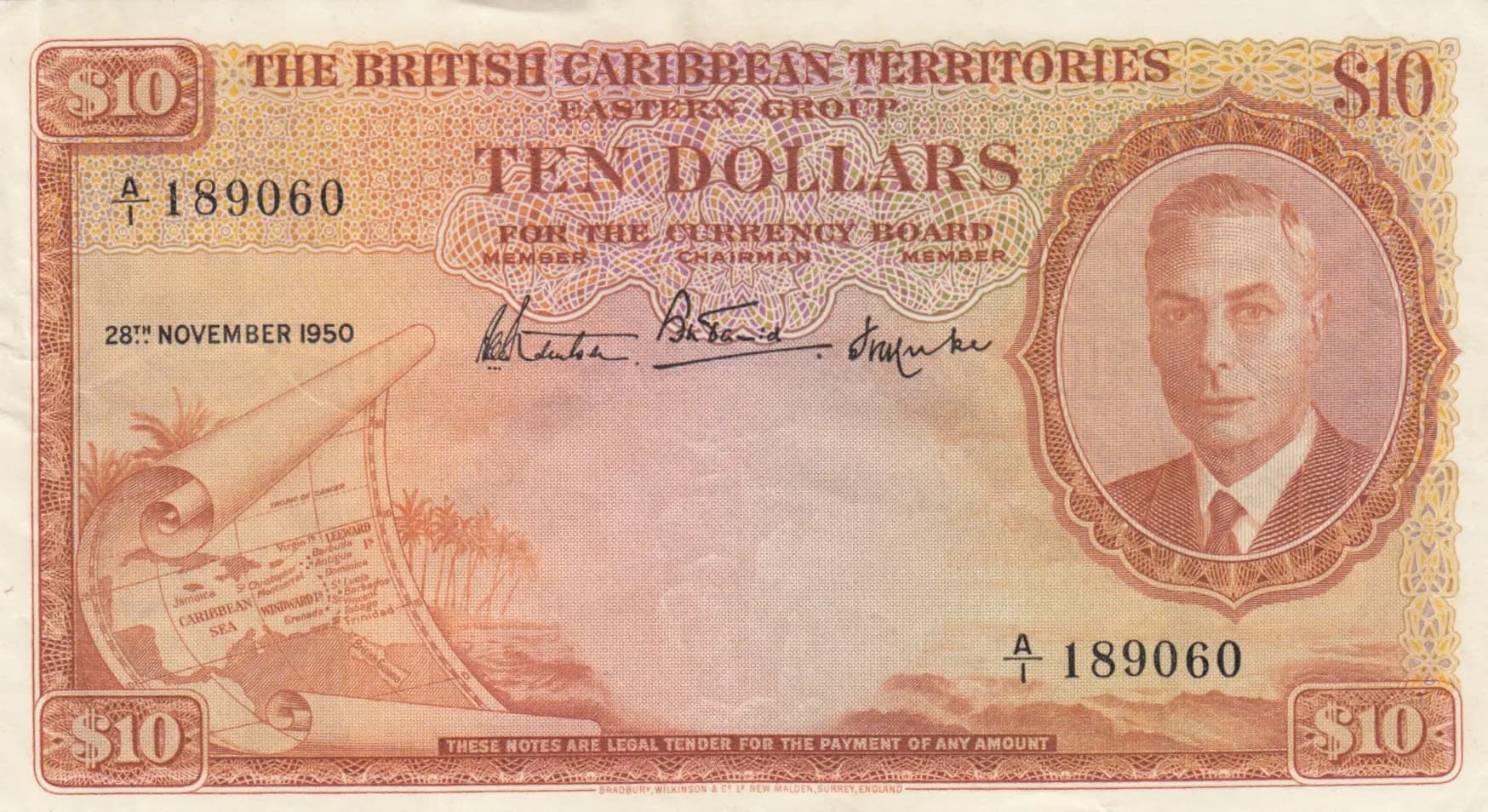
The obverse features a formal right-profile portrait of King George VI in black and white within an ornate rococo oval frame, positioned on the right side of the note. The dominant design element on the left is a detailed map of the Caribbean Sea region illustrating the constituent territories, rendered in green and blue with decorative baroque scrollwork. Corner denominations display '$2' within ornamental blocks. The reverse showcases heraldic artistry with four coats of arms positioned in the corners representing the four constituent territories of the Eastern Group: British Guiana (lower left), Trinidad & Tobago (lower right), Leeward Islands (upper left), and Windward Islands (upper right). The central composition features a classical allegorical scene depicting figures engaged in commerce, flanked by symbolic emblems—a full-rigged sailing ship on the lower left and a mountainous landscape with water on the lower right—both enclosed in circular frames. The entire design is executed in fine-line engraving with intricate geometric borders and decorative elements characteristic of 1950s Commonwealth currency design.
FRONT: 'THE BRITISH CARIBBEAN TERRITORIES EASTERN GROUP' (issuing authority), 'TWO DOLLARS' (denomination), 'FOR THE CURRENCY BOARD' (legal authorization), 'MEMBER CHAIRMAN MEMBER' (signature designations), '1ST SEPTEMBER 1951' (issue date), 'D 600069' (serial number), 'THESE NOTES ARE LEGAL TENDER FOR THE PAYMENT OF ANY AMOUNT' (legal tender declaration), 'BRADBURY, WILKINSON & CO LTD, NEW MALDEN, SURREY, ENGLAND' (printer identification), 'CARIBBEAN SEA' (geographical reference on map). BACK: 'TWO DOLLARS' (denomination), 'THE BRITISH CARIBBEAN TERRITORIES EASTERN GROUP' (issuing authority), 'BARBADOS', 'BRITISH GUIANA', 'WINDWARD ISLANDS', 'LEEWARD ISLANDS', 'TRINIDAD & TOBAGO' (territorial designations), 'OPEDE FAUSIO' and 'MISCERQUE PHOHAS DIREXLT FUBERIS JUNIO' (Latin inscriptions, partially legible, typical of classical currency design motifs).
Intaglio engraving (fine-line engraving) printed by Bradbury, Wilkinson & Co Ltd, New Malden, Surrey, England. Multiple color printing technique employing blue and green as dominant colors with beige/cream underprinting. The fine-line engraving is evident in the precise detail work visible throughout, including the portrait, map, heraldic designs, and decorative scrollwork. Multiple passes of color plates create the multicolored effect, a standard security feature of the era that demonstrates the complexity of the design and difficulty in counterfeiting.
This specimen represents the P-2 base variety (Eastern Group). The PMG population report indicates two cataloged variants exist: P-2 and P-2s (specimen). Serial number D 600069 with visible signature varieties in the center (three signature lines for member, chairman, and member designations) are documented characteristics of this issue. The specific date '1ST SEPTEMBER 1951' is consistent across this denomination and variety. No overprints or error characteristics are apparent in this example.