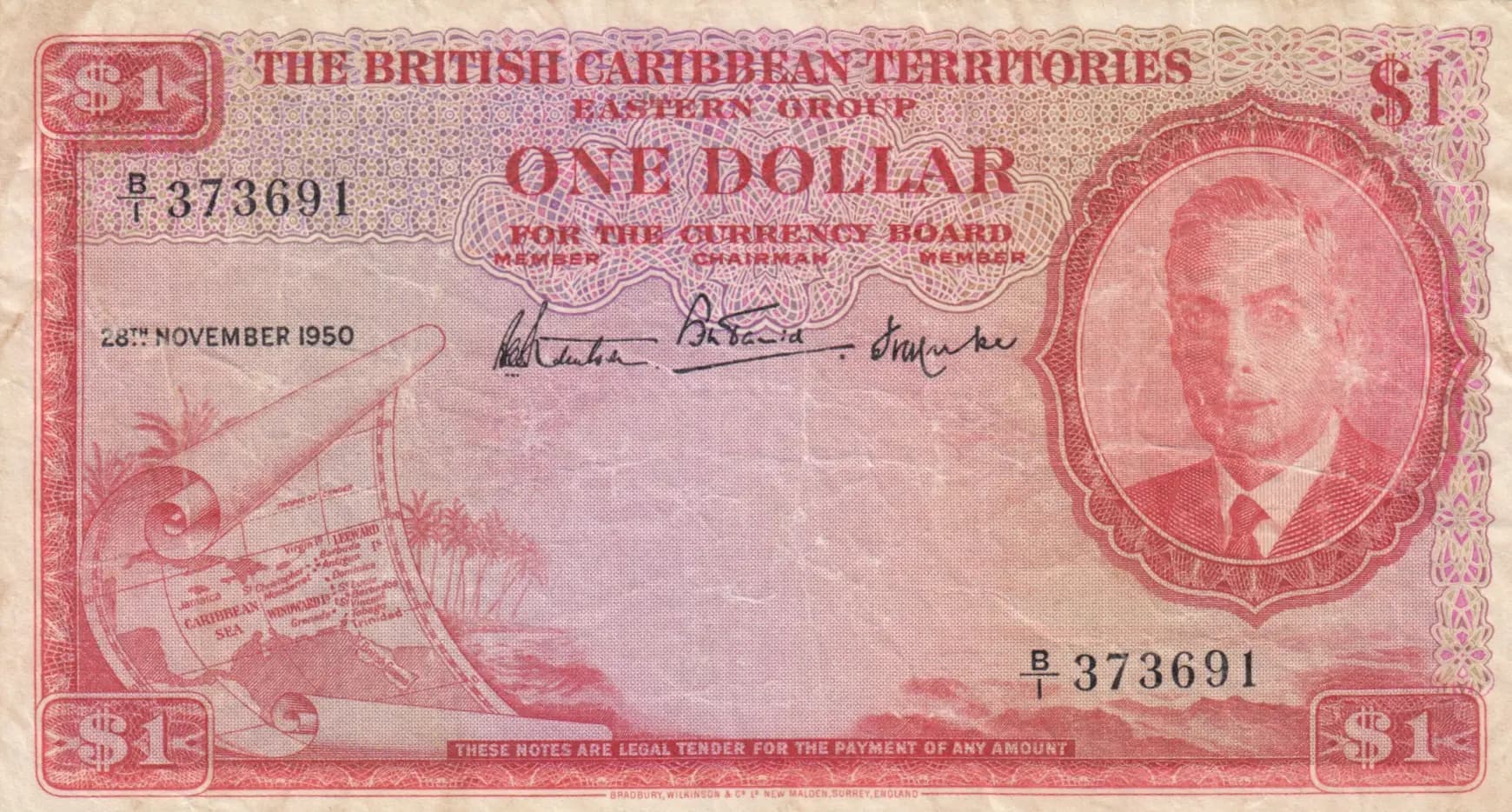
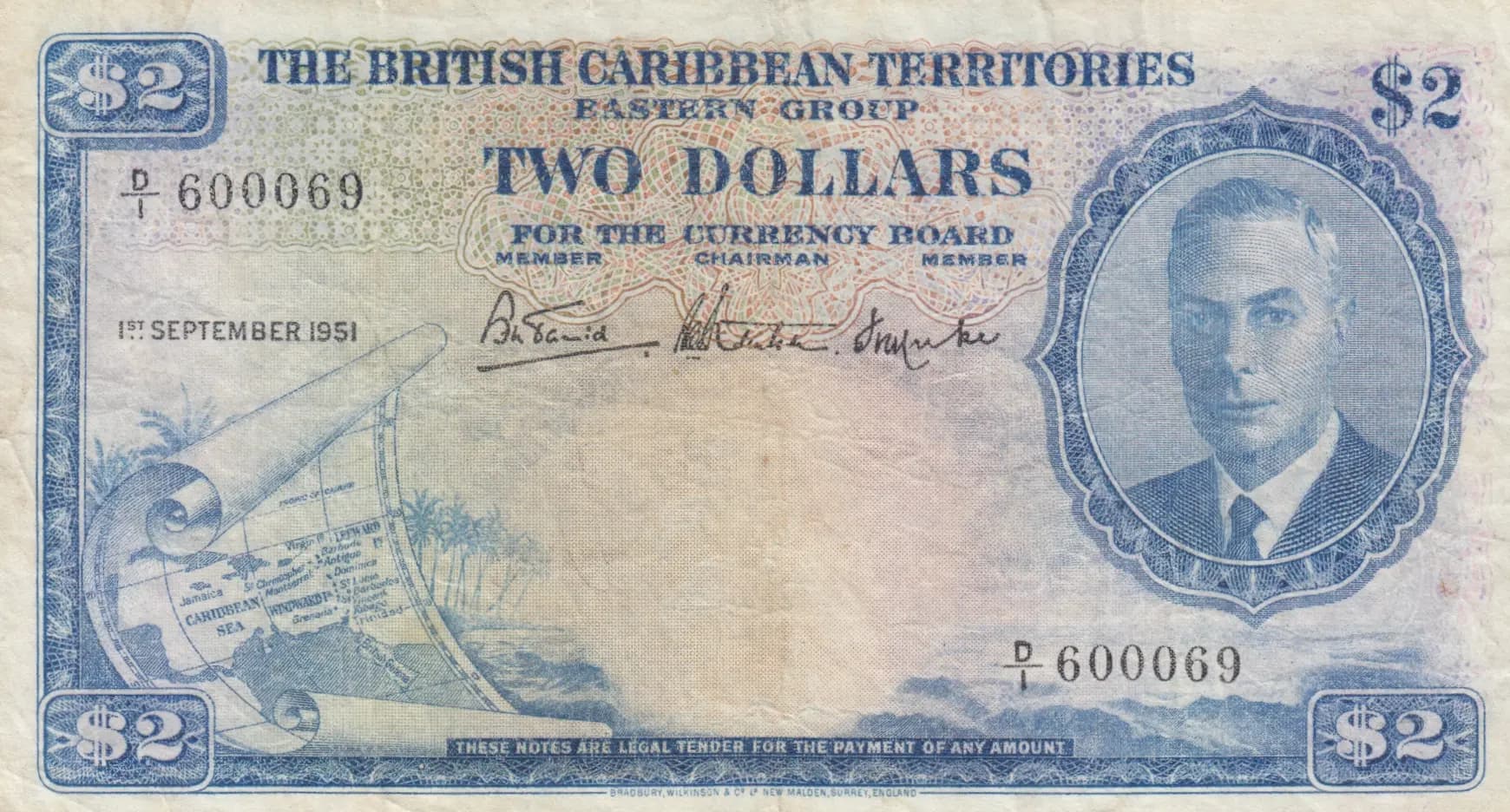
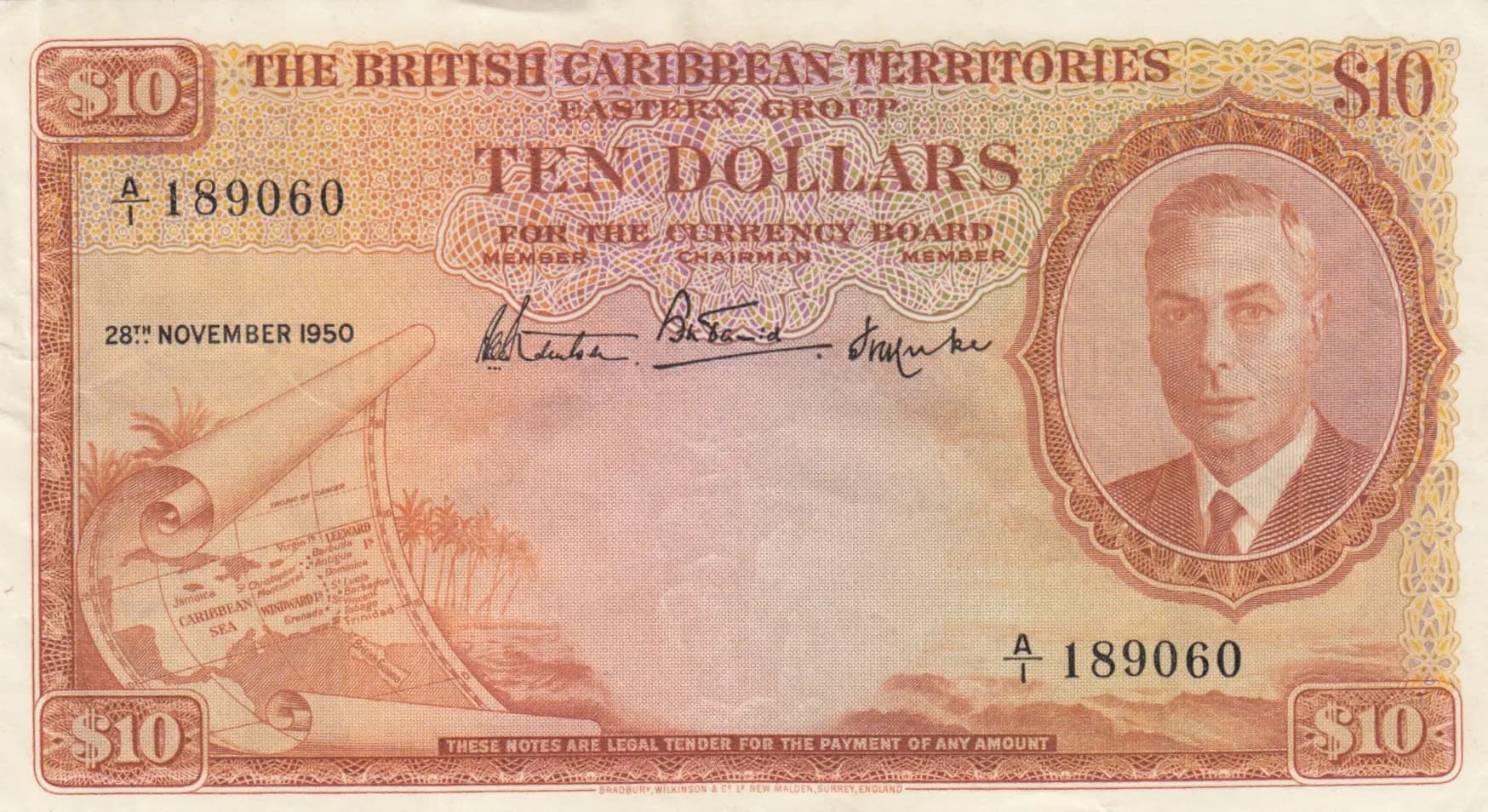
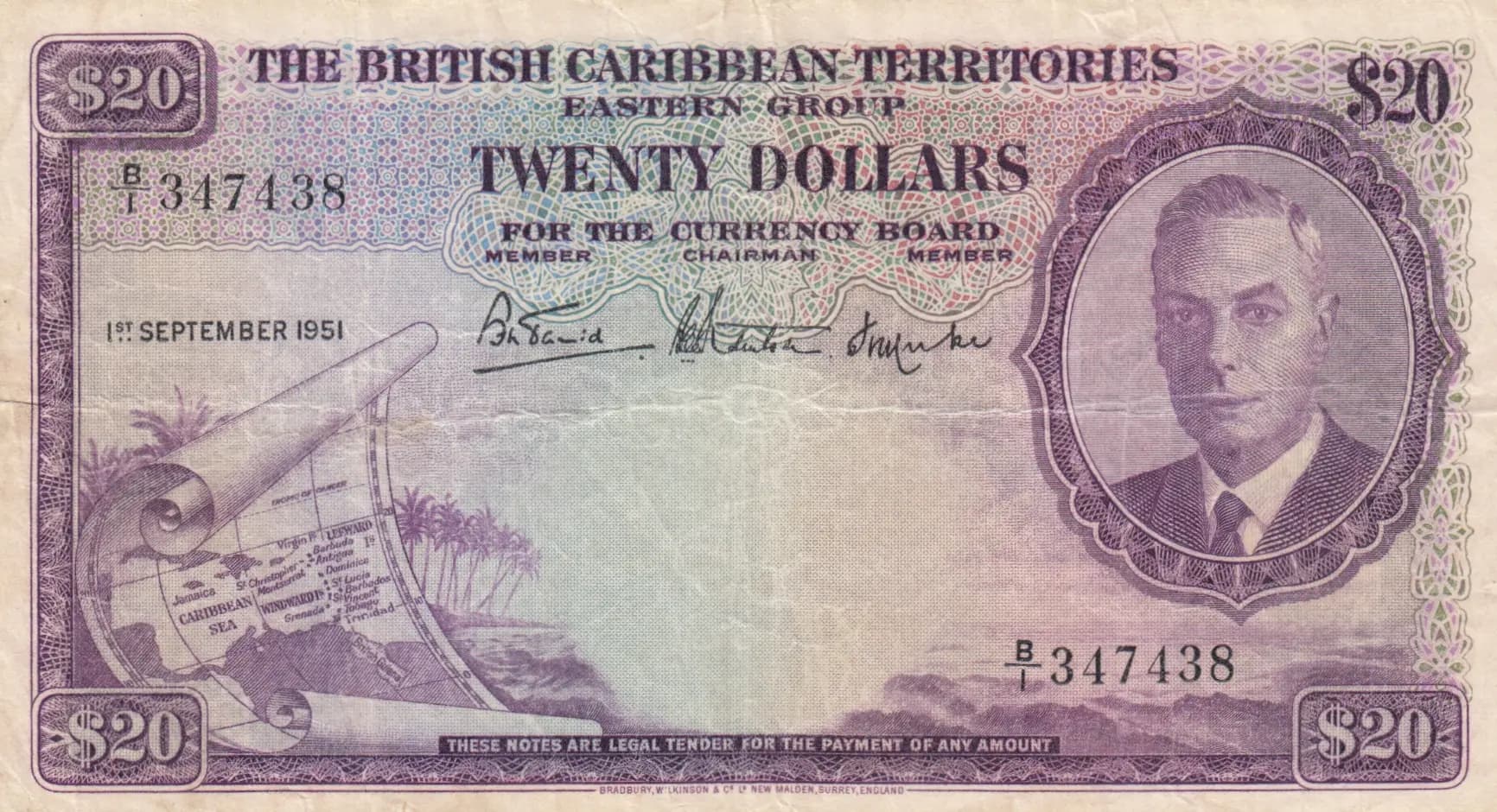
5 dollars 1950
Market Prices
3 salesAbout This Note
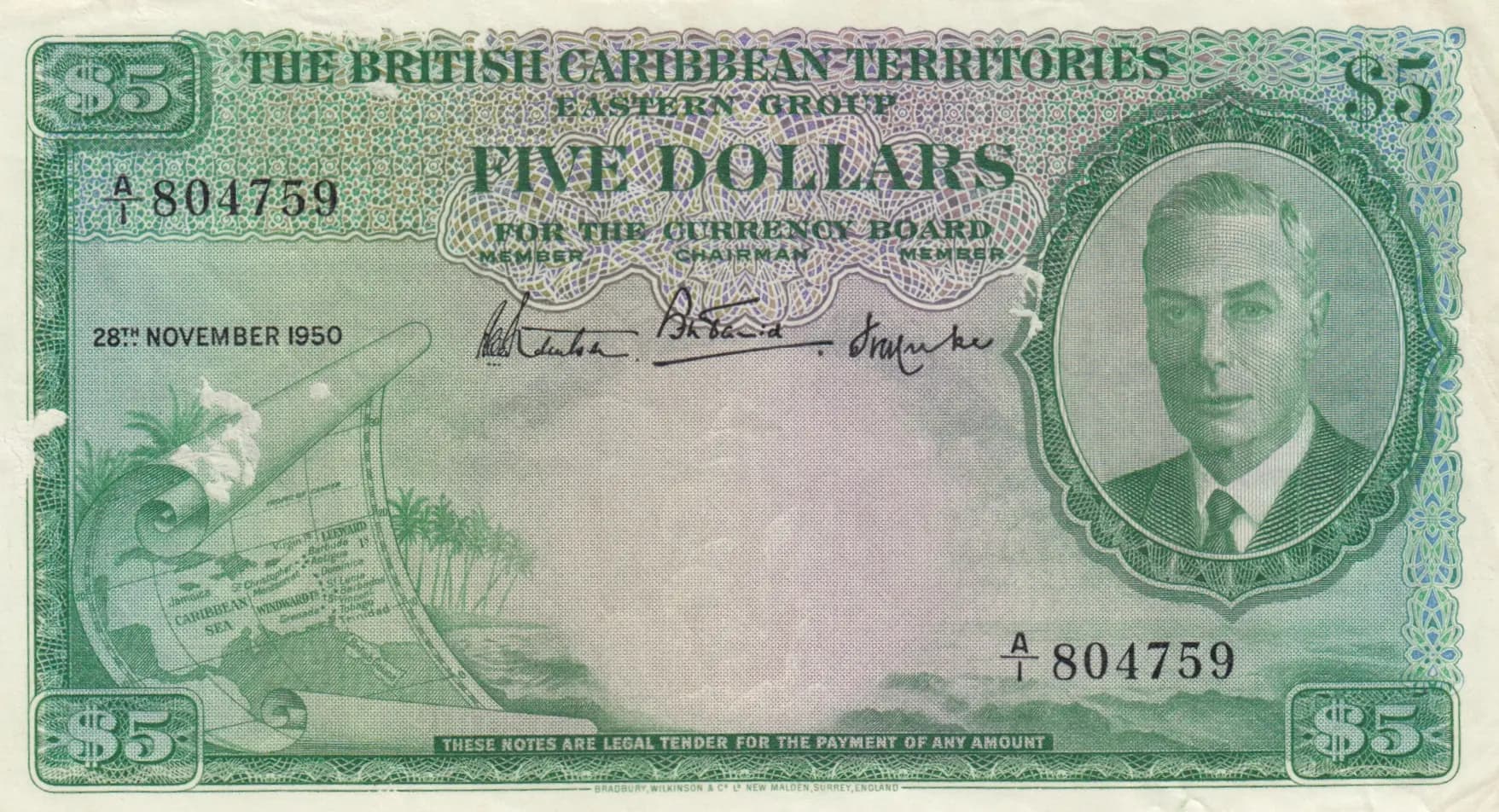
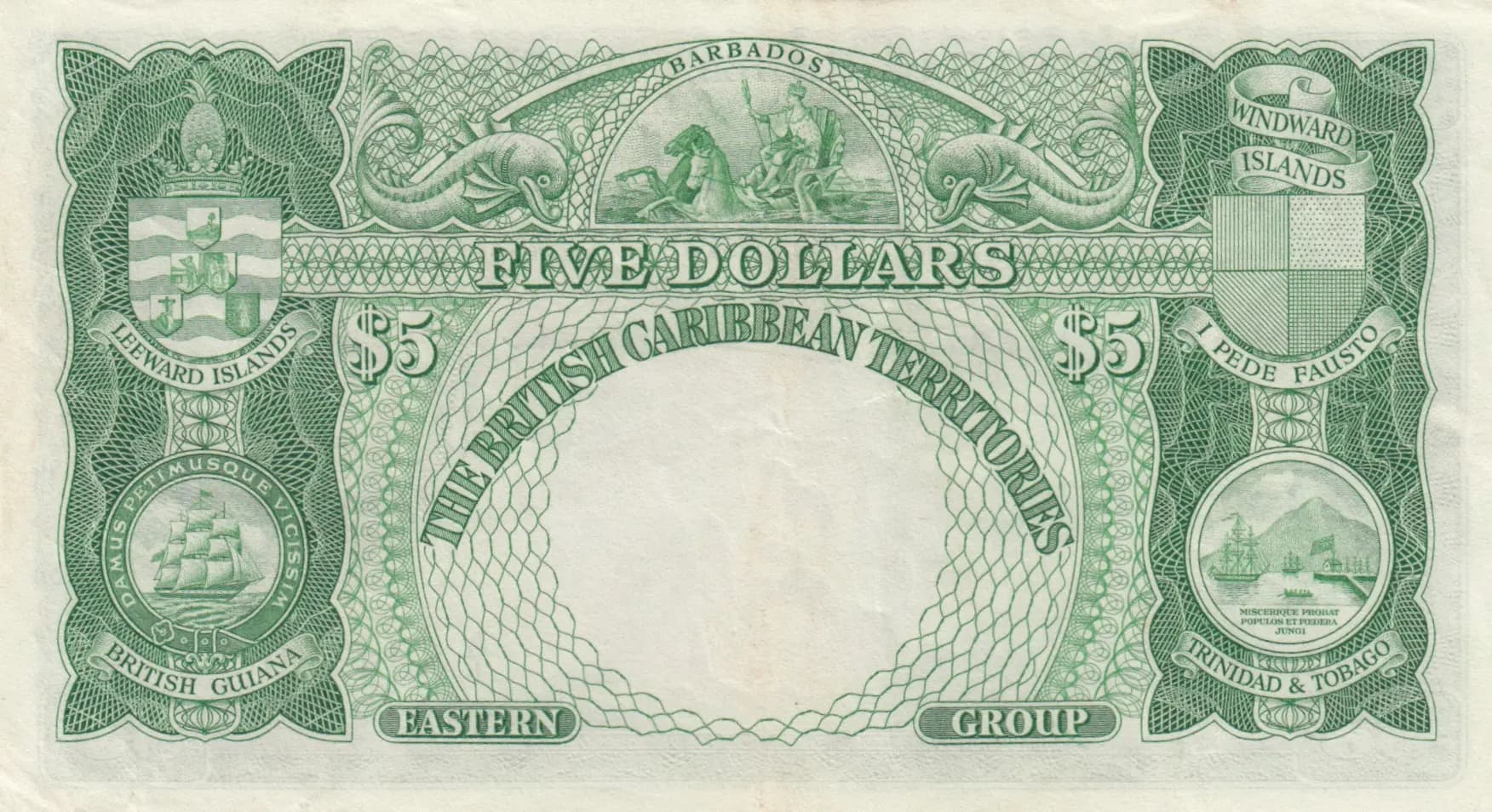
This 1950 British Caribbean Territories 5 Dollar note (Pick P-3) presents a historically significant early postwar Commonwealth currency issue in VF condition. The note features a striking portrait of King George VI on the obverse amid tropical Caribbean imagery and a detailed reverse showcasing the heraldic arms of the four constituent territories (Leeward Islands, Windward Islands, British Guiana, and Trinidad & Tobago). Despite visible creasing and age-related foxing consistent with circulation handling, the note's intricate engraved design remains clearly legible, and recent market data shows VF examples commanding $365-449 at auction, reflecting solid collector demand for this territorial currency board issue.
Common. Print run data for this 1950 issue suggests substantial circulation numbers across the Eastern Caribbean Group territories. The catalog value of $100 VF (2016) and recent eBay sales averaging $365-449 in VF condition indicate this is a regularly encountered banknote in the secondary market, with consistent availability from dealers and auction houses. The note's appearance in multiple signature varieties (P-3, P-3cts, P-3s per PMG records) further supports a large, diverse printing run. No evidence of short-run status, regional scarcity, or early recall status exists for this Pick number.
Issued on 28th November 1950 by the British Caribbean Territory Currency Board, this note represents the early Commonwealth period when Britain's Caribbean colonies were transitioning toward greater autonomy while maintaining sterling-based currencies. The reverse's prominent display of four territorial coats of arms—including the sailing ship of British Guiana and fortified colonial settlements—reflects the economic integration and political structure of the Eastern Caribbean Group under British imperial administration. King George VI's portrait on the obverse underscores the monarchical authority legitimizing this territorial currency during the final years before decolonization movements would reshape the region.
The obverse presents King George VI in formal attire within an oval portrait frame positioned on the right side, surrounded by ornate guilloche borders in green and multicolored underprints. The left side features a map of the Caribbean territories with tropical imagery including palm trees and a Caribbean seascape, establishing the geographical context of the currency board's jurisdiction. The reverse displays an elaborate allegorical or maritime historical scene in the center, possibly depicting Columbus or colonial trade themes, flanked by four heraldic shields in the corners representing the constituent territories: Leeward Islands and Windward Islands in the upper corners, and British Guiana (identifiable by its sailing ship emblem) and Trinidad & Tobago in the lower corners. Each shield is crowned with heraldic lions and decorative frameworks, with Latin mottoes emphasizing prosperity and colonial administration. The 'Eastern Group' designation identifies this as the eastern territorial variant of the currency board's issue.
OBVERSE: 'THE BRITISH CARIBBEAN TERRITORIES' / 'FIVE DOLLARS' / 'FOR THE CURRENCY BOARD' / 'CHAIRMAN MEMBERS' / '28TH NOVEMBER 1950' / Serial number 'A 801759' / 'THESE NOTES ARE LEGAL TENDER FOR THE PAYMENT OF ANY AMOUNT' / 'BRADBURY, WILKINSON & CO LTD NEW MALDEN, SURREY, ENGLAND' / '$5'. REVERSE: 'FIVE DOLLARS' / 'THE BRITISH CARIBBEAN TERRITORIES' / 'EASTERN GROUP' / Territory identifications: 'LEEWARD ISLANDS' / 'WINDWARD ISLANDS' / 'BRITISH GUIANA' / 'TRINIDAD & TOBAGO' / Latin inscriptions including 'COLUMBUS MARITIME' and 'PEDE FAUSTO' (With prosperous foot/step) / 'SUSCEROQUE PROSTAT POPULOS ET IUGERA IUNCTI' (Latin heraldic inscription) / '$5'.
Intaglio/engraving printing executed by Bradbury, Wilkinson & Co Ltd, a premier British security printer based in New Malden, Surrey. The note exhibits characteristic fine line engraving throughout, evidenced by the detailed guilloche patterns, intricate background security designs, and the finely detailed allegorical scene on the reverse. The complex cross-hatching, ornamental borders, and high-definition portraiture are consistent with premium security printing practices of the era, designed to prevent counterfeiting through technical complexity and artistic detail.
This note represents the 'Eastern Group' variant as inscribed on the reverse, distinguishing it from other territorial configurations the Currency Board may have issued. The PMG population report indicates three catalogued variants for Pick P-3: the standard P-3, P-3cts (likely a color trial or special printing variant), and P-3s (possibly a specimen or special issue). The observed serial number prefix 'A 801759' suggests this is from an early printing sequence. Signature varieties exist for this issue as noted in catalog references, though the specific signatures visible in this example would require direct comparison to detailed signature catalogs to definitively classify. The 28th November 1950 date and 'Eastern Group' designation are constant features of this Pick number.