50 francs 1956
Market Prices
33 salesAbout This Note
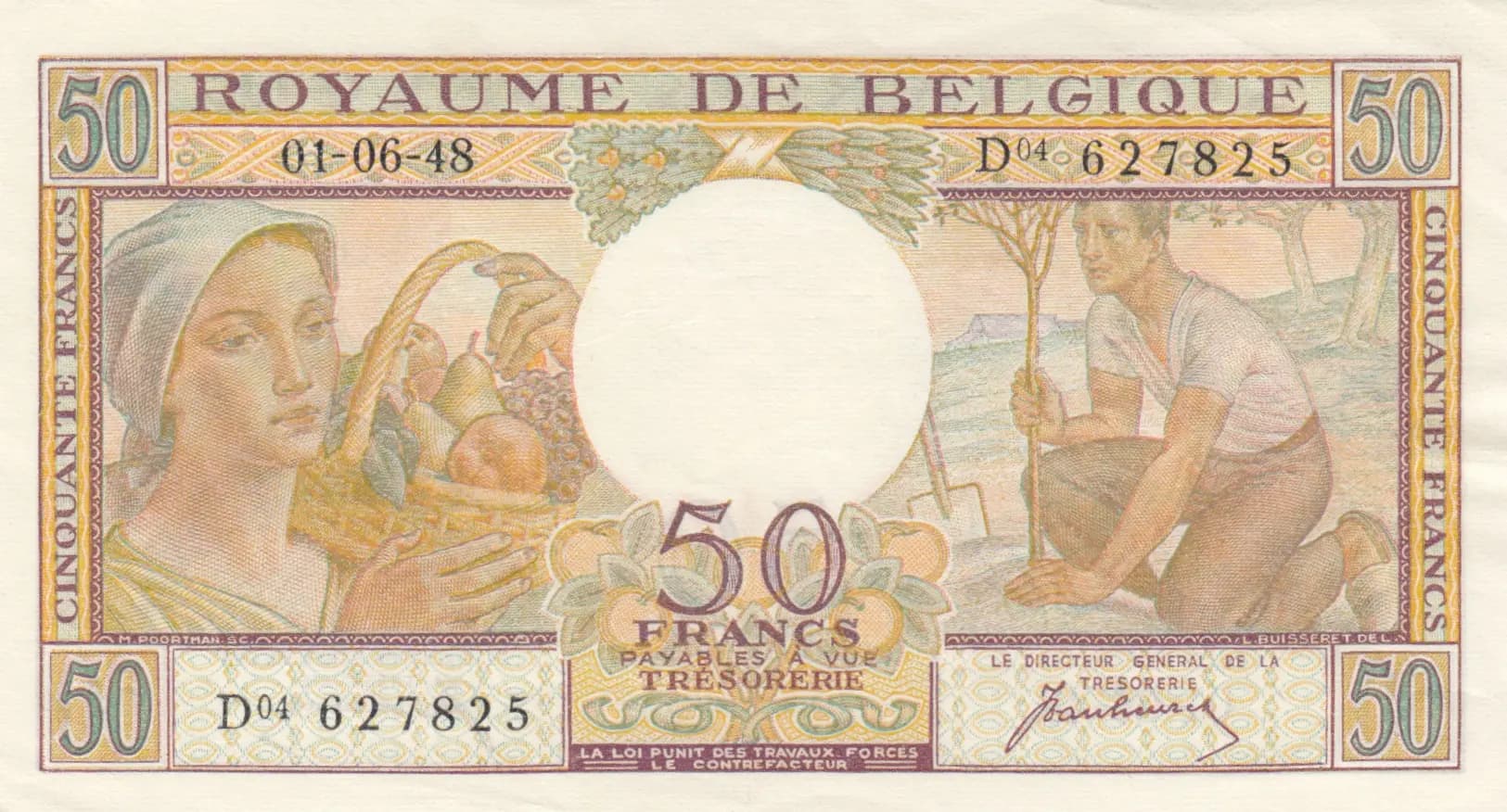
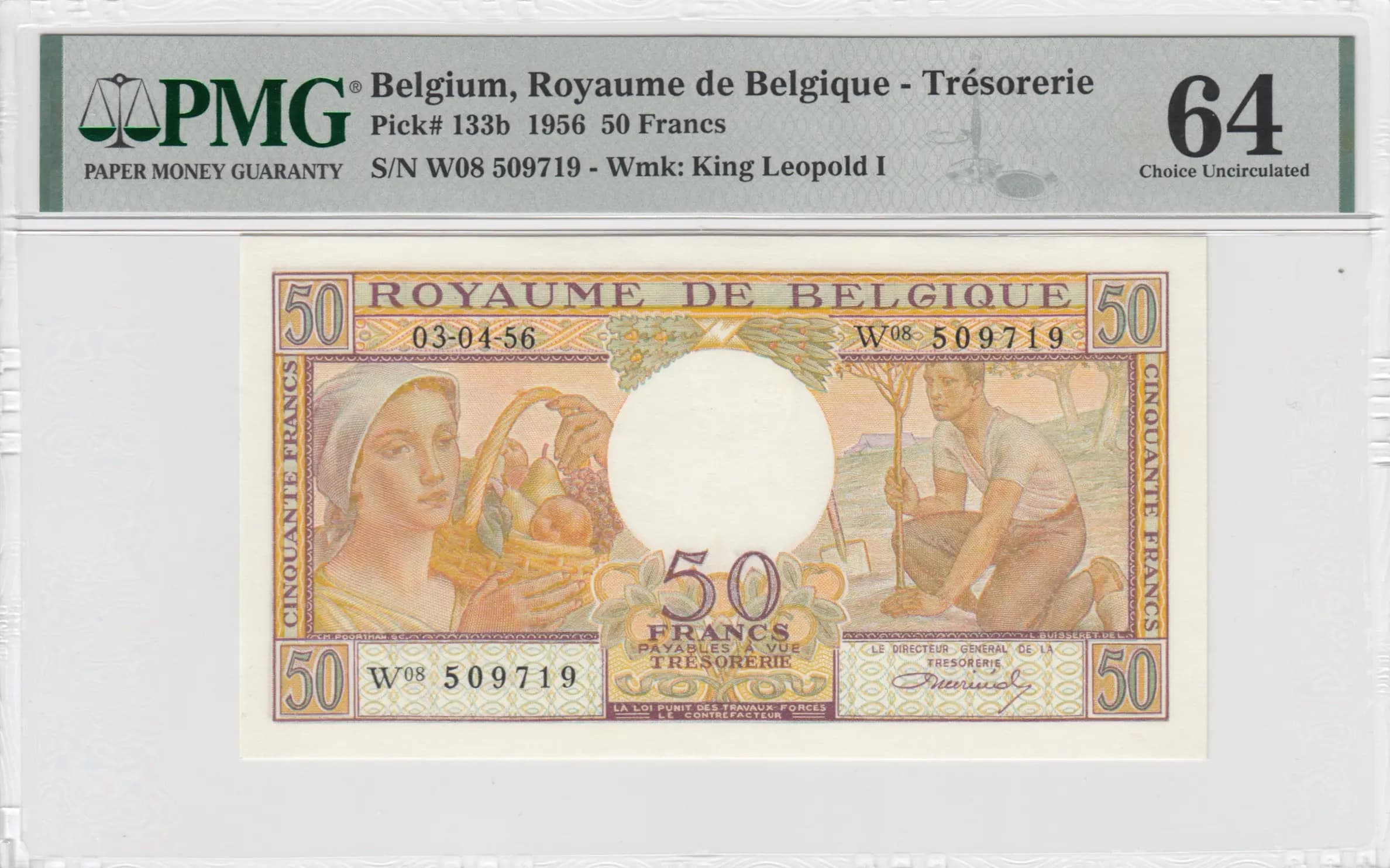
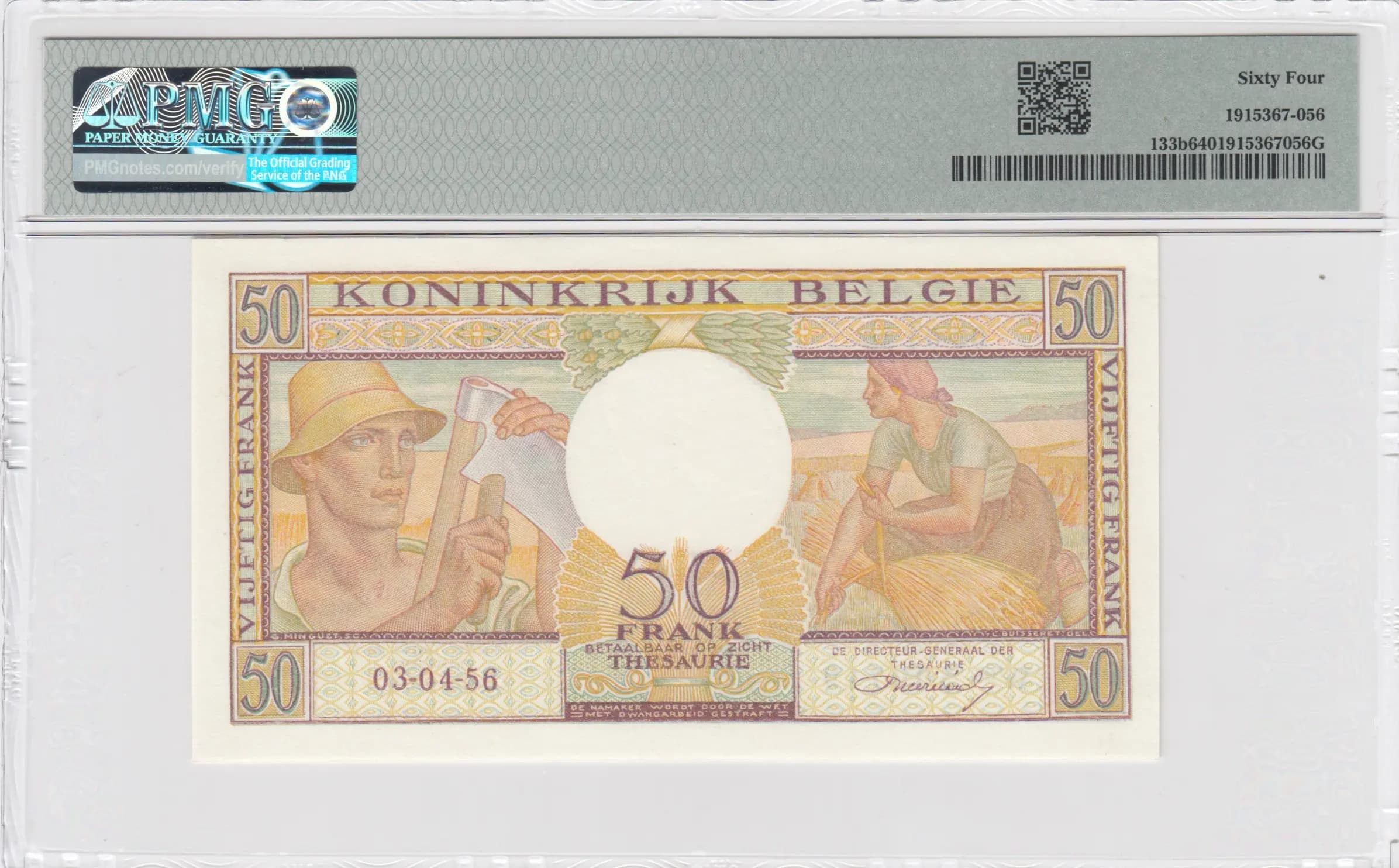
This Belgian 50 Francs note from 1956 presents a well-preserved example of mid-20th century Belgian currency featuring allegorical representations of agriculture and labor. The obverse displays a female figure with wheat and a male laborer, while the reverse depicts agricultural workers with implements, rendered in warm tan, beige, and gold tones with crisp printing throughout. In PMG 64 condition, this note shows no visible wear, creases, or stains, making it an attractive example of this Treasury-issued denomination from the post-war period.
Common. This note sold regularly on eBay across multiple years (2012-2025) at prices ranging from $0.77 to $90.99, with most examples in lower grades selling for $3-18 USD. The consistent availability across multiple condition grades and the moderate prices for even higher-grade examples (PMG 66 at $90.99) indicate a substantial print run and widespread circulation. The 1956 issue was part of Belgium's standard currency production for this denomination and remains readily available to collectors.
Issued in 1956 by the Banque Nationale de Belgique under Treasury authority, this note reflects Belgium's post-World War II economic reconstruction and emphasis on agricultural and industrial labor. The allegorical imagery—featuring a woman with grain, men with farming implements (axe, scythe), and pastoral landscapes—celebrates the agrarian and working-class foundation of Belgium's economy during this period of national recovery and development.
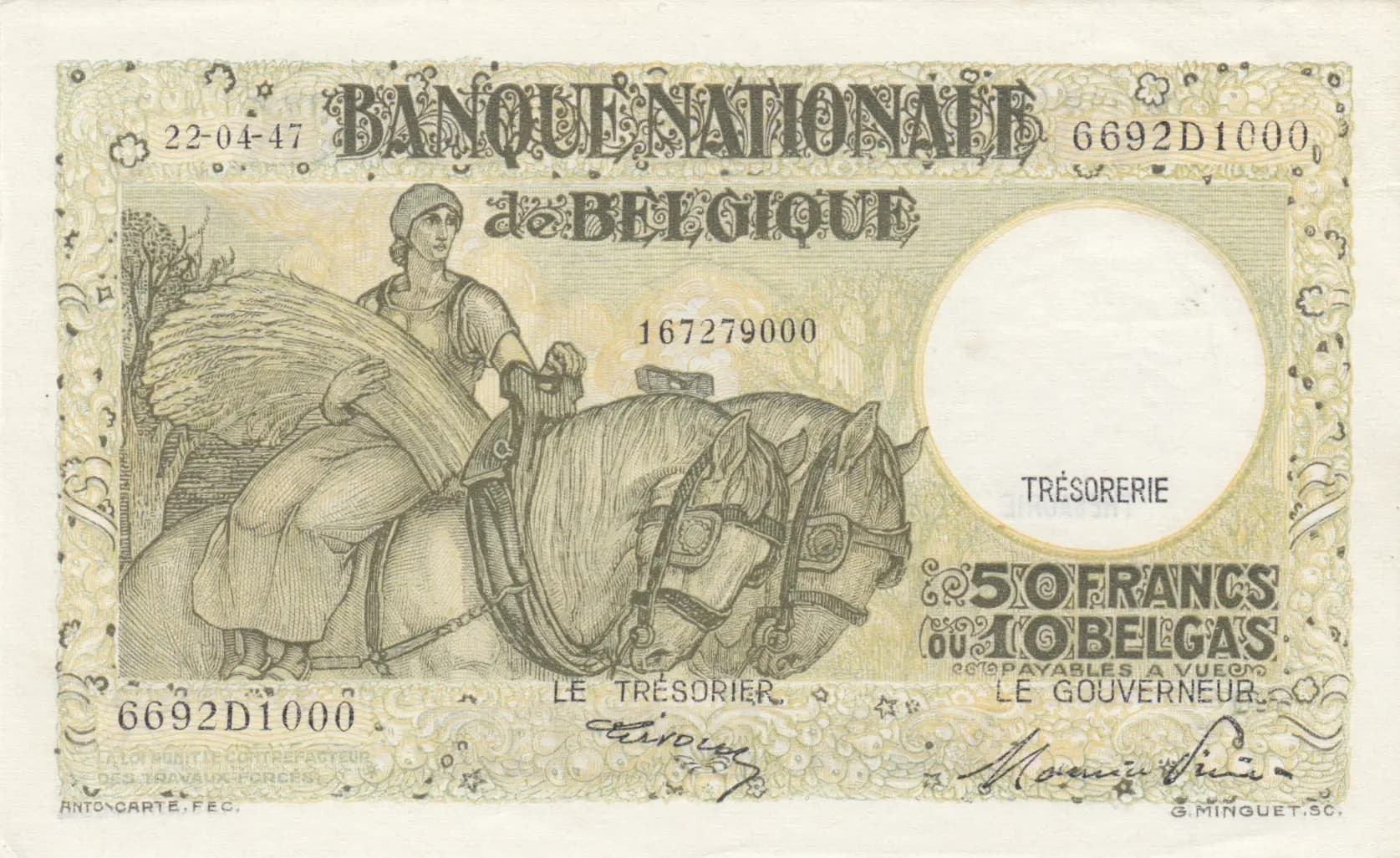
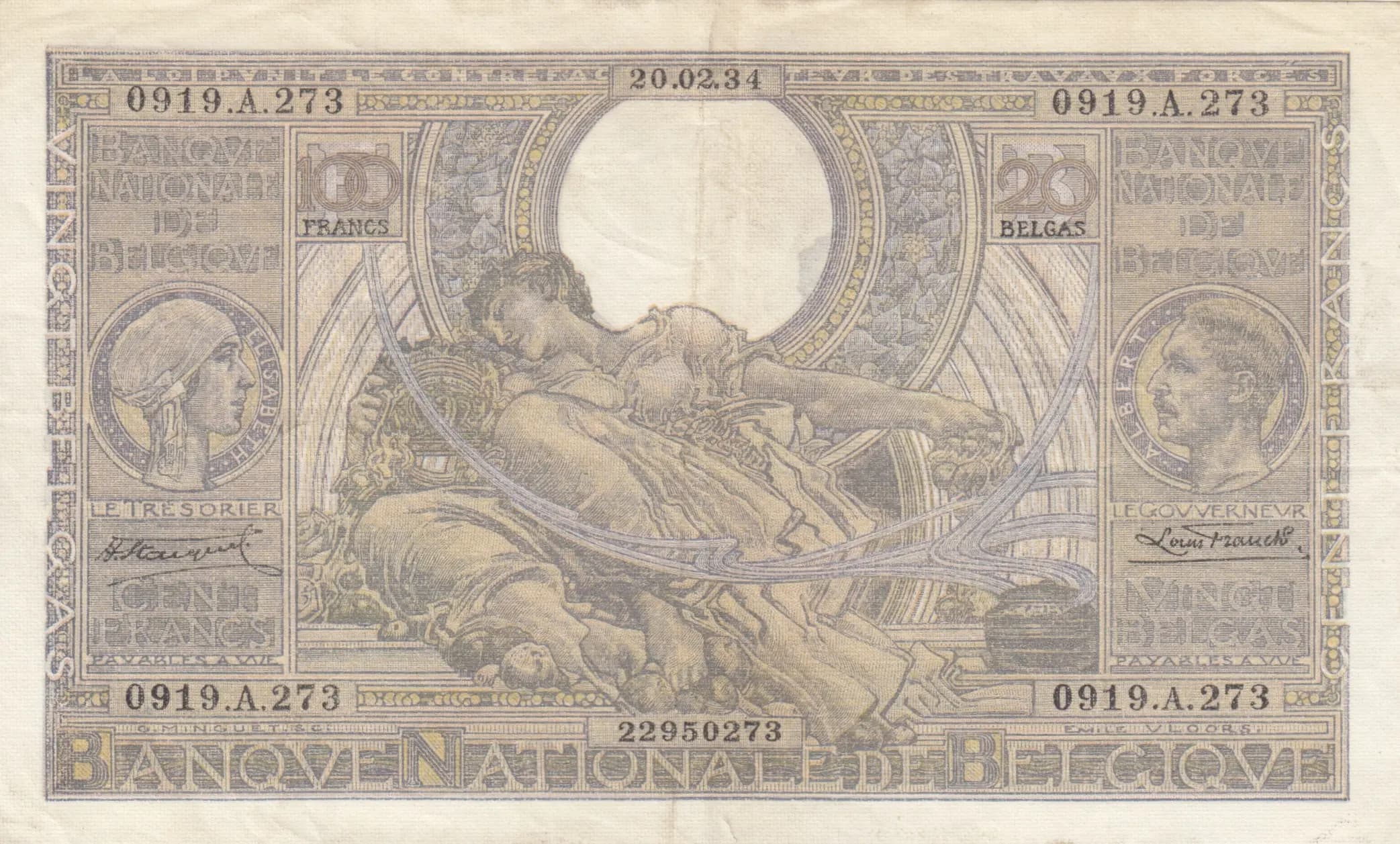
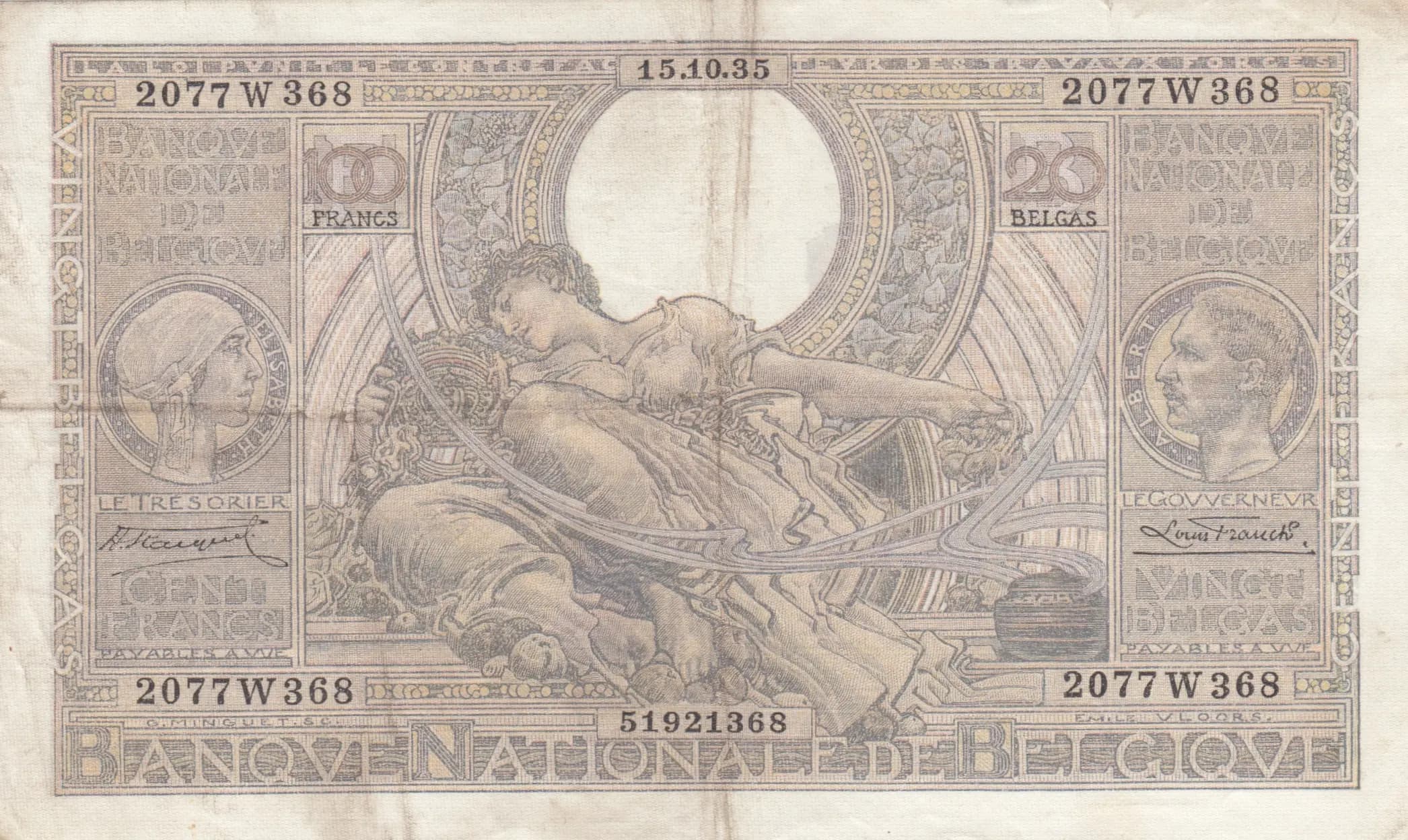
This note exemplifies Belgian allegorical design conventions of the mid-1950s, featuring bilateral bilingual presentation reflecting the country's French and Dutch-speaking regions. The obverse depicts a classical female figure symbolizing Agriculture holding wheat sheaves on the left, paired with a male figure representing Labor or Commerce on the right, both rendered in classical artistic style. The reverse continues the labor theme with a male figure wearing a wide-brimmed hat and holding an axe (representing manual agricultural labor) on the left and another male figure in classical dress on the right. A large circular vignette dominates the center of both sides, functioning as a watermark area bearing the profile of King Leopold I. Ornamental vine wreaths, decorative frames, and corner denomination numerals provide security and aesthetic framing throughout. The warm earth-tone palette (tan, beige, orange, brown, gold, cream) with touches of green conveys themes of harvest and prosperity.
FRONT (French side): 'ROYAUME DE BELGIQUE' (Kingdom of Belgium); '50 FRANCS' (denomination); '03-04-56' (issue date: April 3, 1956); 'PAYABLES A VUE A LA TRESORERIE' (Payable on sight at the Treasury); 'LE DIRECTEUR GENERAL DE LA TRESORERIE' (The General Director of the Treasury); 'LA LOI PUNIT DES TRAVAUX FORCES ENTRE FACTEUR' (The law punishes counterfeiting with forced labor); Serial number 'W08 509719'. BACK (Dutch side): 'KONINKRIJK BELGIE' (Kingdom of Belgium); '50 FRANK' (50 Francs); '03-04-56' (same date); 'BETAALBAAR OP ZICHT AAN DE THESAURIE' (Payable on sight at the Treasury); 'DE DIRECTEUR-GENERAAL DER THESAURIE' (The General Director of the Treasury); 'DE VERVALSCHER WORDT DOOR DE WET DWANGARBEID BESTRAFT' (The counterfeiter is punished by law with forced labor).
Intaglio (recess) printing, the standard security printing method for Belgian banknotes of this era. The crisp, well-defined line work observed in the ornamental borders, portraits, and fine detail work, combined with the sharp denomination numerals and text clarity, are characteristic of high-quality intaglio production. The note likely was produced by Belgium's official security printer, Banque Nationale de Belgique's printing facilities or a contracted European security printer such as those in Brussels or Liège.
Pick catalog P-133b represents the 1956 issue variant; the same Pick number encompasses P-133a and P-133s variants per PMG records. This particular note is dated 03-04-1956 with serial number W08 509719, indicating it is from the April 1956 printing. The prefix 'W08' and the sequential numbering are consistent with standard Belgian Treasury serial numbering of this period. No overprints or signature variations are evident that would constitute distinct catalogued varieties beyond the P-133b base designation.