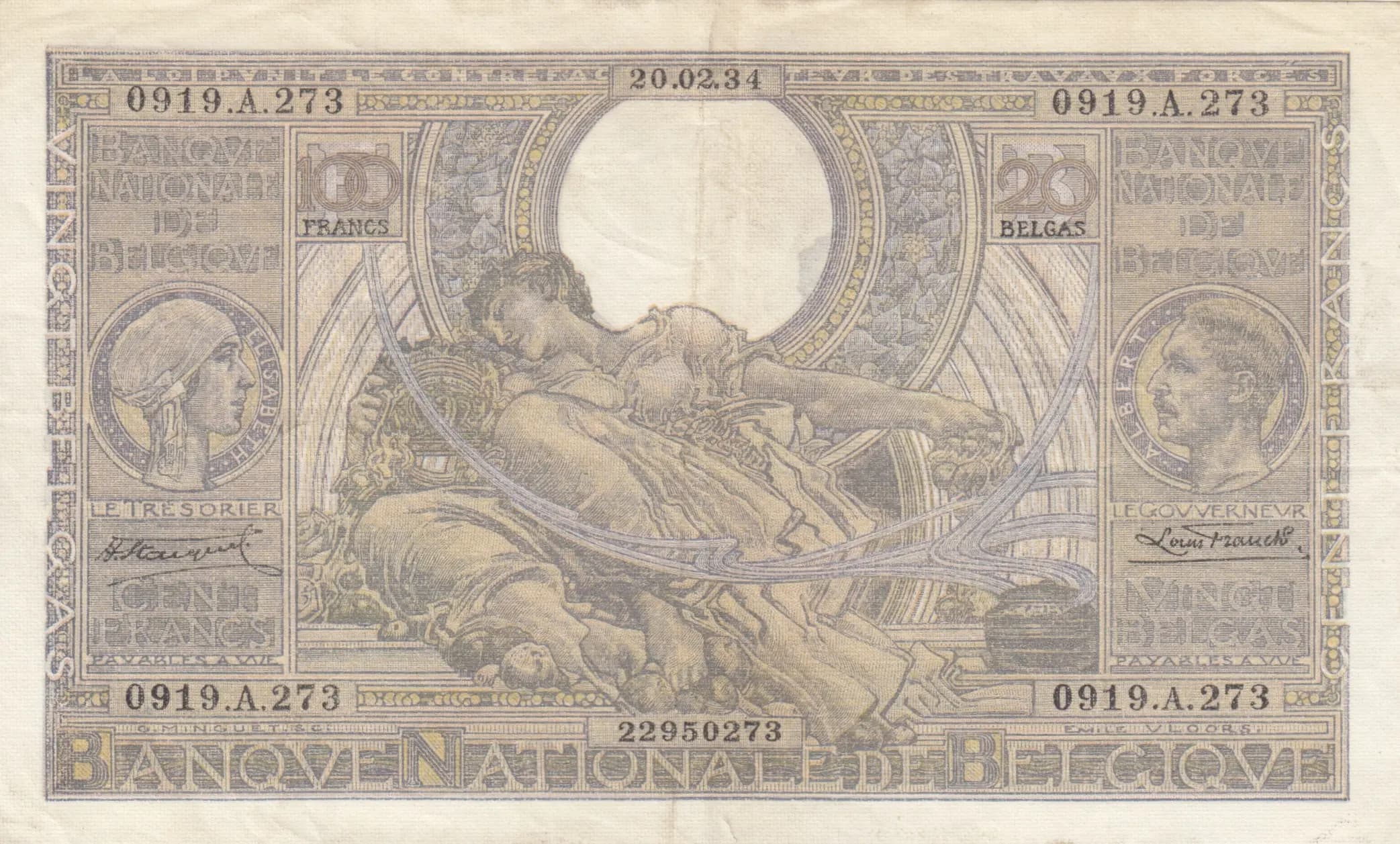
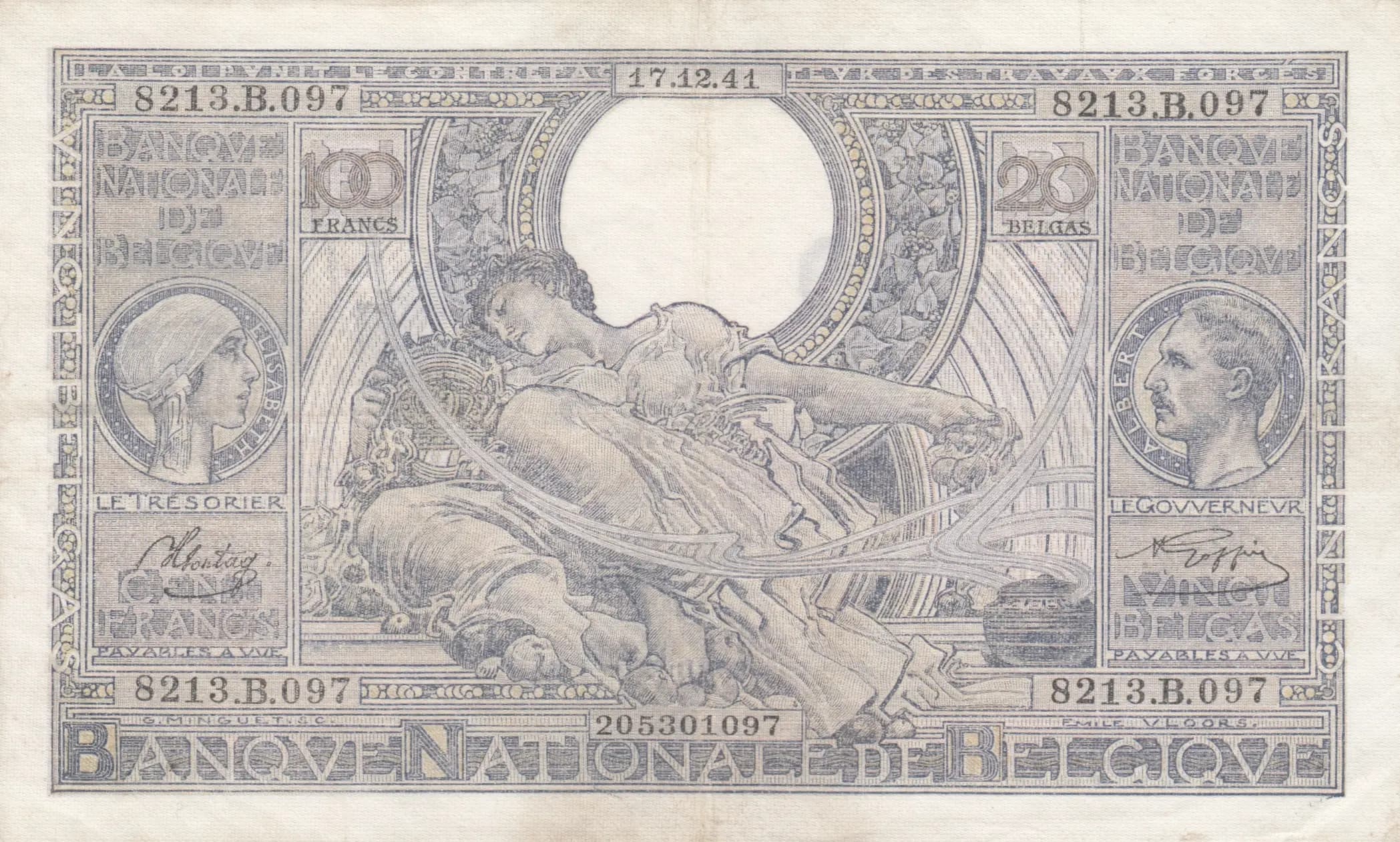
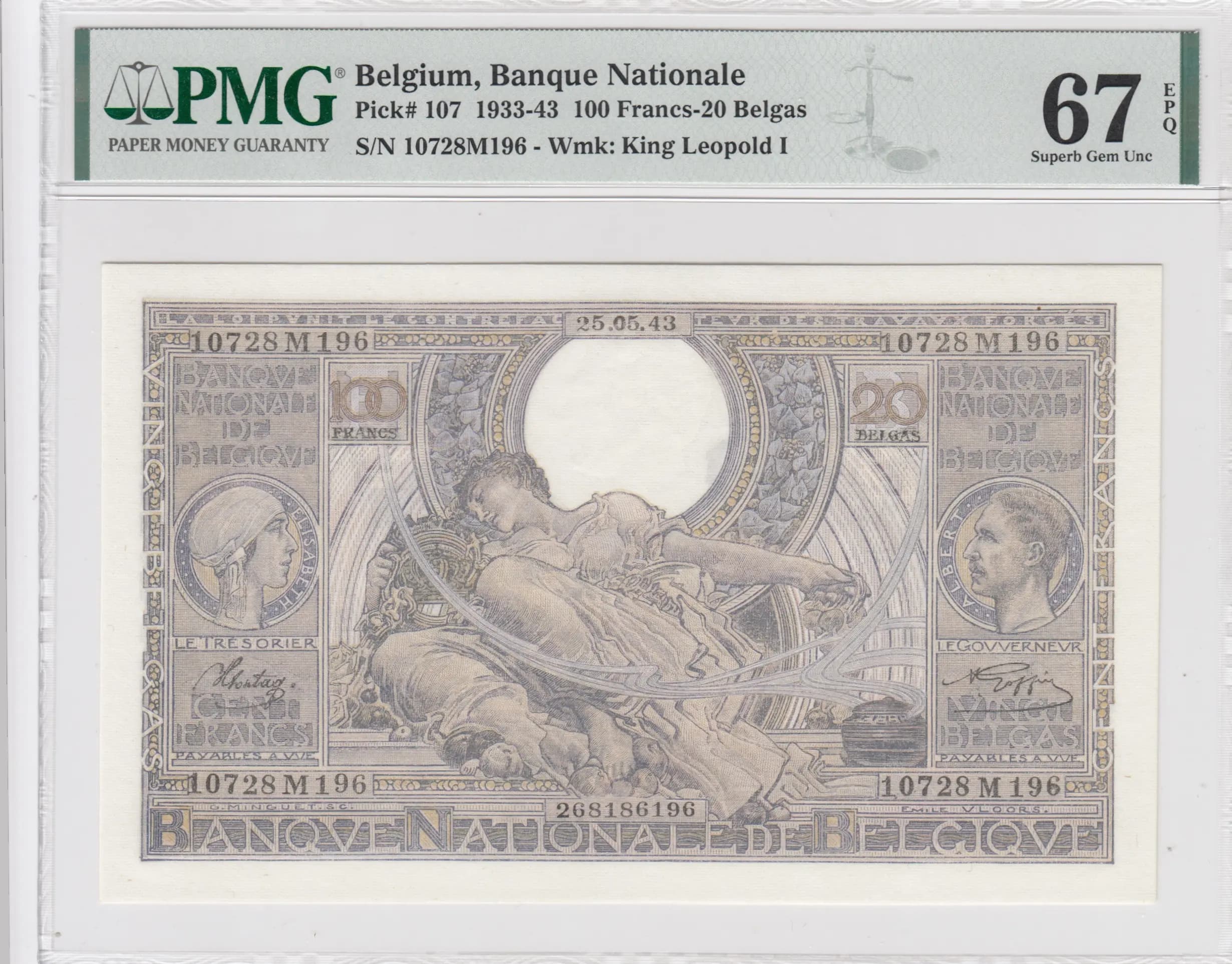
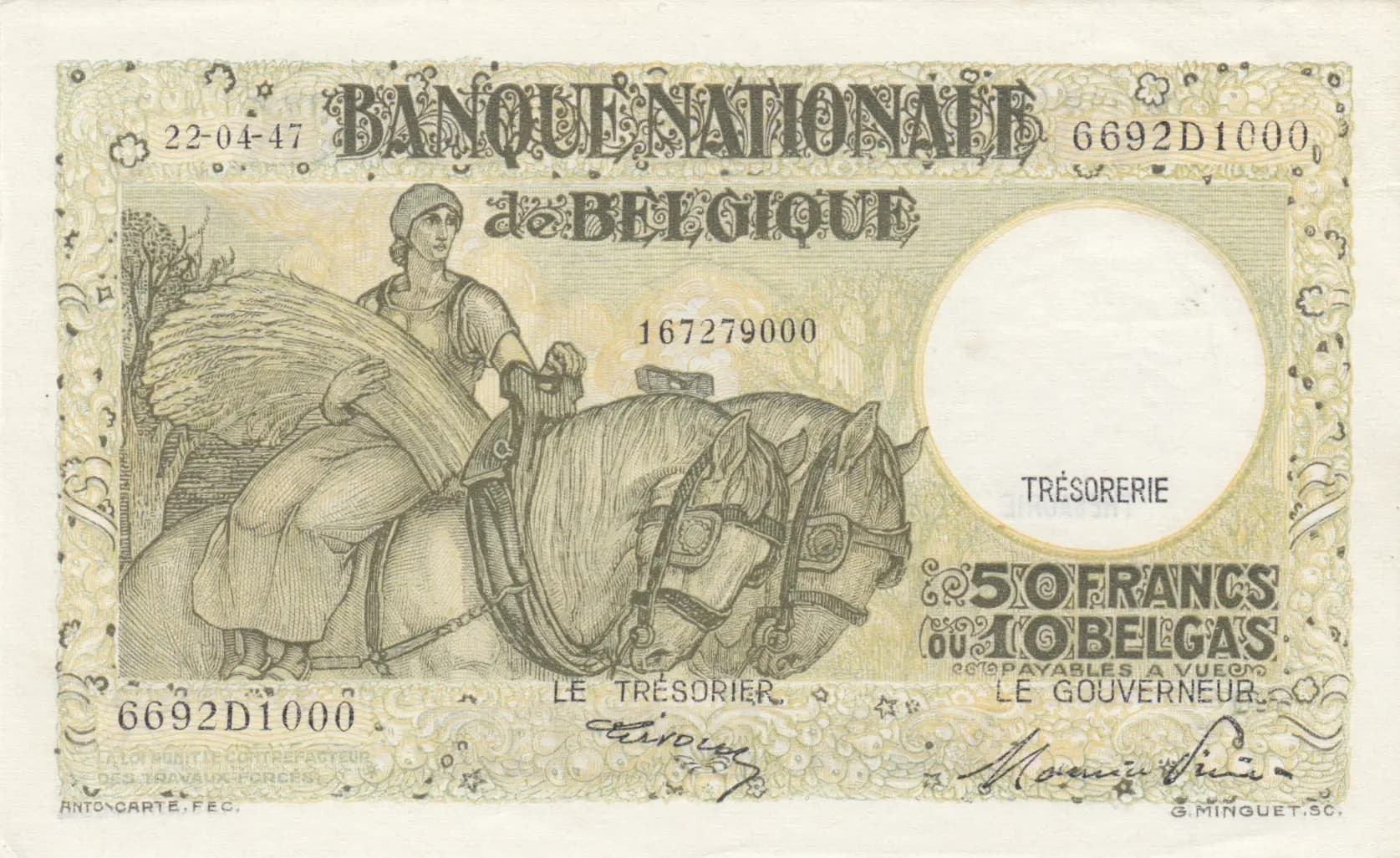
100 francs= 20 belgas 1935
Market Prices
55 salesAbout This Note
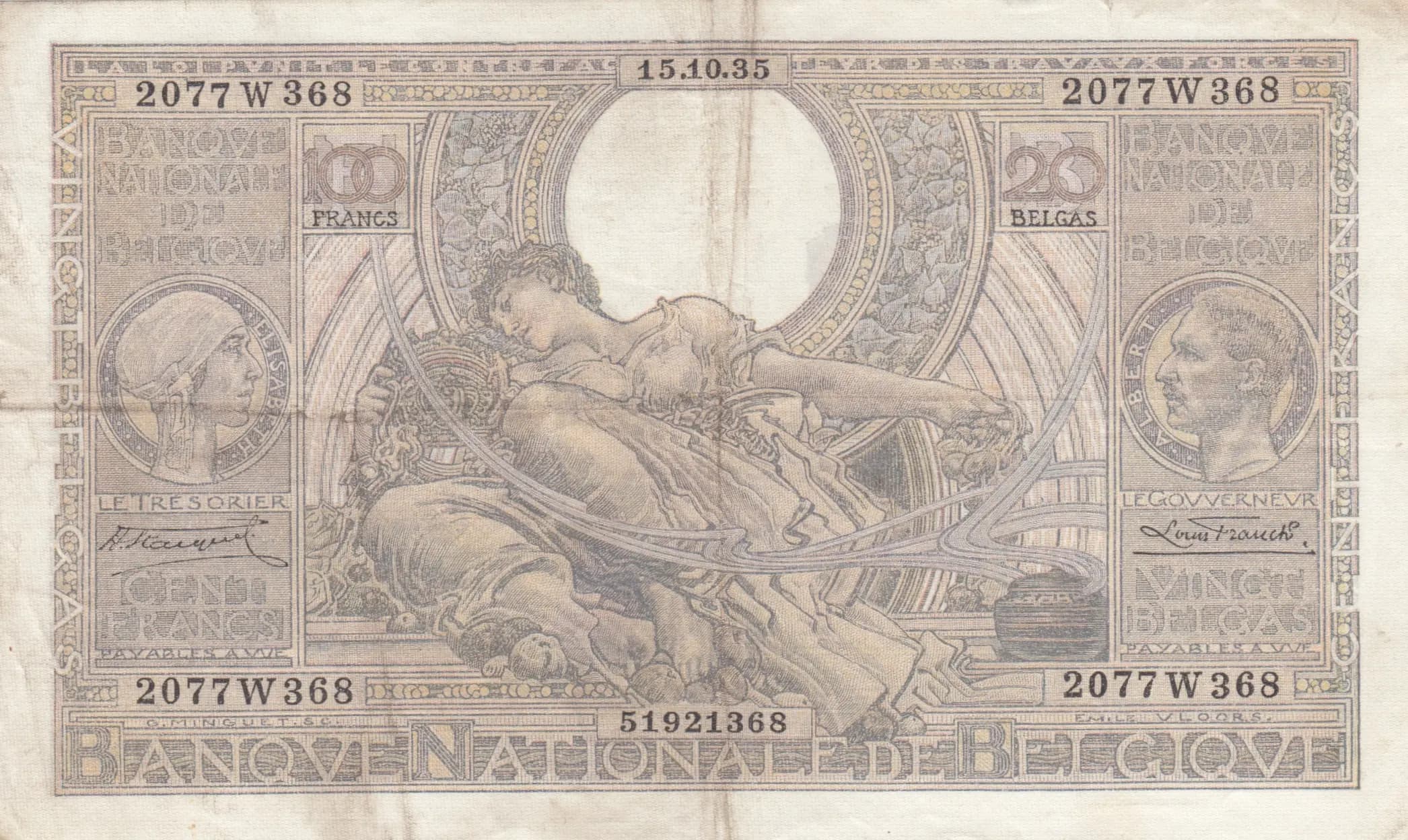
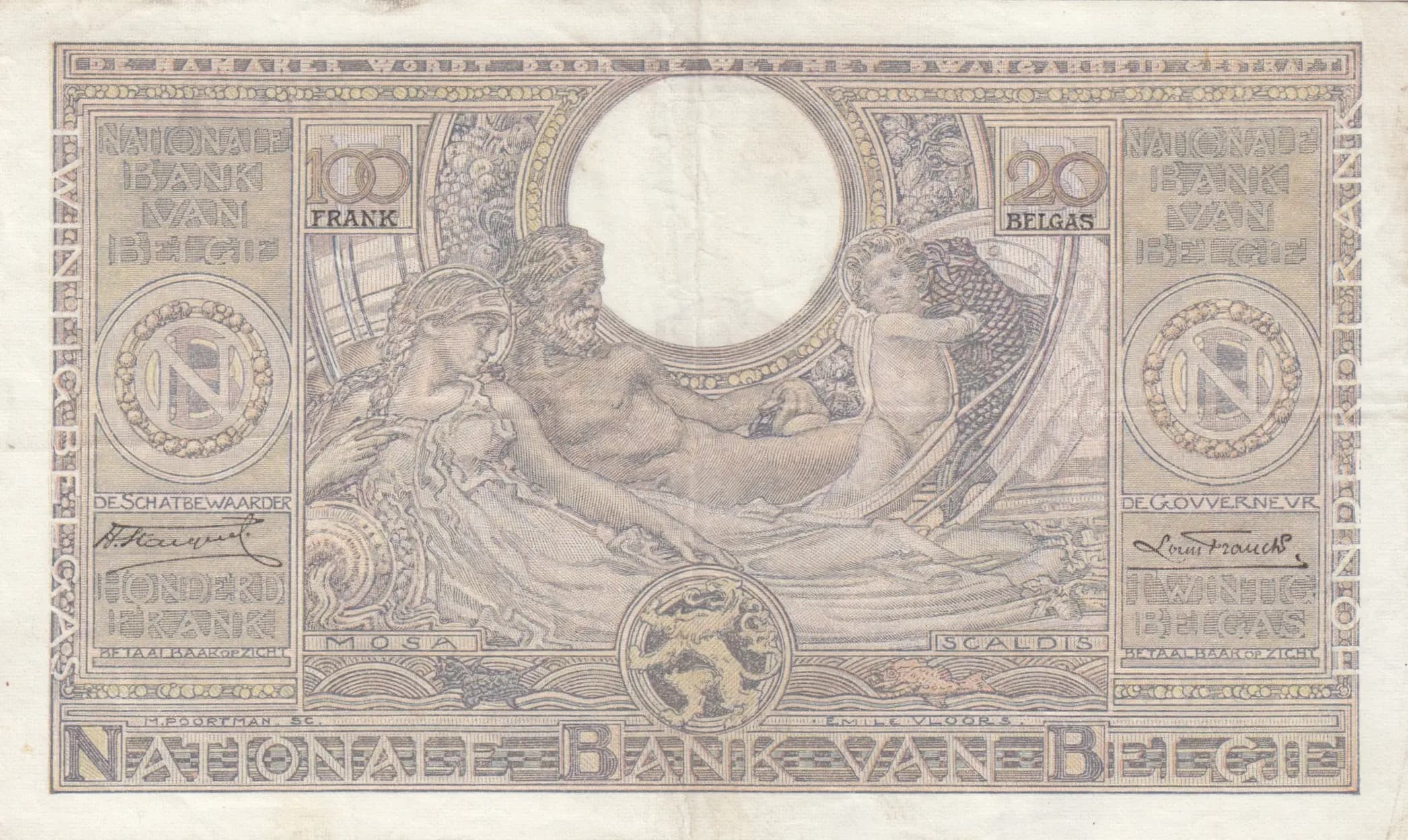
This is a VF-graded Belgian 100 Francs / 20 Belgas banknote from 1935, issued by the Banque Nationale de Belgique. The note displays the characteristic Art Deco design of the era with dual-language presentation (French on obverse, Dutch on reverse), featuring portraits of Queen Elisabeth and King Albert flanking a central allegorical female figure representing Agriculture. While showing moderate circulation wear with visible creasing, foxing, and age patina, the note retains good clarity in its intricate engraved details and denomination markings.
Common. This is a regular-issue note from a 10-year circulation period (1933-1943) with substantial print runs typical of a major denomination for a central bank. eBay transaction data shows VF examples consistently selling for $3.50-$19.50 USD, with most transactions in the $5-$10 range, indicating robust supply and modest collector demand. Population reports show this Pick number represented in professional grading services but without exceptional rarity indicators. The denomination and issuer are standard, not commemorative or short-lived.
This note was issued during the interwar period when Belgium maintained the Gold Standard and used both franc and belga denominations (20 belgas = 100 francs). The dual-language design reflects Belgium's linguistic duality between French-speaking Wallonia and Dutch-speaking Flanders. The allegorical imagery of Agriculture and the river personifications (Mosa and Scaldis) celebrate Belgium's prosperity and natural resources during the 1930s, even as the nation faced economic pressures leading up to World War II.
The obverse features a sophisticated Art Deco composition with three central figures: Queen Elisabeth (left portrait medallion, labeled 'Le Très Grier'), an allegorical female figure representing Agriculture (center vignette, reclining with cherub attendant and surrounded by fruit and cornucopia symbols), and King Albert (right portrait medallion, labeled 'Le Gouverneur'). The reverse depicts allegorical personifications of Belgium's major rivers—Mosa (Meuse) and Scaldis (Scheldt)—as classical female figures in flowing robes with attendant cherubs, reflecting the nation's pride in its waterways. Both sides employ intricate engraved borders with geometric and botanical motifs, decorative scrollwork, and circular medallion frames. The Belgian heraldic lion appears in a circular frame on the reverse, emphasizing national sovereignty. The dual-language presentation (French/Dutch) appears simultaneously on both sides.
FRONT (French text): 'Banque Nationale de Belgique' (National Bank of Belgium), 'Payables à Vue' (Payable on Demand), 'Le Très Grier' (The Treasurer), 'Le Gouverneur' (The Governor), '10 Francs', '20 Belgas', Date: '15.10.35' (15 October 1935), Serial number: '2077 W 368' / '51921368'. BACK (Dutch text): 'Nationale Bank van België' (National Bank of Belgium), 'De Schatbewaarder' (The Treasurer), 'De Gouverneur' (The Governor), 'Onder Toezicht van het Parlement' (Under Supervision of Parliament), 'Mosa' (Meuse River personification), 'Scaldis' (Scheldt River personification), '10 Frank', '20 Belgas'. Both sides include handwritten official signatures.
Intaglio engraving (steel plate engraving), characteristic of high-security currency production of the 1930s. The fine line work, ornamental borders, and detailed portraiture visible in the images—particularly the stippling and cross-hatching in the allegorical figures and the precision of the geometric patterns—are hallmarks of intaglio printing. The Banque Nationale de Belgique commissioned production from the Belgian state printing works, utilizing advanced engraving techniques standard for interwar Belgian banknotes.
This specific example is dated 15 October 1935 with serial number prefix '2077 W 368'. The catalog reference notes 4 signature varieties exist for this Pick number, though this particular combination cannot be definitively identified from the handwritten signatures in the image. The note exhibits French text on the obverse; a related variety (P-112) features Flemish text on the obverse instead. No distinguishing overprints, watermark variations, or other security features unique to this specific example are apparent in the visual analysis.