50 francs= 10 belgas 1947
Market Prices
62 salesAbout This Note
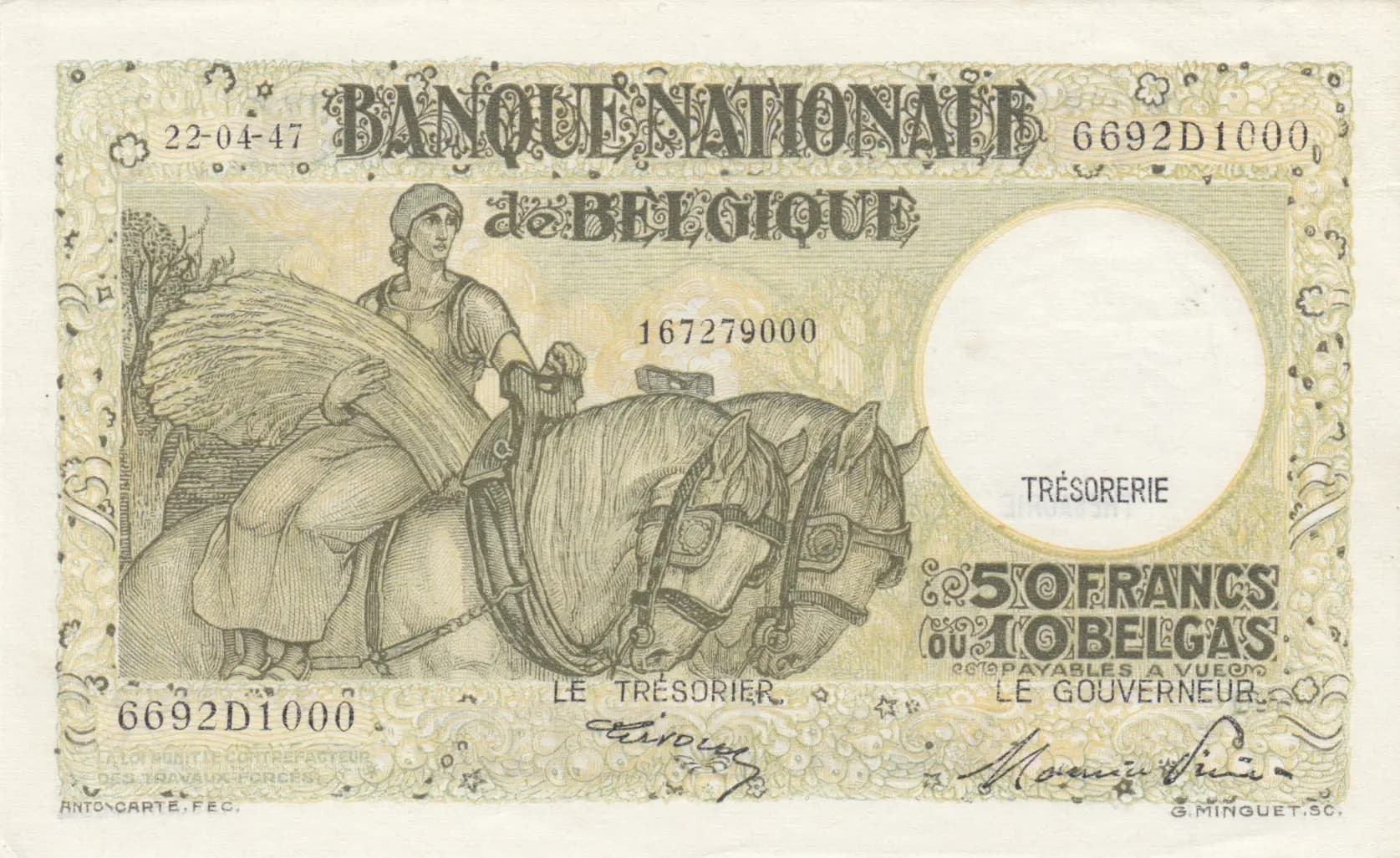
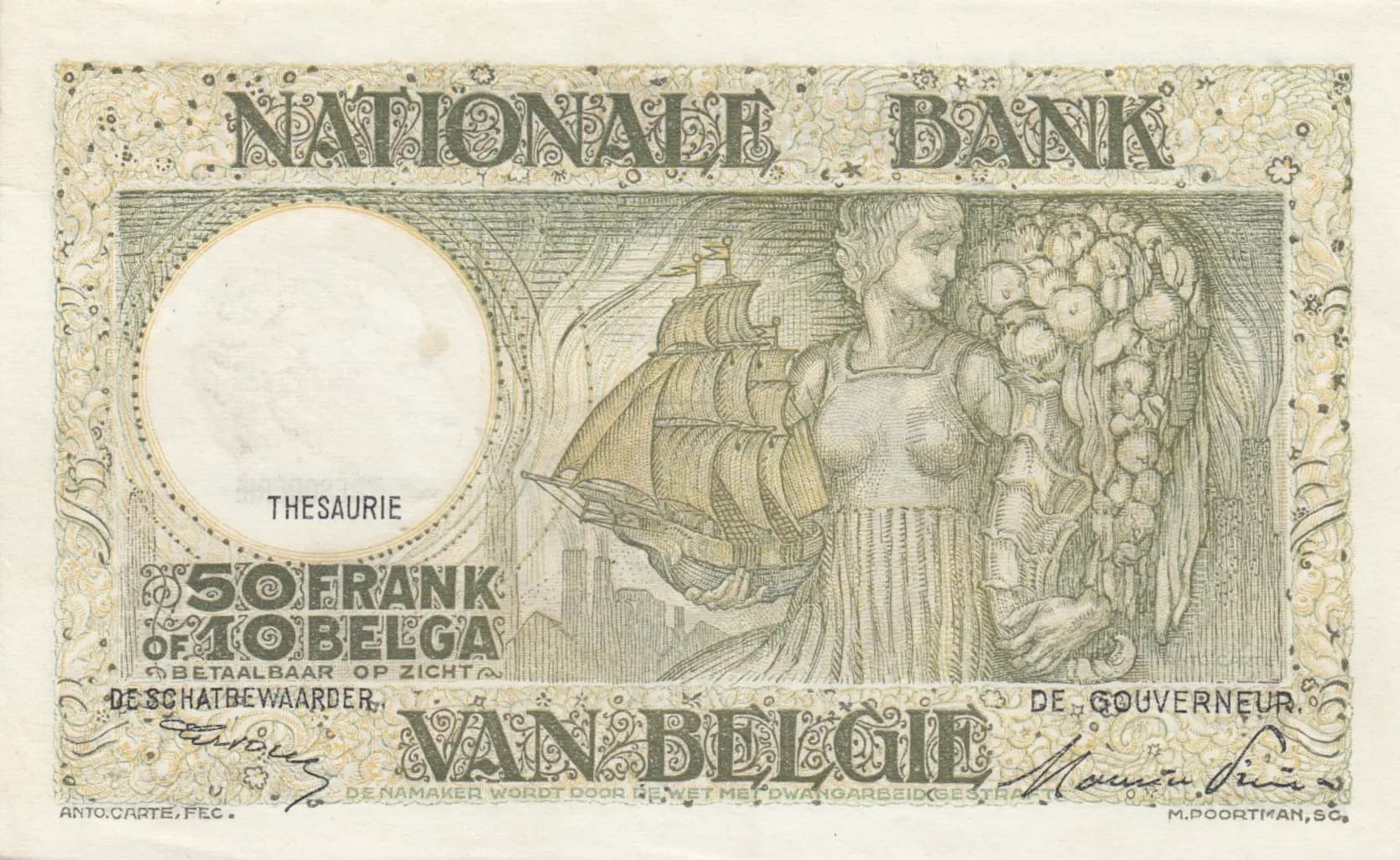
This is a Belgian 50 Francs/10 Belgas note from 1947 (Pick-106) in AU condition, displaying exceptional preservation with crisp intaglio engraving and no visible wear, creases, or stains. The note features allegorical representations of Treasury on both sides—a robed female figure on horseback holding wheat sheaves on the front, and a classical profile bust with maritime commerce symbolism on the back. Dated 22-04-1947 with bilingual French/Dutch inscriptions reflecting Belgium's linguistic duality, this is a desirable mid-20th century European issue with strong collector appeal in this superior condition grade.
Common. The eBay historical pricing data shows consistent sales ranging from $0.55 to $103.51, with typical VF-grade notes selling in the $5-$15 range and AU/UNC specimens commanding $16.50-$29.99. The median price for circulated examples is approximately $5-$8, indicating substantial surviving examples in the collector market. The PMG population report lists only one catalogued variant, but the high frequency of sales across multiple condition grades and the modest premiums for professionally graded examples all point to this being a relatively common issue. The catalog values (2016) of $8-$20 further confirm this is not a scarce note.
Issued during the post-World War II reconstruction period, this 1947 banknote represents Belgium's stabilization efforts through the National Bank of Belgium (Banque Nationale de Belgique/Nationale Bank van Belgie). The allegorical imagery—featuring figures representing Treasury, harvested grain, and maritime trade with a sailing ship and cornucopia—symbolizes the nation's aspirations for agricultural and commercial recovery after wartime devastation. The dual-language design reflects Belgium's commitment to linguistic equality between French-speaking Walloons and Dutch-speaking Flemish populations during this crucial period of national rebuilding.
The front features an allegorical female figure representing Trésorerie (Treasury) in classical robes and head covering, depicted riding a horse through an agricultural landscape while holding wheat sheaves—symbolizing Belgium's agricultural wealth and post-war recovery. The composition employs classical engraved style typical of mid-century European banknote design. The reverse presents a dual allegorical scene: on the left, a classical female profile bust (representing Thesaurie in the Dutch version) appears within a blank circular watermark area; on the right, another classical female figure is depicted in a maritime trade scene with a sailing ship and abundant symbols including grapes or fruit (cornucopia), representing international commerce and prosperity. Both sides are bordered by ornate decorative patterns featuring repeating floral and geometric motifs rendered in intaglio. The color palette of pale cream, light tan, and light olive-green underprints with dark brown engraving lines creates the characteristic refined appearance of this Belgian Treasury-series issue.
FRONT (French): 'BANQUE NATIONALE de BELGIQUE' (National Bank of Belgium); '50 FRANCS / 10 BELGAS' (denomination); 'TRÉSORERIE' (Treasury); 'LE TRÉSORIER' (The Treasurer); 'LE GOUVERNEUR' (The Governor); '22-04-47' (issue date: 22 April 1947); Serial numbers '6692D1000' and '167279000'; Engraver attributions 'ANTO-CARTE. FEC.' and 'G. MINGUET.SC.' BACK (Dutch/Flemish): 'NATIONALE BANK' (National Bank); '50 FRANK / OF 10 BELGA' (denomination); 'THESAURIE' (Treasury); 'BETAALBAAR OP ZICHT' (Payable on Demand); 'DE SCHATBEWAARDER' (The Treasurer); 'DE GOUVERNEUR' (The Governor); 'VAN DE DERDE' (Of the Third); 'DE NAAMAKER WORDT DOOR DE WET MET DWANGARBEIDSTRAF GESTRAFT' (The counterfeiter shall be punished by law with forced labor); Engraver attributions 'ANTO.CARTE. FEC.' and 'M. POORTMAN. SC.'
Intaglio engraving (line engraving) throughout, executed by noted Belgian engravers G. Minguet and M. Poortman as credited on the note ('FEC.' abbreviation indicating the engraved work). The technique is evident from the crisp, fine-line detail visible in the allegorical figures, decorative borders, and security elements. The blank circular watermark areas on both sides indicate the use of watermarked paper, a standard security feature of the era. This production method was typical of Banque Nationale de Belgique's high-security banknote manufacturing during the 1930s-1947 issuance period.
The note displays serial numbers '6692D1000' and '167279000' with signature varieties noted in the catalog (6 signature varieties documented for P-106). The specific date of '22-04-1947' (22 April 1947) represents the later end of the stated issue range (1935-1947), indicating this is from the final issuance period. The 'TRÉSORERIE/THESAURIE' overprints on the French and Dutch sides respectively are characteristic of this particular Treasury-series variant, distinguishing it from earlier P-100 and P-101 issues. The engraver attributions (G. Minguet on front, M. Poortman on back) may represent different engraving variants, though specific cataloging of these varieties would require consultation of specialized Belgian banknote references.