50 francs 1948
Market Prices
13 salesAbout This Note
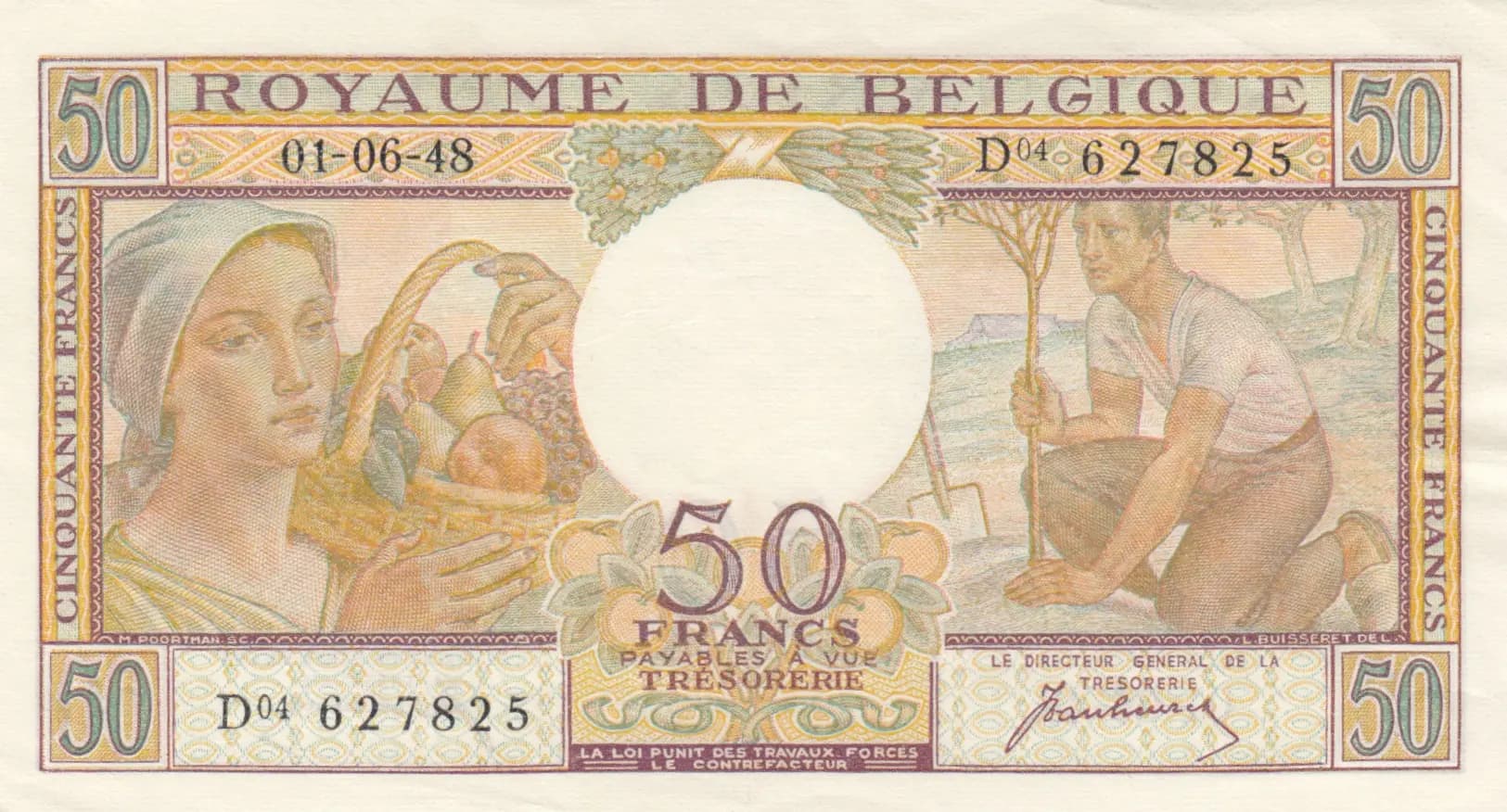
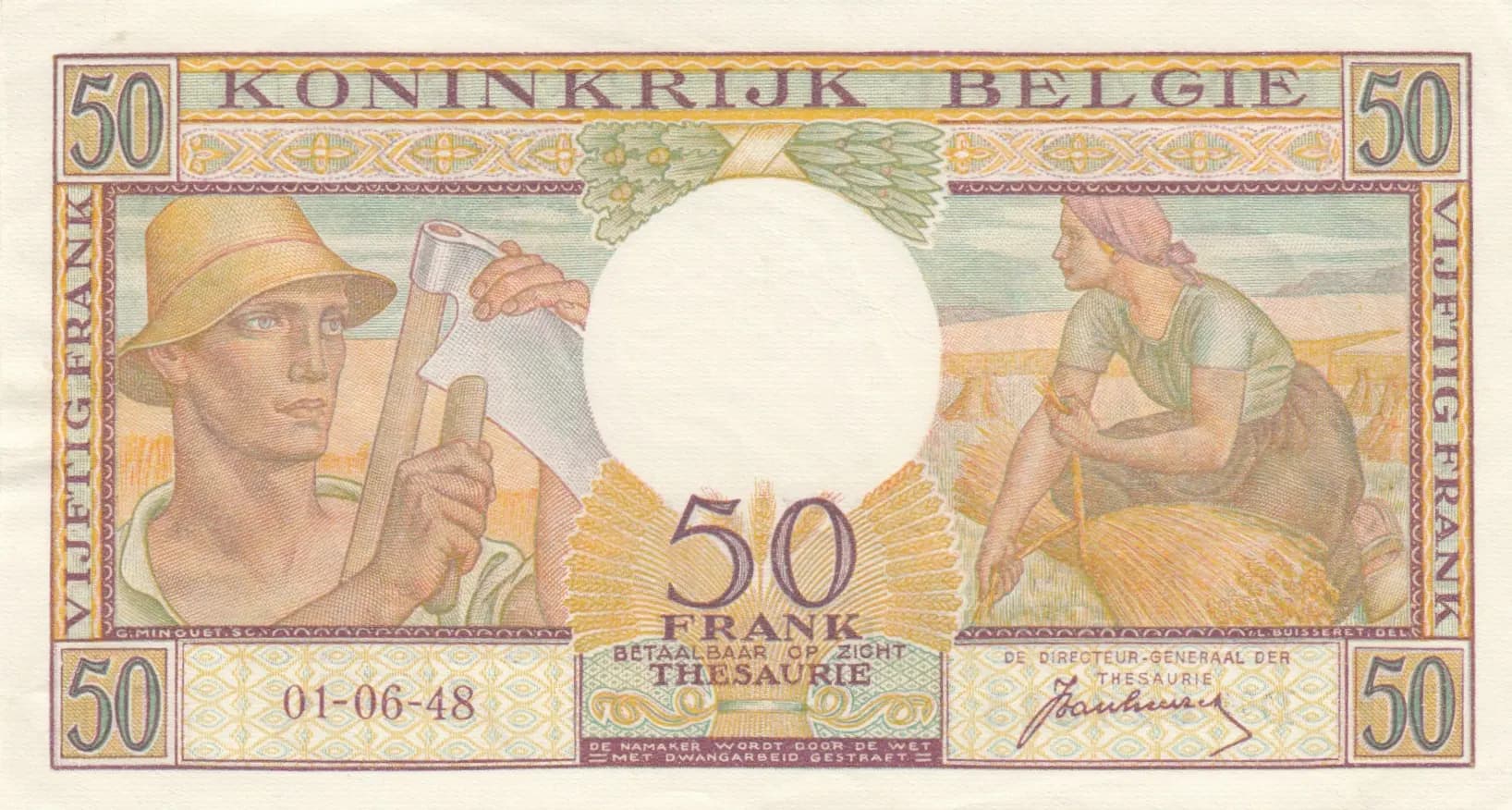
This 50 Francs Belgian banknote from June 1, 1948 presents an exceptional example of post-war Belgian currency in AU condition, featuring allegorical representations of agricultural labor rendered in warm, classical tones of brown, gold, and green. The note exhibits crisp, well-preserved printing with no visible wear, creases, or foxing, representing the kind of minimally circulated specimen that appeals to collectors of mid-20th century European currency. The bilingual design—French on obverse and Dutch on reverse—reflects Belgium's linguistic duality and showcases the fine engraving typical of this era's banknote production.
Common. eBay market data shows numerous transactions across various grades (VG to PMG 67), with most sales ranging from $3.73 to $23.12, with only premium graded specimens (PMG 67) reaching $63–$84. These prices, combined with the apparent circulation of multiple examples at different grade levels over many years, strongly indicate this is a standard circulation note from a large print run. No evidence of rarity or scarcity is apparent from the market activity or catalog records.
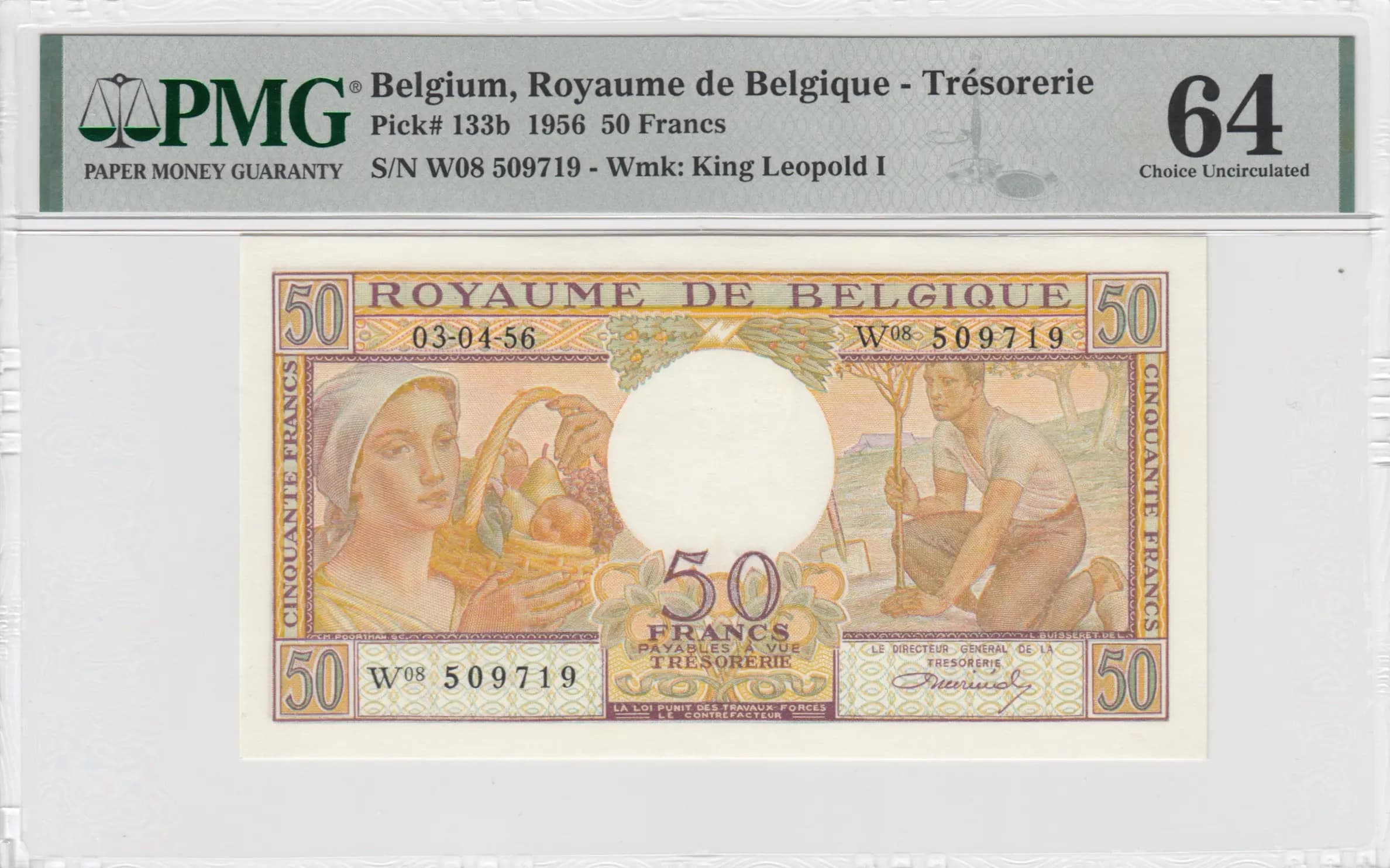
Issued in 1948 during Belgium's post-World War II reconstruction period, this banknote celebrates the agricultural and labor-based recovery of the nation through its allegorical imagery. The depicted grape vines, harvested grain, and working figures—a farm woman with fruit, a man planting a tree, a farmer with scythe, and woman with sheaf—symbolize Belgium's agrarian heritage and the labor-intensive rebuilding of the economy following Nazi occupation. The Treasury (Trésorerie/Thesaurie) issuance underscores the Belgian government's direct monetary authority during this critical period of national recovery.
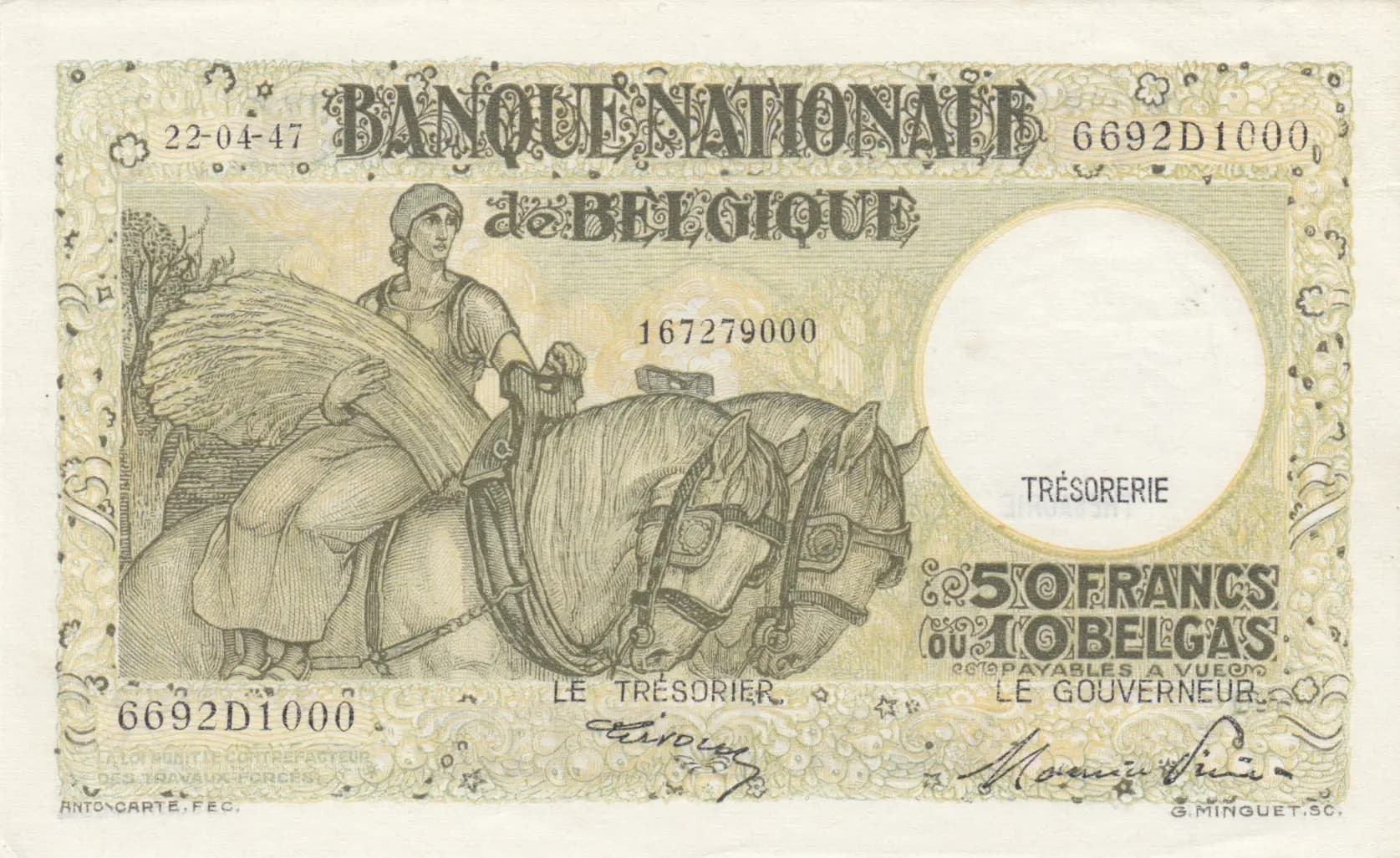
The obverse features a classical allegorical composition with a female profile on the left representing agricultural fertility or harvest, wearing traditional head covering, facing left in profile. Centered above is ornamental grape vine and leaf decoration symbolizing prosperity and abundance. To the right is a seated male laborer in work clothes, likely representing the farmer or agricultural worker engaged in productive labor. The reverse presents complementary agricultural imagery: on the left, a man wearing a straw hat holding a farming implement (scythe or sickle), and on the right, a seated woman in work attire and head covering binding or handling sheaves of harvested grain. Both sides employ the same decorative vine motif at top center, creating visual continuity. The warm color palette of browns, golds, greens, and cream tones creates a cohesive aesthetic celebrating rural labor and agricultural production. The ornamental geometric borders and fine line-work throughout serve both decorative and security functions. A large watermark area (King Leopold I) appears as a blank circle in the center of both sides.
FRONT (French): 'ROYAUME DE BELGIQUE' (Kingdom of Belgium); 'FRANCS PAYABLES A VUE' (Francs payable on demand); 'TRESORERIE' (Treasury); 'CINQUANTE FRANCS' (Fifty francs); 'LE DIRECTEUR GENERAL DE LA TRESORERIE' (The Director General of the Treasury); 'LA LOI PUNIT LES FAUX FORCÉS ET LE CONTREFACTEUR' (The law punishes forgers and counterfeiters); Date: '01-06-48' (June 1, 1948); Serial number: 'D⁰4 627825'; Denomination: '50' (in all four corners); Signature element: 'LE BUISSERET DE LA' (part of official signature). BACK (Dutch): 'KONINKRIJK BELGIE' (Kingdom of Belgium); 'FRANK' (Francs); 'BETAALBAAR OP ZICHT' (Payable on sight); 'THESAURIE' (Treasury); 'DIRECTEUR-GENERAAL DER THESAURIE' (Director General of the Treasury); 'VIJFTIG FRANCS' (Fifty francs); 'DE NAAMTEKER WORDT DOOR DE WET MET DWANGBAREID GESTRAFT' (The counterfeiter is punished by law with forced labor); Signature: 'G.MINQUET'; Date: '01-06-48'; Denomination: '50' (in all four corners); Signature element: 'LE BUISSERET DE LA'.
This banknote employs intaglio (engraved) printing, evidenced by the fine line work, intricate ornamental details, and the crisp impression visible throughout both sides. The quality of the engraving—particularly in the rendering of human figures, decorative elements, and borders—is characteristic of security printing by a professional banknote printer. Belgian Treasury notes of this period were typically printed by the Banque Nationale de Belgique's printing facilities or contracted security printers such as Giesecke+Devrient or similar European banknote manufacturers. The multi-color application shows the sophisticated color registration typical of mid-20th century commercial banknote production.
This note is cataloged as Pick-133a, with two other documented variants (P-133b and P-133s) noted in the PMG population report. The 'a' designation typically indicates the primary version or first state of this denomination. Without additional specific information on the differences between variants, the distinguishing factors may relate to signature variations, date changes, or serial number prefixes. The observed example features the signature 'G.MINQUET' on the reverse and the date '01-06-48' (June 1, 1948). Further variety identification would require comparison with authenticated examples of P-133b and P-133s to determine whether variations exist in signatures, printer's marks, serial number prefixes, or other security features.