5 pounds 1938
Market Prices
8 salesAbout This Note
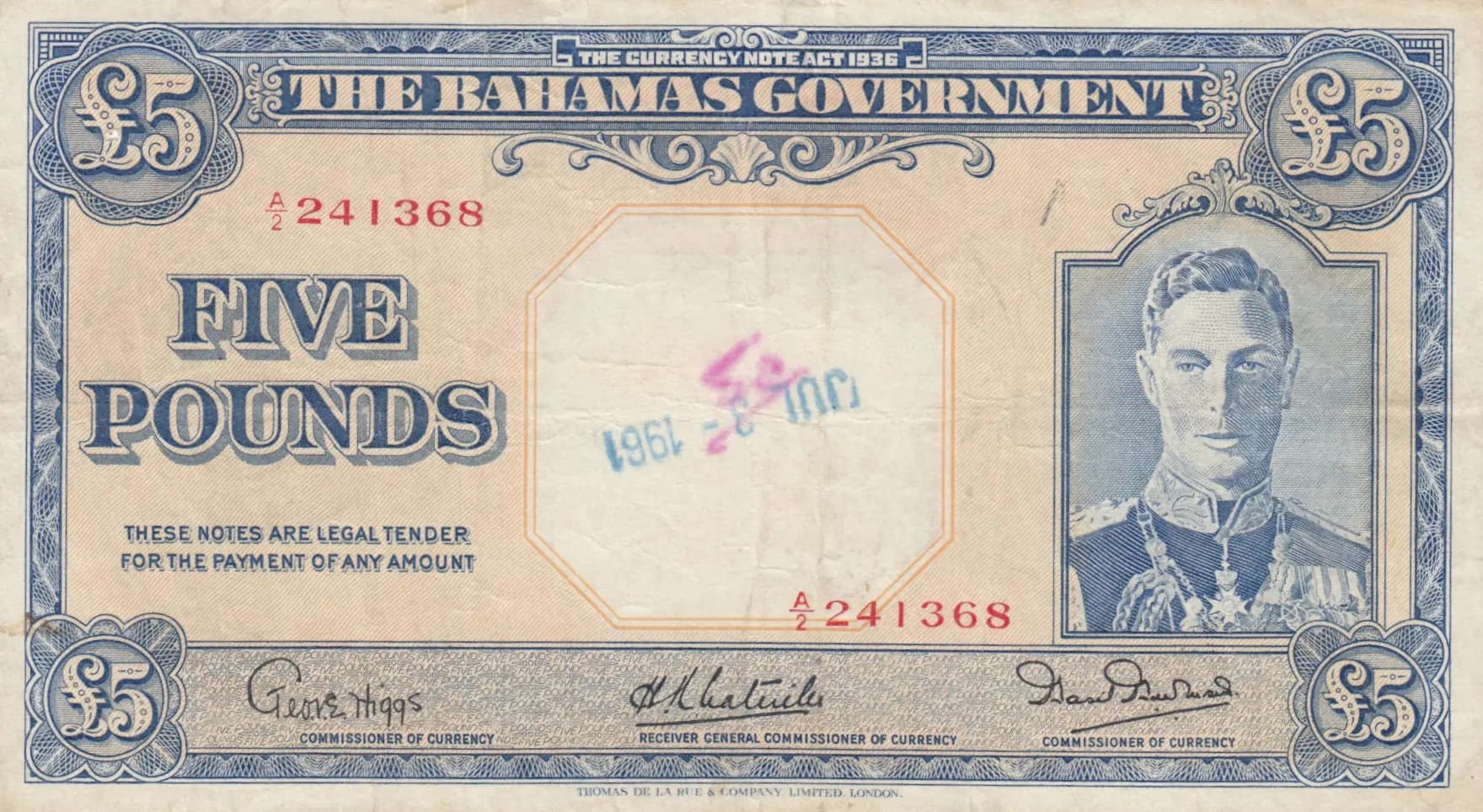
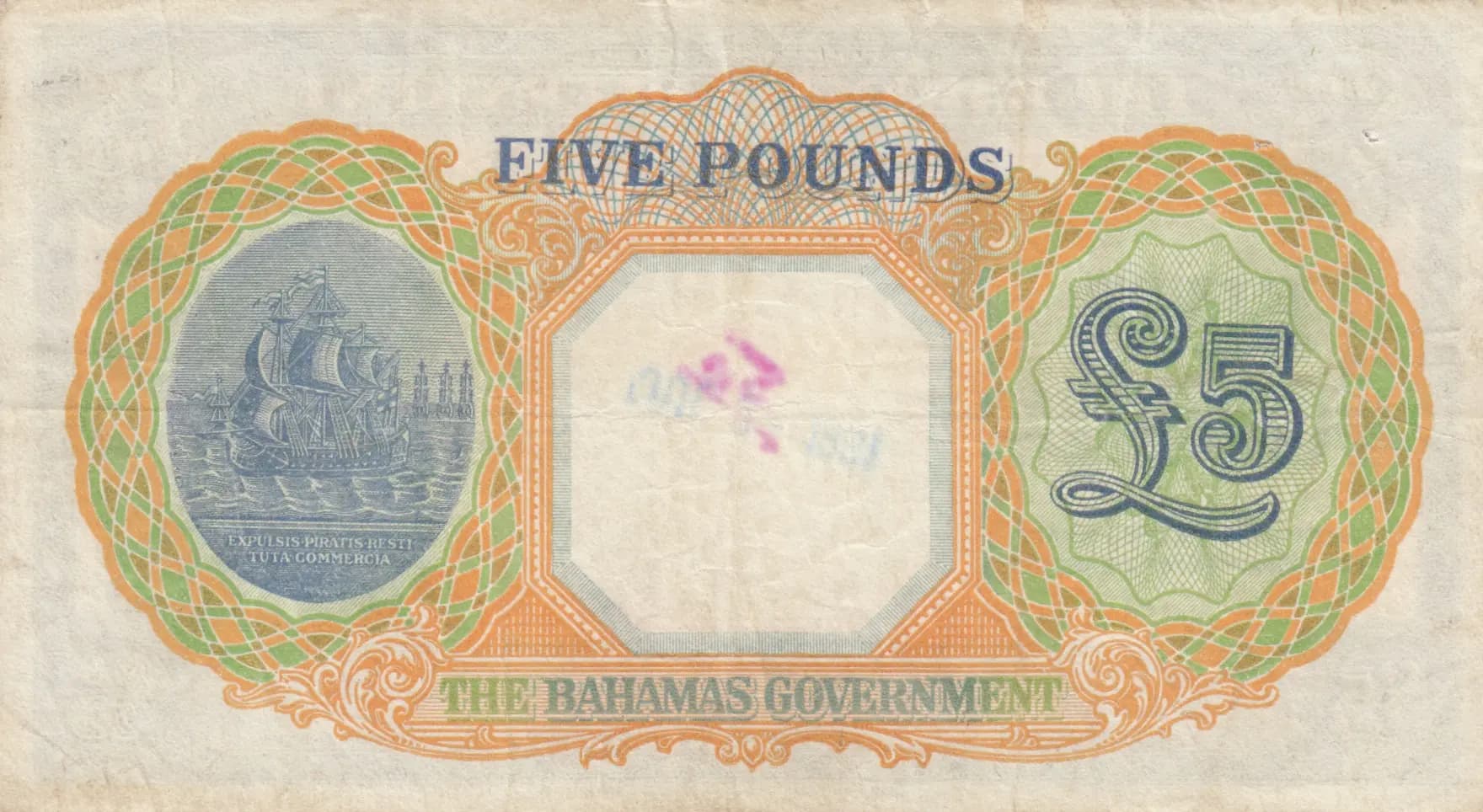
This is a VF-graded 1938 Five Pounds banknote from The Bahamas Government, issued under the Currency Note Act of 1936 and printed by Thomas de La Rue in London. The note features a striking portrait of King George VI in military dress uniform on the obverse, paired with an elaborate reverse design showcasing a three-masted sailing ship and ornamental numeral '5' within decorative Celtic knot borders. The note displays moderate age-related wear including creasing and foxing, with a notable pink/purple cancellation stamp across the central panel, consistent with circulation in the early 20th century.
Common. This is a standard regular issue of the 1938 Five Pounds note (Pick P-12b) from The Bahamas Government, with no evidence of limited print runs or recall status. Market data from eBay auctions shows consistent sales in the $200-$400 range for VF-graded examples across multiple years (2010-2020), with recent PMG-graded examples commanding higher prices ($201-$660 depending on grade). The 2016 catalogue value for VF is $400, and auction history demonstrates reliable market availability. VF examples are neither scarce nor difficult to locate for collectors.
This note was issued during the reign of King George VI (1936-1952) under the Bahamas Government's Currency Note Act of 1936, marking the transition to a formal currency system for the island colony. The reverse design's ship imagery and Latin motto 'Expulsis Piratis Bessi Tuta Commercia' (With pirates expelled, commerce is secure) reflect the Bahamas' maritime heritage and its historical struggle against piracy in Caribbean waters. The use of English inscriptions and George VI's portrait emphasize the Bahamas' status as a British colonial possession during this period.
The obverse features a formal portrait of King George VI positioned on the right side, depicted in full military dress uniform with medals, crosses, and decorative insignia visible on his chest, rendered in fine engraved detail. The left side displays the denomination 'FIVE POUNDS' in large serif letters within ornate cartouches. The entire design is framed by intricate blue decorative borders with scrollwork and floral elements in the corners, utilizing fine guilloche patterns throughout for security purposes. The reverse presents two circular medallion vignettes: on the left, a three-masted sailing ship representing Bahamas' maritime commerce; on the right, a large ornamental numeral '5' with decorative flourishes. These vignettes are framed within an elaborate interlaced Celtic or geometric knot pattern border in orange and green, with 'FIVE POUNDS' centered at the top and 'THE BAHAMAS GOVERNMENT' in green text at the bottom. An octagonal central panel with decorative orange/tan borders frames the core design elements.
FRONT: 'The Currency Note Act 1936' - legal basis for note issuance; 'The Bahamas Government' - issuing authority; 'Five Pounds' - denomination; Serial number A 2441368; 'These notes are legal tender for the payment of any amount' - legal tender declaration; 'Commissioner of Currency' / 'Receiver General Commissioner of Currency' - signature authority titles; '1961 2/JUN' - cancellation/handling stamp date. BACK: 'Five Pounds' - denomination; 'Expulsis Piratis Bessi Tuta Commercia' - Latin motto translating to 'With pirates expelled, commerce is secure'; 'The Bahamas Government' - issuing authority.
Intaglio engraving, the primary method employed by Thomas de La Rue & Company, London, as evidenced by the fine, detailed portrait work, intricate guilloche patterns, and the precise line work visible in the decorative borders and vignettes. The multi-color printing technique is evident from the combination of blue, orange, green, and red inks used throughout the design. Red serial numbering was applied as a separate print pass.
This note is catalogued as Pick P-12b, representing the standard printing variant by Thomas de La Rue. The PMG Population Report identifies two variants for the base Pick number (P-12b and P-12s), with P-12b being the primary issue. The observed specimen carries serial number A 2441368 and shows the standard 'Commissioner of Currency' signature titles without specialized overprints beyond the post-issue 1961 cancellation stamp visible on the specimen. No signature variations or printer variants are evident from the visual analysis.