10 shillings 1936
Market Prices
2 salesAbout This Note
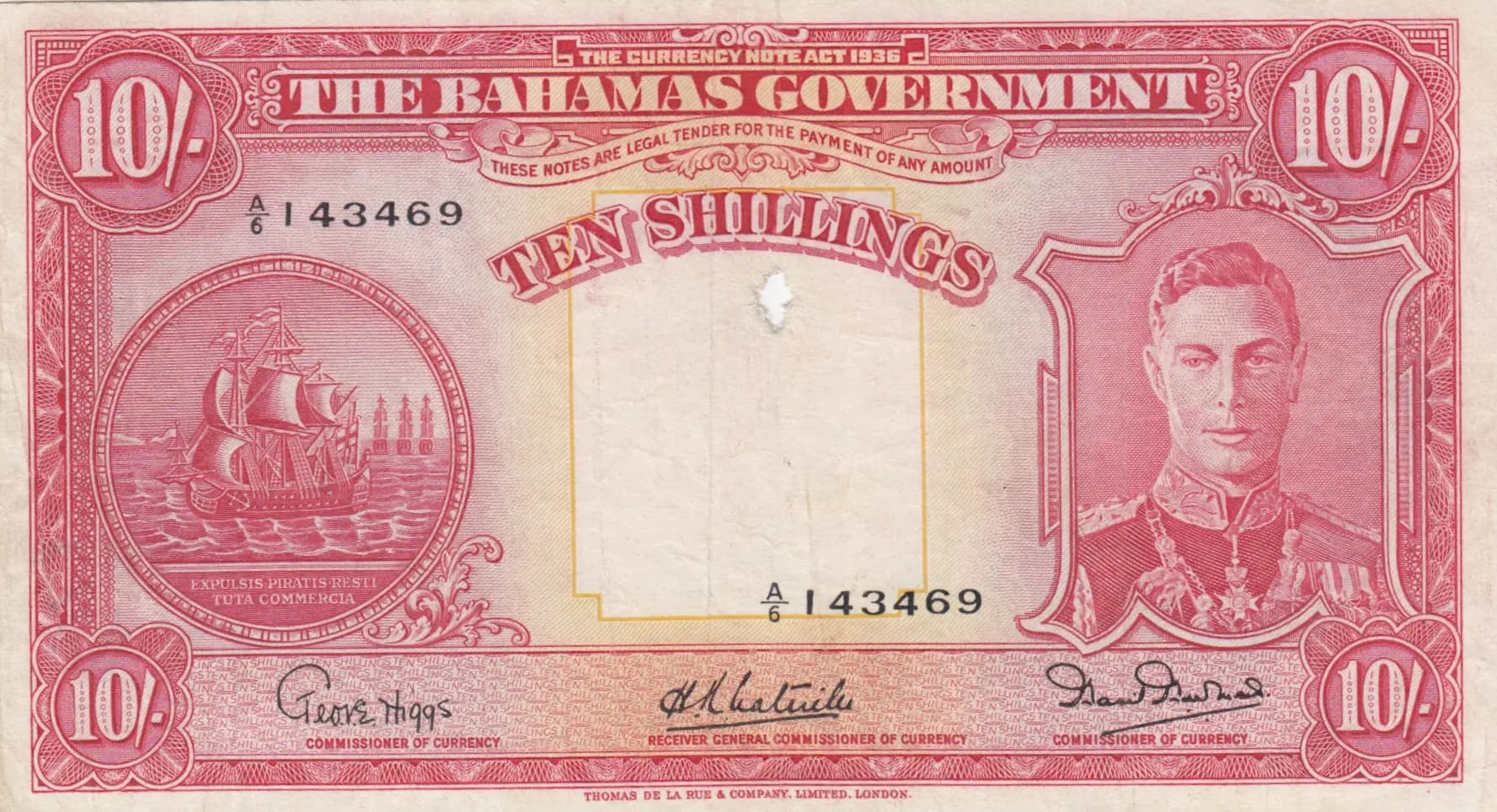
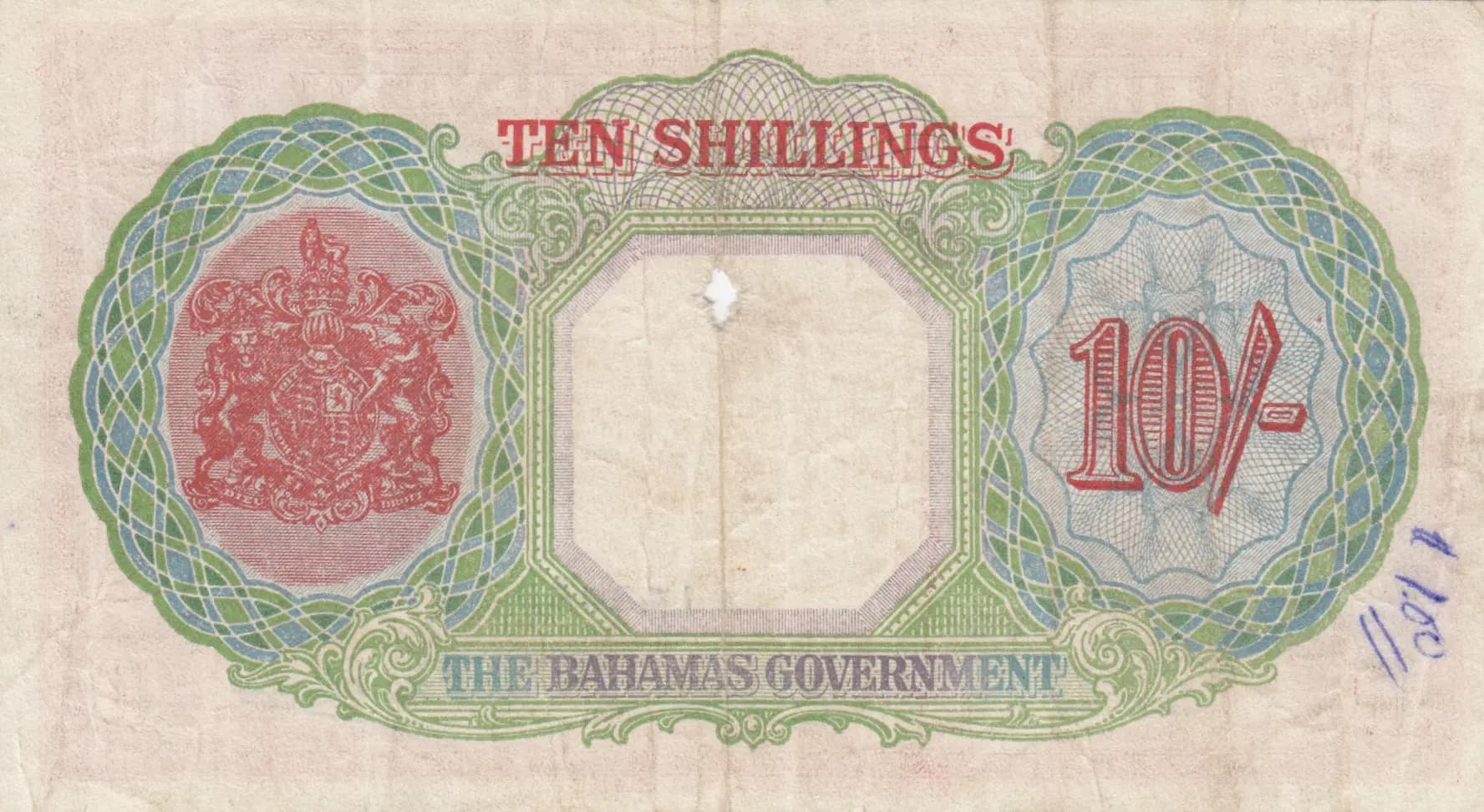
This is a 1936 Bahamas Government 10 shillings note (Pick P-10d) printed by Thomas de La Rue in pink/rose and green/blue colors, featuring King George VI in military dress on the obverse and the Bahamas coat of arms on the reverse. The note exhibits Fair condition with visible aging including foxing, yellowing, creasing, and a small hole in the center, consistent with a note that has seen considerable age and storage over nearly nine decades.
Common. While this is a pre-independence colonial currency note now over 85 years old, the eBay price tracking data indicates relatively modest valuations with VF specimens selling in the $62-$89 range as recently as 2021, and catalog values placing VF examples at $100 and UNC at $800. These moderate prices and the existence of multiple cataloged varieties (P-10a, P-10b, P-10d) suggest adequate production and survival rates. The 1936 issue appears to have been printed in substantial quantities sufficient to meet circulation demands, and examples remain accessible to collectors at reasonable prices. A note in Fair condition would be valued well below the VF figures, likely in the $15-$30 range based on standard grading discounts.
Issued under the Currency Note Act of 1936, this note represents the Bahamas Government's establishment of its own currency system during the latter years of the British Empire. The obverse prominently features King George VI in formal military uniform, reflecting the dominion's loyalty to the Crown during this period. The reverse displays the heraldic coat of arms with the Latin motto 'Expilsis Piratis Restituta Commercia' (Commerce Protected with Pirates Expelled), referencing the islands' historical struggles against piracy and their role in maritime commerce.
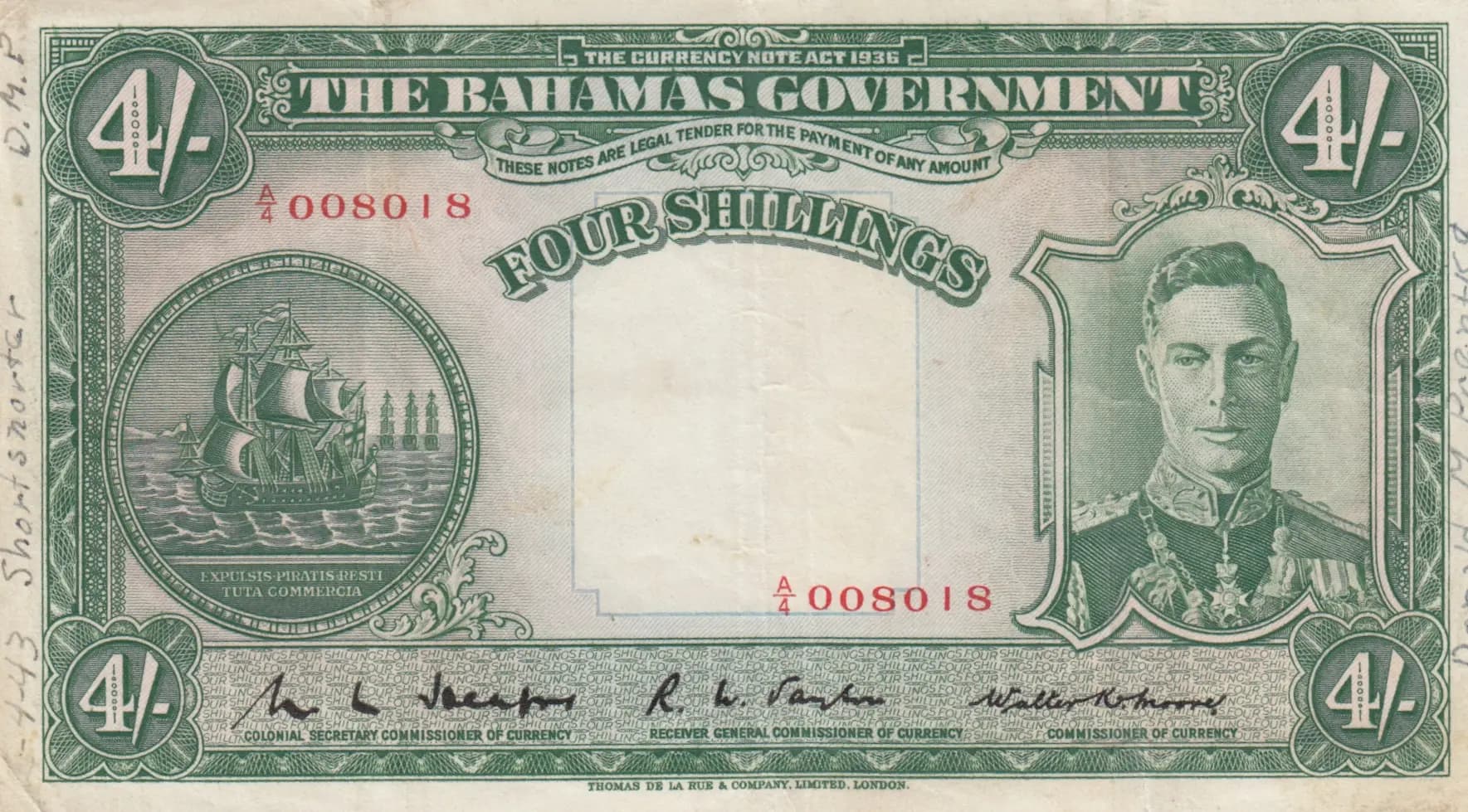
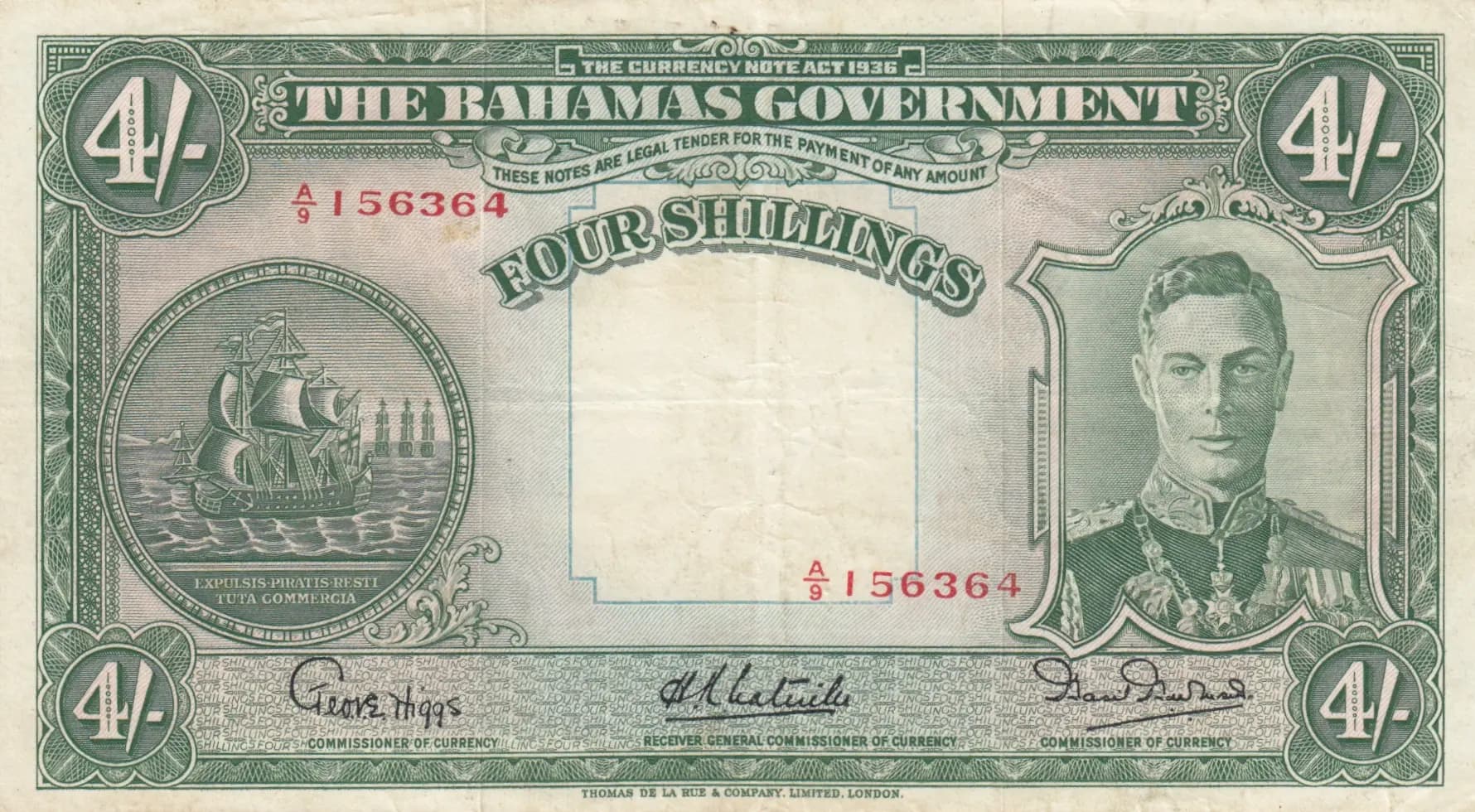
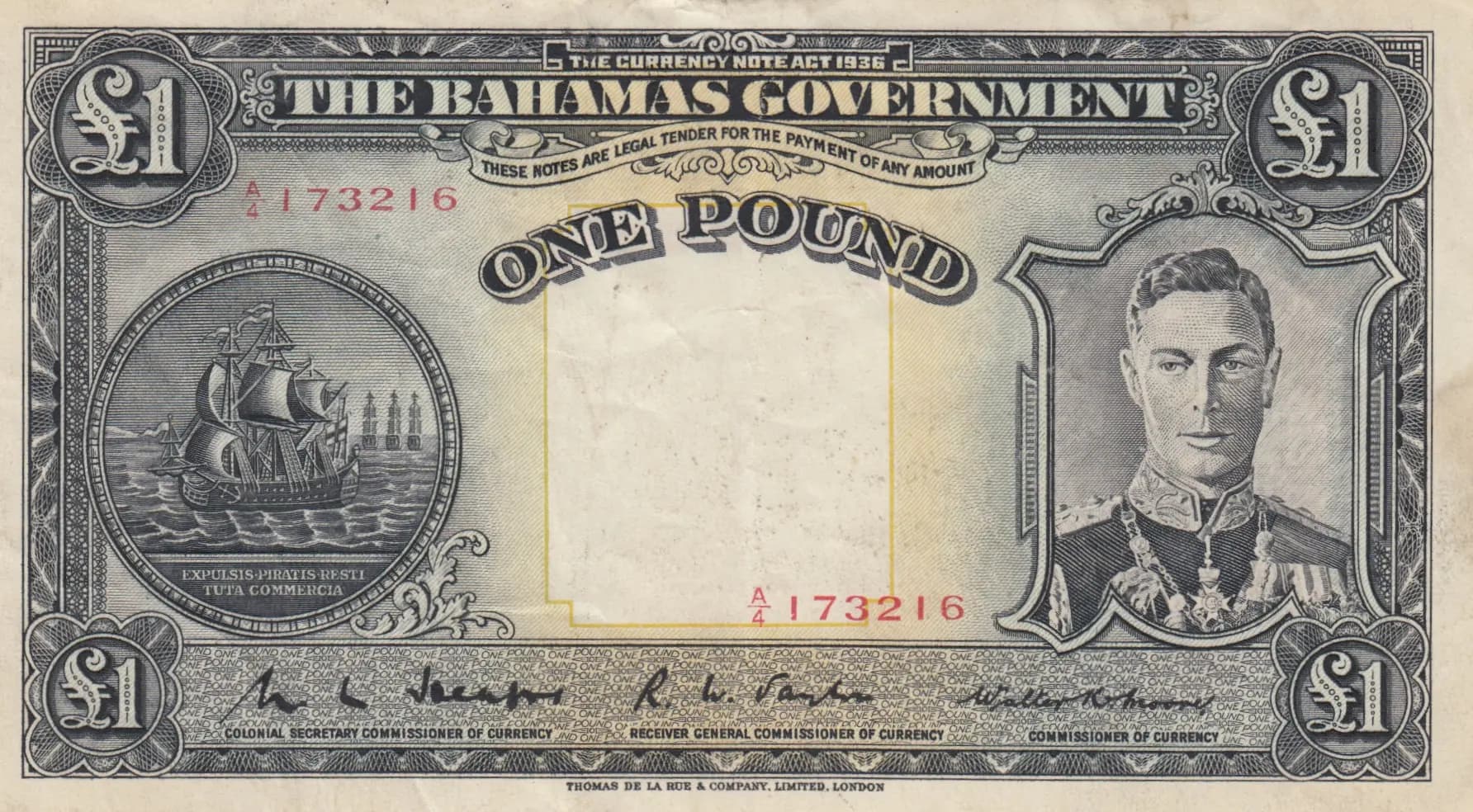
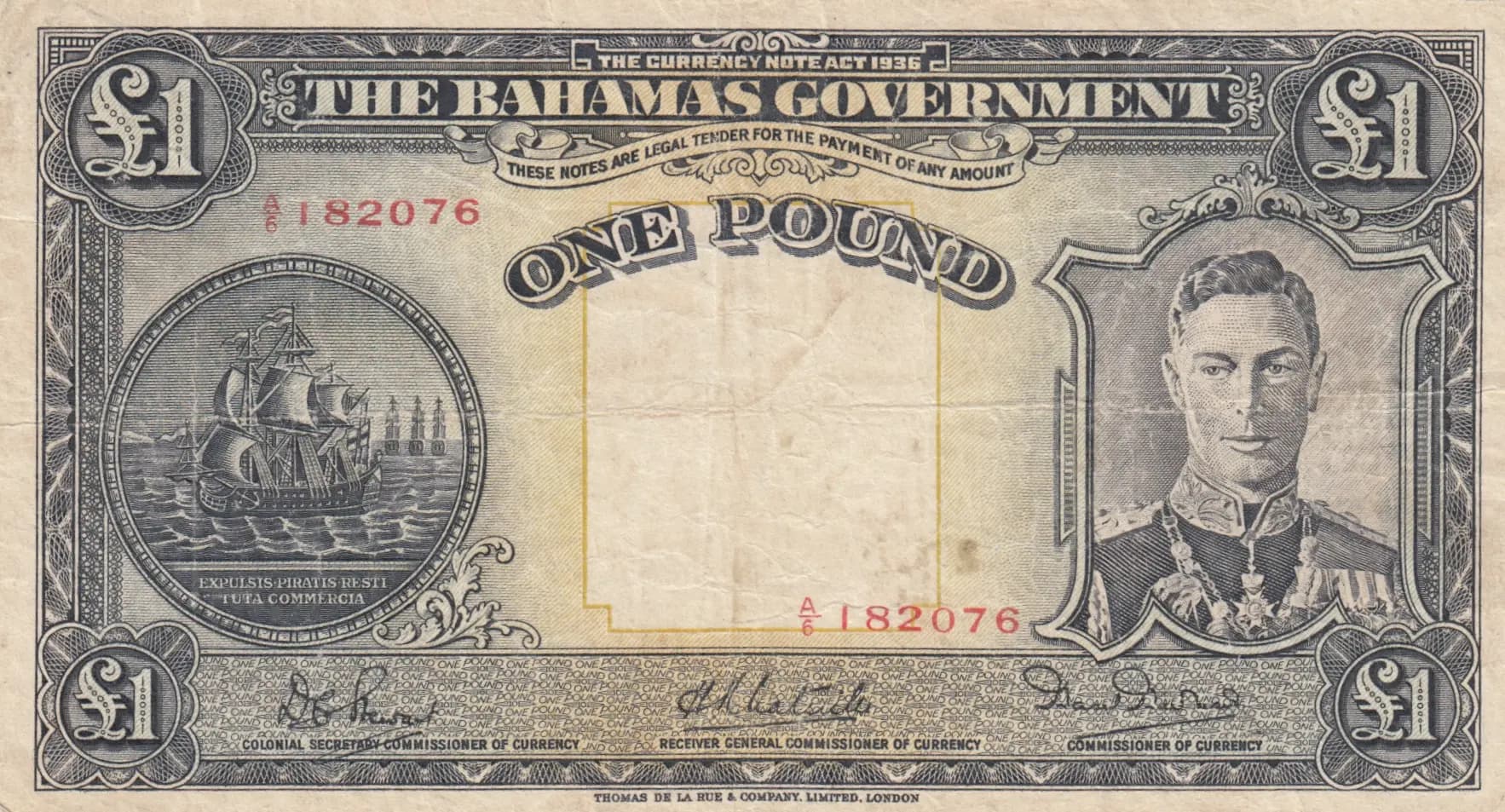
The obverse features a symmetrical design with King George VI depicted in formal military dress uniform with medals and insignia, positioned within an ornate decorative frame on the right side. On the left side is a circular maritime medallion containing an engraved multi-masted sailing ship with Latin inscription, representing the islands' naval heritage and historical significance. The denomination '10/-' appears in ornate corner medallions in all four corners. The reverse displays the Bahamas coat of arms—a heraldic shield featuring a lion rampant—within an elaborate medallion on the left, balanced by large red denomination numerals '10/-' on the right. Both sides feature intricate decorative scrollwork, fine line borders, and geometric patterning in the ornamental frames. The note utilizes a pink/rose color scheme on the front and green/blue coloring on the reverse, creating a visually distinctive two-tone presentation typical of high-quality government currency of the 1930s.
FRONT SIDE: 'THE BAHAMAS GOVERNMENT' - The Bahamas Government; 'THE CURRENCY NOTE ACT 1936' - The Currency Note Act 1936; 'THESE NOTES ARE LEGAL TENDER FOR THE PAYMENT OF ANY AMOUNT' - These notes are legal tender for the payment of any amount; 'TEN SHILLINGS' - Ten Shillings; '10/-' - Ten shillings (abbreviated); 'EXPILSIS PIRATIS RESTI TUTA COMMERCIA' - Commerce protected with pirates expelled (Latin motto); 'THOMAS DE LA RUE & COMPANY, LIMITED, LONDON' - Thomas De La Rue & Company, Limited, London (printer); 'COMMISSIONER OF CURRENCY' - Commissioner of Currency (signature title); 'RECEIVER GENERAL COMMISSIONER OF CURRENCY' - Receiver General Commissioner of Currency; Signatures of George Higgs and D.D Sands in their official capacities; Serial number 'A/6 143469'. BACK SIDE: 'TEN SHILLINGS' - Ten Shillings; '10/-' - Ten shillings (abbreviated); 'THE BAHAMAS GOVERNMENT' - The Bahamas Government.
Intaglio engraving (line engraving), the signature printing method of Thomas de La Rue & Company, Limited, the world-renowned London security printer. The fine line engraving is evident throughout the design in the detailed portrait work, intricate border patterns, geometric decorations, and the heraldic imagery. This labor-intensive engraving process provided inherent security through the difficulty of reproduction and the fine detail visible in the printed result. The two-color printing (pink/red on obverse, green/blue on reverse) would have been accomplished through separate engraved plates and multiple press passes, a standard practice for this printer during the 1930s.
This note is cataloged as Pick P-10d, one of three known varieties for the 1936 10 shillings denomination (P-10a, P-10b, and P-10d), all printed by Thomas de La Rue. The specific variety distinction typically relates to signature variants or minor design changes across the three versions. The observed serial number prefix 'A/6' and the signature of George Higgs as Commissioner of Currency are identifying features. Without direct comparison to other varieties, the specific distinguishing characteristics of the P-10d variant cannot be definitively confirmed from the visual analysis alone, though the presence of Higgs' signature may indicate this particular variety.