4 shillings 1936
Market Prices
7 salesAbout This Note
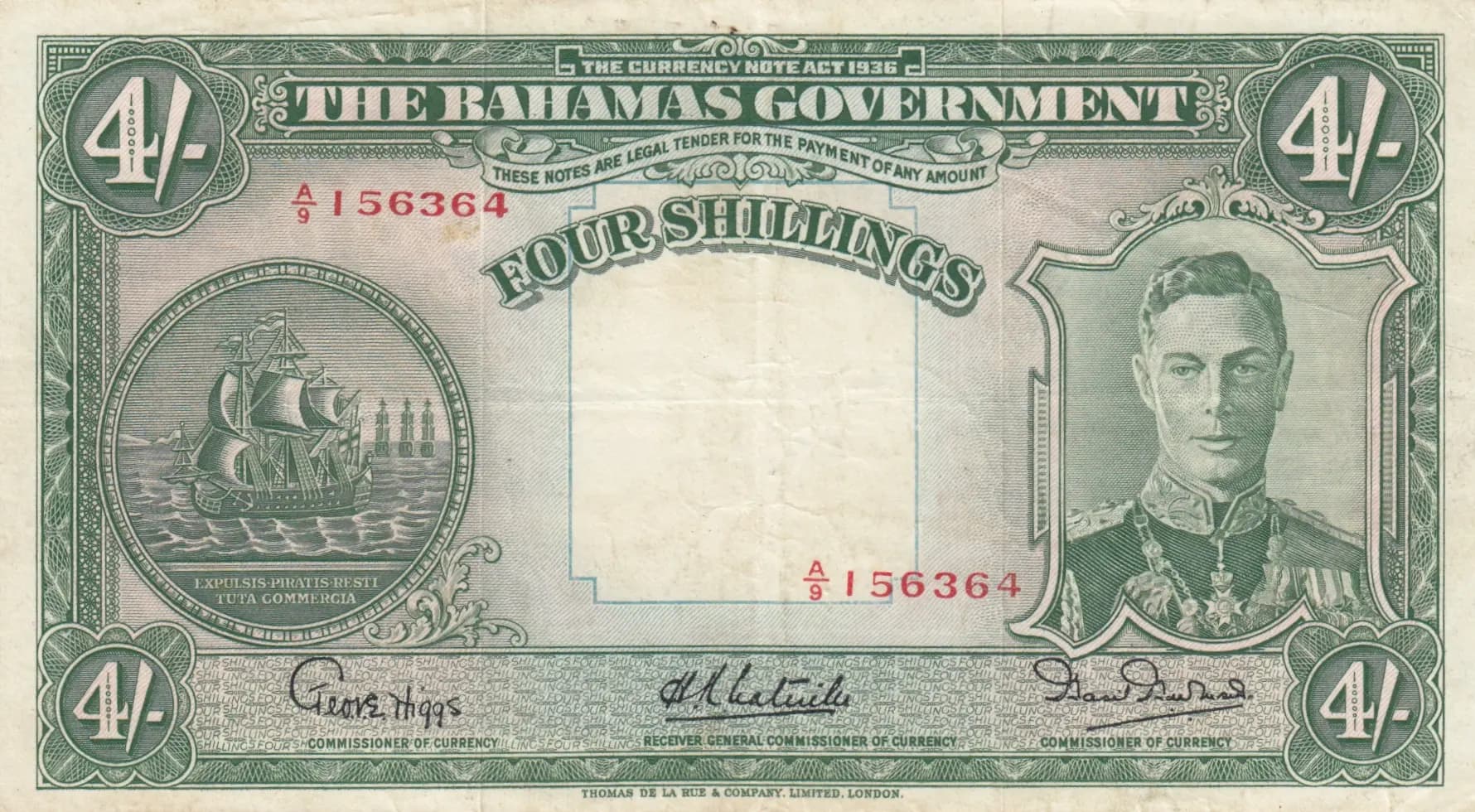
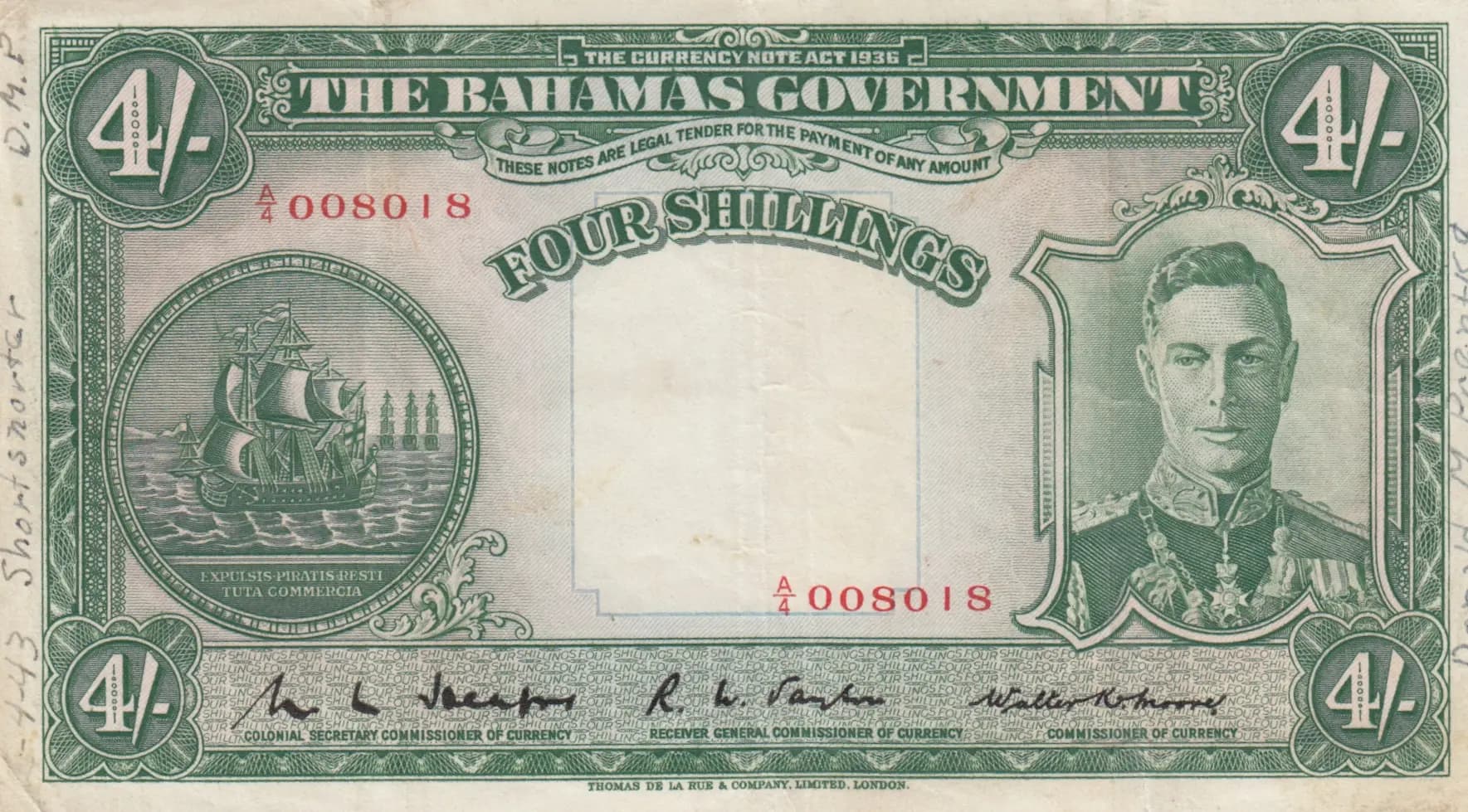
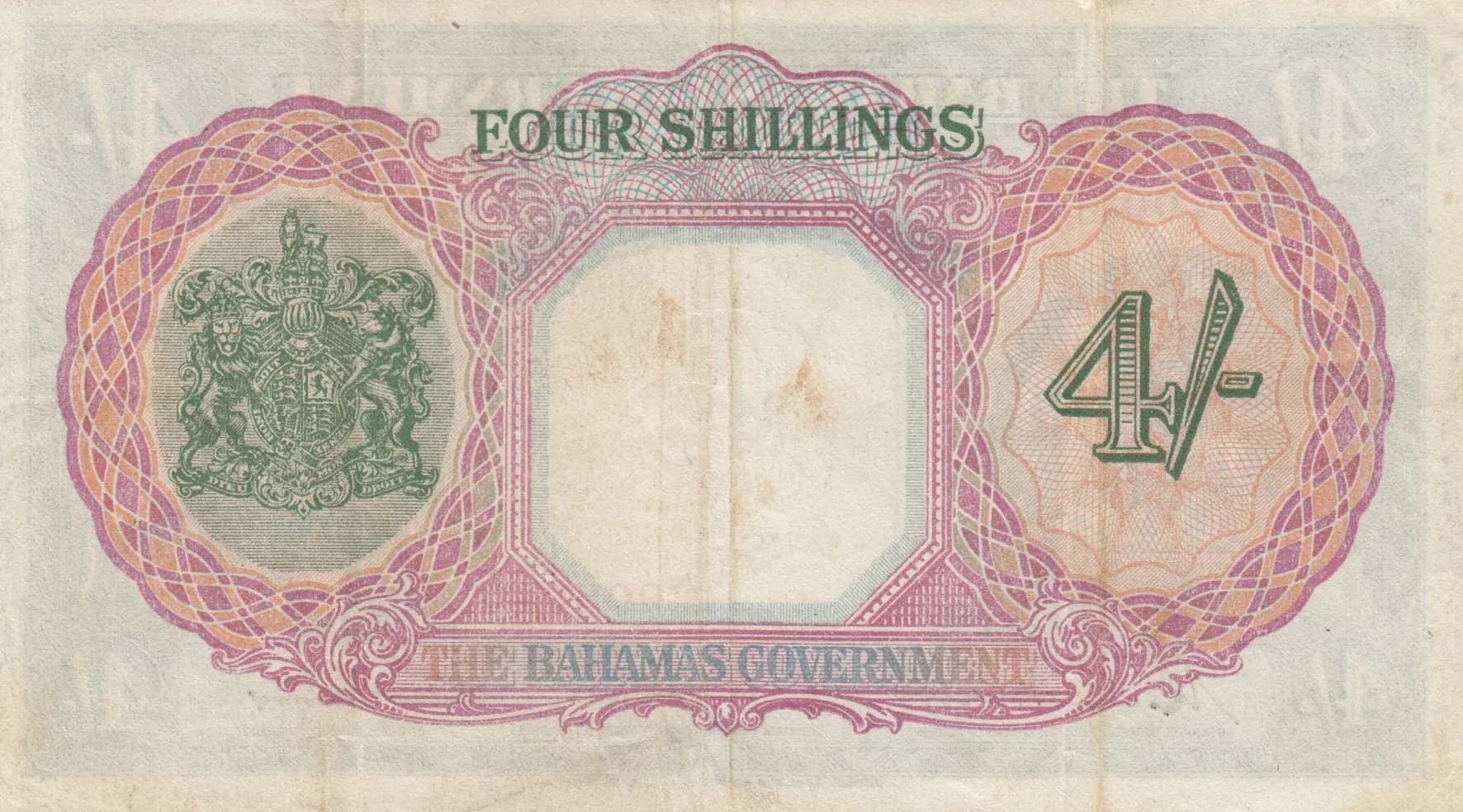
This is a VF-graded 4 Shillings banknote from the Bahamas Government issued under the Currency Note Act of 1936, printed by the prestigious Thomas de la Rue & Company in London. The note displays the characteristic green obverse with a detailed ship vignette and portrait of King George VI in military dress, while the reverse features the Bahamas coat of arms in pink/mauve tones. Despite visible creasing, foxing, and age-related wear consistent with its circulated VF condition, the note retains good detail in the fine-line engraving and remains a solid mid-grade example of early Bahamian currency.
Common. This note is a regular-issue currency piece from the Bahamas Government with substantial print runs typical of the 1936 Currency Note Act issuance. The eBay price history shows consistent VF sales averaging $48-61, with occasional lower prices around $25, indicating steady collector availability without premium scarcity. The 2016 catalog value of $75 for VF examples aligns with prices seen in the secondary market, and the presence of multiple graded examples in PMG records further confirms this is not a scarce variety. Most banknotes from established governments in the mid-20th century were produced in large quantities and remain common today unless subject to recall or destruction.
This note represents the Bahamas' early monetary independence under the 1936 Currency Note Act, marking the colony's transition to its own government-issued currency. The ship vignette likely references the maritime heritage and colonial trading history of the Bahamas, while the Latin motto 'Expuisis Piratis Restituta Commercia' (Commerce Restored from Pirate Expulsion) commemorates the colony's historical struggle against Caribbean piracy and its subsequent commercial recovery. The portrait of King George VI in formal military regalia emphasizes the Bahamas' continued connection to the British Crown during this period of the British Empire.
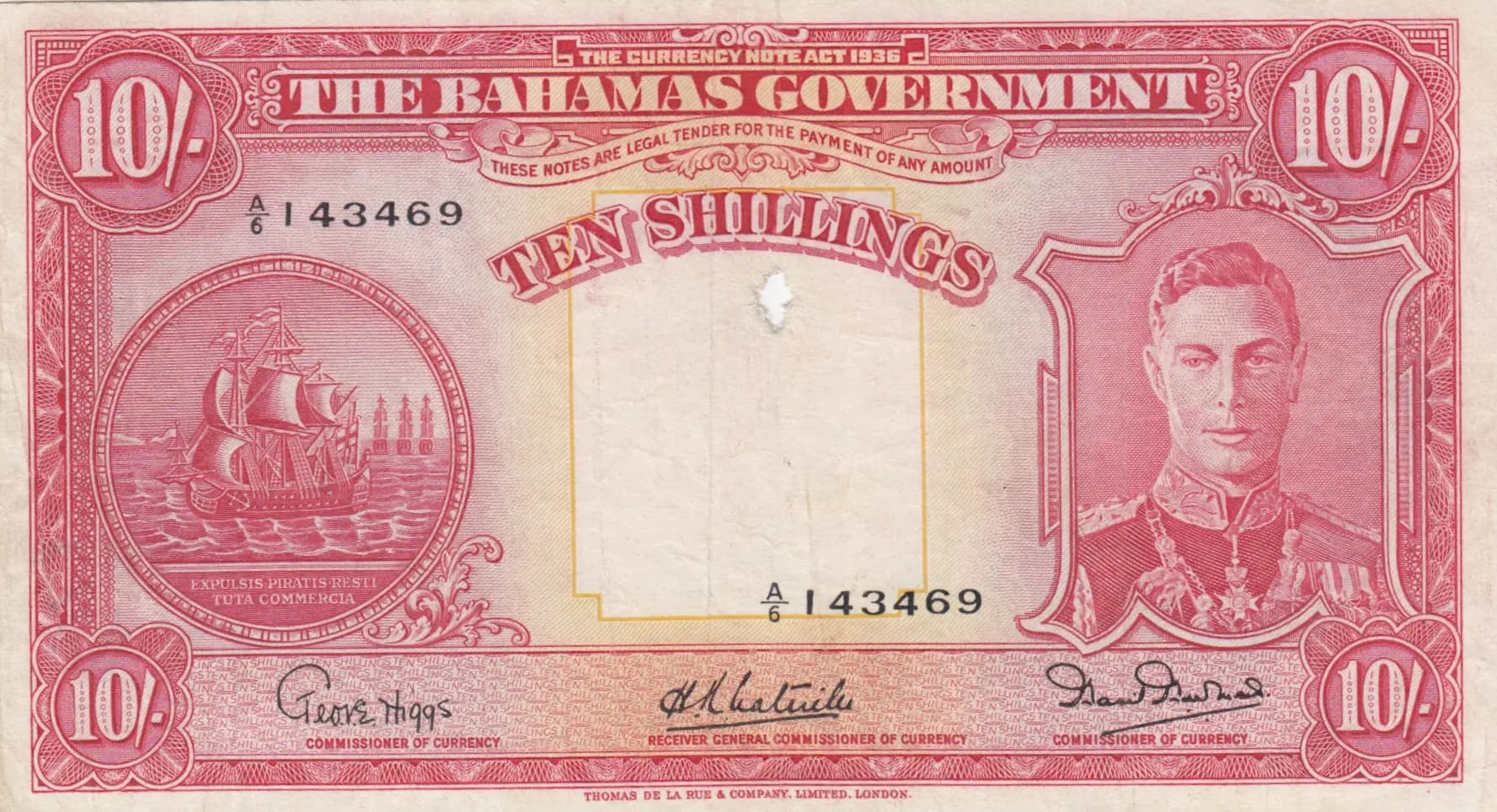
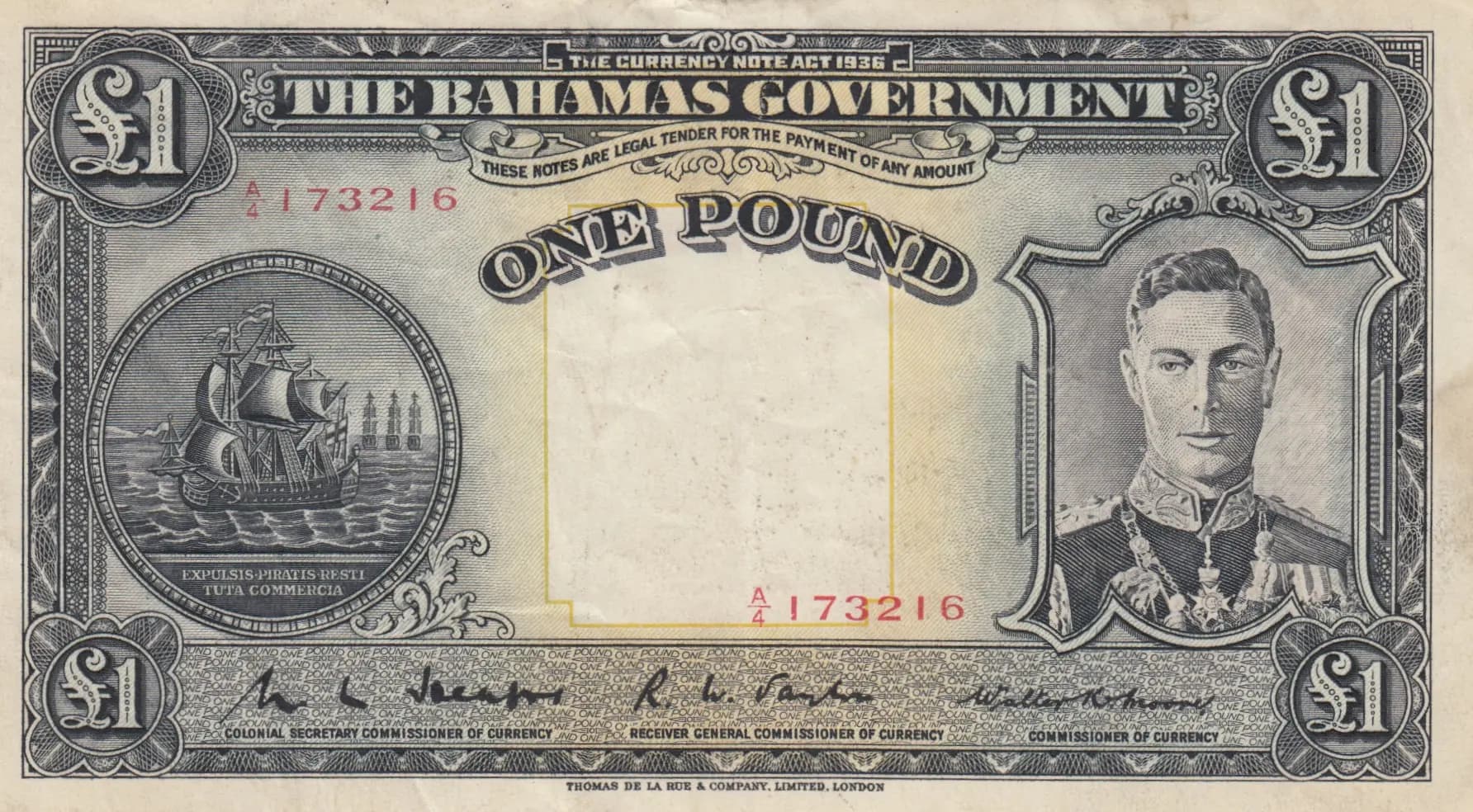
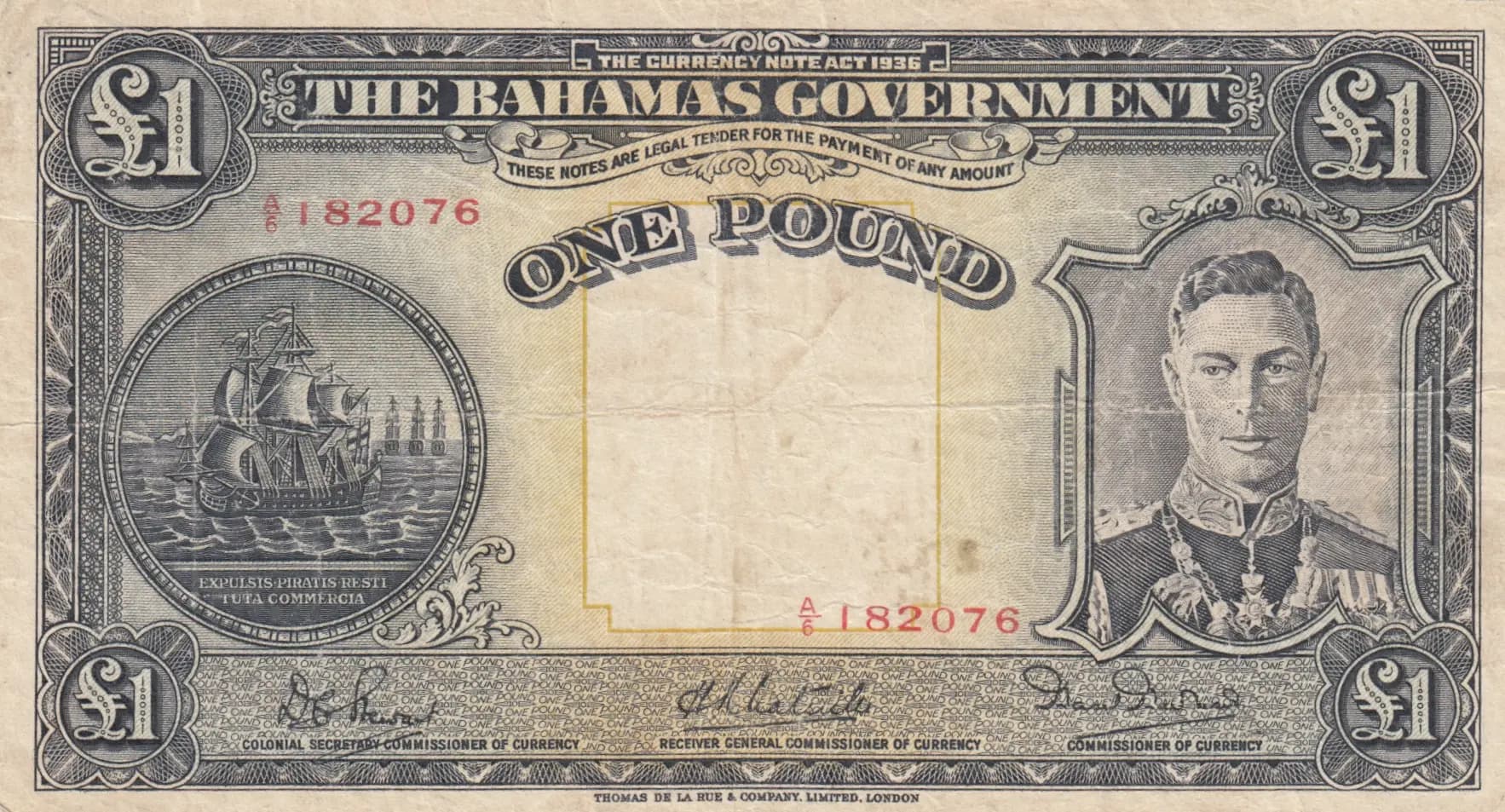
The obverse features King George VI portrayed in profile facing right, wearing formal military dress uniform with medals, insignia, and a decorated collar—a common representation of the British monarch on Commonwealth currency of this era. The left side displays an intricate circular vignette depicting a multi-masted sailing ship on water with a fortress or fortification visible in the background, enclosed within a decorative circular border with inscribed text. This maritime imagery reflects the Bahamas' seafaring and colonial heritage. The design incorporates the denomination '4/-' in rounded corner medallions at all four corners in green ink. The reverse features the Bahamas coat of arms with heraldic shield, crown, and supporting figures, rendered in fine-line engraving against the pink/mauve background, with the denomination prominently displayed on the right side. Both sides feature ornamental scrollwork, flourishes, and decorative latticed border patterns throughout.
Front side: 'THE CURRENCY NOTE ACT 1936' / 'THE BAHAMAS GOVERNMENT' / 'THESE NOTES ARE LEGAL TENDER FOR THE PAYMENT OF ANY AMOUNT' / 'FOUR SHILLINGS' / '4/-' / Serial number 'A008018' / 'EXPUISIS PIRATIS RESTITUTA COMMERCIA' (Commerce restored from pirate expulsion) / 'COLONIAL SECRETARY' / 'COMMISSIONER OF CURRENCY' / 'RECEIVER GENERAL COMMISSIONER OF CURRENCY' / 'THOMAS DE LA RUE & COMPANY, LIMITED, LONDON.' Back side: 'FOUR SHILLINGS' / '4/-' / 'THE BAHAMAS GOVERNMENT'
Intaglio (line engraving) printing by Thomas de la Rue & Company, Limited, London, as indicated by the printer's imprint and the fine-line engraving technique visible throughout the design. The security features include intricate decorative scrollwork, detailed heraldic engraving, and fine-line border patterns characteristic of De la Rue's high-security banknote production. The dual-color printing (green on obverse, pink/mauve on reverse) demonstrates sophisticated multi-plate intaglio work typical of mid-20th century British currency printers.
This note is cataloged as Pick P-9b, one of two known varieties for the 4 Shillings 1936 issue. Both P-9a and P-9b were printed by Thomas de la Rue & Company, London. The specific distinguishing characteristics between P-9a and P-9b are not evident from the visual analysis provided, but may relate to signature variations, serial number prefixes, or minor design modifications. The signature line visible in the image shows 'W. L. Heape' as noted in the reference catalogs, though the specific signature combination should be verified against the P-9b variety definition in the Pick catalog.