4 shillings 1953
Market Prices
32 salesAbout This Note
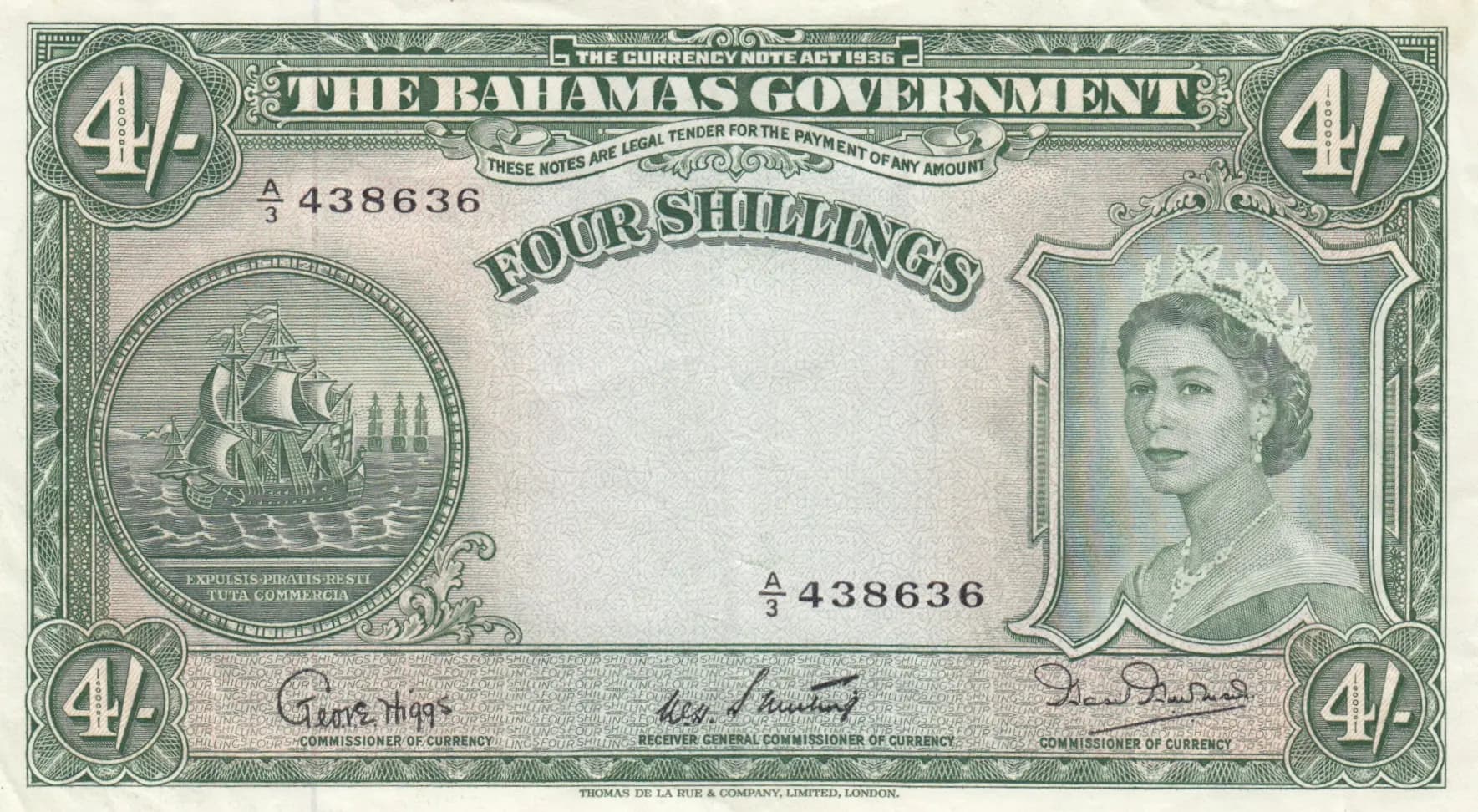
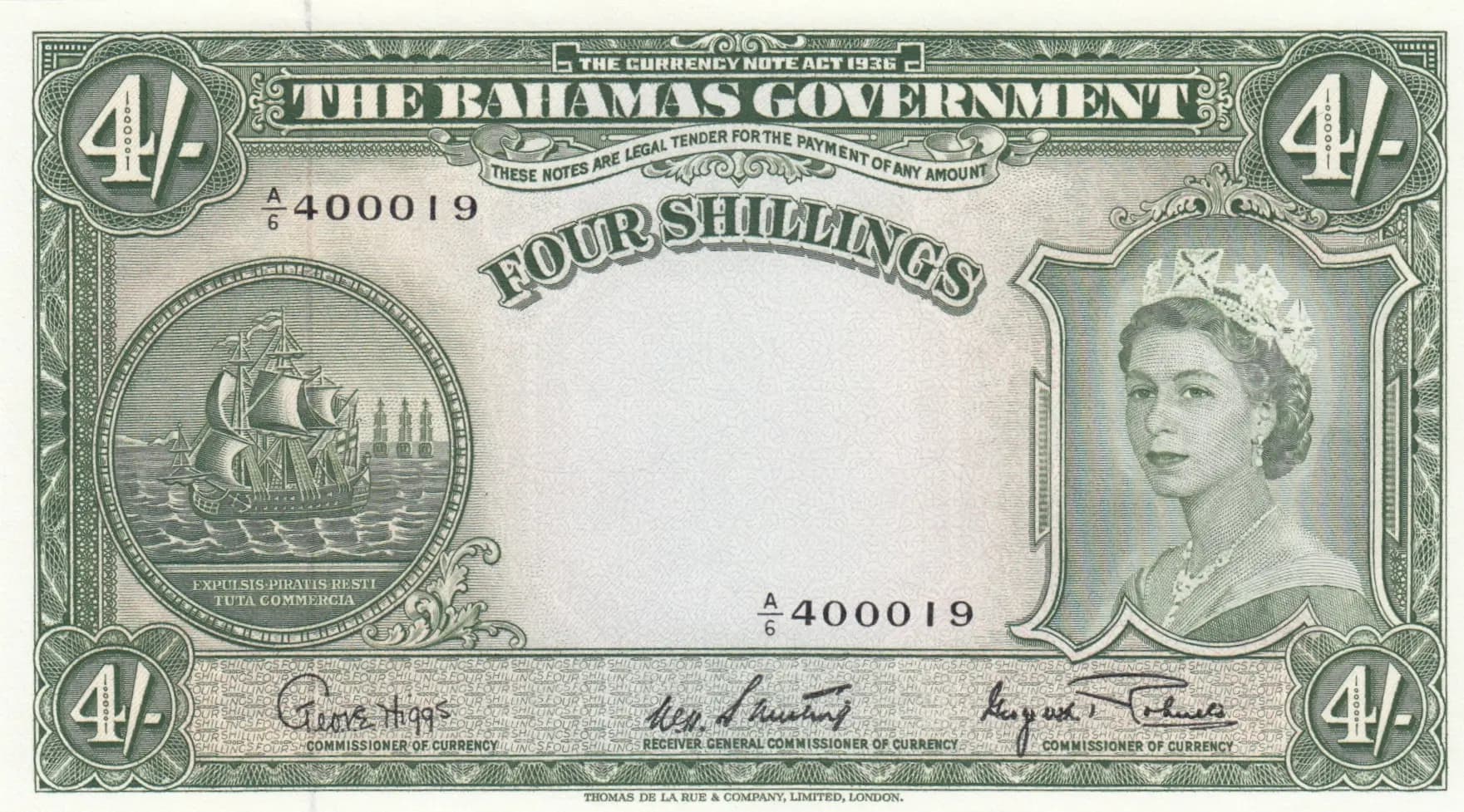
A crisp, uncirculated example of the Bahamas Government's 1953 Four Shillings note (Pick P-13d), printed by Thomas de La Rue in green ink. The note features a striking portrait of Queen Elizabeth II on the obverse and the Bahamas coat of arms on the reverse, with exceptional preservation showing no wear, creasing, or discoloration. This early Commonwealth currency issue represents an important piece of Bahamian monetary history from the post-war period.
Common. While this is an early Commonwealth issue from 1953, the eBay market data shows consistent availability with notes in average to fine condition selling regularly in the $12-40 range, and even graded examples (PMG 58-66) trading between $100-400. The 2016 catalog value of $450 for UNC reflects strong collector demand, but the consistent sales history and multiple examples reaching the market indicate this is a regularly available note in the collector market. Print run data is not definitively available, but the circulation of numerous examples in various grades suggests a substantial original issue.
Issued in June 1953 under the Currency Note Act of 1936, this banknote was produced during the early reign of Queen Elizabeth II, shortly after her accession in 1952. The reverse displays the Bahamas coat of arms with the Latin motto 'Expel the pirates, trade is safe,' reflecting the islands' historical maritime heritage and colonial governance. The note's design exemplifies the formal, ornate engraving style characteristic of British Commonwealth currency during the 1950s, a period when the Bahamas was transitioning toward greater financial independence while maintaining strong ties to British imperial traditions.
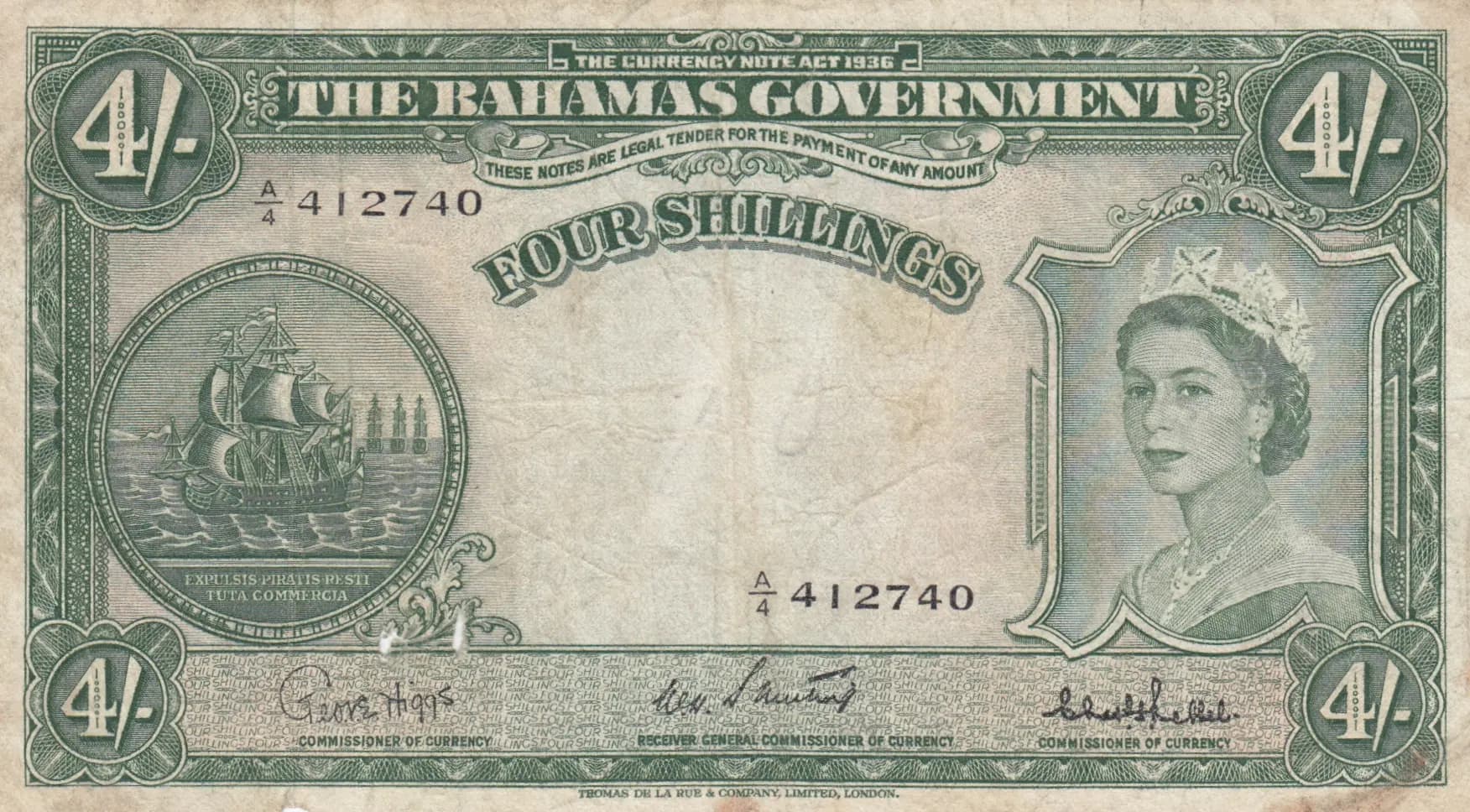
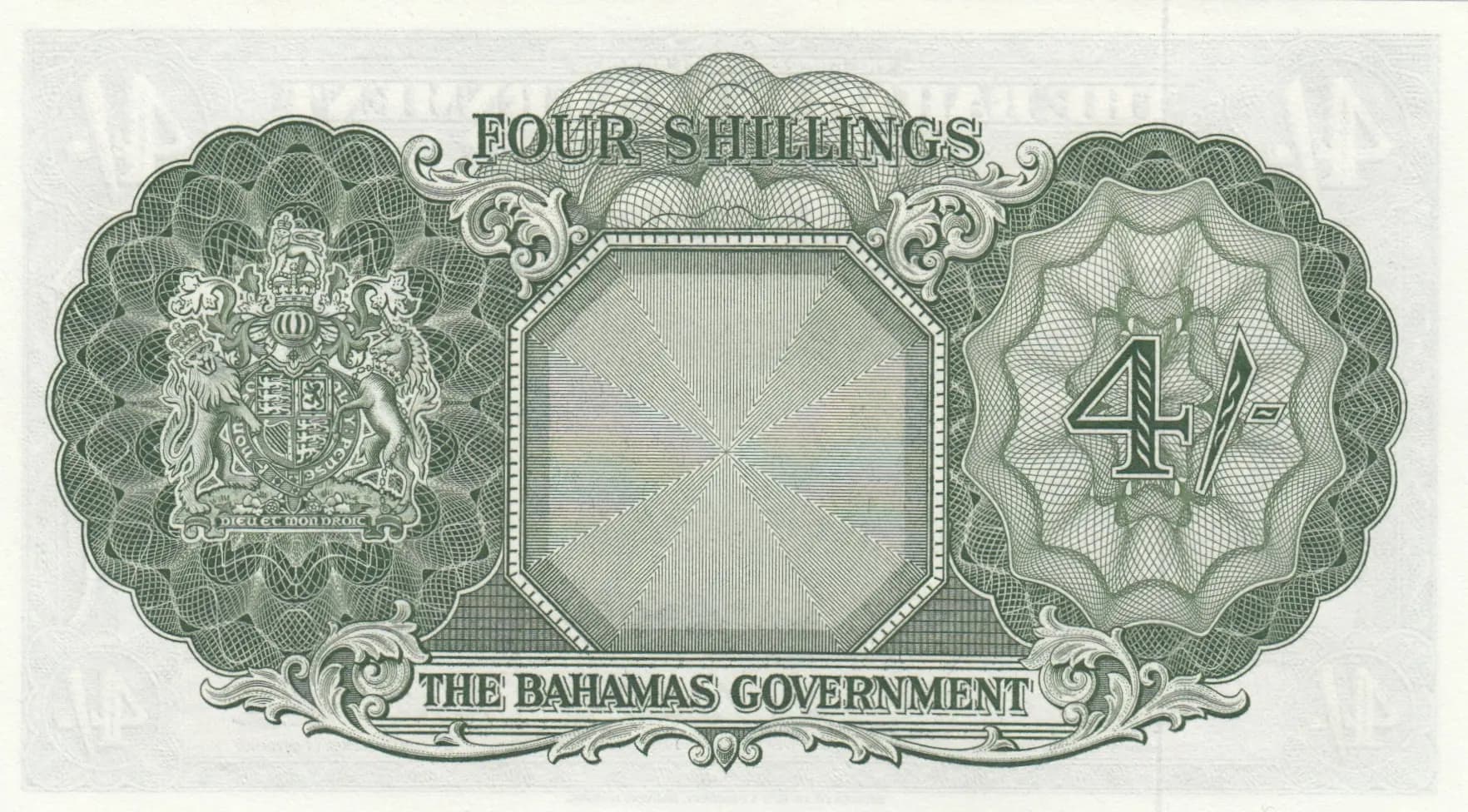
The obverse features a formal, right-facing portrait of Queen Elizabeth II wearing a tiara and formal regalia, positioned within an ornate rectangular frame on the right side of the note. The reverse showcases the Bahamas coat of arms—a heraldic achievement featuring a lion and other traditional royal symbols—positioned within an elaborate decorative frame on the left. A prominent sailing ship in full sail is depicted in a circular medallion on the front left, symbolizing the Bahamas' maritime tradition and colonial trading heritage. The ship engraving includes coastal architectural elements in the background. All four corners of both sides feature ornamental circular medallions containing the denomination '4/-'. The overall design employs elaborate geometric patterns, scrollwork flourishes, and fine mesh backgrounds typical of high-security banknote design.
FRONT: 'The Currency Note Act 1936' (legislative authority), 'The Bahamas Government' (issuing authority), 'These notes are legal tender for the payment of any amount' (legal tender declaration), 'Four Shillings' / '4/-' (denomination), Serial number 'A 6 400019', Latin motto 'Expuis sis piratis besti tuta commercia' translating to 'Expel the pirates, trade is safe' (coat of arms legend), 'Commissioner of Currency' and 'Receiver General Commissioner of Currency' (signing authorities), 'June 1953' (issue date), 'Thomas De La Rue & Company, Limited, London' (printer). BACK: 'Four Shillings' (denomination at top), 'The Bahamas Government' (issuing authority at bottom), '4/-' (denomination in circular frame), 'Dieu et mon droit' (French heraldic motto meaning 'God and My Right').
Intaglio engraving (steel plate engraving), the primary security printing method used by Thomas de La Rue & Company. The visual analysis confirms characteristic intaglio features including fine line work, intricate decorative patterns with complex geometric mesh backgrounds, ornate scrollwork, and detailed portraiture that creates the distinctive raised tactile quality of engraved currency. No evidence of additional security features such as watermarks or security threads is visible in the image analysis, consistent with 1950s banknote production standards.
This specimen is identified as Pick P-13d, one of five cataloged variants of the 1953 Four Shillings note (P-13a through P-13d plus P-13s). The specific variety appears to be determined by printer characteristics (all variants show TDLR—Thomas de La Rue, London). The serial number prefix 'A 6' and the signatures of W. H. Sweeting and W. K. Roberts noted in market references are consistent with this variant. The June 1953 date confirms this as the original 1953 issue rather than a later reprint. UNC notes of this variety typically command premium prices relative to circulated examples, with recent market sales of comparable UNC specimens ranging from $180-$334.