4 shillings 1953
Market Prices
20 salesAbout This Note
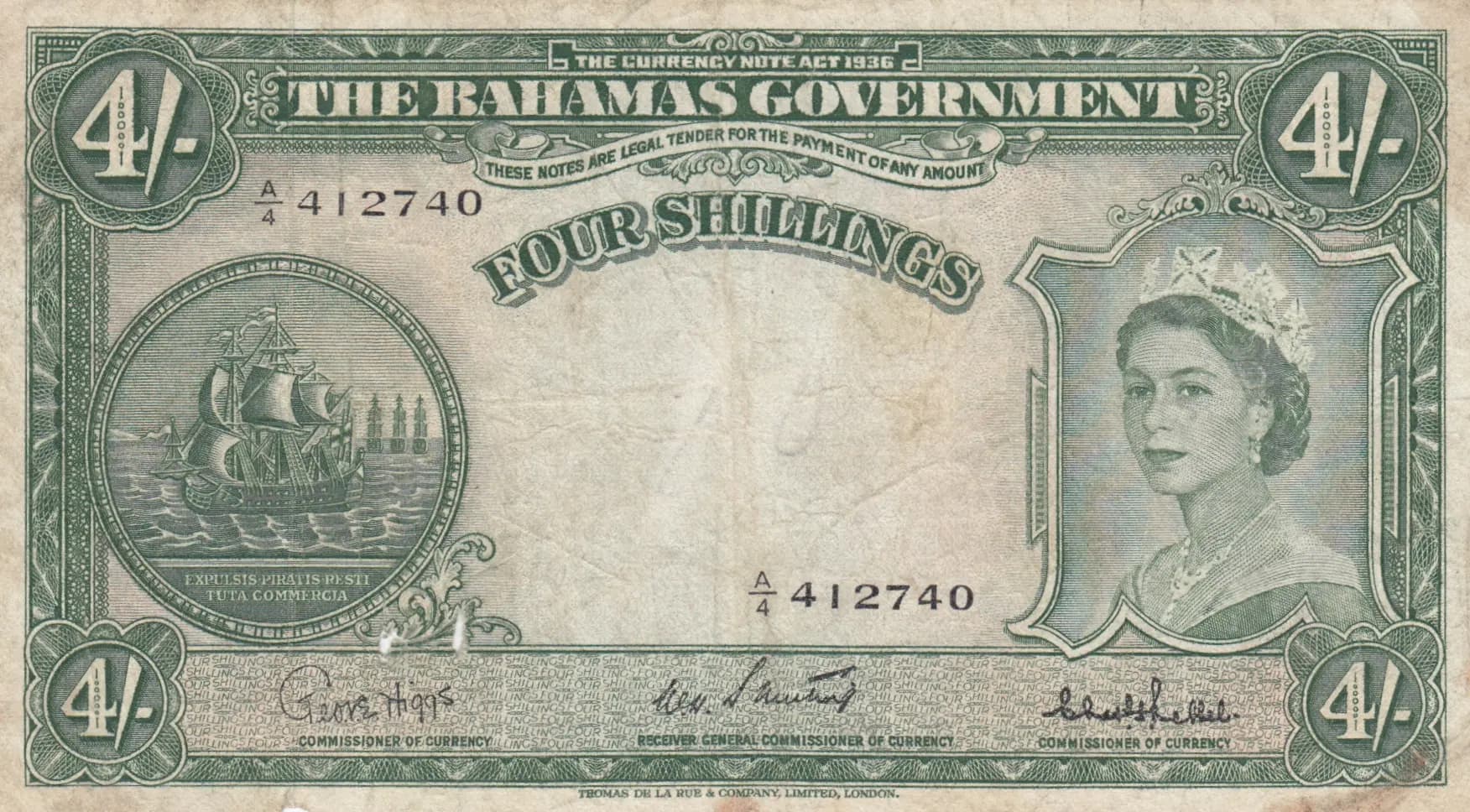
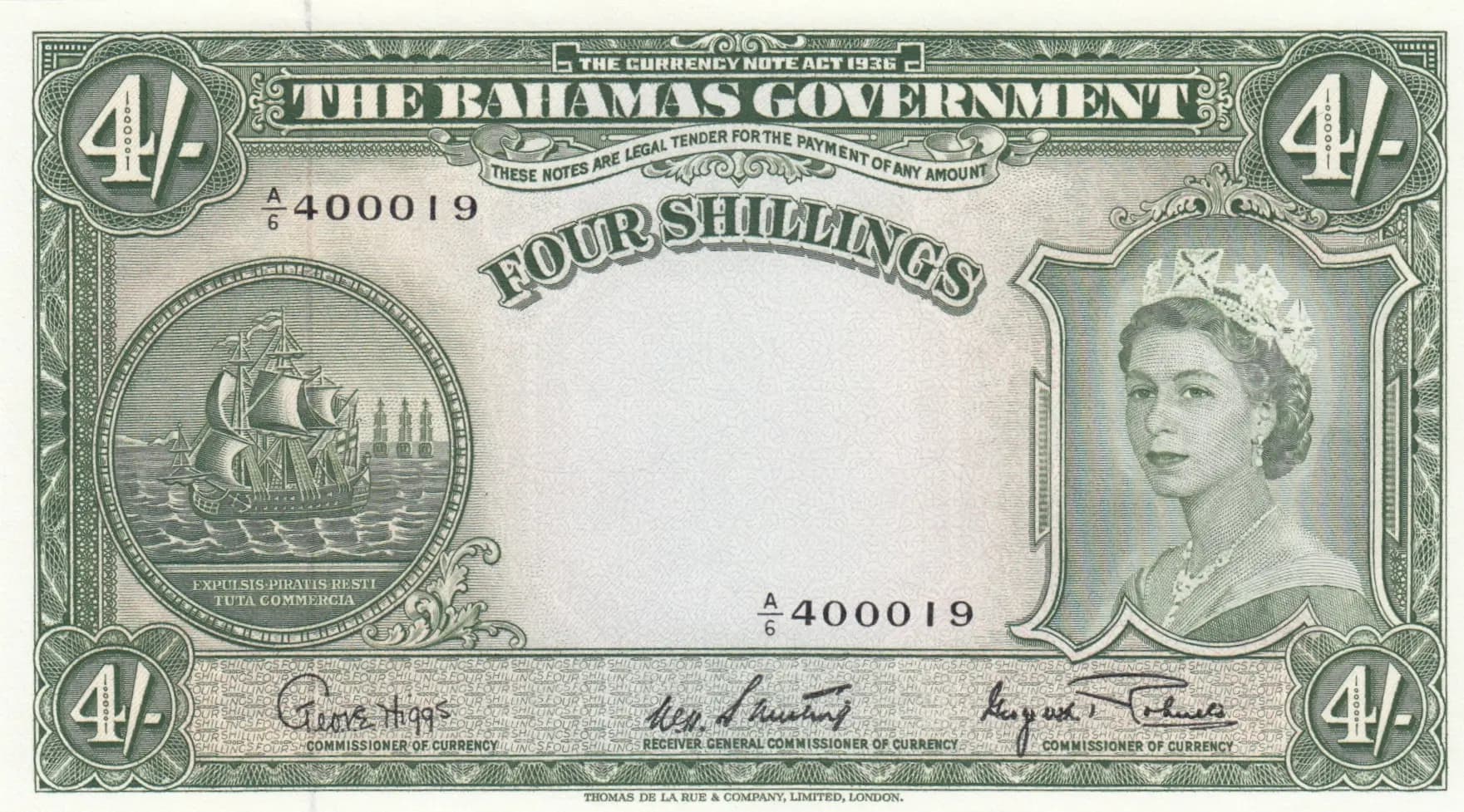
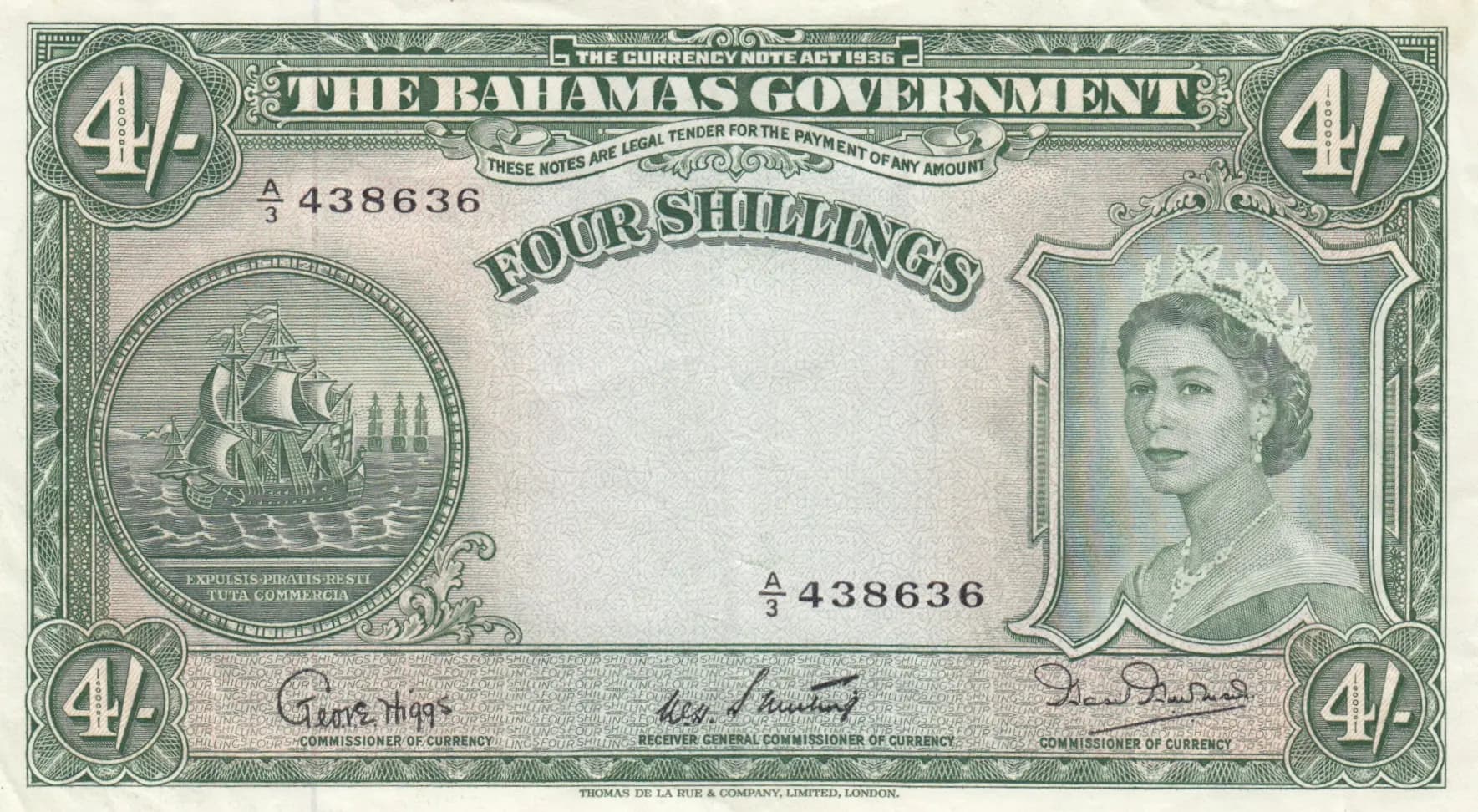
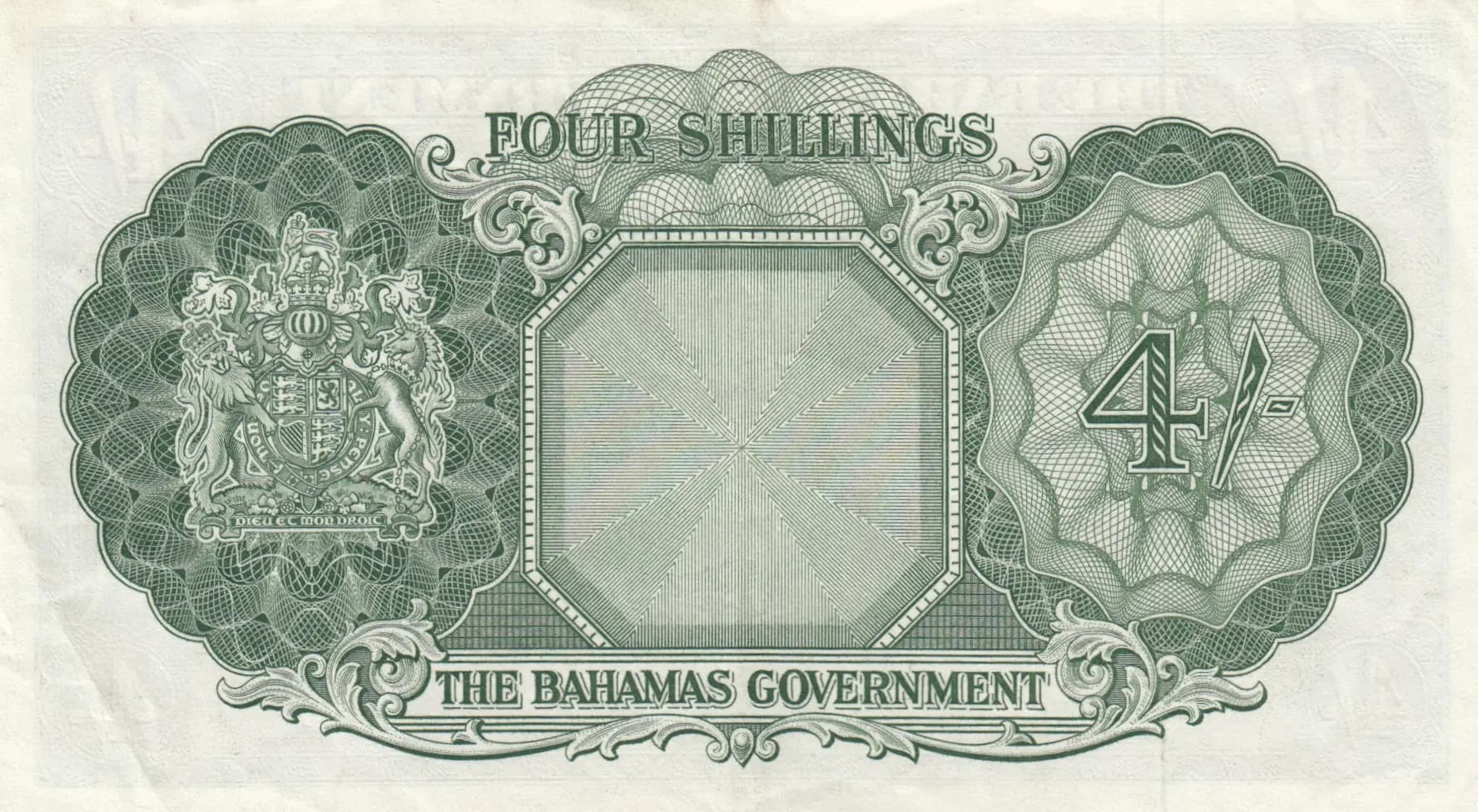
This is a Bahamas Government 4 Shillings banknote from 1953 (Pick-13b), printed by Thomas de la Rue and graded in Very Fine condition. The note displays the characteristic green coloring and intricate engraved design with Queen Elizabeth II's portrait on the obverse and the Bahamian coat of arms on the reverse. Despite the catalog condition grade of VF, the visual analysis indicates the note appears to be in pristine, uncirculated condition with sharp detail throughout and no visible wear, making it a particularly attractive example for collectors.
Common. This is a standard regular-issue banknote from the Bahamas' post-war currency series, with a substantial print run typical of government denominations used in everyday circulation. eBay market data shows consistent trading in the $20-$40 range for VF examples across multiple sales spanning from 2011 to 2025, with only premium graded specimens (PMG 67, PMG 58, PMG 53) commanding significantly higher prices ($130-$365). The 2016 catalog value of $90 for VF condition aligns with market activity, indicating stable but modest collector demand. The existence of multiple Pick varieties (P-13a through P-13d) further suggests substantial production across different printings.
This note was issued under the Currency Note Act of 1936, representing the Bahamas Government's post-war monetary authority during the early reign of Queen Elizabeth II. The obverse features a multi-masted sailing ship in a circular medallion on the left, symbolizing the maritime heritage and colonial trading history of the Bahamas, while the Latin inscription 'Expulsis Piratis Restituta Commercia' (With pirates expelled, trade is secure) references the historical suppression of piracy in Caribbean waters. The heraldic coat of arms on the reverse emphasizes British Commonwealth sovereignty during this period of gradual decolonization.
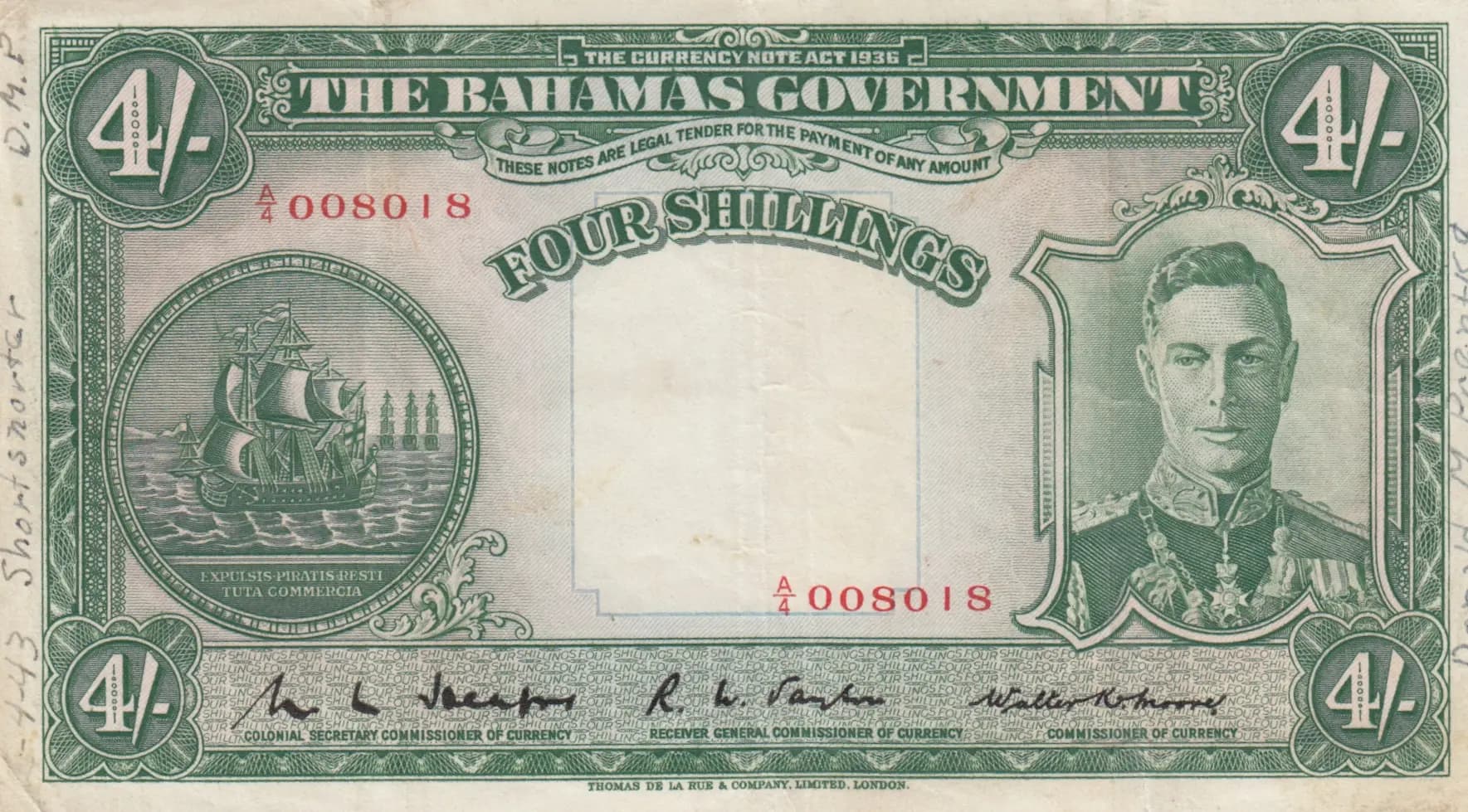
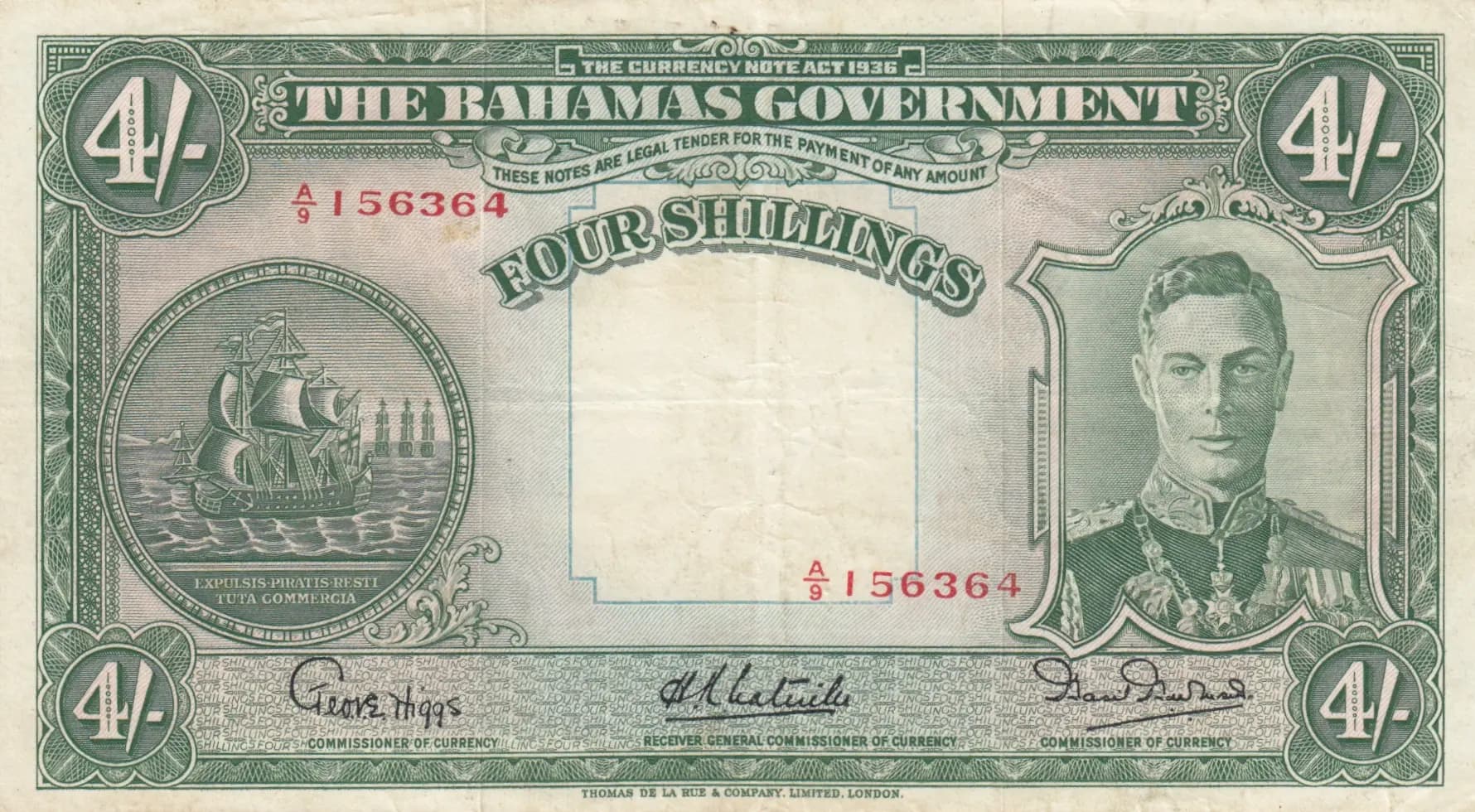
The obverse features a formal portrait of Queen Elizabeth II wearing a tiara and formal attire, positioned on the right side of the note, reflecting her status as reigning monarch at the time of issue. On the left, a circular medallion depicts a multi-masted sailing ship on the ocean, symbolizing the maritime commerce and naval heritage of the Bahamas. The reverse displays an elaborate heraldic coat of arms with a shield containing multiple quarters with various heraldic symbols, positioned on the left side, with a large denomination marking '4/-' in an ornamental circular frame on the right. Both sides feature ornate decorative borders, classical scrollwork, floral patterns, and denomination circles marked '4/-' in all four corners. The central reverse panel features a large octagonal frame, typical of de la Rue's design aesthetic of the period.
Front side: 'THE CURRENCY NOTE ACT 1936' — identifies the legislative authority; 'THE BAHAMAS GOVERNMENT' — issuing authority; 'THESE NOTES ARE LEGAL TENDER FOR THE PAYMENT OF ANY AMOUNT' — legal tender declaration; 'FOUR SHILLINGS' and '4/-' — denomination; 'EXPULSIS PIRATIS RESTITUTA COMMERCIA' (Latin) — 'With pirates expelled, trade is secure/restored,' referencing historical maritime security; 'COMMISSIONER OF CURRENCY' and 'RECEIVER GENERAL COMMISSIONER OF CURRENCY' — signatory titles; 'THOMAS DE LA RUE & COMPANY, LIMITED, LONDON' — printer attribution; Serial number 'A 3 438636' — individual note identification; Signature of 'George Higgs' — Commissioner of Currency. Back side: 'THE BAHAMAS GOVERNMENT' and 'FOUR SHILLINGS' and '4/-' — issuing authority and denomination repeated.
This note was produced using intaglio engraving by Thomas de la Rue & Company, Limited of London, the world's premier security printer of the era. The visual analysis confirms the characteristic fine line work, cross-hatching patterns, and intricate engraved details throughout both sides that are the hallmark of intaglio printing. The sharp detail, precise registration of colors, and complex decorative elements visible in the pristine condition of this example demonstrate the high-quality craftsmanship typical of de la Rue's Commonwealth banknote production.
This note is cataloged as Pick-13b, one of four documented varieties (P-13a, P-13b, P-13c, P-13d) plus a specimen note (P-13s), all printed by Thomas de la Rue. The specific variety distinction likely relates to signature combinations or subtle design variations across the print runs. The observed signatures of W. H. Sweeting and Basil Burnside at right, along with George Higgs as Commissioner of Currency, are consistent with the 1953 issuance period. The serial number prefix 'A 3' and format provide standard tracking for individual note identification within the series.