3 dollars 1965
Market Prices
33 salesAbout This Note
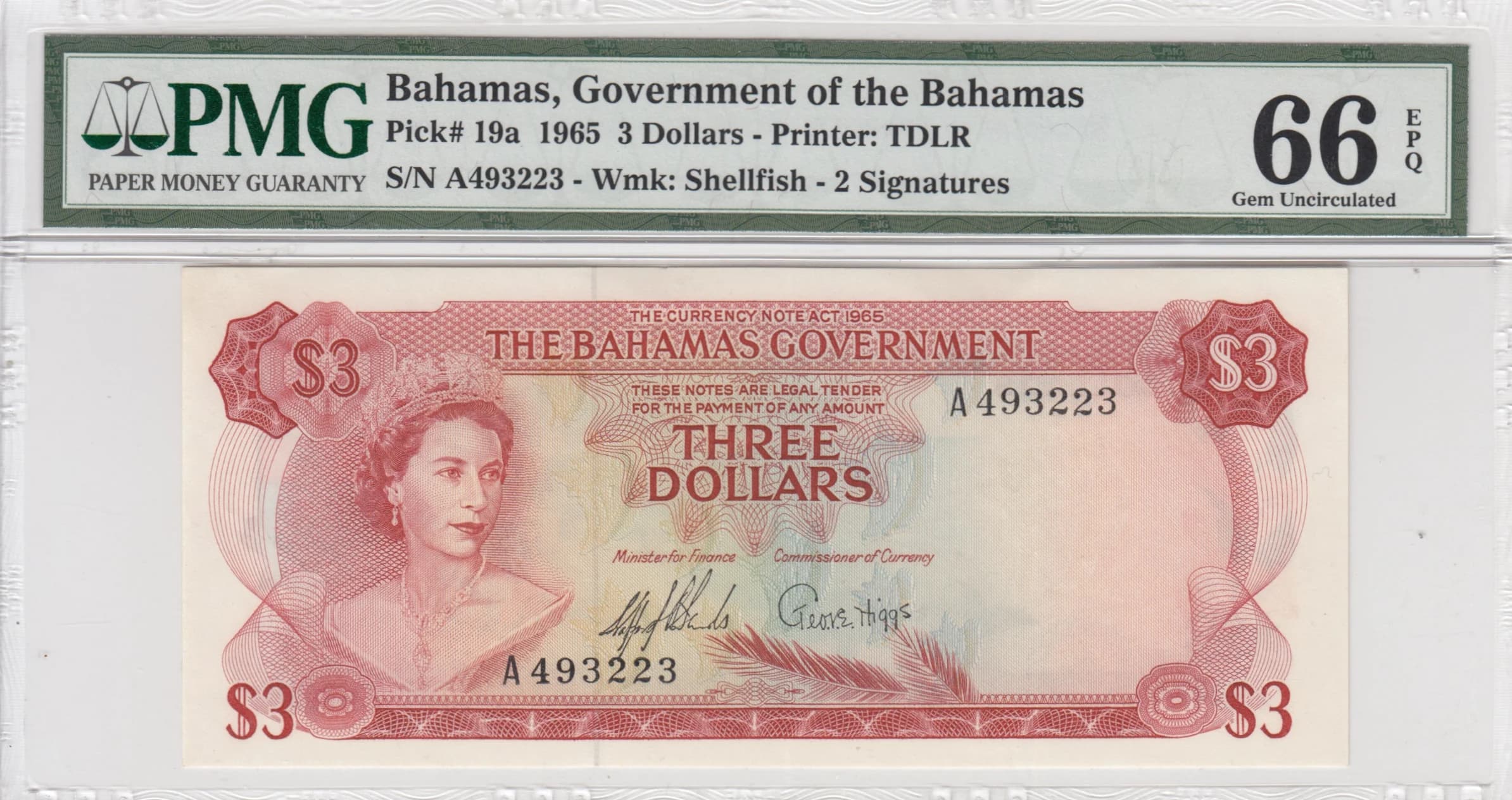
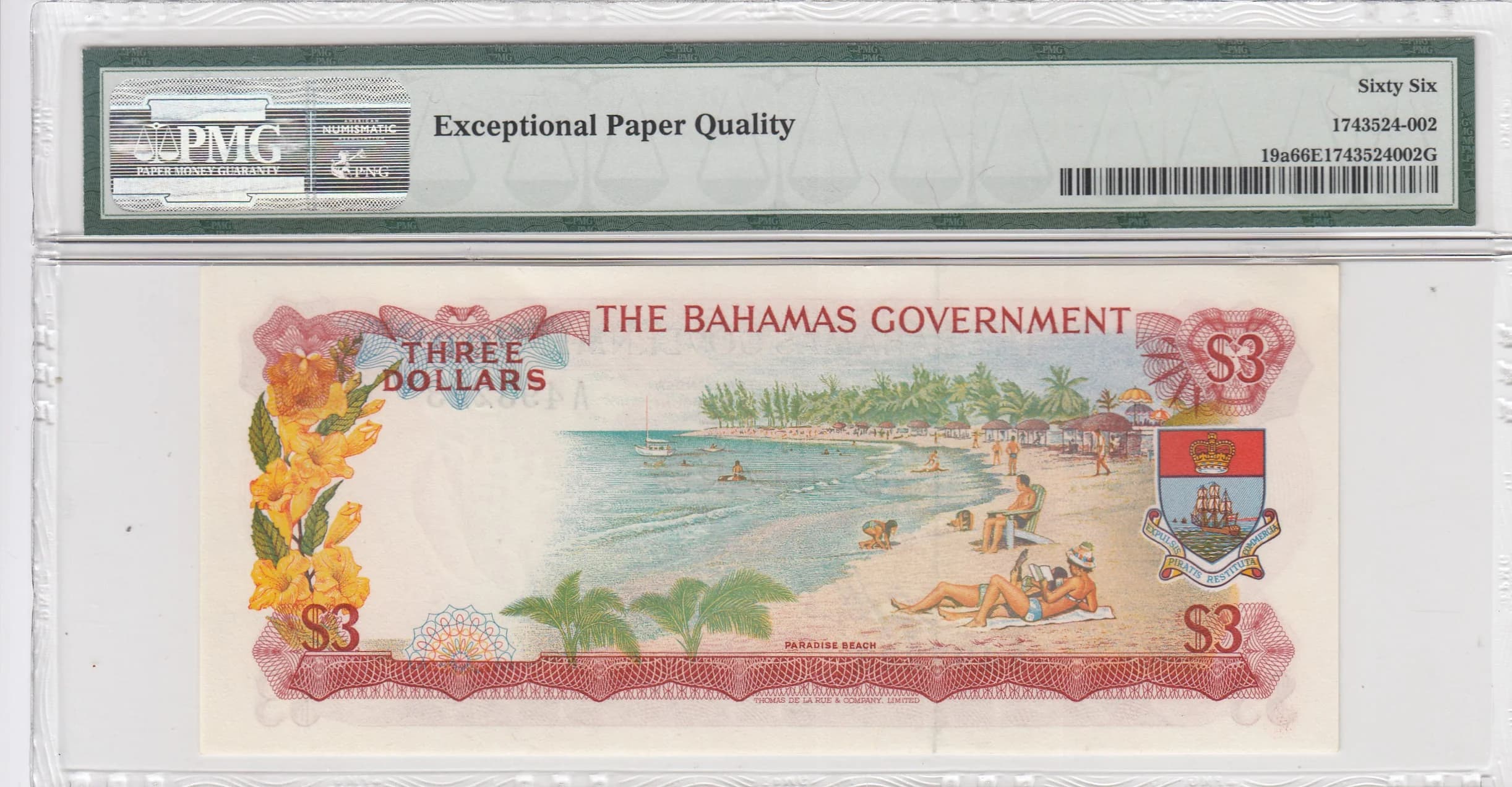
This is an exceptionally well-preserved example of the 1965 Bahamas Government Three Dollars note (Pick 19a), graded PMG 66 EPQ. The note exhibits the characteristic red/pink color scheme with cream underprint and features Queen Elizabeth II in profile on the obverse, paired with a charming Paradise Beach vignette on the reverse. The pristine condition, crisp paper quality, and vibrant colors make this an attractive mid-grade specimen that represents the early currency issues of independent Bahamas.
Common. While this is the first issue of the Bahamas' Three Dollars denomination, it was produced in substantial quantities as a regular issue. The eBay market data supports commonality: PMG 66 examples have sold consistently in the $100–$120 range (recent sales at $108.50 and $122.50), with UNC specimens selling for $30–$112, indicating a well-supplied market. The PMG population report shows this as the standard cataloged variant with no indication of short print runs or scarcity. Circulated examples trade for well under $30, confirming abundant availability.
This note was issued under the Currency Note Act of 1965, marking the Bahamas' transition to its own distinctive currency following the islands' path toward independence (formally achieved in 1973). The reverse design featuring Paradise Beach reflects the nation's emerging identity as a tropical tourism destination, while the retention of Queen Elizabeth II on the obverse acknowledges the Bahamas' continued Commonwealth status during this transitional period. The Bahamas Government coat of arms, depicting a shield with a sailing ship, reinforces the maritime heritage central to the archipelago's identity.
The obverse features a left-facing profile portrait of Queen Elizabeth II positioned on the left side of the note, rendered in the classical style typical of Commonwealth currency from this period. The portrait is framed by ornamental rosette designs and intricate guilloche patterns in the corners, which serve both decorative and security purposes. The reverse depicts Paradise Beach, a specific tropical coastal landmark in the Bahamas, rendered as an idyllic beach scene complete with palm trees, beachgoers, swimmers, and boats in turquoise waters. The scene is flanked by vibrant yellow and orange tropical flowers (likely hibiscus) on the left side. The Bahamas Government coat of arms—a shield design featuring a crown and sailing ship—appears prominently on the right side of the reverse, establishing national sovereignty and maritime identity.
FRONT: 'THE BAHAMAS GOVERNMENT' (issuing authority); 'THE CURRENCY NOTE ACT 1965' (legislative basis); 'THREE DOLLARS' (denomination in words); '$3' (denomination in numerals); 'THESE NOTES ARE LEGAL TENDER FOR THE PAYMENT OF ANY AMOUNT' (legal tender declaration); 'A 493223' (serial number); 'Minister for Finance' and 'Commissioner of Currency' (signature titles). BACK: 'THE BAHAMAS GOVERNMENT' (issuing authority); 'THREE DOLLARS' (denomination); '$3' (denomination in numerals); 'PARADISE BEACH' (named vignette/landmark); 'BAHAMAS GOVERNMENT' (text on coat of arms).
This note was produced by Thomas de La Rue (TDLR), the renowned London-based security printer. The printing employs intaglio engraving (recess printing) as evidenced by the fine-line guilloche patterns, detailed portrait work, and intricate landscape engraving visible in the Paradise Beach vignette. The multicolored execution and precise registration of colors on the underprint indicate skilled multicolor intaglio work. A shellfish watermark was incorporated into the paper stock as a security feature.
The catalog lists this as Pick 19a with one known variant according to PMG. The observed specimen carries serial number A 493223, indicating the first serial number range issued. Signature varieties are known to exist on this issue (as noted in reference sources), likely corresponding to different Ministers for Finance and Commissioners of Currency, though the specific signatures on this specimen would need to be cross-referenced against known signature varieties. Without additional documentation of signature changes, this appears to be a standard printing of the primary variety.