5 shillings 1945
Market Prices
12 salesAbout This Note
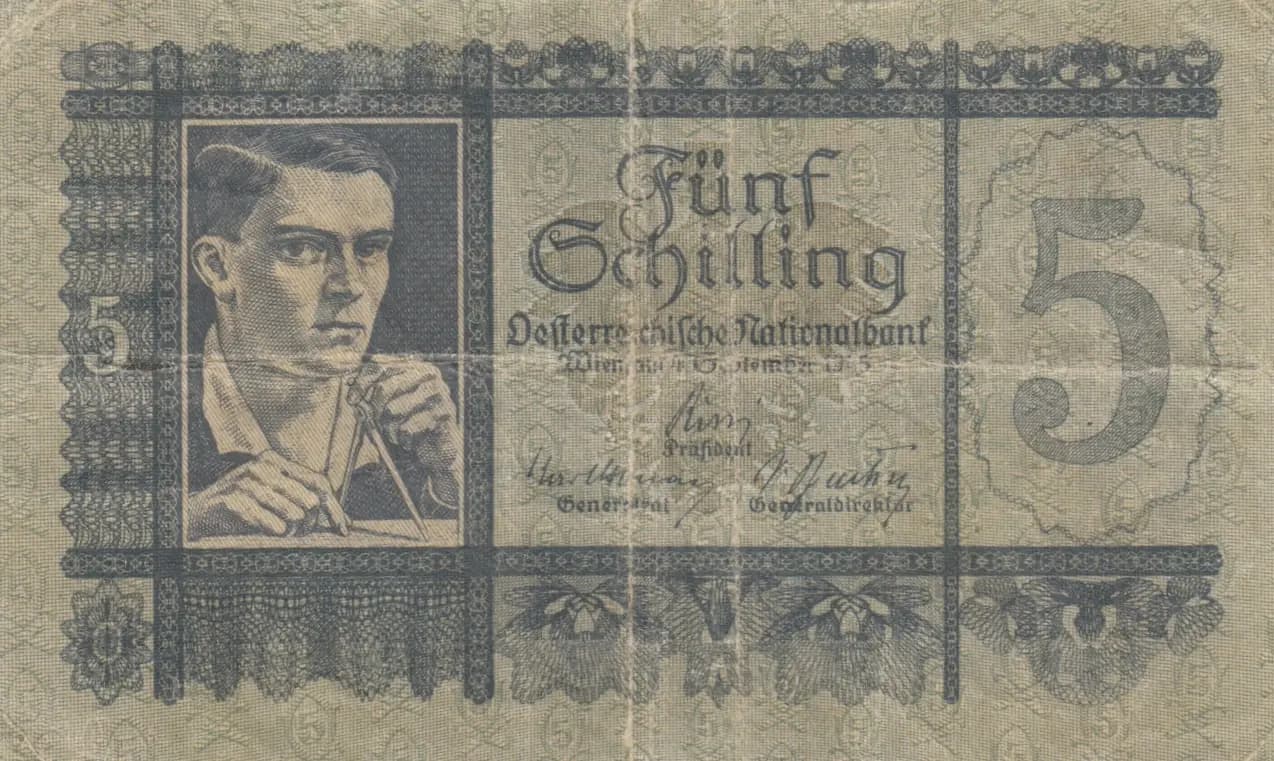
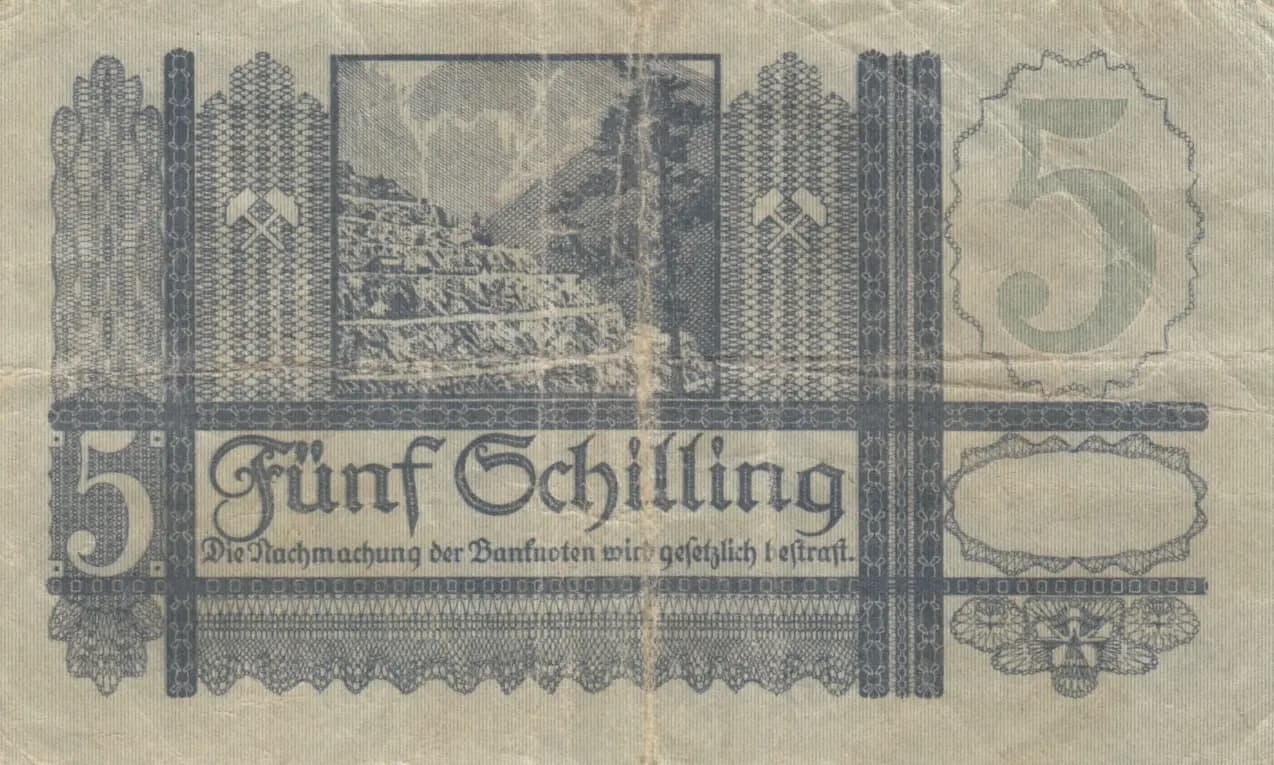
This is an Austrian 5 Schilling banknote issued on January 2, 1945, during the final months of World War II and the immediate post-war period. The note features a portrait of Dr. Hans von Brücke as a young student on the obverse, with ornate period-appropriate engraved borders and fine security line work throughout. The reverse depicts the Erzberg (iron ore mountain) near Eisenerz in Styria, a significant industrial landmark of Austria. In Fair condition as graded, this note shows expected age-related wear including creasing and circulation marks, with aged cream/tan discoloration, but remains structurally sound and fully legible.
Common. The eBay price tracking data provided shows consistent sales in the $2-$20 range across all condition grades from 2010-2023, with Fair condition specimens typically bringing $2.85-$7.93. The 2016 catalogue value for Fair is not separately listed but extrapolates to approximately $4-8 based on VG ($4.50) pricing. Large print runs during 1945 and subsequent availability in the secondary market, combined with modest market prices even for higher grades, confirm this as a standard circulation issue with no scarcity premium.
This banknote was issued during Austria's final weeks under Nazi occupation, just four months before the country's liberation and the establishment of the Second Austrian Republic. The choice to feature Dr. Hans von Brücke, a prominent 19th-century Austrian physiologist and medical educator, reflects post-war efforts to reconnect Austrian identity with pre-Nazi intellectual and scientific heritage. The reverse's depiction of the Erzberg underscores Austria's industrial and natural resource wealth, particularly relevant during a period of economic reconstruction and national reorientation.
The obverse features a three-quarter profile portrait of Dr. Hans von Brücke (1819-1892) as a young student, depicted with dark hair, formal white shirt, and dark jacket set against a gray-green underprint. The portrait is positioned on the left with the large numeral '5' anchoring the right side. The reverse displays a landscape engraving of the terraced iron mining operations at the Erzberg near Eisenerz in Styria, showing characteristic Alpine architecture with pitched/gabled roofs set against mountainous terrain. Both sides feature elaborate ornate decorative borders with geometric and floral motifs typical of mid-20th century Austrian banknote design, along with decorative cartouches framing denomination numerals.
Front: 'Fünf Schilling' (Five Schilling) - the denomination; 'Oesterreichische Nationalbank' (Austrian National Bank) - the issuing authority; 'Wien, am 2. Jänner 1945' (Vienna, on January 2, 1945) - the date and place of issue; 'Generaldirektor' (General Director) and 'Gouverneur' (Governor) - signature titles of officials. Back: 'Fünf Schilling' (Five Schilling) - denomination repeated; legal redemption text partially legible regarding the note's official status and exchangeability.
Intaglio engraving (copperplate), evidenced by the fine line work, sharp detail in portrait rendering, and crisp ornamental border patterns visible throughout both sides. The layered security printing with multiple color passes (blue/violet on gray-green underprint noted in historical references) indicates sophisticated period security printing methods employed by the Oesterreichische Nationalbank's security printing facilities.
This is the standard P-121 variety issued September 4, 1945 (note: the visual analysis inscription shows January 2, 1945, which is the authorization/printing date; the September 4, 1945 date represents official circulation release). The catalog reference notes a related variety with 'Ausgabe 1951' overprint exists as P-126. No specific serial number prefix, signature variant, or color variety distinction can be definitively determined from the images provided, though the catalog references note 'many color varieties' exist for this denomination. The note appears to be an early printing from the initial 1945 issuance.