2 gulden 1800
Market Prices
2 salesAbout This Note
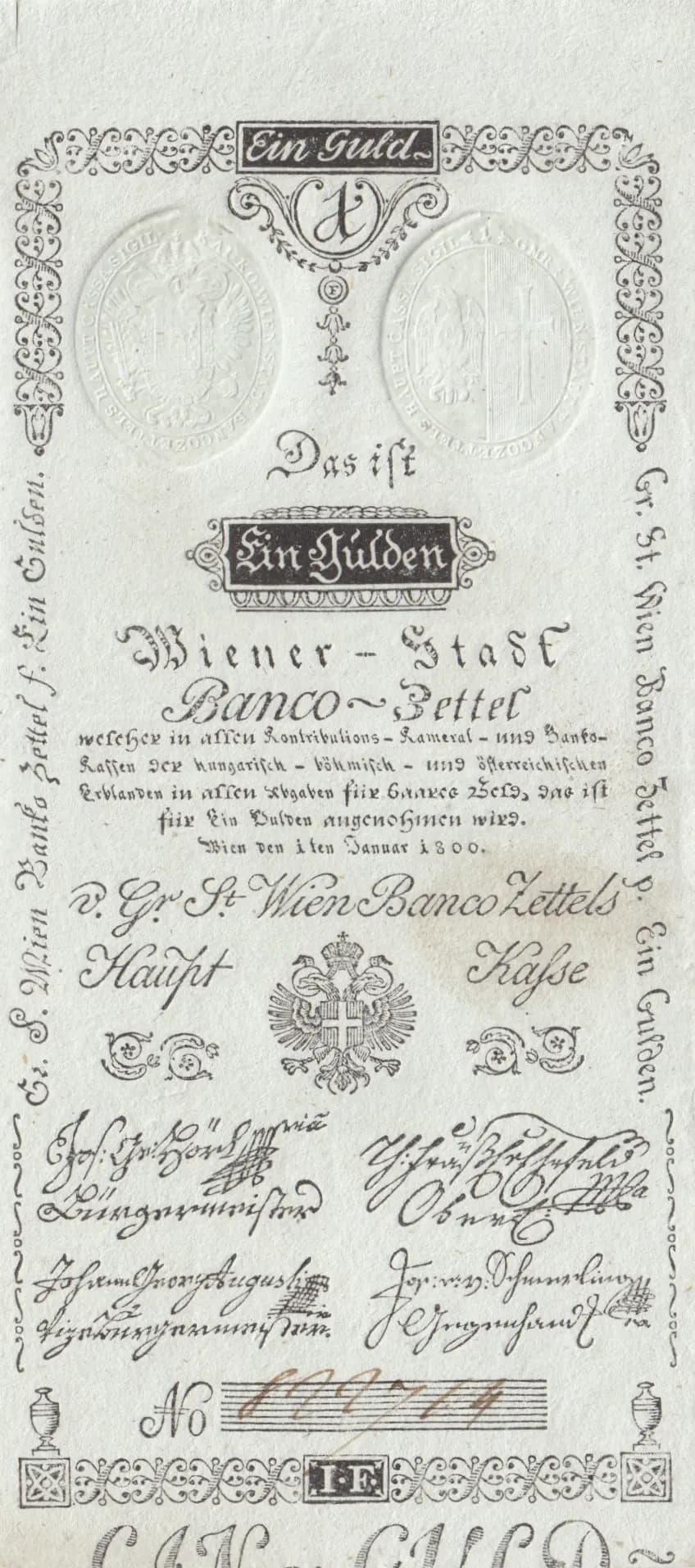
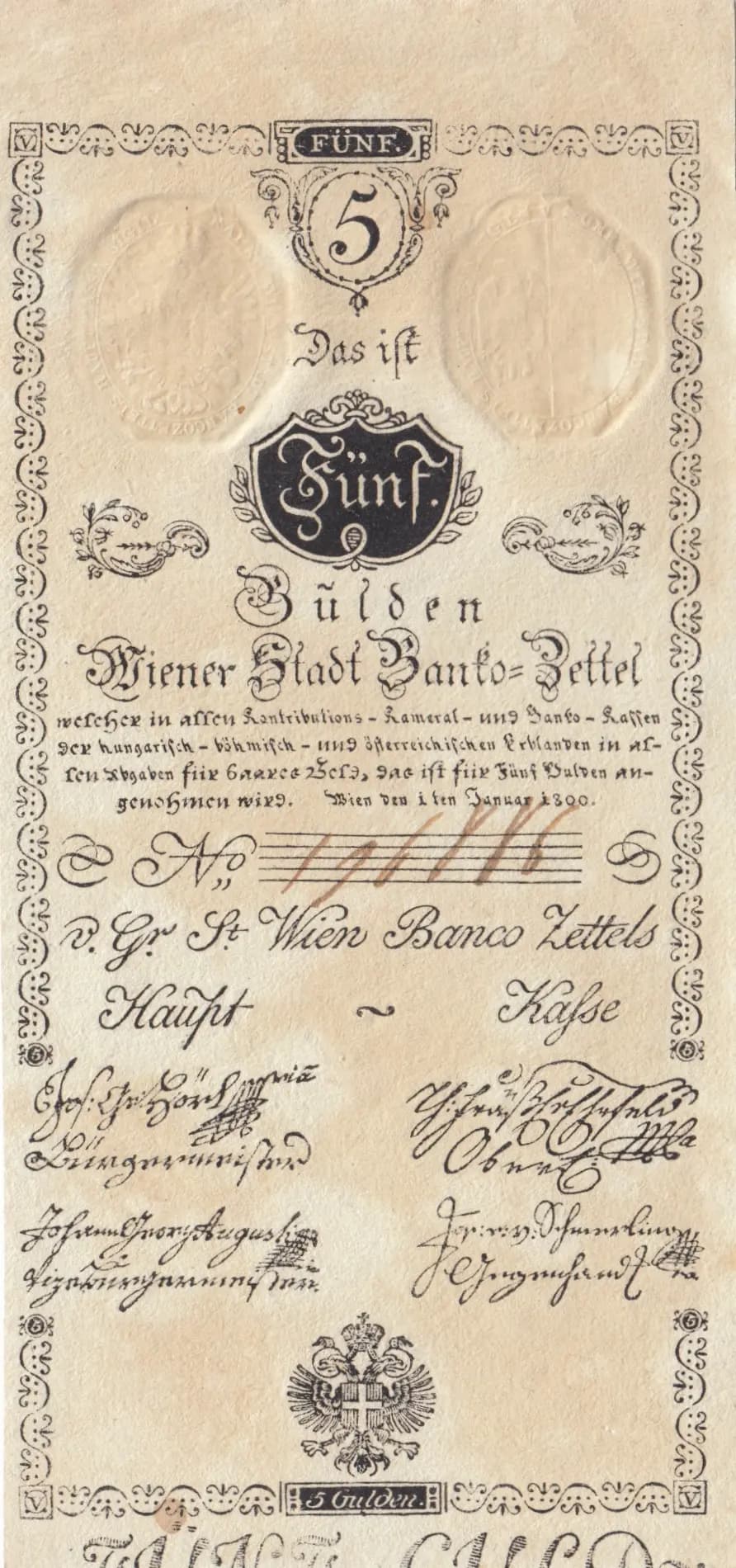
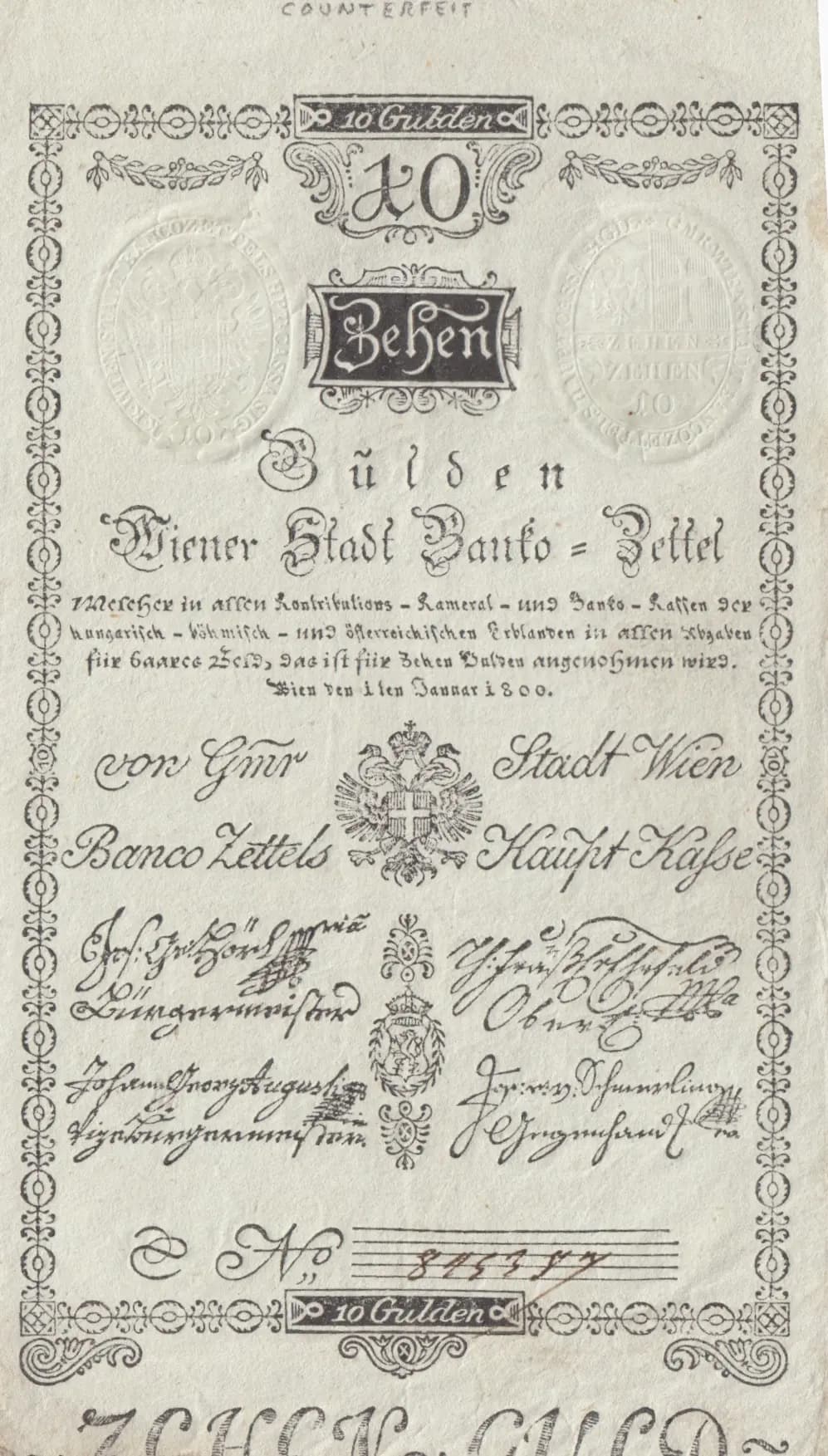
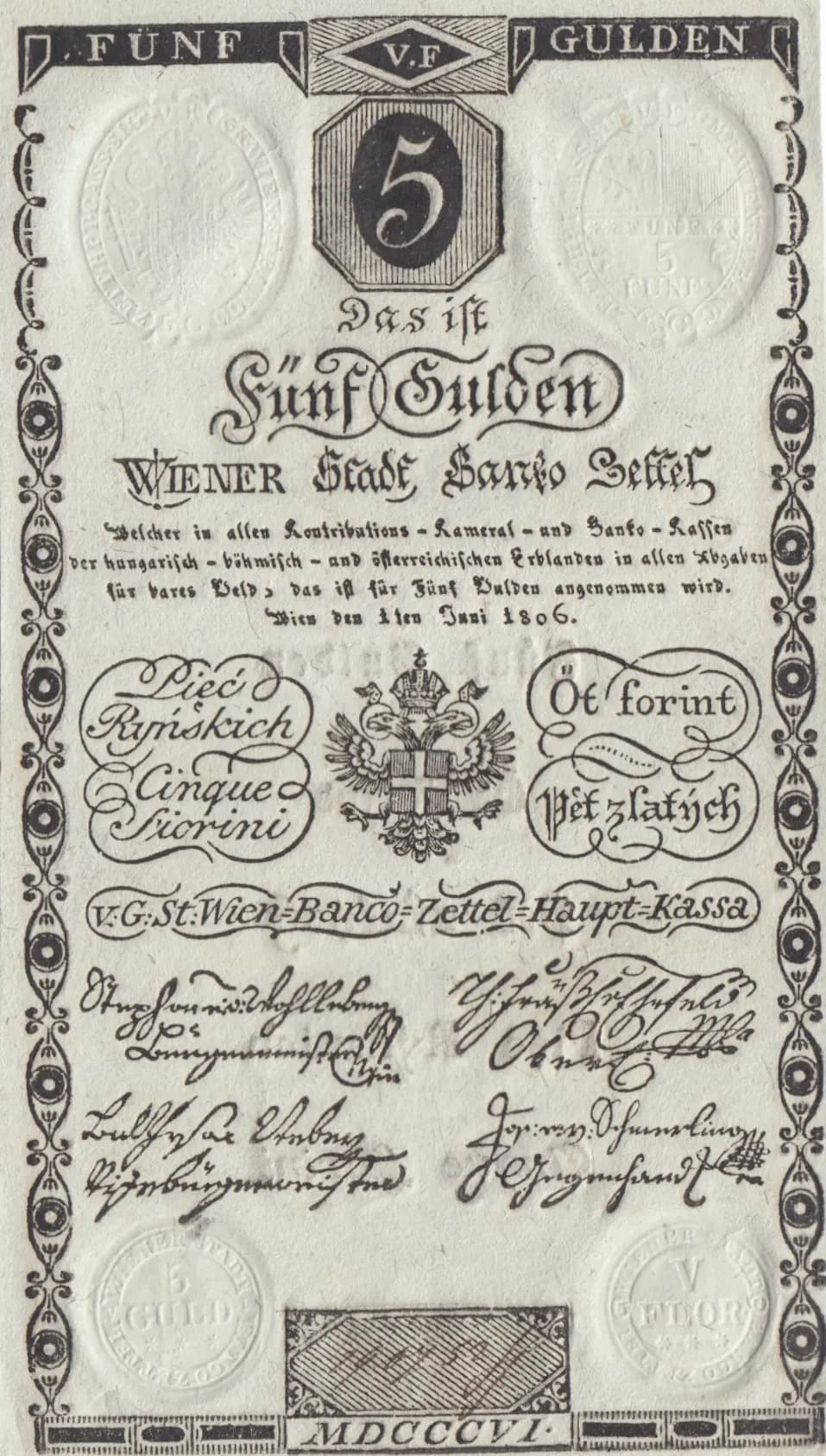
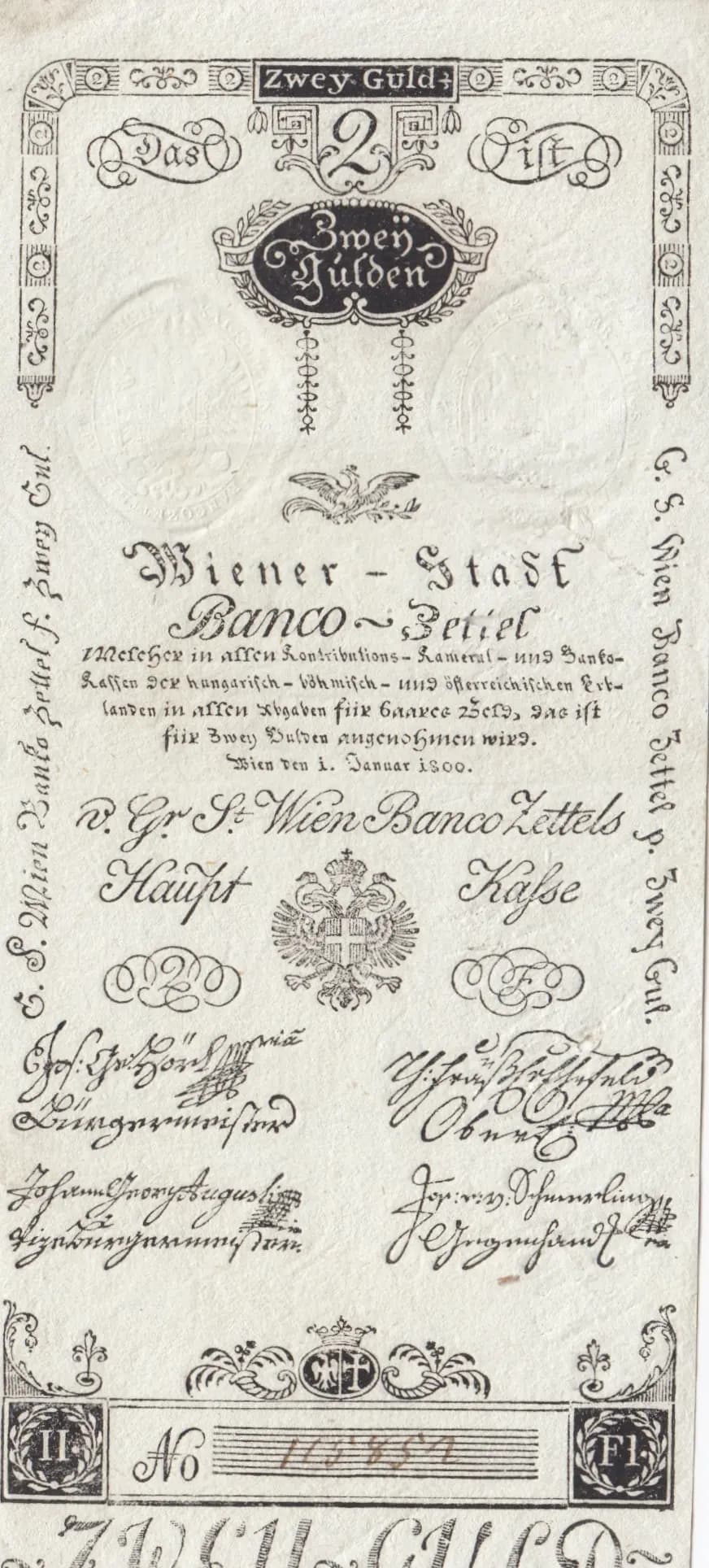
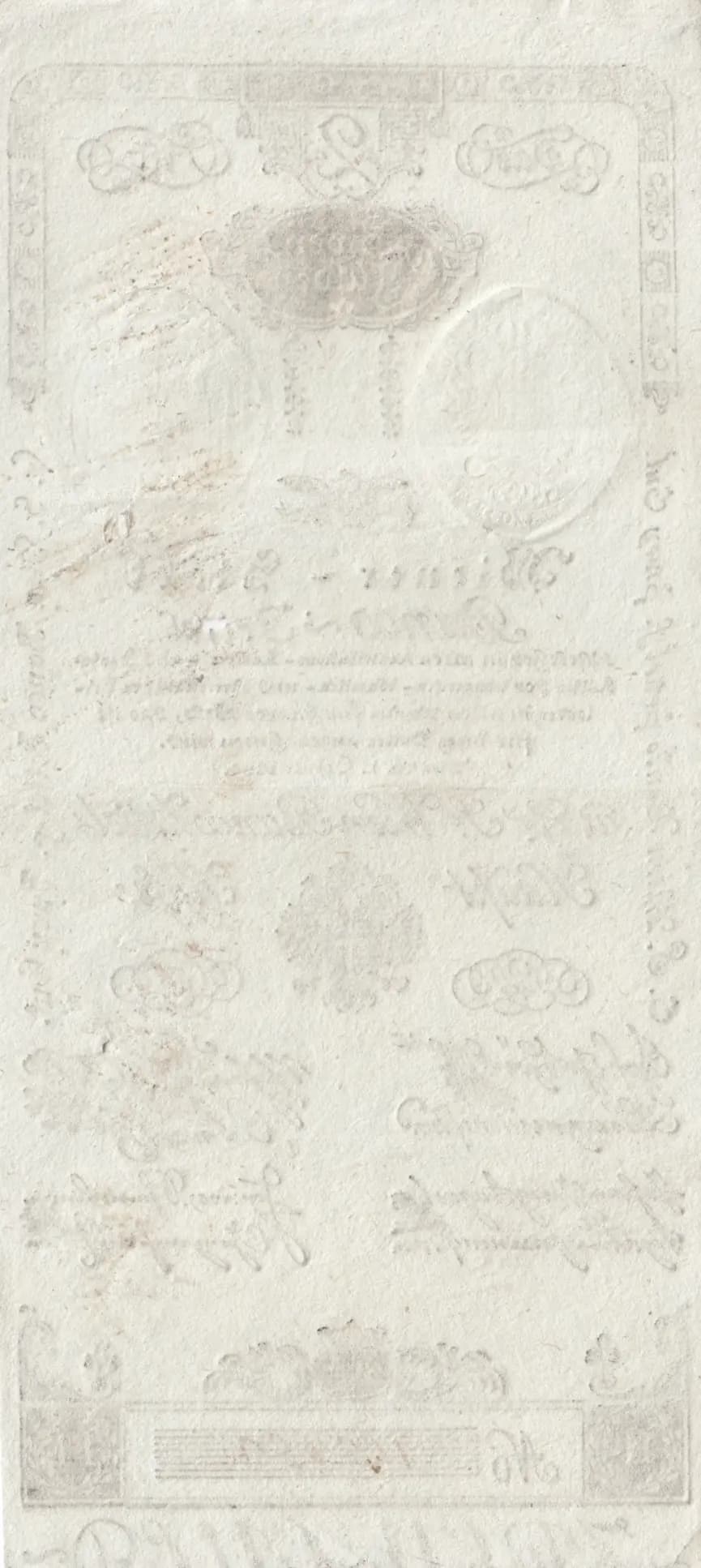
This is an Austrian 2 Gulden banknote issued by the Banco Zettel (Vienna City Bank) on January 1, 1800, representing an early example of Austrian paper currency from the Napoleonic era. The note features a striking baroque design with an elaborate double-headed Habsburg eagle as its central emblem, surrounded by intricate decorative borders and official signatures, printed entirely in black ink on cream-colored paper. While the front is well-preserved with legible text and ornamental details, the reverse shows significant age-related deterioration with extensive foxing and fading, consistent with the note's 200+ year history; the VF grade reflects its circulation wear and natural aging.
Common. This assessment is based on multiple factors: (1) eBay historical price data shows VG examples selling for approximately $10.50 and G examples for $23.39, well below typical rare note pricing; (2) catalog values in the 2016 reference are modest ($5.50-$90 depending on grade), with the VF-grade specimen in question valued at approximately $23, indicating steady availability; (3) the Banco Zettel issued 2 Gulden notes in multiple date varieties during 1800-1801, suggesting a reasonable print run; (4) the note, while historically significant, is not from a recalled series or short-lived issuing authority. These notes are routinely encountered in collections and institutional holdings of early Austrian currency.
The Banco Zettel notes were issued during Austria's financial reorganization under Emperor Francis II, coinciding with the monetary pressures of the Napoleonic Wars and the subsequent reforms of the Austrian financial system. The central double-headed eagle emblem directly references the Habsburg coat of arms and imperial authority, while the inscription referencing acceptance across 'Hungarian, Bohemian, and Austrian hereditary lands' reflects the multinational structure of the Austrian Empire at the turn of the 19th century. This 1800 issue represents an important transitional period in Austrian numismatics, bridging 18th-century baroque aesthetics with emerging modern banking practices.
The obverse features an elaborate baroque-style engraved design centered around the double-headed Habsburg eagle, the imperial coat of arms symbolizing the authority of the Austrian Empire. The eagle is positioned prominently in the center with detailed heraldic ornamentation, flanked by ornamental scrollwork and classical motifs. The entire perimeter is framed by intricate decorative borders composed of fine line work and flourishes, with decorated corner elements featuring small eagle figures or similar heraldic birds. The denomination 'Zwey Guldi' (2 Gulden) is clearly displayed, with accompanying text in German Gothic typography arranged in cartouches and banners throughout the design. Multiple official signatures appear in cursive script in the lower portion, lending authenticity and individual accountability to the note. The reverse is too deteriorated to provide meaningful design analysis, though faint impressions suggest similar decorative borders and possibly embossed security features.
FRONT SIDE: 'Zwey Guldi' (Two Gulden) - the denomination. 'Wiener - Stadt Banco - Zettel' (Vienna City Bank Note) - the issuing authority. 'Wien den 1. Januar 1800' (Vienna, 1st January 1800) - the issue date. 'matcher in allen Kontributiones - Kammeral - und Sanct - Kaffen der hungarisch - böhmisch - und österreichischen Erbländer in allen Stahden für Glanee 25cto, Das ist für Zwey Gulden angenohmen wird' (Accepted in all contributions, chamber, and sacred coffers of the Hungarian, Bohemian, and Austrian hereditary lands in all states for 25%, that is for two gulden accepted will be) - the acceptance clause defining legal tender status. Official signatures include 'Hofrath Georg August Iietz' (Court Councillor Georg August Iietz), 'Franz Dimmelhuber', and titles 'Haupt Kasse' (Chief Cashier) and 'Kurfürst Wien Banco Zettels' (Elector Vienna Bank Note). BACK SIDE: Largely illegible due to deterioration; text content cannot be reliably determined from visual analysis.
This note was produced using engraved intaglio printing (copperplate engraving), the standard security printing method for high-value currency of the period. The fine, intricate line work visible throughout—particularly in the baroque borders, decorative flourishes, and the detailed double-headed eagle emblem—is characteristic of hand-engraved copperplate work. The uniformity of the black ink impression and the depth of detail visible even through 200+ years of aging confirm the use of this technique. The security design relied on the complexity and artistry of the engraved plates themselves, as no mechanical security features (watermarks, security threads, or modern anti-counterfeiting elements) are evident. The Banco Zettel notes were produced under the supervision of the Vienna banking authority; specific printer attributions for this series are not definitively established in standard catalogs.
This specific variety is dated 'Wien den 1. Januar 1800' (Vienna, 1st January 1800), the initial issue date of the Banco Zettel series. The note bears signatures of 'Hofrath Georg August Iietz' and 'Franz Dimmelhuber' as the authorized officials. The Banco Zettel 2 Gulden series includes multiple date varieties throughout 1800-1801, with different signature combinations appearing on notes issued at different times. Collectors distinguish varieties by issue date and signatory combinations. No serial numbers are evident from the visual analysis, which is typical of early 19th-century Austrian currency where individual note tracking was not yet standardized. The denomination is clearly marked as '2 Gulden' with no fractional variants noted for this Pick number.