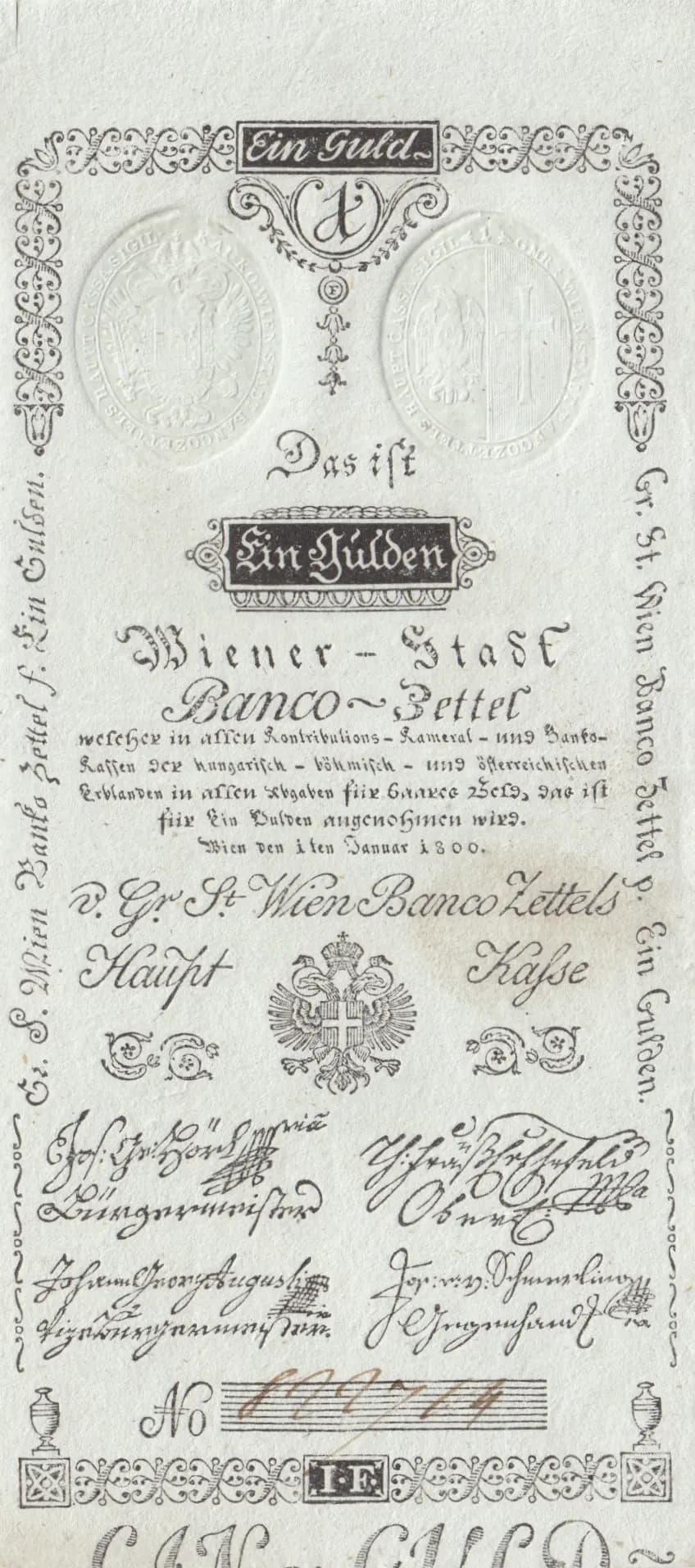
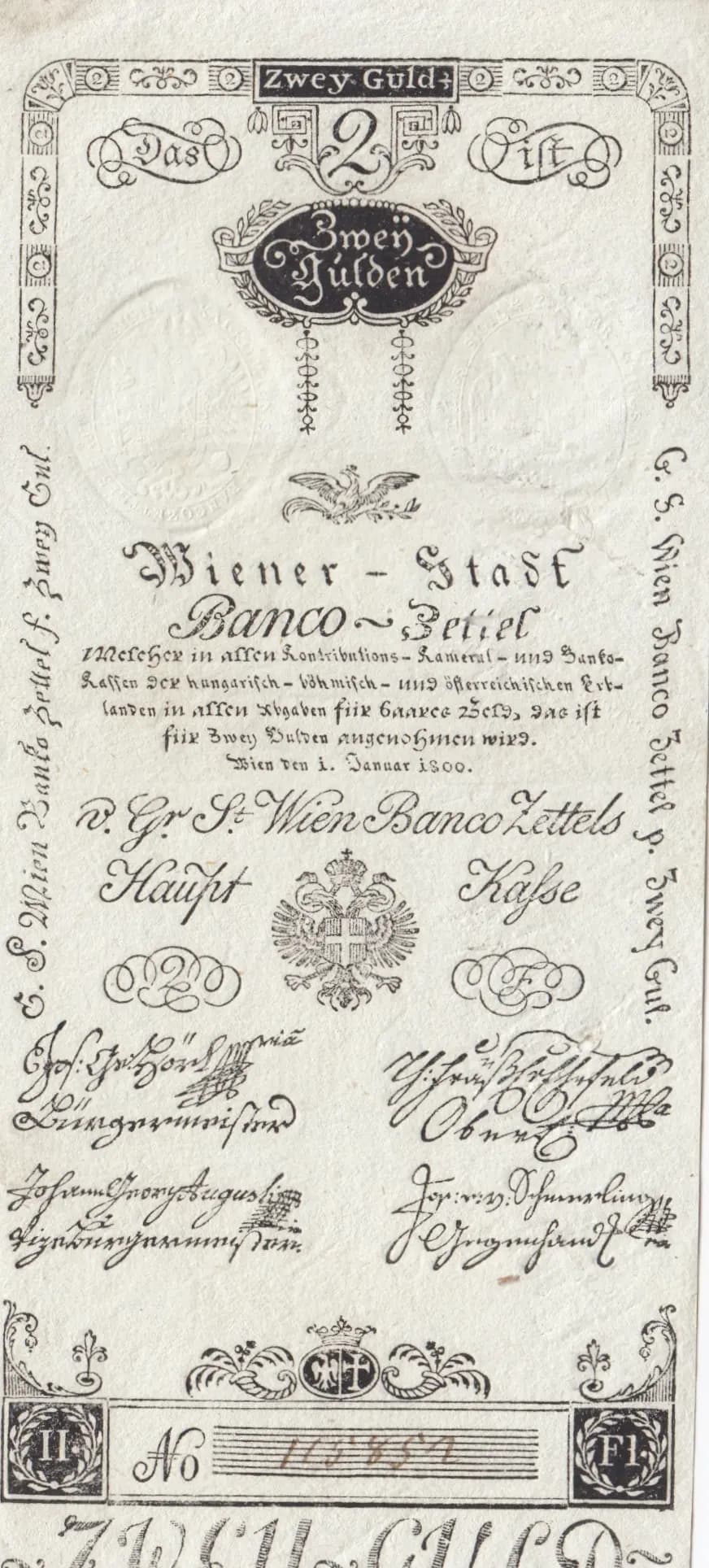
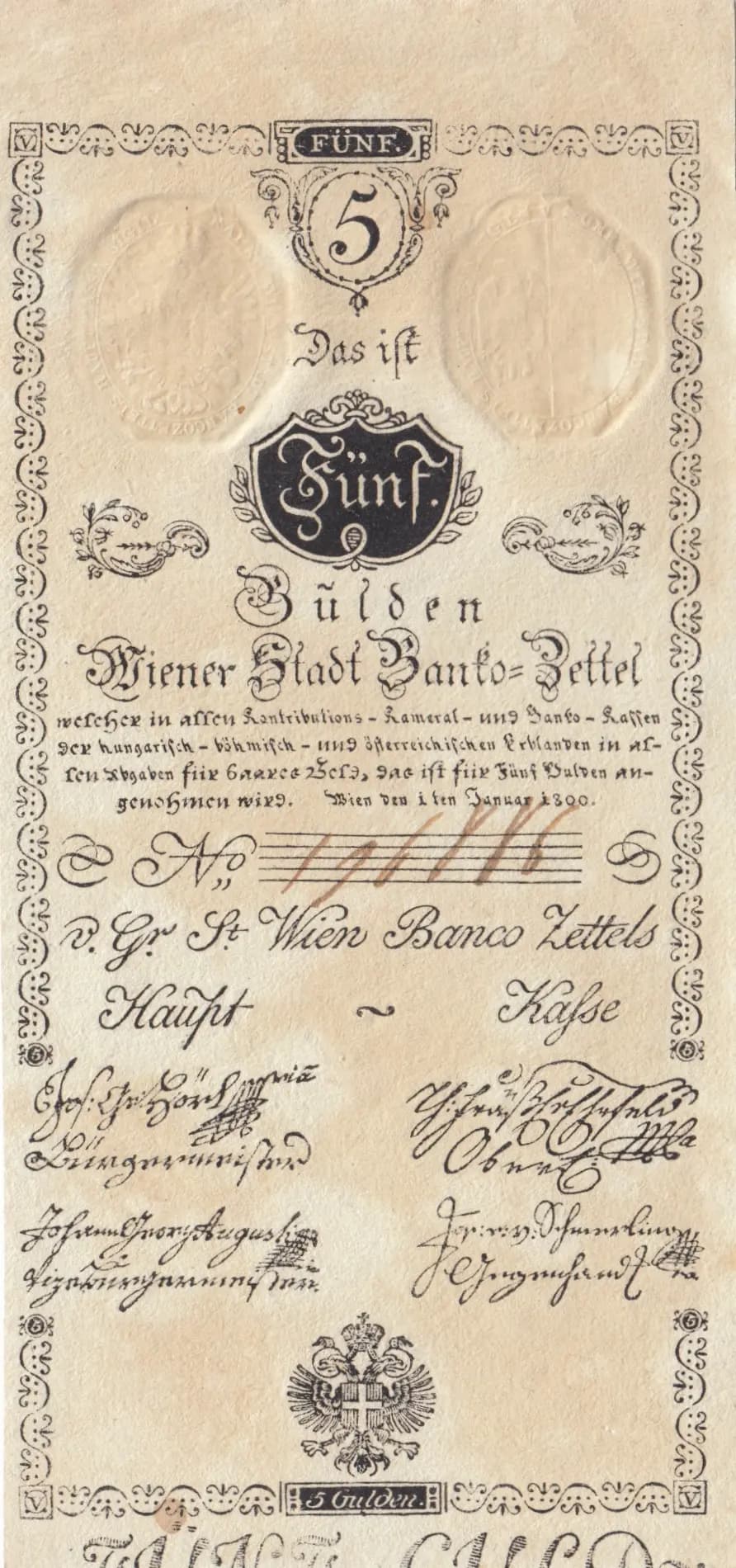
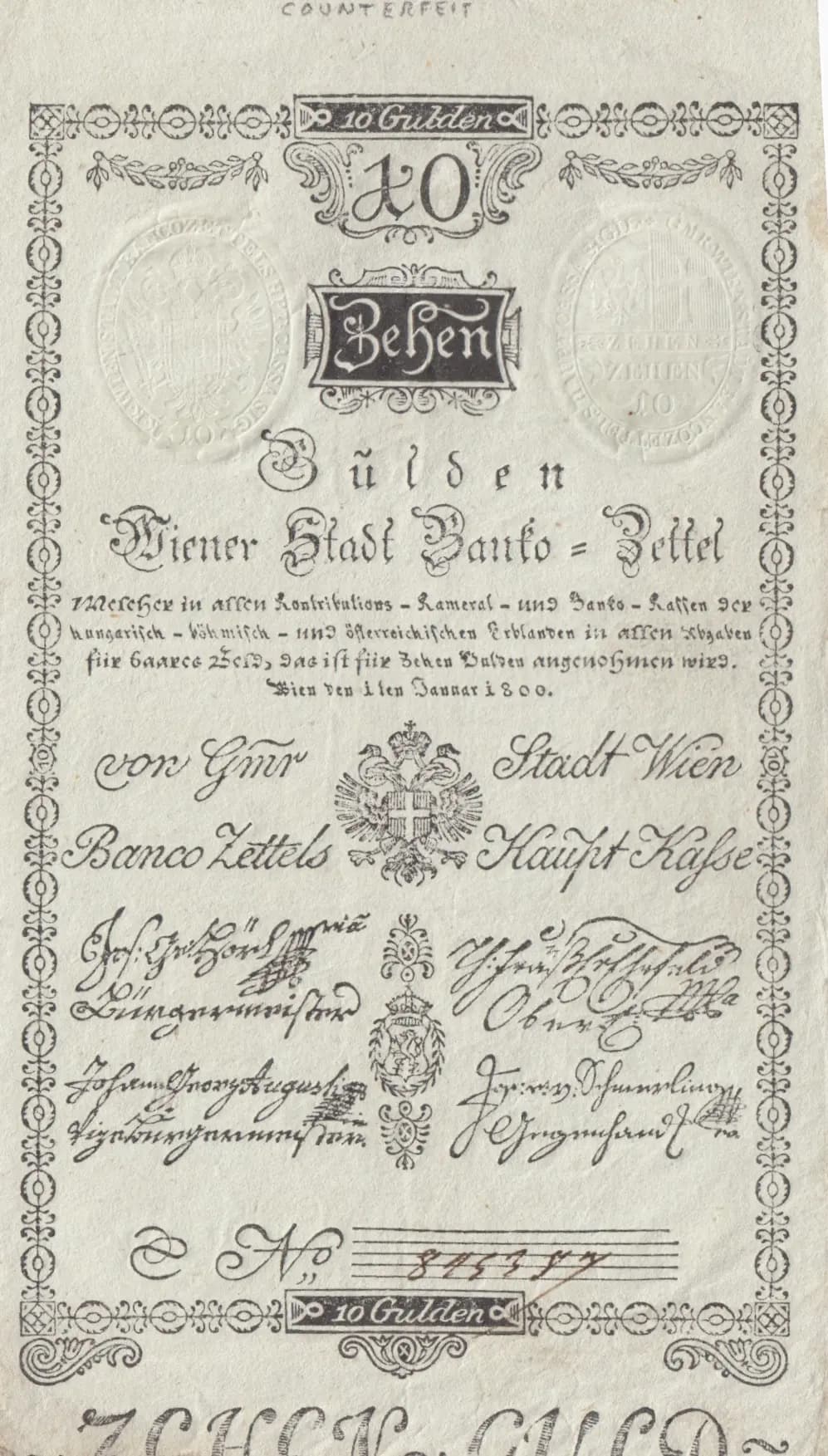
5 gulden 1806
Market Prices
8 salesAbout This Note
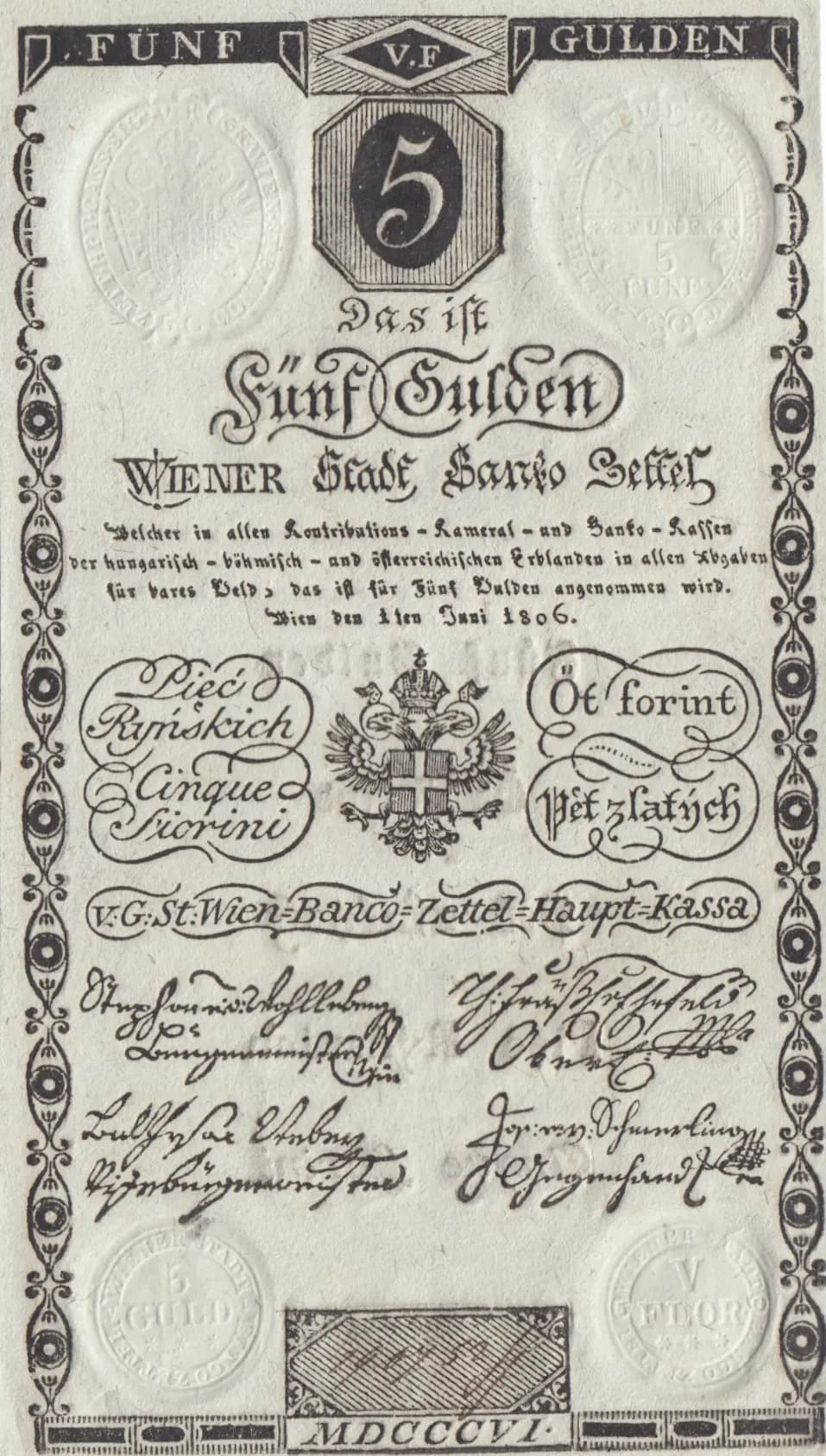
This is an Austrian 5 Gulden banknote issued by the Wiener Städte Bank (Vienna City Bank) on June 1, 1806, catalogued as Pick A38. The note displays exceptional period engraving with ornate decorative borders, multiple language denominations reflecting the multi-ethnic Austro-Hungarian Empire, and clear impressions of circular watermarked seals in the corners. Despite significant age-related foxing and cream-colored patina consistent with nearly 220 years of aging, the note remains in AU condition with legible inscriptions and intact paper structure, making it a substantial example of early 19th-century Austrian monetary instruments.
common. eBay market data shows consistent sales across multiple condition grades (VG to EF) ranging from $31 to $125, with prices in the $50-85 range being typical for Fine to EF examples. The 2016 catalog values ($28.50 for F grade, $125 for EF) align with observed eBay transaction data, indicating steady collector demand but no scarcity premium. PMG population data shows only one catalogued variant for Pick A38, suggesting either that the note was produced in sufficient quantities for widespread survival or that professional grading has been limited. The note is a regular-issue piece from a functioning metropolitan bank during a turbulent historical period, and surviving examples are encountered with reasonable regularity in the collector market.
The Banco Zettel notes were issued during the Napoleonic Wars period when Austria faced severe financial strain. The Vienna City Bank's decision to issue these denominated notes in multiple languages—German, Hungarian, Italian, and Polish—reflects the complex political geography of the Habsburg Empire at that moment. The double-headed imperial eagle with cross, prominently featured as a heraldic emblem, symbolized imperial authority during a period when Austria was reorganizing its monetary and administrative systems following military defeats.
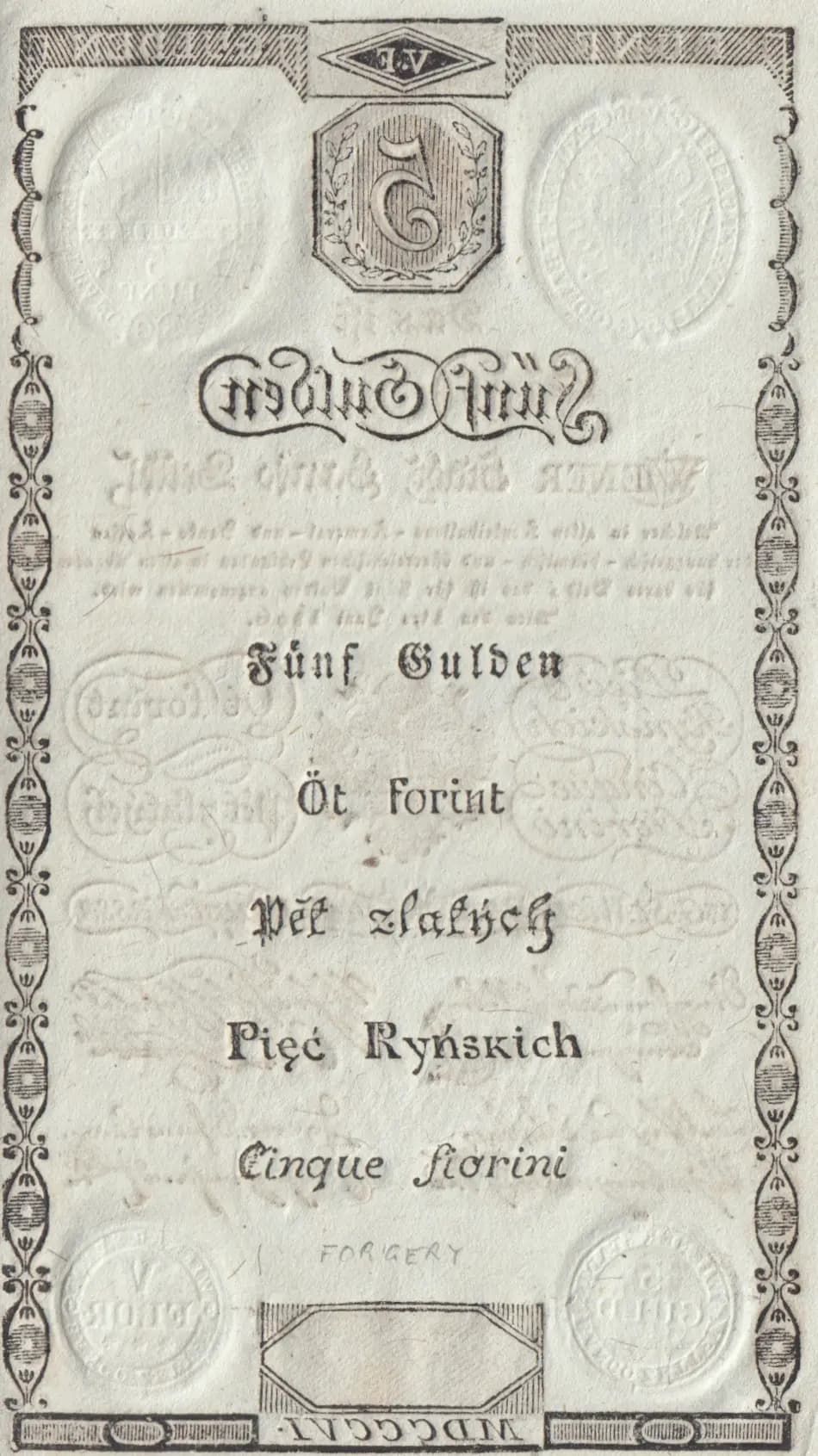
The 5 Gulden features a formal, classical engraved design typical of early 19th-century Central European banking instruments. The front displays the denomination '5' within an octagonal frame marked 'V.F.' at the top center, flanked by two circular seal impressions representing the imperial authority. The entire note is framed by an intricate ornamental border composed of floral scrollwork and geometric patterns in black engraving on cream-colored paper. The primary heraldic symbol is the double-headed imperial eagle with a cross in the center, symbolizing the Habsburg Dynasty's dominion over multiple crowns. Four signature spaces appear in the lower portion, indicating authorization by multiple bank officials. The reverse side mirrors the front's decorative scheme but displays a hexagonal frame with denomination marker 'LV', containing the numeral '6', likely indicating a different denomination classification system or engraver's mark. Text appears in formal Gothic and cursive scripts arranged in multiple horizontal bands, with the date and Roman numeral year prominently displayed. The multilingual inscriptions—appearing in German, Hungarian, Italian, and Polish—demonstrate the note's intended circulation across the diverse territories of the Austro-Hungarian realm.
FRONT SIDE: 'Fünf Gulden' (Five Gulden) / 'Das ist' (That is) / 'WIENER Städte Banco Zettel' (Vienna City Bank Note) / Main text: 'Which in all Contribution Treasury and Bank cashiers of the Hungarian, Bohemian, and Austrian hereditary lands in all places is accepted for cash; that is for five halves' / 'Wien den 1ten Junii 1806' (Vienna the 1st of June 1806) / 'MDCCCVI' (1806 in Roman numerals) / 'Pec Rynskisch Cinque Fiorini' (Five Florins) / 'Ott forint Pétzlatch' (Eight Florin variant denomination) / 'V.G. St.Wien-Banco-Zettel-Haupt-Kassa' (Vienna City Bank Note Main Treasury). BACK SIDE: 'Fünf Gulden' (Five Gulden) / 'Öt Forint' (Five Florin in Hungarian) / 'Pięć Rynskich' (Five Rhine currency in Polish) / 'Cinque fiorini' (Five Florins in Italian) / Additional denomination markings in mixed Germanic-Hungarian-Romance languages reflecting the Empire's multilingual character.
This note was produced using traditional engraving and letterpress printing methods characteristic of early 19th-century bank note production. The detailed decorative borders, fine line work in the heraldic emblems, and the clarity of the Gothic script indicate skilled copperplate engraving. The circular watermarked seals visible in the corners represent impressed or embossed security features. The consistent ink impression and the precision of the multi-language text suggest professional bank note printing by a specialized security printer, though the specific printer for this Banco Zettel issue is not definitively identified in standard references.
Pick A38 catalogues a single variant for this base number. The visual analysis reveals four distinct signature spaces on the front, consistent with official bank authorization procedures. The specific variety would be determined by examining the individual signatures present, though these are not clearly legible in the provided images. No serial numbers, overprints, or date variations are apparent. The note conforms to the standard 1806 Vienna City Bank issue dated 'Wien den 1ten Junii 1806' (June 1, 1806), with Roman numeral year designation MDCCCVI. Collectors should note that the word 'FORGERY' appearing on the reverse side in the visual analysis is highly anomalous and requires authentication verification—this may indicate either a contemporaneous counterfeit detection mark, a modern cataloging notation, or an artifact of the imaging process, and should be examined on the original note before acquisition.