5 gulden 1866
Market Prices
About This Note
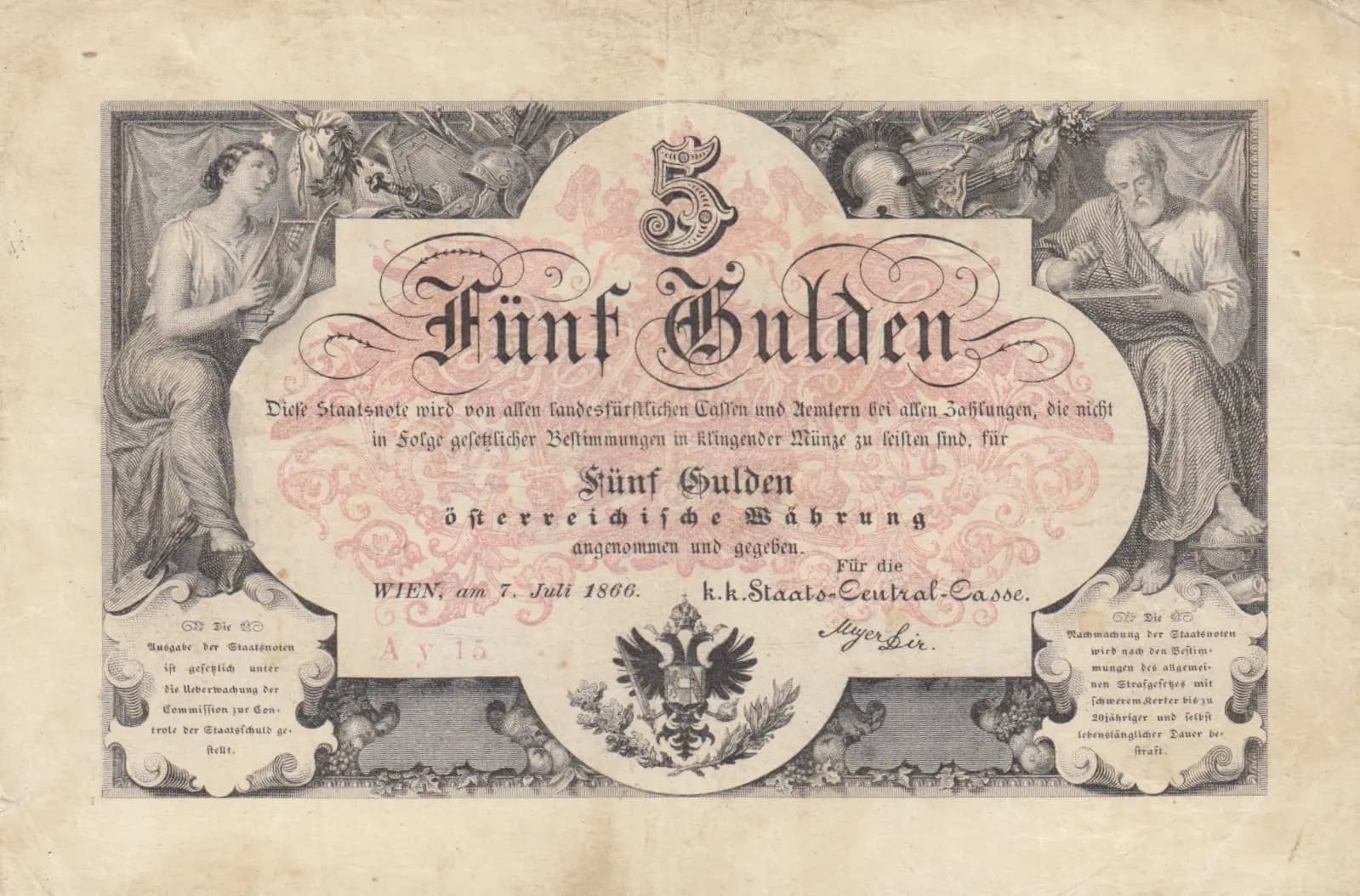
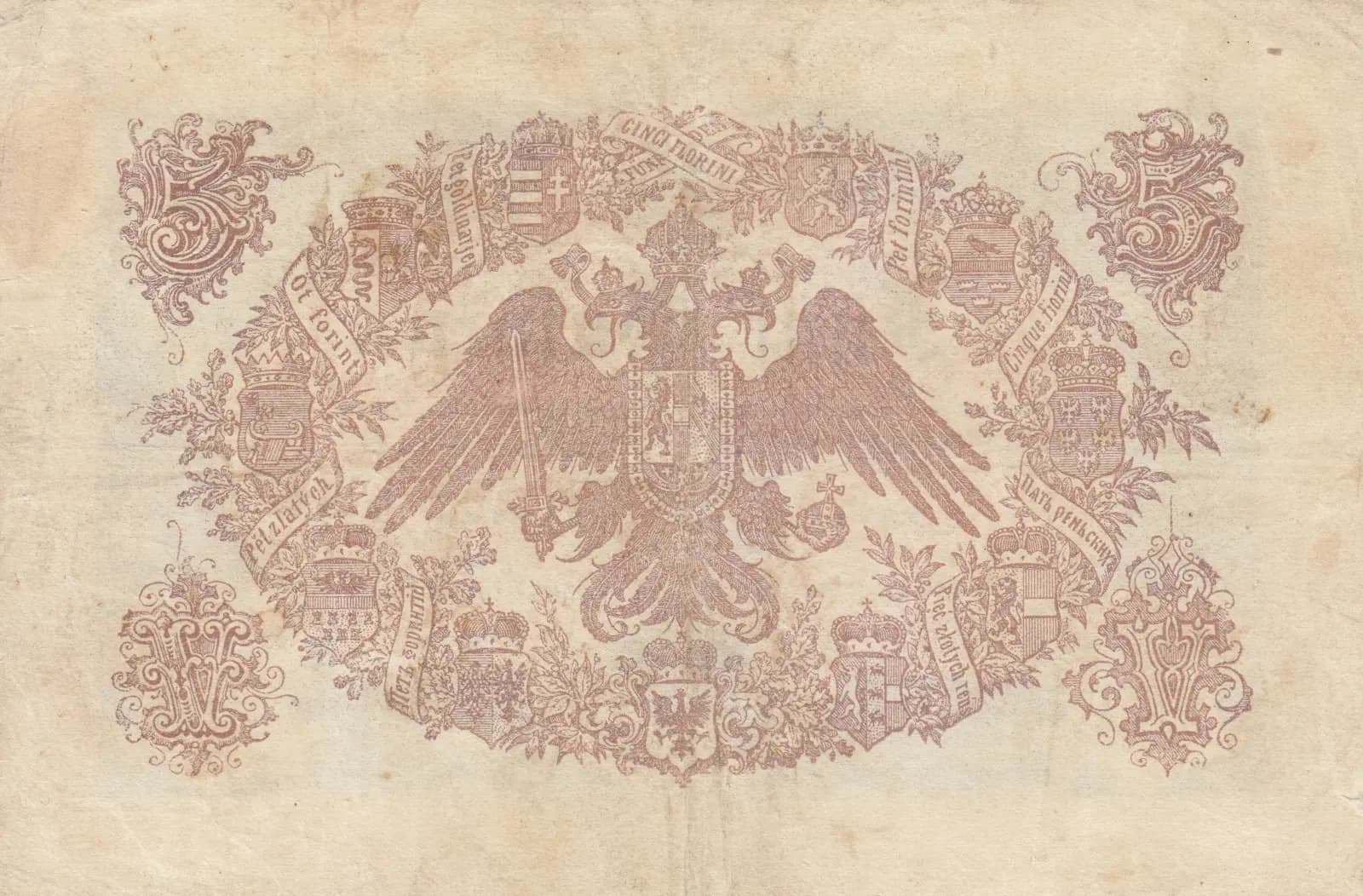
This is an exceptionally well-preserved example of the Austrian 5 Gulden note from 1866, issued by the k.k. Staats-Central-Casse in Vienna. The note displays the characteristic dual-language design (German and Hungarian) reflecting the Austro-Hungarian Empire's political structure, with allegorical figures representing knowledge and wisdom on the obverse, and an elaborate heraldic composition featuring eight regional coats of arms surrounding the imperial double-headed eagle on the reverse. Despite visible age-related patina and foxing consistent with 19th-century paper currency, the intricate engraved details remain crisp and clearly legible, making this a significant historical specimen of early Austro-Hungarian state currency.
Common. While this is a legitimate historical 19th-century note, the eBay market data shows consistent pricing in the $155-$299 range for circulated to VF examples, with VF specimens regularly appearing at $285 and the 2016 catalog valuing VF at $395. The consistent availability at moderate prices and the regular eBay transaction history indicate this was a substantial issue with adequate surviving population. No historical record suggests this was a short-lived or recalled issue, and the note does not appear in specialized literature as notably scarce. The straightforward cataloging as Pick A151b without variant designation further supports common status.
Issued on July 7, 1866, this banknote represents a critical moment in Austrian financial history, coming immediately after Austria's defeat in the Austro-Prussian War and preceding the Austro-Hungarian Compromise of 1867. The eight heraldic shields on the reverse represent the various crown lands and territories of the Austrian Empire, symbolizing the multinational character of the state during this period of political reorganization. The dual inscriptions in German and Hungarian reflect the transitional period between the centralized Austrian Empire and the federal Austro-Hungarian Monarchy that would officially be established one year later.
The obverse features an ornate cloud-shaped central cartouche in pink and red tones containing the denomination, surrounded by fine engraved borders with allegorical figures. On the left stands a female figure representing Knowledge or the Arts (partially draped, holding symbolic items), while on the right is a bearded male figure representing Wisdom or Craftsmanship. The large numeral '5' in decorative style crowns the design. The double-headed imperial eagle—symbol of Habsburg authority—is positioned at the bottom center with crown, scepter, and imperial regalia. The reverse is an elaborate heraldic composition dominated by the central double-headed imperial eagle surrounded by eight distinct coats of arms arranged symmetrically, representing the major crown lands of the Austrian Empire (likely including representations of Austria proper, Hungary, Bohemia, Galicia, and other territories). Decorative scrollwork and floral patterns fill all spaces between heraldic elements. The color scheme combines black engraved lines with pink/red overprinting on the obverse and brown/sepia tones on the reverse.
FRONT: Principal denomination text reads 'Fünf Gulden' (Five Gulden) and 'CINCI FORINTI' (Five Forint in Hungarian/Romanian). The main legal text states: 'Diese Staatsnote wird von allen landesfürstlichen Cassen und Aemtern bei allen Zahlungen, die nicht in loser gesetzlicher Bestimmungen in klingender Münze zu leisten sind, für Fünf Gulden überreichliche Währung angenommen und gegeben' (This state note is accepted and given by all territorial princely treasuries and offices for five gulden in all payments that are not required to be made in current legal tender coin). Issuer information: 'Für die WIEN, am 7. Juli 1866. k.k. Staats-Central-Casse' (For Vienna, July 7, 1866. Imperial-Royal State Central Treasury). Additional legal notices regarding counterfeiting penalties appear in the bottom panels. REVERSE: 'FÜNF GULDEN' and 'CINCI FORINTI' are repeated, with additional heraldic inscriptions within or near the territorial shields (not fully legible in image but indicating regional identities).
This note was produced using intaglio engraving (steel plate engraving), the standard security printing method for high-value currency of the period. The complex multi-layer design with fine line work, varying line densities, and intricate allegorical and heraldic compositions demonstrates the sophisticated engraving capabilities required for state security printing. The pink/red overprinting on portions of the obverse was applied separately from the primary black engraved design, indicating a multi-pass printing process. The printer for this series is not definitively identified in the available catalog data, but the quality and execution suggest work from the Austro-Hungarian State Printing Office or an authorized security printer contracted by the k.k. Staats-Central-Casse.
This specimen is cataloged as Pick A151b, which is the standard variety for the 1866 issue. The note exhibits a red serial (block) number and STN watermark as described in the catalog reference. The specific date of July 7, 1866 appears on the front, representing the official issue authorization date. No additional printer's signatures or control marks are noted that would distinguish this as a rare printer's variety or special issue. The condition grade of VF places this example in the higher end of typical surviving specimens but not in the premium uncirculated range that would indicate special provenance or preservation.