20 shillings 1967
Market Prices
104 salesAbout This Note
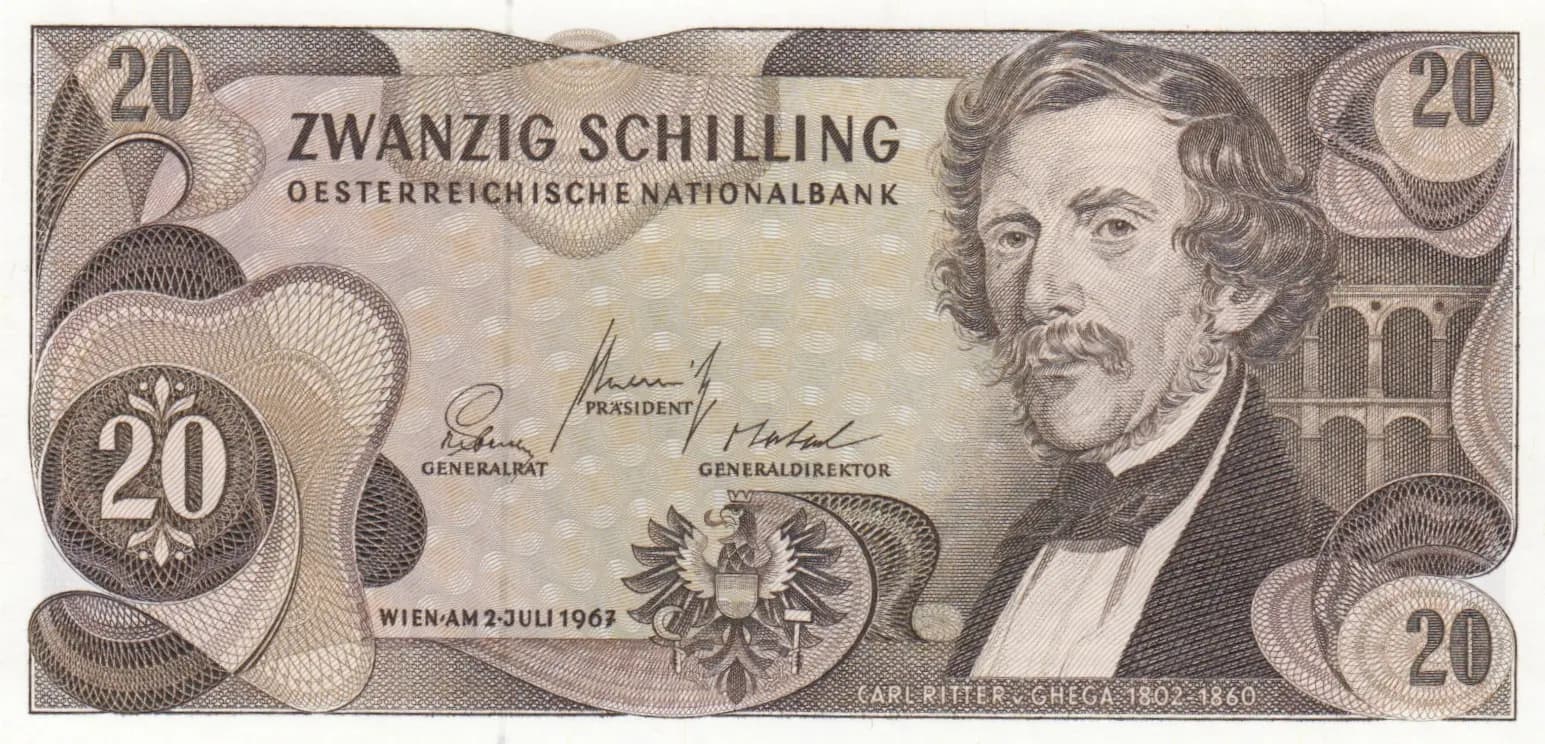
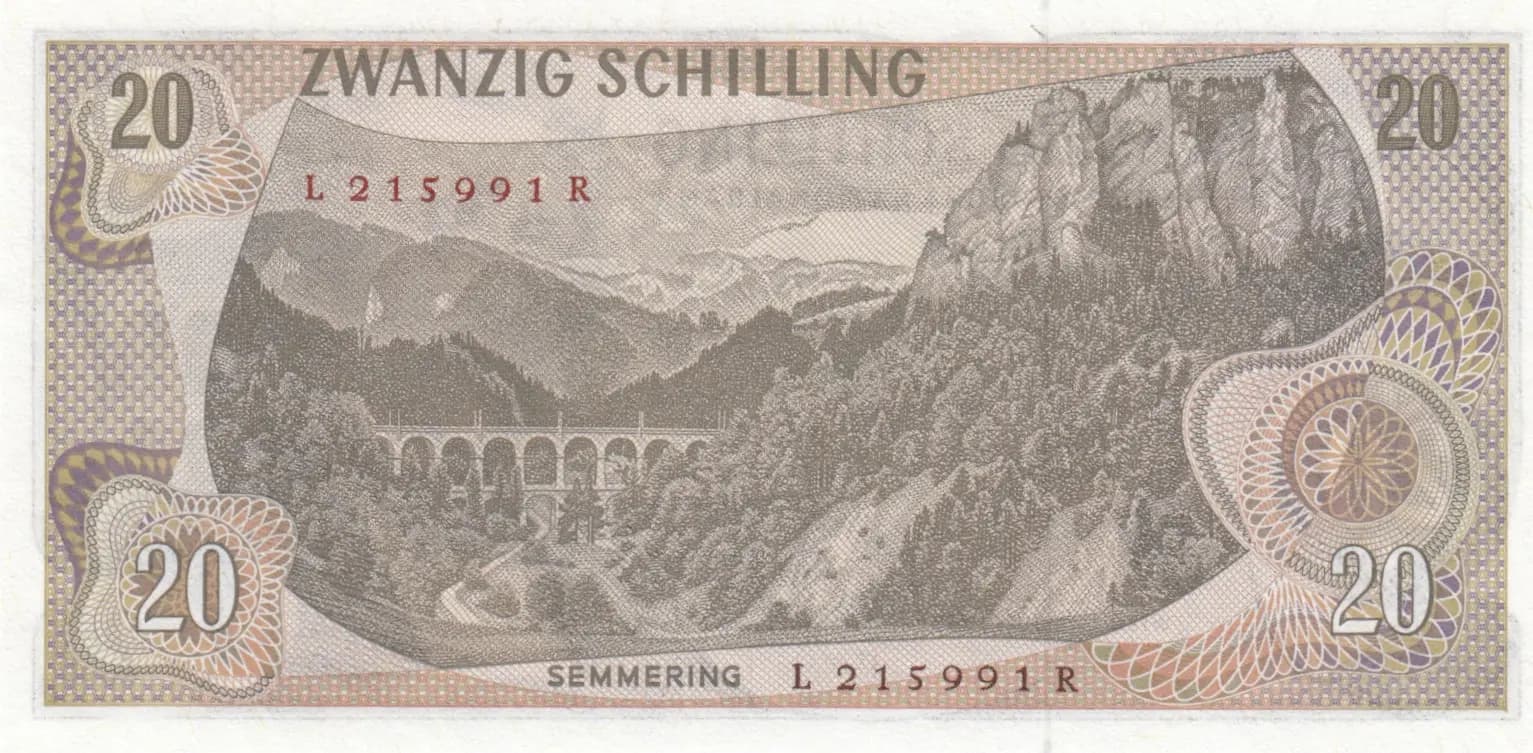
This is an uncirculated example of the Austrian National Bank's 20 Schilling note from 1967, featuring Carl Ritter von Ghega on the obverse and the iconic Semmering Railway viaduct on the reverse. The note displays excellent print quality with sharp engraving throughout, vibrant brown and sepia tones on the front, and multicolored ornamental corner medallions on the back. As an UNC specimen, this note represents a pristine example of mid-20th century Austrian currency design.
Common. The secondary market data from realbanknotes.com shows this note trading at modest prices typical of common circulating currency from this period. UNC examples have sold consistently between $1.99 and $20.50 over more than a decade of auction records, with most UNC sales clustering between $2-$8, indicating strong availability. The note was a regular issue during Austria's post-war period with substantial print runs. Even professionally graded PMG specimens command prices in the $20-$60 range, well below thresholds for rare notes.
Issued on July 2, 1967, by the Oesterreichische Nationalbank, this note commemorates Austria's engineering and industrial heritage through its dual imagery. Carl Ritter von Ghega was a pioneering Austrian railway engineer, while the Semmering Railway viaduct depicted on the reverse represents one of Europe's greatest 19th-century engineering achievements, completed in 1854 and spanning 986 meters across the Semmering Pass in Lower Austria and Styria. Together, these elements reflect Austria's proud tradition of technical innovation during the post-war economic recovery period.
The obverse features a right-facing profile portrait of Carl Ritter von Ghega, a bearded man with curled hair, positioned on the right side of the note. The left side displays ornamental circular designs with nested ovals containing floral patterns. The Austrian double-headed eagle coat of arms is prominently positioned in the center-lower portion. The reverse depicts the Semmering Railway viaduct with its distinctive multiple arched structure spanning across a forested mountainous valley, surrounded by coniferous forests and mountain peaks. Ornamental circular medallions with floral and geometric patterns in purple, orange, and yellow occupy all four corners of the reverse, providing decorative contrast to the landscape scene.
FRONT SIDE: '20' and 'ZWANZIG SCHILLING' (Twenty Schilling) appear as the denomination; 'OESTERREICHISCHEN NATIONALBANK' (Austrian National Bank) identifies the issuer; 'WIEN.AM 2.JULI 1967' (Vienna, July 2, 1967) shows the official issue date; signature titles include 'PRÄSIDENT' (President), 'GENERALRAT' (General Council), and 'GENERALDIREKTOR' (General Director). BACK SIDE: '20' and 'ZWANZIG SCHILLING' (Twenty Schilling) repeat the denomination; 'SEMMERING' identifies the featured railway line; Serial number 'L 215991 R' is printed in alphanumeric format.
Intaglio (engraved) printing technique, with fine line engraving visible throughout the ornamental designs, architectural elements, and landscape details. The note employs multicolor printing, particularly evident in the corner medallions on the reverse which display purple, orange, and yellow tones layered over the brown/sepia base. The sharp detail and fine line patterns visible in the visual analysis are characteristic of professional security printing by Austria's central bank printing facility.
PMG catalogs this as P-142a (base variety) with serial number format 'L 215991 R' (letter prefix, numeric series, letter suffix). The visual analysis confirms this is the standard 1967 issue dated 'WIEN.AM 2.JULI 1967'. No overprints, signatures variations, or notable production anomalies are visible that would distinguish this as a rare variety. The note represents the standard production version of the 1967 series.