2 shillings 1944
Market Prices
19 salesAbout This Note
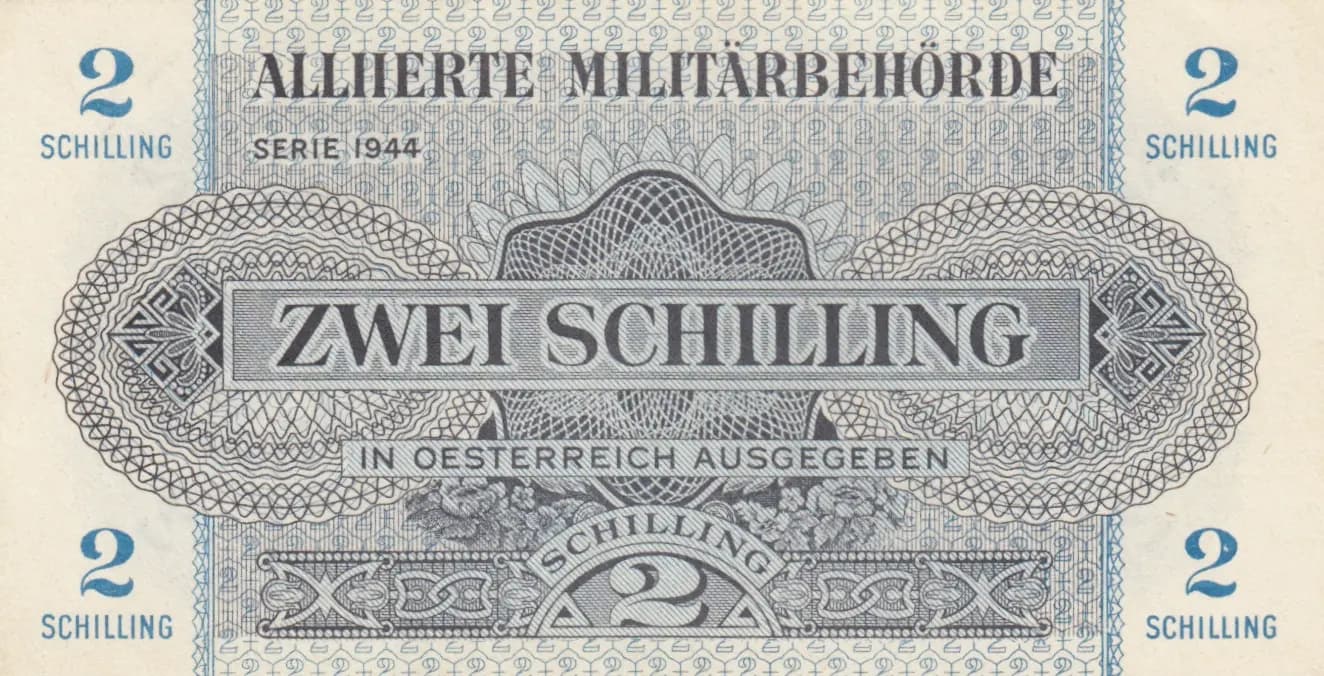
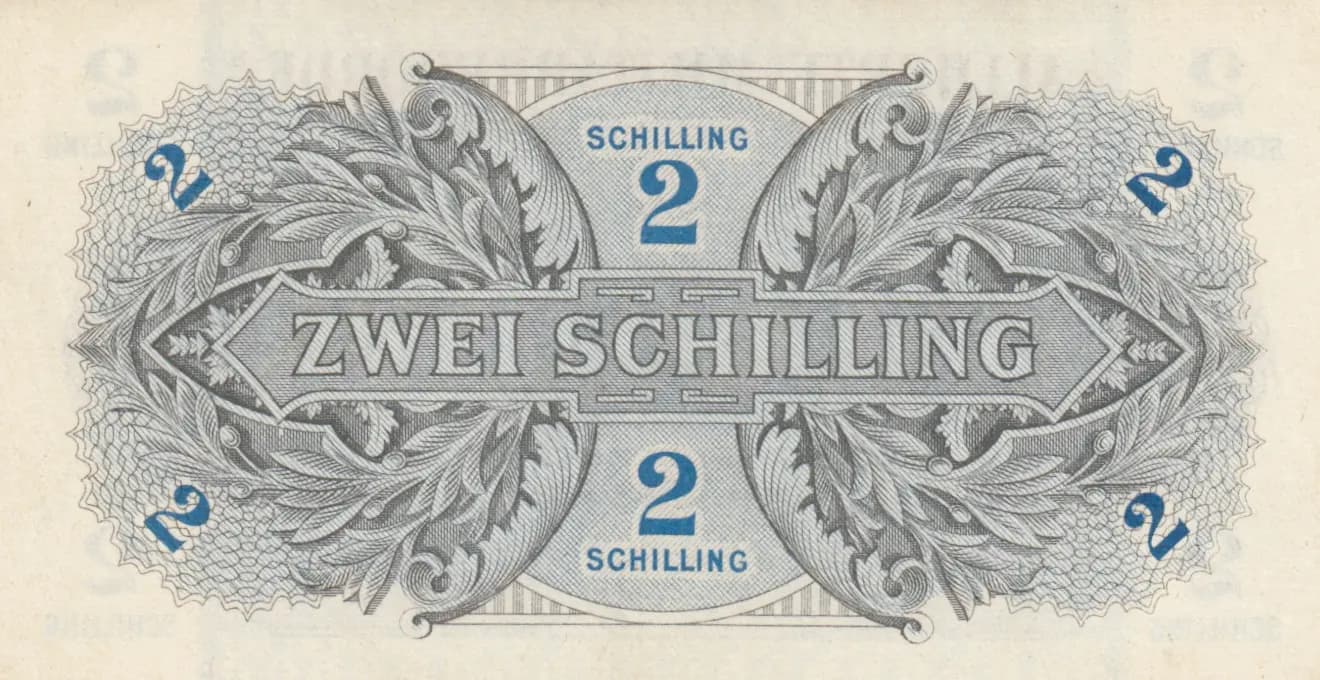
This 2 Schilling banknote from Austria's 1944 Allied Military Authority issue is presented in AU (About Uncirculated) condition, displaying the characteristic blue and black color scheme and classical engraved design typical of WWII-era occupation currency. The note features ornate decorative borders, a central shield cartouche, and symmetrical reverse design with laurel wreaths, all rendered in fine parallel line work that demonstrates sophisticated period printing techniques. This denomination and issuer combination represents an important historical artifact of the Allied occupation of Austria, with the visual evidence showing exceptional preservation and no visible wear.
Common. This note represents a regular issue of occupation currency with substantial print runs typical of Allied military administration notes. eBay sales data confirms robust collector market activity with consistent transactions ranging from $2–$13.50 across various condition grades, indicating abundant supply relative to demand. The 2016 catalogue values ($0.75–$11.50 depending on grade) and consistent low-to-mid single-digit selling prices further confirm this as a common, frequently traded banknote rather than a scarce issue.
The 2 Schilling note issued by the Alliierte Militärbehörde (Allied Military Authority) in 1944 reflects the transitional period following Nazi Germany's defeat, when Allied forces established occupation currency in Austria. The German-language inscriptions 'IN OESTERREICH AUSGEGEBEN' (Issued in Austria) and 'ALLIIERTE MILITÄRBEHÖRDE' explicitly document this military administration's authority over the defeated nation's monetary system. The classical decorative design—with laurel wreaths and geometric ornamentation—symbolized democratic restoration and the re-establishment of legitimate governance after the Nazi regime.
This banknote employs a classical approach to allied occupation currency design. The obverse features an elaborate decorative framework with intricate geometric and floral border patterns, a central ornamental shield or cartouche rendered with fine hatched line work, and repeating background denomination numerals for security purposes. The reverse presents a symmetrical composition centered on a rectangular frame containing the denomination 'ZWEI SCHILLING' flanked by laurel wreaths—traditional symbols of peace and legitimate authority. The denomination '2' appears in blue circles at all four corners of the reverse. No portraits or specific landmarks are depicted; instead, the design relies entirely on abstract ornamental elements typical of interwar and occupation-era currency that avoided potentially controversial national imagery.
Front: 'ALLIIERTE MILITÄRBEHÖRDE' (Allied Military Authority), 'SERIE 1944' (Series 1944), 'ZWEI SCHILLING' (Two Schilling), 'IN OESTERREICH AUSGEGEBEN' (Issued in Austria), '2 SCHILLING' (2 Schilling), 'SCHILLING' (Schilling). Back: 'SCHILLING' (Schilling), '2' (denomination), 'ZWEI SCHILLING' (Two Schilling), 'SCHILLING' (Schilling), '2' (denomination in corner circles). All text in German reflecting the occupation administration's official language.
The note was produced using intaglio (engraved line) printing, evidenced by the sophisticated parallel line patterns creating texture and depth throughout both sides, the fine geometric patterning, and the characteristic appearance of classical banknote engraving. The catalog reference confirms printing in England, likely by the British security printer Thomas De La Rue or a similar established printer contracted for Allied occupation currency production. The color application (blue and black on cream stock) and precise registration visible in the visual analysis are consistent with professional offset lithography combined with intaglio engraving for security features.
Pick catalog identifies this as P-104b, indicating a variant of the base 2 Schilling 1944 issue. The PMG Population Report documents two variants for this denomination (P-104a and P-104b). Based on visual analysis, this note presents the standard obverse and reverse design characteristics of the P-104b variety. Without serial number, signature, or overprint variations visible in the provided images, the specific differentiating characteristic between P-104a and P-104b cannot be definitively stated from this visual analysis alone, though both represent the same 1944 Allied Military Authority emission.