1000 kronen 1919
Market Prices
58 salesAbout This Note
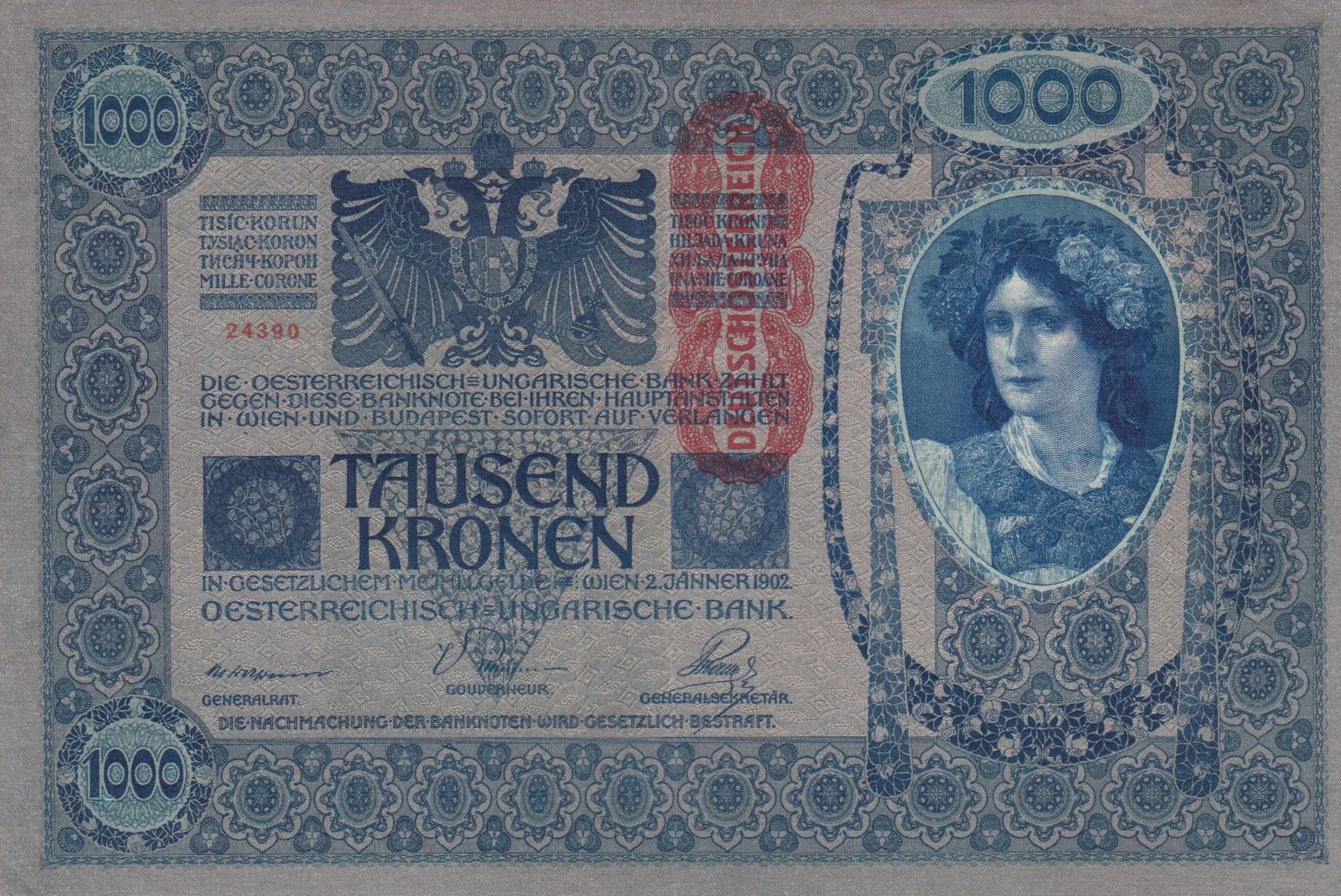
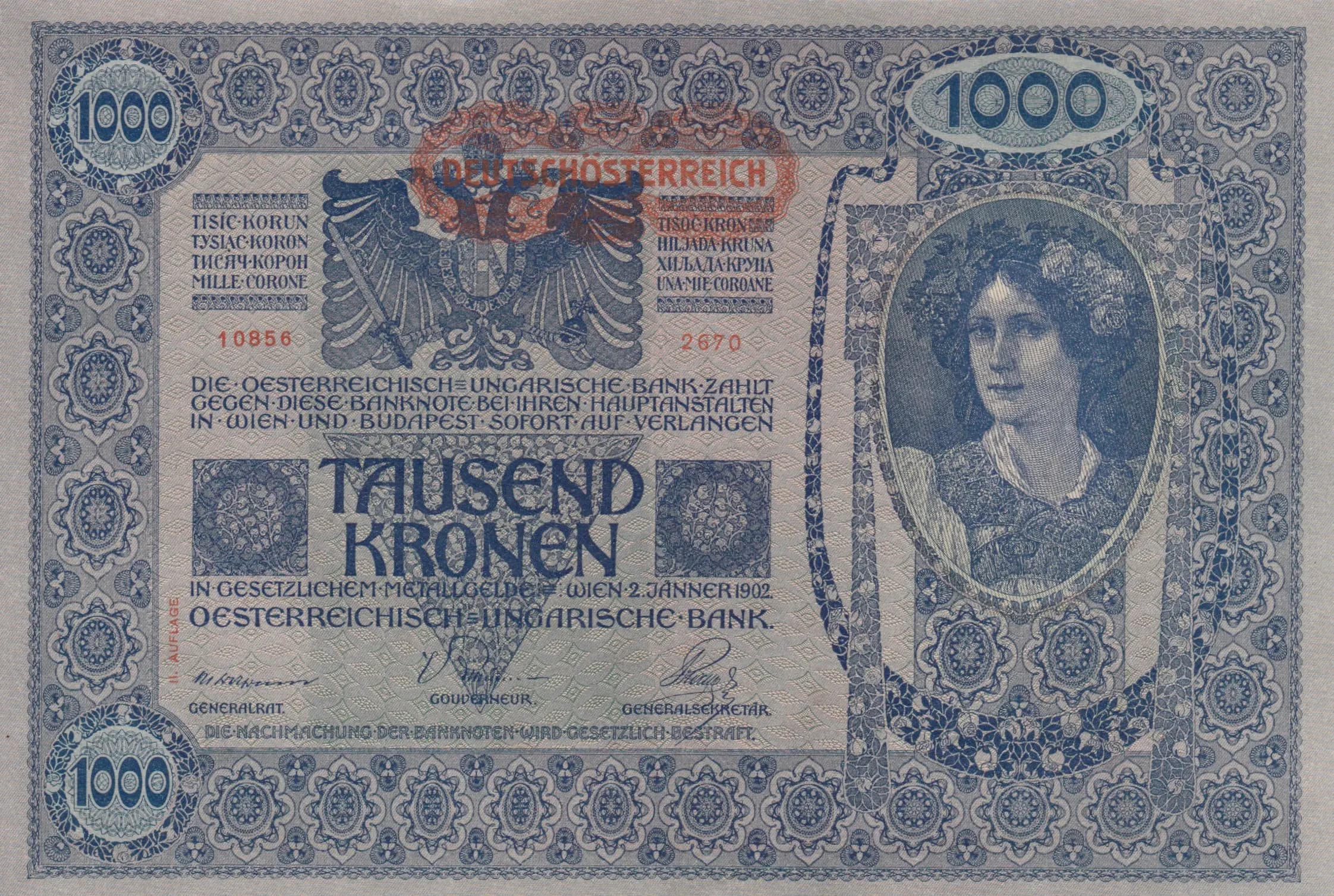
This 1000 Kronen note from 1919 is a striking example of the post-WWI Austrian overprinted currency, issued during the dissolution of the Austro-Hungarian Empire. The note features the classic Austro-Hungarian Bank design with the distinctive red 'DEUTSCHOESTERREICH' overprint across the upper portion, marking Austria's assertion of independence. In AU condition, this note displays crisp, clear printing with well-preserved colors and minimal wear, representing a desirable example of this politically and historically significant issue.
Common. The eBay price history provided demonstrates consistent market activity with dozens of sales over multiple years at modest prices, predominantly in the $30-80 range for PMG-graded examples in the 65-66 range, and $1-6 for ungraded VF/F examples. The 2016 catalogue values list UNC at only $10, indicating substantial availability. The large number of sales transactions and low price points confirm this is a readily available note in the collector market, despite its historical significance.
This note represents a pivotal moment in European history—the 1919 overprinted kronen issued following Austria-Hungary's collapse at the end of World War I. The 'DEUTSCHOESTERREICH' (German Austria) overprint reflects the new Austrian Republic's attempt to distinguish its currency from that of the former empire and establish monetary sovereignty. The original design, dated January 2, 1902, was retained but repurposed with this nationalist overprint, creating a tangible record of the political transition from monarchy to republic.
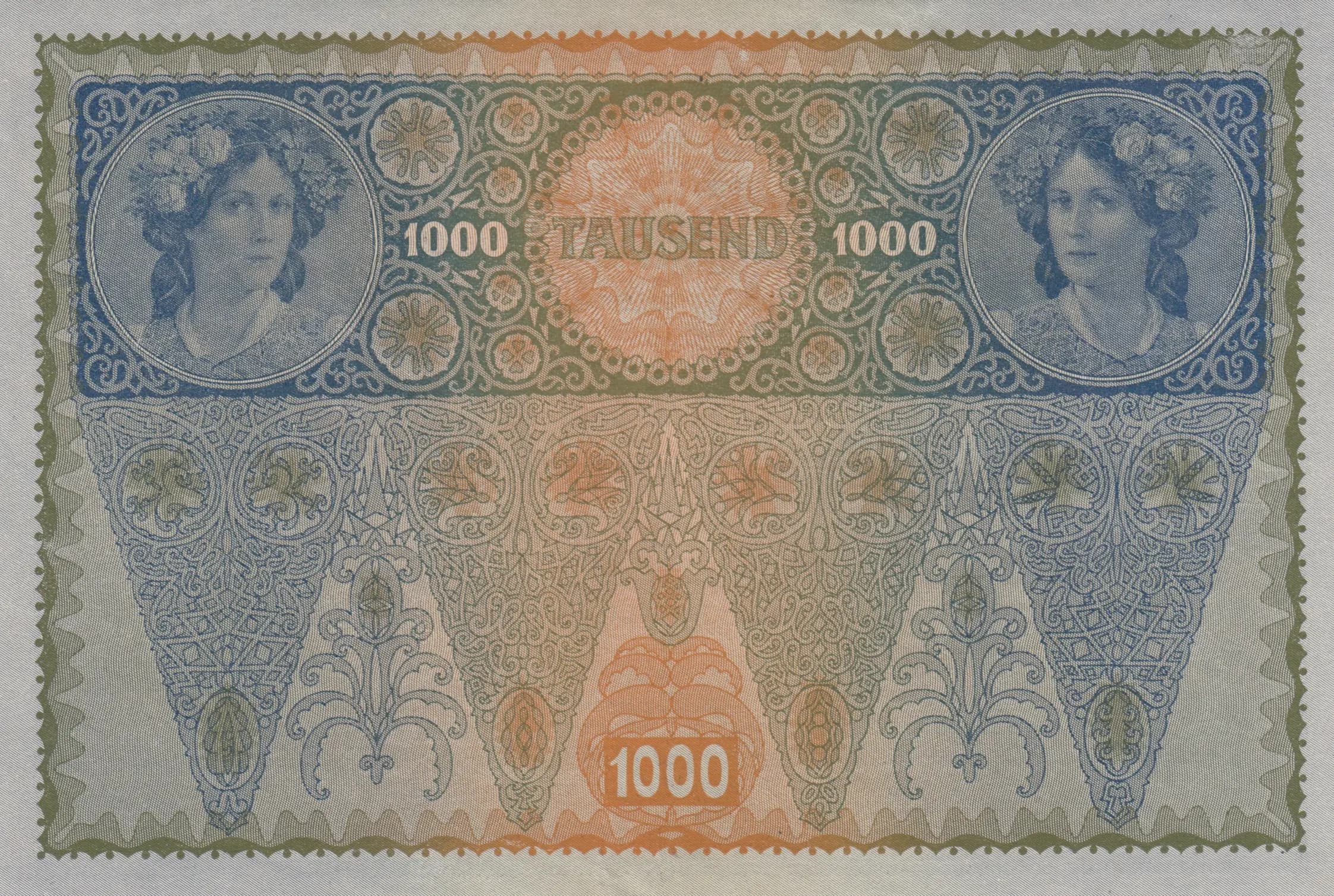
The obverse features the double-headed eagle of the Austro-Hungarian Empire with spread wings and an ornamental shield, centered prominently above the denomination and issuer text. A woman in classical profile facing right is depicted in an oval frame on the right side of the note—this same female portrait (likely representing Austria or a classical allegorical figure) appears again on the reverse in dual form, with two identical portraits facing inward toward the center. The elaborate border consists of repeated floral and geometric ornamental motifs in blue, with cream/tan background elements. The reverse displays an even more ornate design with a radial sunburst pattern in orange/red at its core, surrounded by concentric rings of complex interlocking scrollwork and floral engraving in blue and cream. A green border frames the entire reverse. The red 'DEUTSCHOESTERREICH' overprint on the obverse is the defining feature of the 1919 issue, distinguishing it from the unoveprinted 1902 original.
Front: '1000' (denomination), 'DEUTSCHOESTERREICH' (German Austria - overprint), 'TISIC-KORUN / TISIC-KORON / TISYCH-KORON / MILLE-CORONE' (Thousand crowns in Czech, Slovak, Polish, and Italian), 'TAUSEND KRONEN' (Thousand crowns in German), 'DIE OESTERREICHISCH UNGARISCHE BANK ZAHLT GEGEN DIESE BANKNOTE BEI IHREN HAUPTANSTALTEN IN WIEN UND BUDAPEST SOFORT AUF VERLANGEN' (The Austro-Hungarian Bank pays this banknote at its main offices in Vienna and Budapest on demand), 'IN GESETZLICHEM METALLEGELDE WIEN 2 JÄNNER 1902' (In legal tender - Vienna, January 2, 1902), 'OESTERREICHISCH UNGARISCHE BANK' (Austro-Hungarian Bank), Serial numbers '10856' and '2670', Signatures labeled 'GOUVERNEUR' (Governor), 'GENERALRAT' (General Council), 'GENERALSEKRETÄR' (General Secretary), 'DIE NACHMACHUNG DER BANKNOTEN UND GESETZLICH BESTRAFT' (Counterfeiting of banknotes is punishable by law). Back: '1000' and 'TAUSEND' (Thousand) within the central sunburst design.
Intaglio engraving (line engraving) was used for the primary design elements, as evidenced by the fine line work visible in the portraits, eagle, and ornamental borders. The overprint 'DEUTSCHOESTERREICH' was applied separately in red ink, likely by letterpress or offset lithography. The multiple colors (blue, cream, orange, green, red, black) suggest a multi-pass printing process typical of high-security banknote production of this era. The Austro-Hungarian Bank employed Austria's state security printer for this note series.
This note is specifically the 1919 'II AUFLAGE' (2nd issue) variety with the red 'DEUTSCHOESTERREICH' overprint, as distinguished from the original 1902 unoveprinted Austro-Hungarian Bank issue (Pick-60). The overprint marks Austria's post-WWI monetary independence. Serial numbers observed include '10856' and '2670', suggesting no specific serial number variety restrictions. The Pick catalog lists this as P-61 with one documented variant. The overprint placement and red ink color are consistent with the standard 1919 Austrian Republic issue.