1000 kronen 1919
Market Prices
65 salesAbout This Note
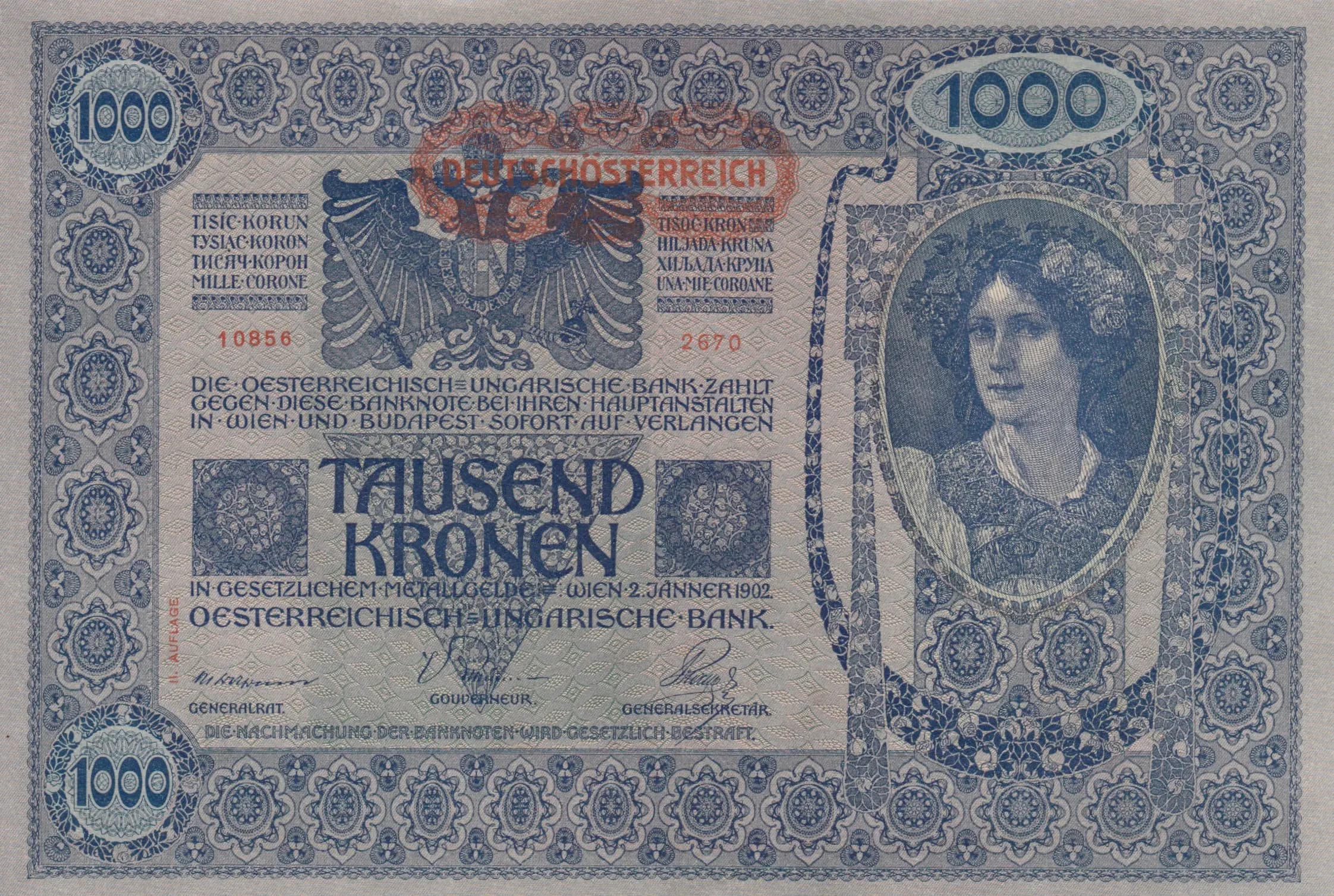
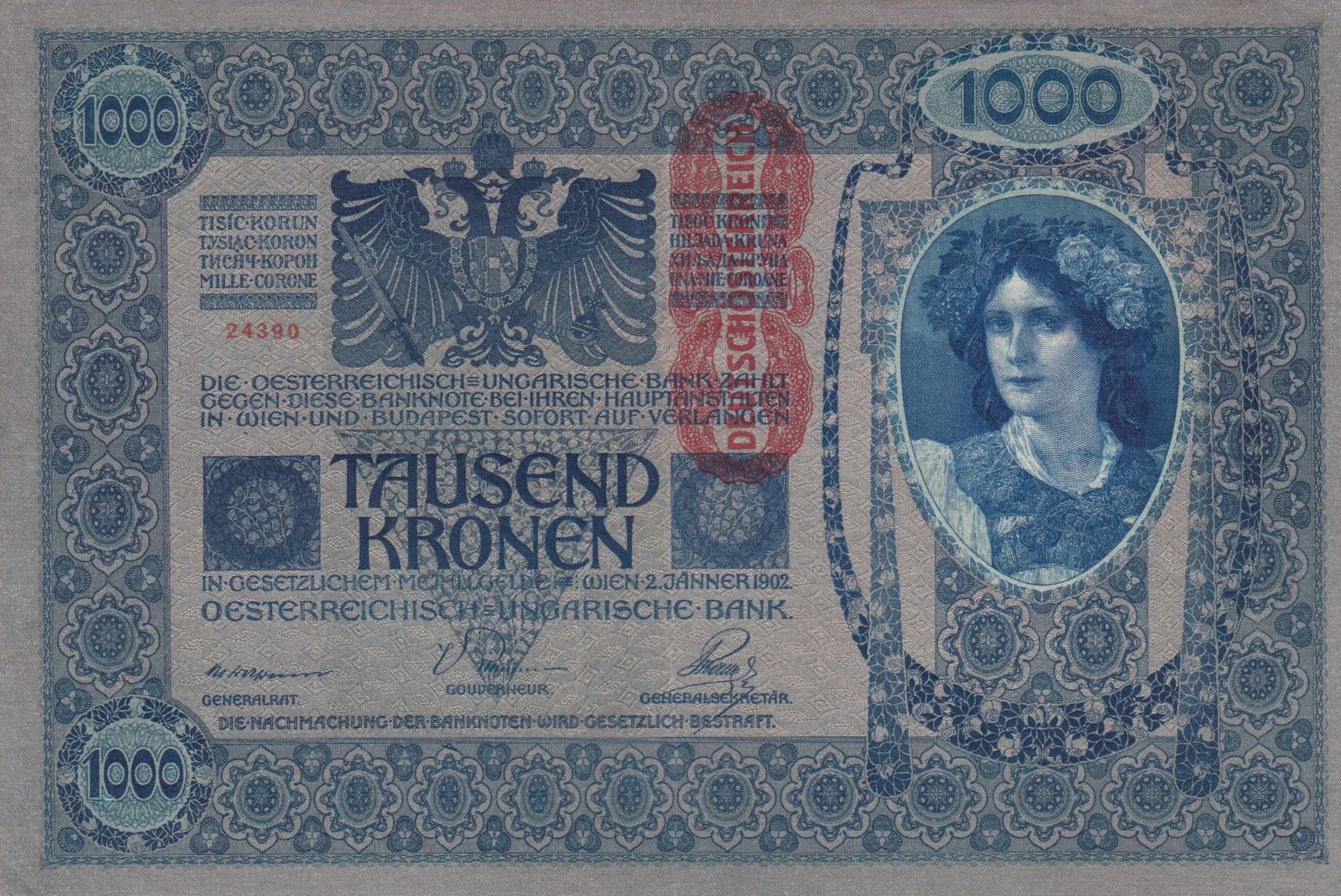
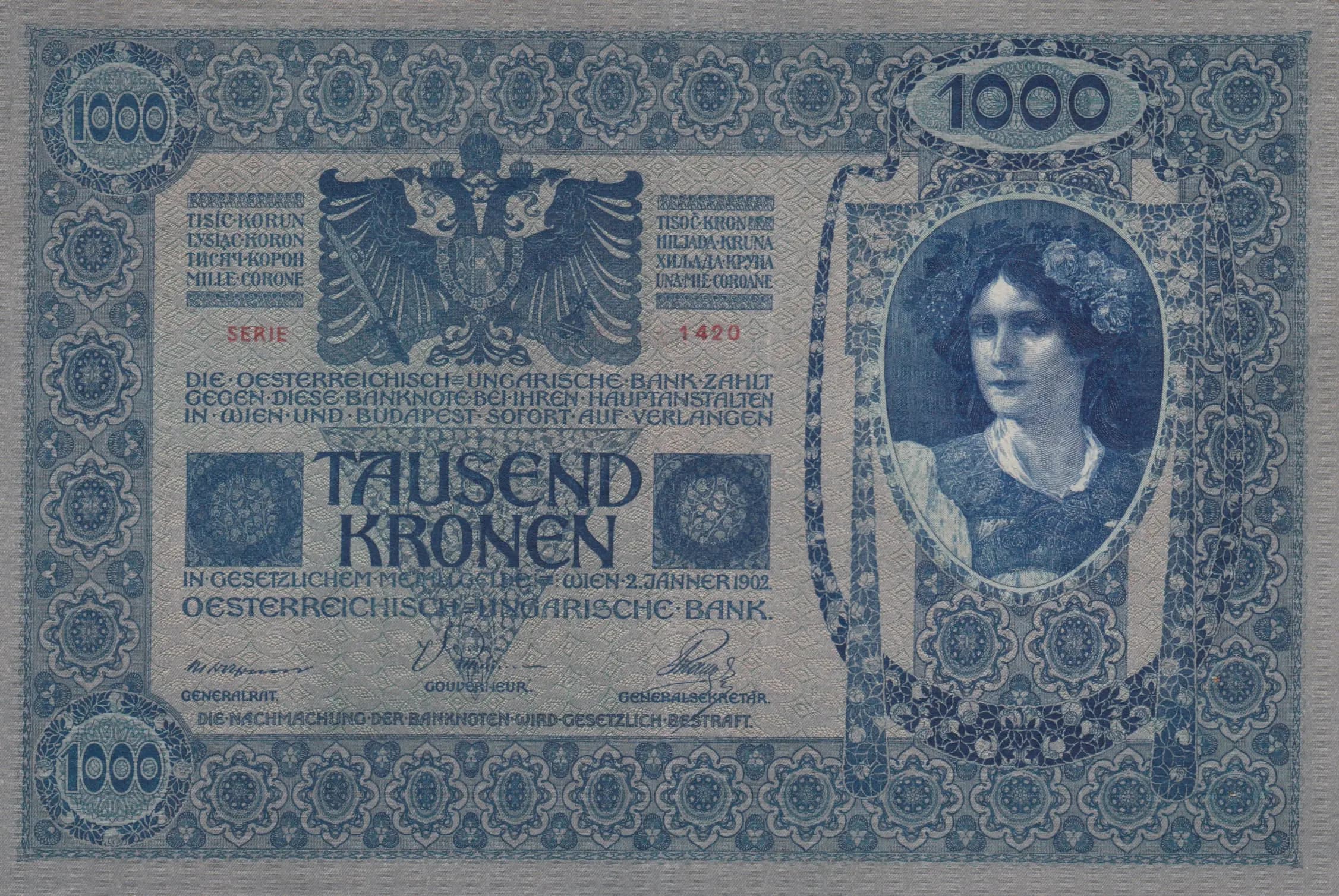
This Austria-Hungary 1000 Kronen banknote from 1919 features an ornate blue and white decorative border with a double-headed imperial eagle emblem and a portrait of a woman in oval frame on the right side. The note displays moderate circulation wear with visible foxing and discoloration throughout, consistent with its AU condition grade, and bears a distinctive red overprint stamp across the central eagle emblem. The denominational text 'TAUSEND KRONEN' is prominently displayed in German, with multilingual inscriptions reflecting the multinational Austro-Hungarian Empire.
Common. The eBay price history provided demonstrates consistent market activity with notes regularly selling in the $2–$5 range for VF condition over many years, and AU/AUNC examples typically commanding $10–$16. The large number of sales transactions (60+ documented sales from 2009–2025) indicates substantial availability in the collector market. This note was issued in significant quantities as a high-denomination denomination of the late Austro-Hungarian Empire, and survived in reasonable numbers post-1919 as an interwar relic. Population data shows PMG has graded examples but does not indicate extreme scarcity. The AU condition grade assigned does not change the rarity assessment, as AU examples consistently achieve modest prices reflecting common status.
Issued by the Oesterreichisch-ungarische Bank (Austro-Hungarian Bank) during the final years of the Austro-Hungarian Empire, this 1000 Kronen note represents a transitional period when the empire was fragmenting following World War I. The double-headed eagle emblem and multilingual text (German, Hungarian, Czech, and Italian) on the banknote symbolize the imperial authority attempting to maintain control over its ethnically diverse territories. The January 2, 1902 date printed on the note reflects the original plate design, which continued to be used for reissues through 1919 as the empire approached its dissolution.
The 1000 Kronen note features a symmetric bilateral design with an elaborate blue and white ornamental border composed of repeated floral medallion patterns, serving both decorative and security purposes. The central motif is the double-headed eagle of the Austro-Hungarian Empire, positioned in the center-left area of the note on both sides, representing imperial authority. On the right side of both the front and back appears the portrait of a woman with long dark hair enclosed in an ornate oval frame; this female allegorical figure likely represents Austria or the Austrian crown. The denomination '1000' appears in circular cartouches at the top left and top right corners. The multilingual text arrangement acknowledges the empire's diverse linguistic regions: German text dominates, with Hungarian, Czech, and Italian translations providing accessibility across the realm. The color scheme of predominant blue and white with cream/beige background creates a distinguished, formal appearance befitting high-denomination currency.
FRONT AND BACK SIDES (largely identical): Main Denomination: 'TAUSEND KRONEN' (One Thousand Crowns in German); Multilingual denomination text: 'TISICKORUN' (German), 'TISICKORON' (Hungarian), 'TICHTI-KORON' (Czech), 'MILLE-CORONE' (Italian). Issuer statement: 'DIE OESTERREICHISCH-UNGARISCHE BANK ZÄHLT GEGEN DIESE BANKNOTE BEHIRDEN HAUPTANSTALTEN IN WIEN UND BUDAPEST SOFORT AUF VERLANGEN' (The Austro-Hungarian Bank pays against this banknote at the main institutions in Vienna and Budapest on demand). Date and authority: 'IN GESETZLICHEM MEISSER (WIEN 2 JÄNNER 1902' (In lawful measure, Vienna, January 2, 1902). Official positions: 'GENERALRAT' (General Council), 'GOUVERNEUR' (Governor), 'GENERALSEKRETÄR' (General Secretary). Security notice: 'DIE NACHMACHUNG DER BANKNOTEN WIRD GESETZLICH BESTRAFT' (Counterfeiting of banknotes is punished by law). Series marking on back: 'SERIE 1420' (Series 1420). Serial numbers observed: '24390' (front), additional series designation on back.
This banknote was produced using the intaglio (engraved) printing method, evidenced by the fine detail and precision visible in the ornamental border patterns and portrait rendering. The multiple color printing (blue, black, red, and natural paper tone) suggests sequential printing passes typical of early 20th-century note production. The red overprint stamp visible across the central eagle emblem on both sides appears to be a post-printing addition, possibly applied during reissue or as a security/validity mark during the transitional 1919 period. The security printer for Austro-Hungarian notes of this denomination was typically the Oesterreichisch-ungarische Bank's own printing works or contracted European security printers such as the Oesterreichische Staatsdruckerei.
This example represents the standard P-59 variety, confirmed by the Pick catalog designation. The visual analysis identifies this as Series 1420 (back side marking) with serial number 24390 (front side). The 1902 date printing, reissued in 1919, is the expected variety for this late-period iteration. The red overprint stamp across the eagle emblem appears to be a characteristic feature of later-state printings or reissues, possibly applied between 1918–1919 during the empire's dissolution and currency transition. Signature variants (Governor, General Secretary, General Council positions) are expected to exist across the print run but cannot be individually assessed from the visual analysis provided. No evidence of major varieties such as different portraits, text variations, or color schemes is apparent in the observed specimen.