10 hillings 1945
Market Prices
35 salesAbout This Note
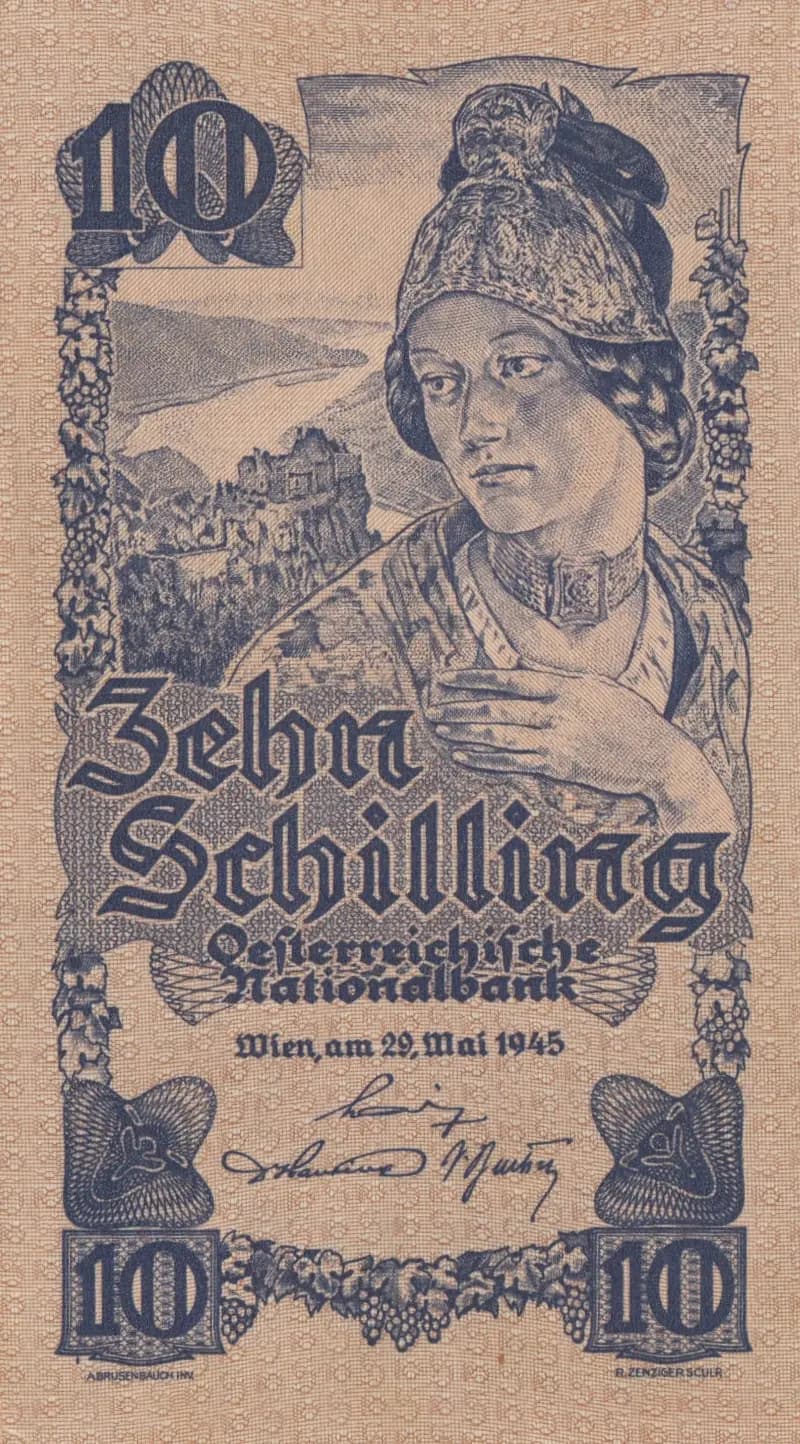
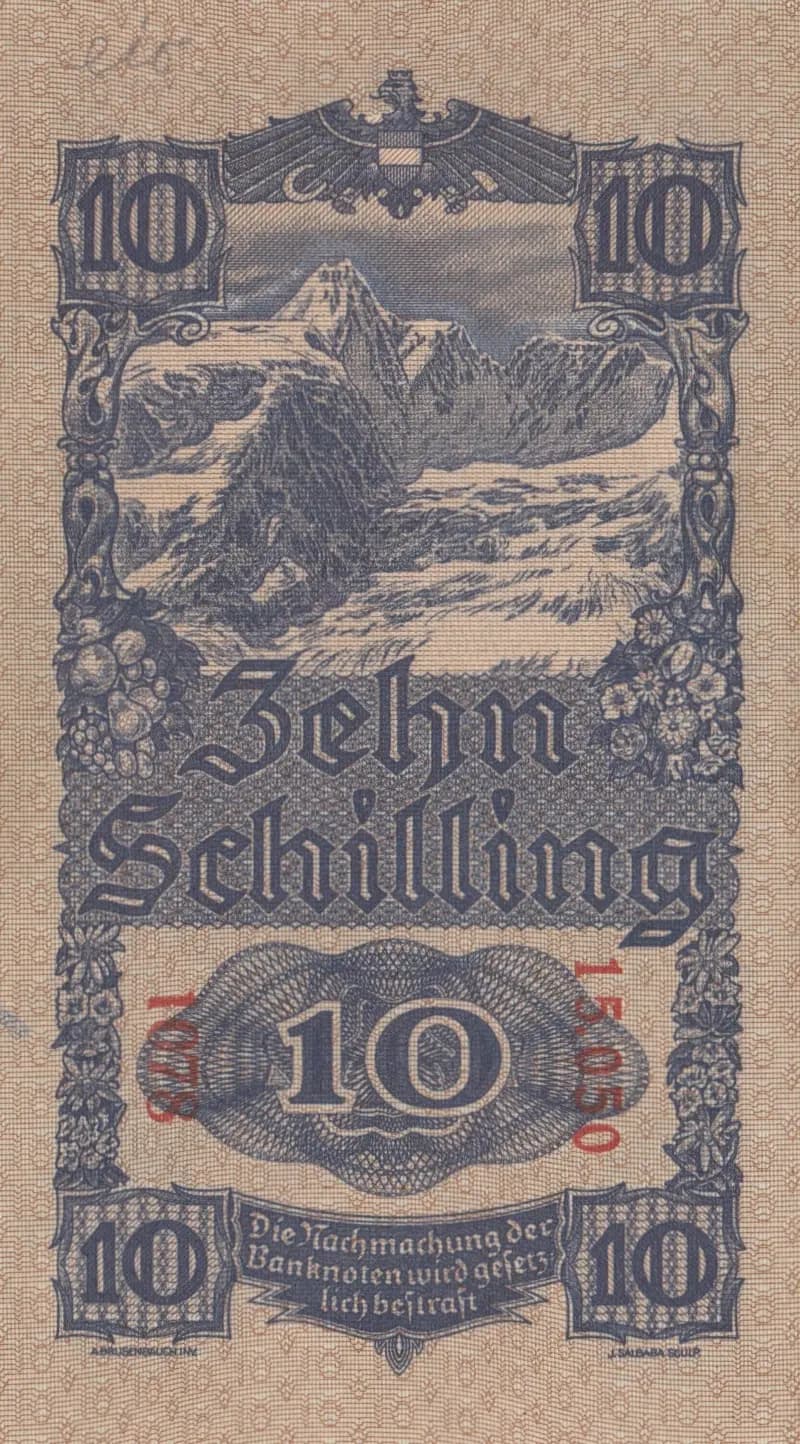
This Austria 10 Schilling note from May 29, 1945 is presented in UNC condition with exceptional preservation. The obverse features a woman in traditional Austrian national costume wearing an ornate jeweled hat, set against an alpine landscape background, while the reverse depicts the Grossglockner mountain with an imperial eagle. The note exhibits sharp, clear printing throughout with no visible wear, creases, or foxing, representing an excellent example of immediate post-war Austrian currency.
Common. The eBay market data provided shows consistent sales activity over multiple years across a wide range of grades (F to PMG 66), with VF and lower grades typically selling for $3-$12 and UNC/near-UNC specimens reaching $15-$60. The 2016 catalog value of $17 for UNC confirms this is a readily available note in the collector market. Print runs for Austrian currency in 1945 were substantial, and this note has not been recalled or withdrawn from circulation in a manner that would artificially restrict supply.
Issued just weeks after Austria's liberation on May 29, 1945, this note represents the Oesterreichische Nationalbank's first currency reissue following Nazi occupation. The imagery deliberately emphasizes Austrian cultural identity—the woman in traditional Tyrolean costume and the Grossglockner (Austria's highest peak) in Eastern Tyrol—serving as symbols of national restoration and territorial integrity during the immediate post-war reconstruction period.
The obverse depicts a woman representing Austrian national identity, depicted from the shoulders up wearing a traditional Tyrolean costume with an ornate tall pointed hat adorned with jeweled decoration. Behind her is a landscape featuring alpine scenery with castle or fortified buildings. The design is framed by decorative vine and grape leaf borders with floral rosettes at the corners. The reverse features the Grossglockner mountain—Austria's highest peak at 3,798 meters located in the Hohe Tauern range of Eastern Tyrol—rendered as a dramatic snow-capped alpine landscape with rocky peaks and valleys. An imperial eagle with spread wings dominates the top center, positioned above an ornamental shield. The denomination '10' appears in decorative geometric frames on both sides. Both sides employ fine line engraving with complex geometric patterns in the denomination circles.
FRONT: '10' (denomination), 'Zehn Schilling' (Ten Schilling), 'Oesterreichische Nationalbank' (Austrian National Bank), 'Wien, am 29. Mai 1945' (Vienna, May 29, 1945), 'R. ZENZINGER SCULPTOR' (sculptor credit), 'A. BRUSENBAUCH HTM.' (printer/engraver credit). BACK: '10' (denomination), 'Zehn Schilling' (Ten Schilling), 'Die Nachmachung der Banknoten wird gesetzlich bestraft' (The counterfeiting of banknotes is punishable by law), 'A. BRUSENBAUCH HTM.' (printer/engraver credit), 'K. KAROLY SCUL.' (sculptor credit).
Intaglio engraving (line engraving), the standard security printing method for high-value banknotes of this era. The fine detail work, complex border patterns, and precise geometric frames visible throughout the note are characteristic of master engravers' work. Credits to R. Zenzinger (sculptor), K. Karoly (sculptor), and A. Brusenbauch (printer/engraver) are noted on the design.
Pick catalog P-114 represents the first issue of the 10 Schilling denomination from May 29, 1945. The catalog data notes the existence of a 'ZWEITE AUSGABE' (second issue) variant catalogued as P-115. Two serial number varieties are documented according to RealBanknotes.com. The specific variety of this example would require examination of the serial number prefix and format, which cannot be fully determined from the provided visual analysis, though the note appears to represent the standard P-114 type without overprints or special markings beyond standard authentication features.