10 000 kronen 1919
Market Prices
12 salesAbout This Note
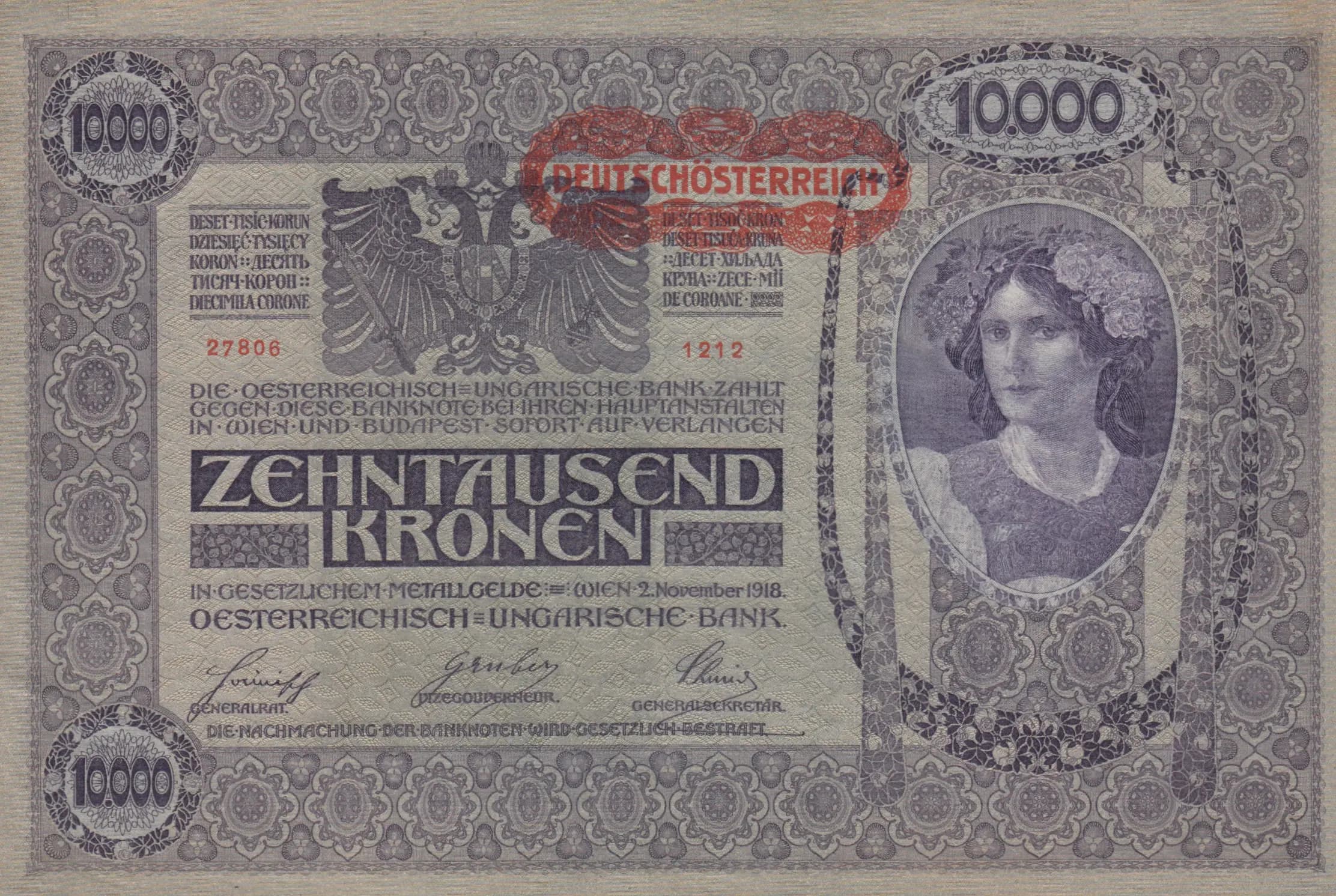
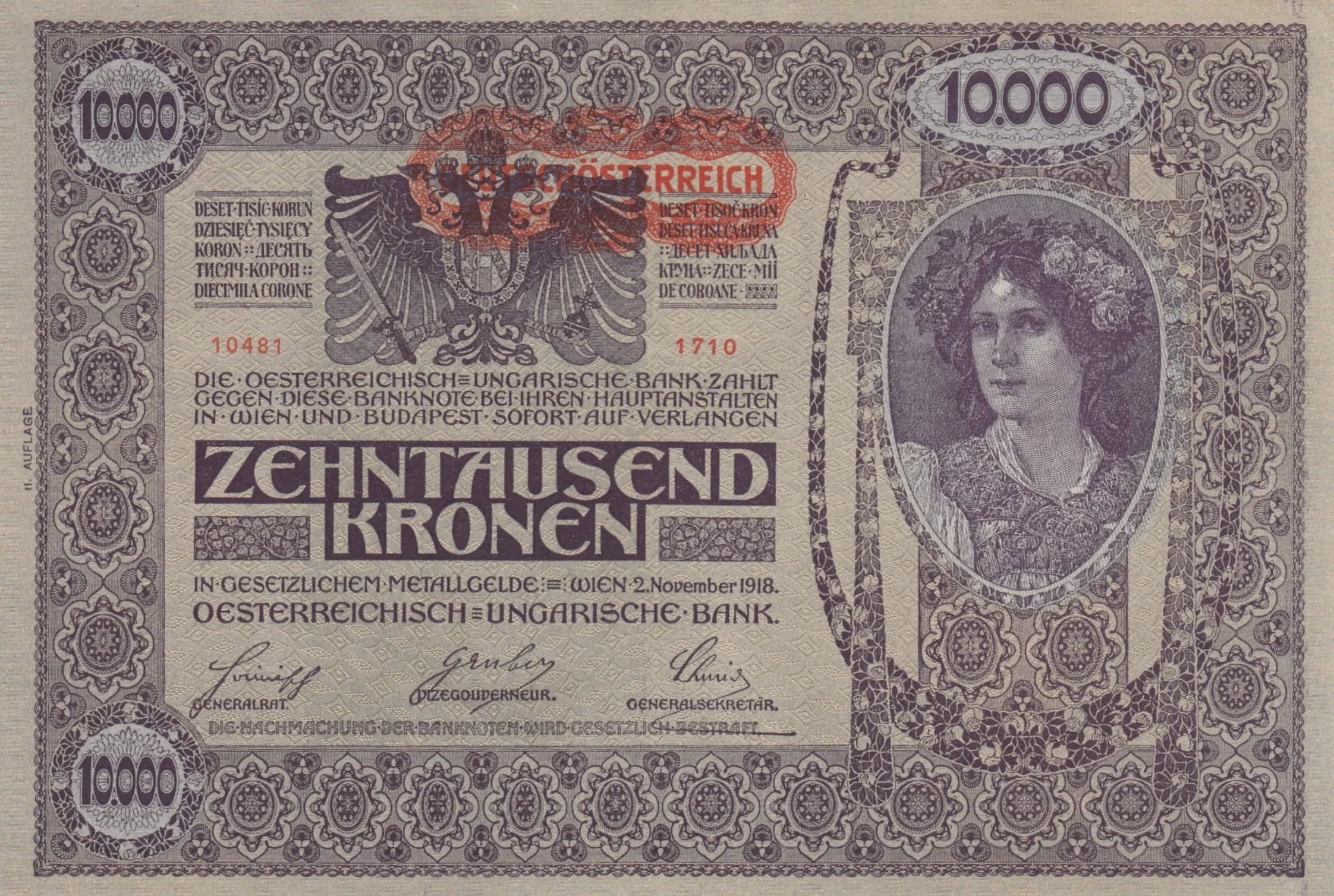
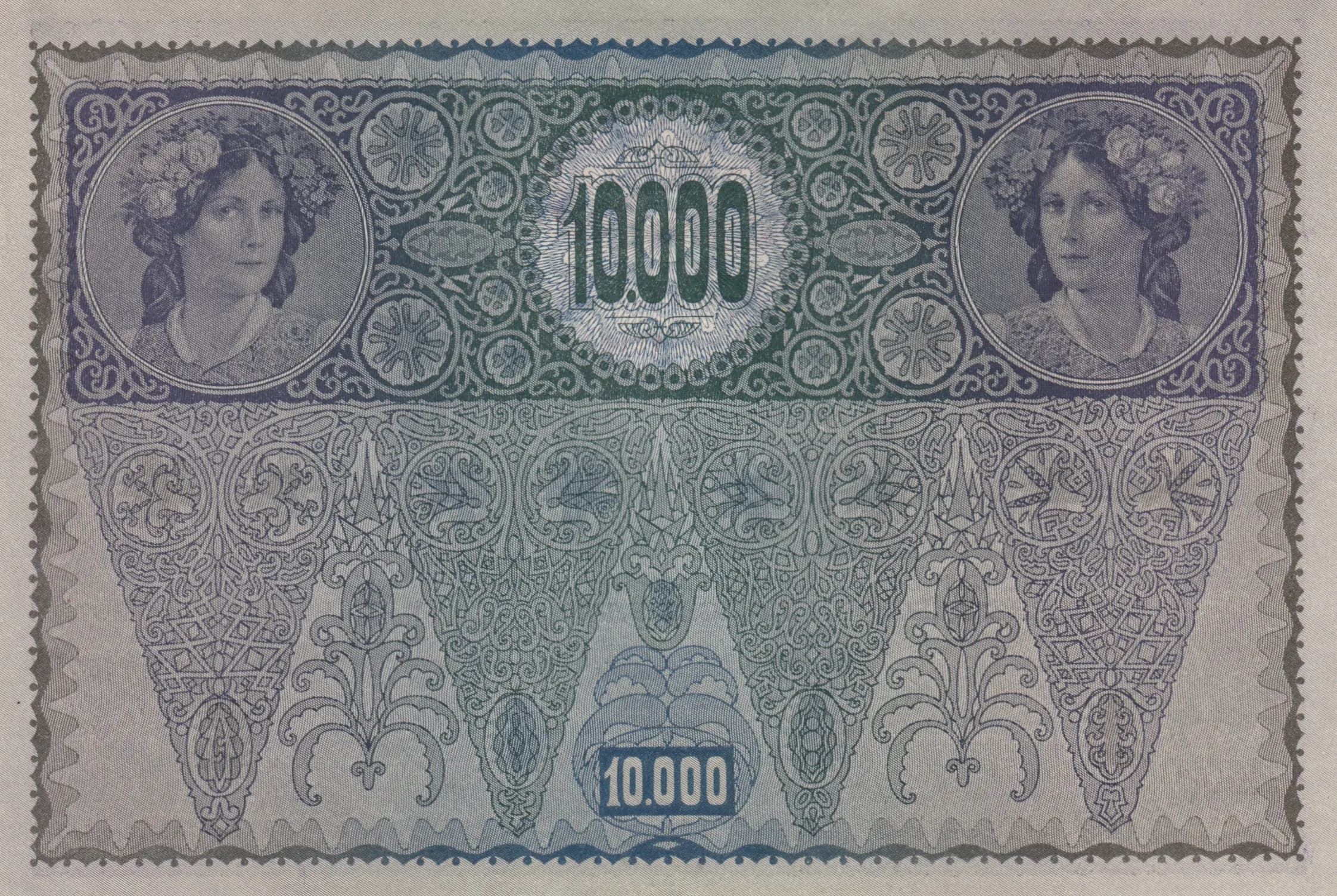
This 10,000 Kronen note from 1919 is an exceptional example of post-WWI Austrian currency issued during the empire's final dissolution. The note features a striking red 'OESTERREICH' overprint across the Austrian imperial eagle, marking it as a deutschösterreich (German-Austria) issue—a critical transitional document from the Austro-Hungarian Bank era. In AU condition, the note displays crisp detail in its ornate engraving with the characteristic purple-brown palette on the obverse and blue-green reverse, though visible aging and the dramatic red stamp testify to its historical passage.
Common. eBay market data shows consistent sales in the $5–$17.50 range across multiple condition grades (VF, EF, AUNC) from 2012–2025, with catalog values listing UNC examples at $10 and VF at $1 (2016 data). This indicates substantial surviving quantities and modest collector demand. The 10,000 Kronen denomination was issued in large quantities before the currency's replacement, and the deutschösterreich overprints, while historically significant, were applied to many thousands of notes. The AU grade specimen described here is desirable for condition but not scarce within this note type.
This banknote represents a pivotal moment in Central European history: the dissolution of the Austro-Hungarian Empire following World War I. Issued on November 2, 1918—just days before the empire's formal collapse—the note originally promised payment 'in legal metal currency' by the Austro-Hungarian Bank in Vienna and Budapest. The overprinted 'OESTERREICH' designation reflects the immediate declaration of German-Austria as a separate state, making these overprinted notes tangible evidence of the empire's fragmentation and the birth of the Austrian Republic.
The obverse features an allegorical female portrait in classical style, positioned in an oval frame on the right side of the note, representing Austria or Liberty. The dominant central element is the imperial two-headed Austrian eagle with spread wings, rendered in dark purple-brown with intricate heraldic detailing—this is the coat of arms of Austria-Hungary. The eagle bears the red 'OESTERREICH' overprint, a governmental stamp applied post-issuance to repurpose Austro-Hungarian currency as German-Austrian notes. Denomination numerals '10000' appear in circular medallions at the upper corners. The reverse displays two identical allegorical female portraits in matching oval frames (left and right), with the same classical styling, separated by ornate scrollwork, floral patterns, and geometric designs rendered in blue and green tones. The entire note is surrounded by an intricate border of fine-line engraving with Art Nouveau-inspired ornamentation, and multiple denomination displays serve as anti-counterfeiting measures. The perforated or scalloped edge visible on the reverse may indicate original sheet separation or a design element.
FRONT: 'Die Oesterreichisch-Ungarische Bank zahlt gegen diese Banknote bei ihren Hauptanstalten in Wien und Budapest sofort auf Verlangen' (The Austro-Hungarian Bank pays against this banknote at its main offices in Vienna and Budapest on demand) | 'Zehntausend Kronen' (Ten Thousand Kronen) | 'In gesetzlichem Metallgelde' (In legal metal currency) | 'Wien 2. November 1918' (Vienna 2 November 1918) | 'Oesterreichisch-Ungarische Bank' (Austro-Hungarian Bank) | Signature lines labeled 'Generalrat' (General Council), 'Directionneur' (Director—in French), 'Generalsekretaer' (General Secretary) | Serial number and reference number visible. BACK: Multiple denominations '10000' displayed as security features, with inscriptions repeated in multiple European languages (German, Polish, and others) denoting the currency value across the empire's multilingual regions.
Intaglio engraving (steel plate or copper plate), which is evident from the fine detail work, intricate line patterns, relief texture, and the characteristic crisp definition visible throughout both sides. The multi-color printing (purple-brown on obverse, blue-green on reverse, with red overprint) was achieved through multiple passes through different plates or successive plate impressions. The ornamental security patterns, signatures, and denomination text show the hallmark precision of turn-of-the-century European central bank note production. No specific printer attribution is confirmed in the catalog data, but production would have been by or under contract to the Austro-Hungarian Bank's official printing facilities.
This note is identified as Pick P-66 (10,000 Kronen, 1919). According to external references, this is the '2nd Issue' (II AUFLAGE) variant, distinguishable by text in the left margin—a detail consistent with Austria's rapid reissuance of denomination plates following the empire's collapse. The red 'DEUTSCHOESTERREICH' overprint on what was originally an Austro-Hungarian Bank note places this specifically within the overprinted varieties created in late 1918 for the nascent Austrian state. The November 2, 1918 date is the original date of Austro-Hungarian issuance; the 1919 Pick catalog year reflects when these overprinted versions entered circulation as Austrian currency. Serial number and signature varieties exist but are not specified in the catalog data provided.