10 000 kronen 1919
Market Prices
19 salesAbout This Note
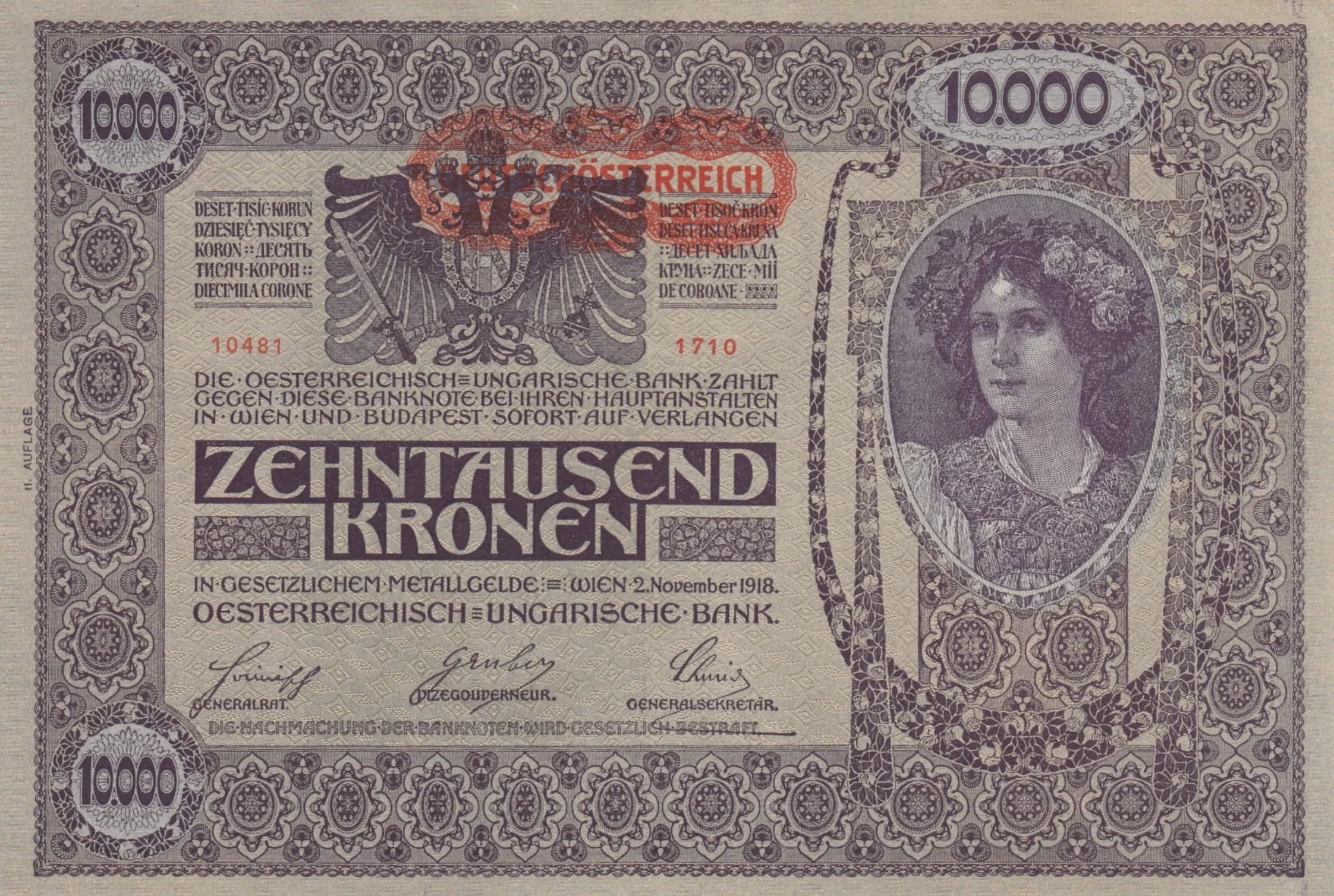
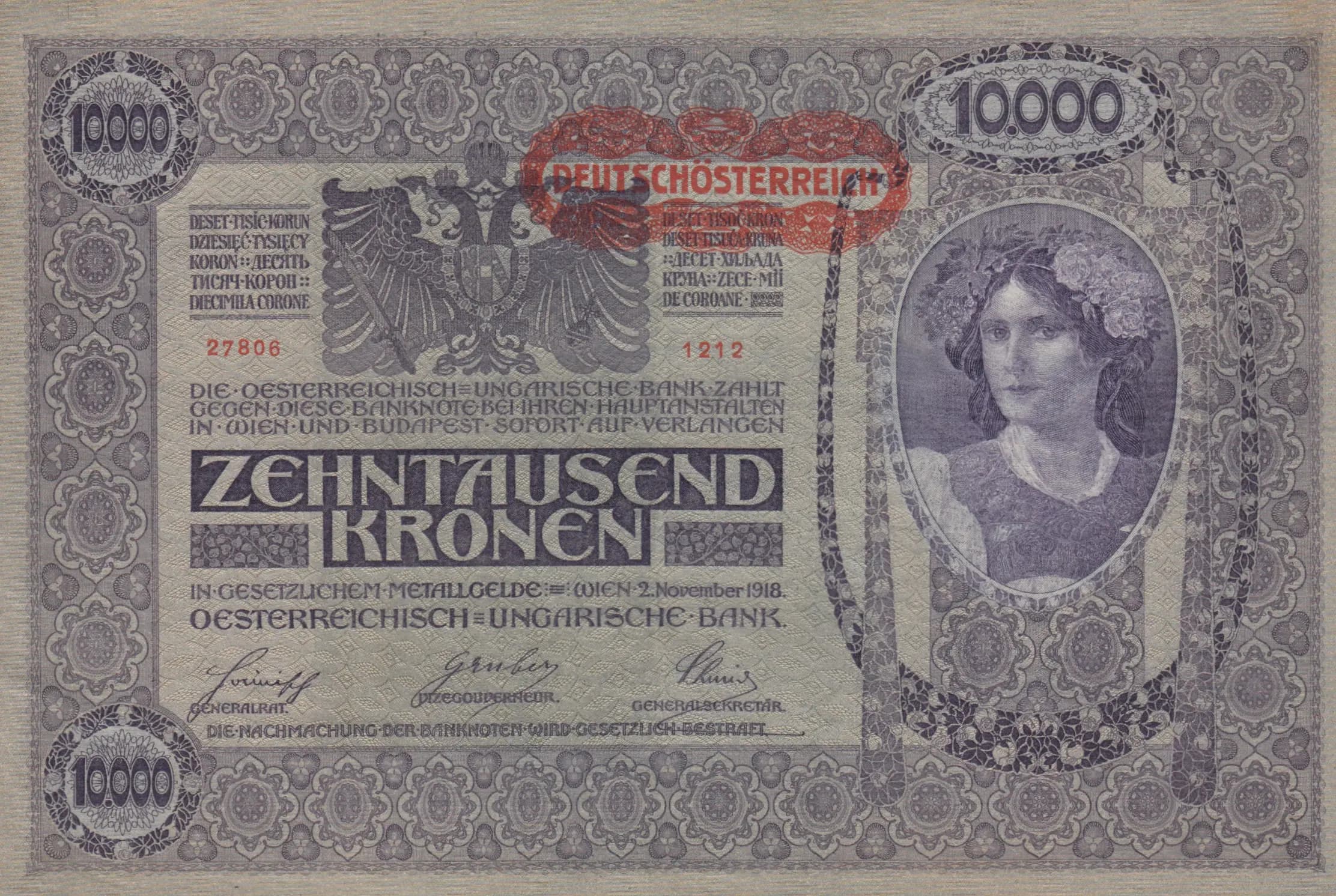
This 10,000 Kronen note from 1919 represents a fascinating transitional piece from the Austro-Hungarian Empire to the First Austrian Republic. The note features the distinctive 'DEUTSCHOESTERREICH' (German-Austria) overprint in red across the front, indicating its use during the brief period of the post-WWI Austrian state before the Treaty of Saint-Germain. Despite age-related toning and surface wear consistent with storage rather than heavy circulation, the note remains in AU condition with crisp details visible throughout, including the ornate border work, dual female portraits, and imperial eagle emblem.
Common. The eBay market data provided shows consistent sales ranging from approximately $2 to $12 for notes in VF through EF condition, with catalog values at $25 for UNC specimens. The PMG population report indicates at least one graded example exists, but the frequency and pricing of sales demonstrates this is a regularly encountered note in the secondary market. While historically significant as a transitional overprinted issue, the note was produced in substantial quantities sufficient to satisfy post-war Austrian monetary demand, and examples survive in numbers typical of regularly-circulated early 20th-century currency from a major central bank.
This banknote was issued by the Oesterreichisch-Ungarische Bank (Austro-Hungarian Bank) on November 2, 1918, precisely at the moment of the Empire's collapse. The red 'DEUTSCHOESTERREICH' overprint reflects the political upheaval of the immediate post-war period, when Austria attempted to unite with Germany before the Treaty of Saint-Germain (September 1919) explicitly forbade it. The imperial double-headed eagle and formal banking language represent the final gasps of Austro-Hungarian monetary authority before the currency system was restructured under the new Austrian state.
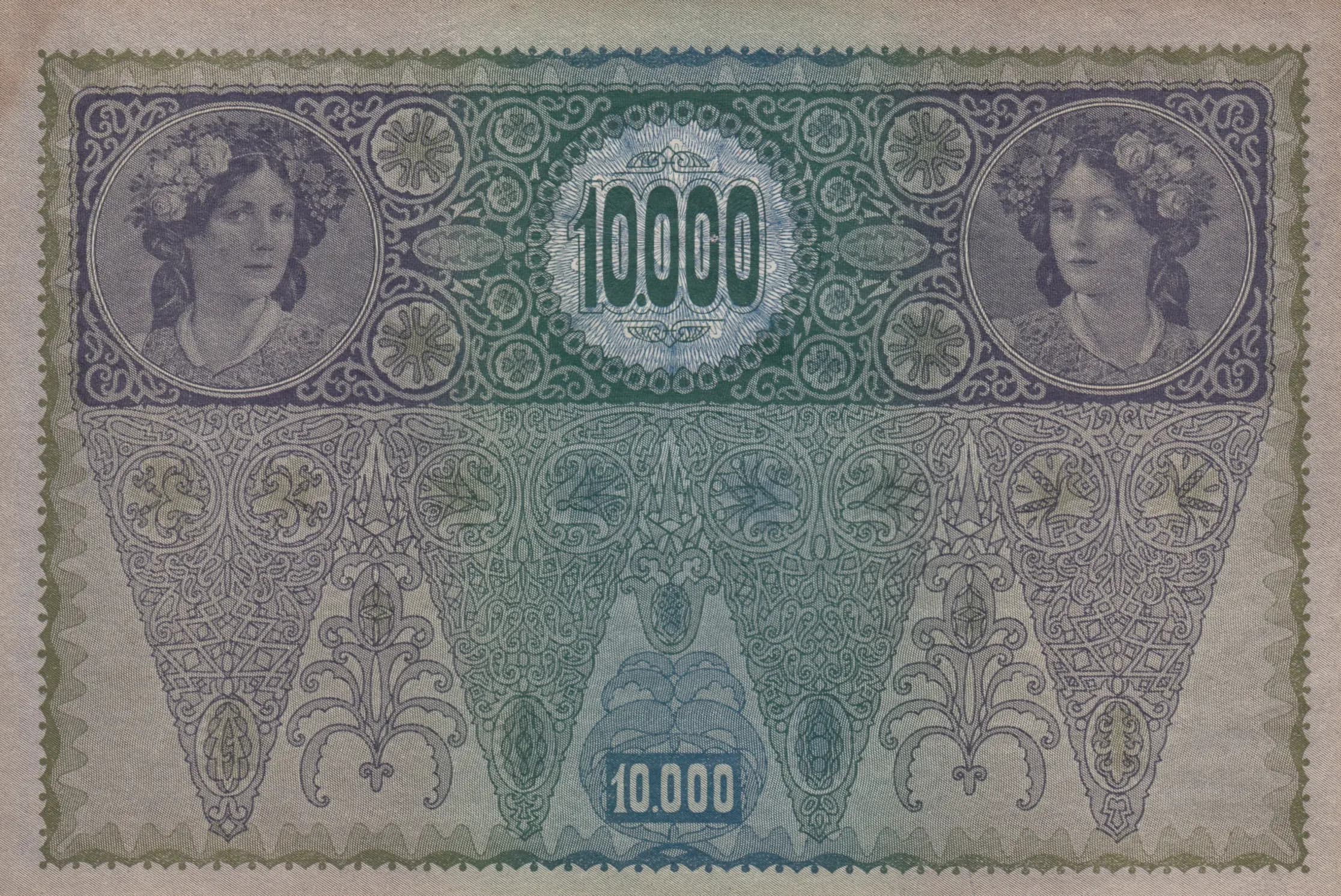
The obverse features a classical female allegorical figure representing Austria, depicted in profile facing right within an oval frame on the right side of the note. The portrait exhibits fine engraved detail characteristic of early 20th-century security printing, with carefully rendered curled hair and refined facial features. The dominant central element is the imperial double-headed eagle of the Austro-Hungarian Empire, displayed with spread wings in authoritative posture. The reverse presents a symmetrical design with two identical portraits of the same allegorical woman positioned at top left and top right within circular medallion frames, emphasizing the dual nature of the Austro-Hungarian state. The entire design is surrounded by an intricate baroque-inspired ornamental border composed of repeating floral medallion patterns, scrollwork, and decorative flourishes executed in green, blue, and purple tones on the back and gray-purple on the front. Corner elements display circular denomination markers in all four corners for security verification. The color palette—predominantly gray-purple on the obverse and green-blue on the reverse—reflects the sophisticated security printing standards of the Austro-Hungarian central bank.
FRONT: Main text reads 'OESTERREICHISCH-UNGARISCHE BANK' (Austro-Hungarian Bank) with the denomination 'ZEHNTTAUSEND KRONEN' (Ten Thousand Kronen) prominently displayed. The legal promise states: 'DIE OESTERREICHISCHE BANKZAHLT GEGEN DIESEN BANKNOTEBEI IHREN HAUPTANSTALLTEN IN WIEN UND BUDAPEST SOFORT AUFVERLANGEN' (The Austrian Bank pays on demand against this banknote at its main offices in Vienna and Budapest). The issue date is marked 'WIEN-2. NOVEMBER 1918' (Vienna—2. November 1918) with the phrase 'IN GESETZLICHEM METALLGEILDE' (In legal metal currency). Official positions are noted: 'GENERALRAT' (General Councillor), 'DIREKTOR' (Director), and 'GENERALSEKRETAER' (General Secretary). A security warning reads 'DIE NACHMAECHUNG DER BANKNOTEN WIRD GESETZLICH BESTRAFT' (Counterfeiting of banknotes is punishable by law). Serial numbers 27806 and 1212 are visible. BACK: Denomination repeated as '10000' and '10,000' in decorative cartouches. OVERPRINT: 'DEUTSCHOESTERREICH' (German-Austria) in red diagonal stamp across front.
Intaglio (engraved) printing on high-quality banknote paper, executed with the precision characteristic of Imperial-era Austro-Hungarian security printing. The intricate ornamental borders, fine line work in the portraits, and detailed scrollwork patterns are consistent with steel engraving by specialized security printers. The Austro-Hungarian Bank contracted with renowned security printers such as Giesecke & Devrient or similar firms during this period. The red overprint 'DEUTSCHOESTERREICH' was applied as a separate overprinting operation, likely via lithography or stamp, to existing banknote stock after the political transition of November 1918.
This specimen is Pick 65, the standard issue of the 10,000 Kronen from the Austro-Hungarian Bank dated November 2, 1918, with the 'DEUTSCHOESTERREICH' overprint characteristic of notes issued during the German-Austrian union period (November 1918–September 1919). The catalog reference notes that Pick 66 (II. AUFLAGE / Second Edition) exists as a distinct variety, indicating this represents the first printing/edition. The serial numbers visible (27806 and 1212) are specific to this individual note. The red diagonal overprint positioning and intensity may vary slightly between notes, representing typical overprinting variations rather than distinct varieties.