1 gulden 1882
Market Prices
10 salesAbout This Note
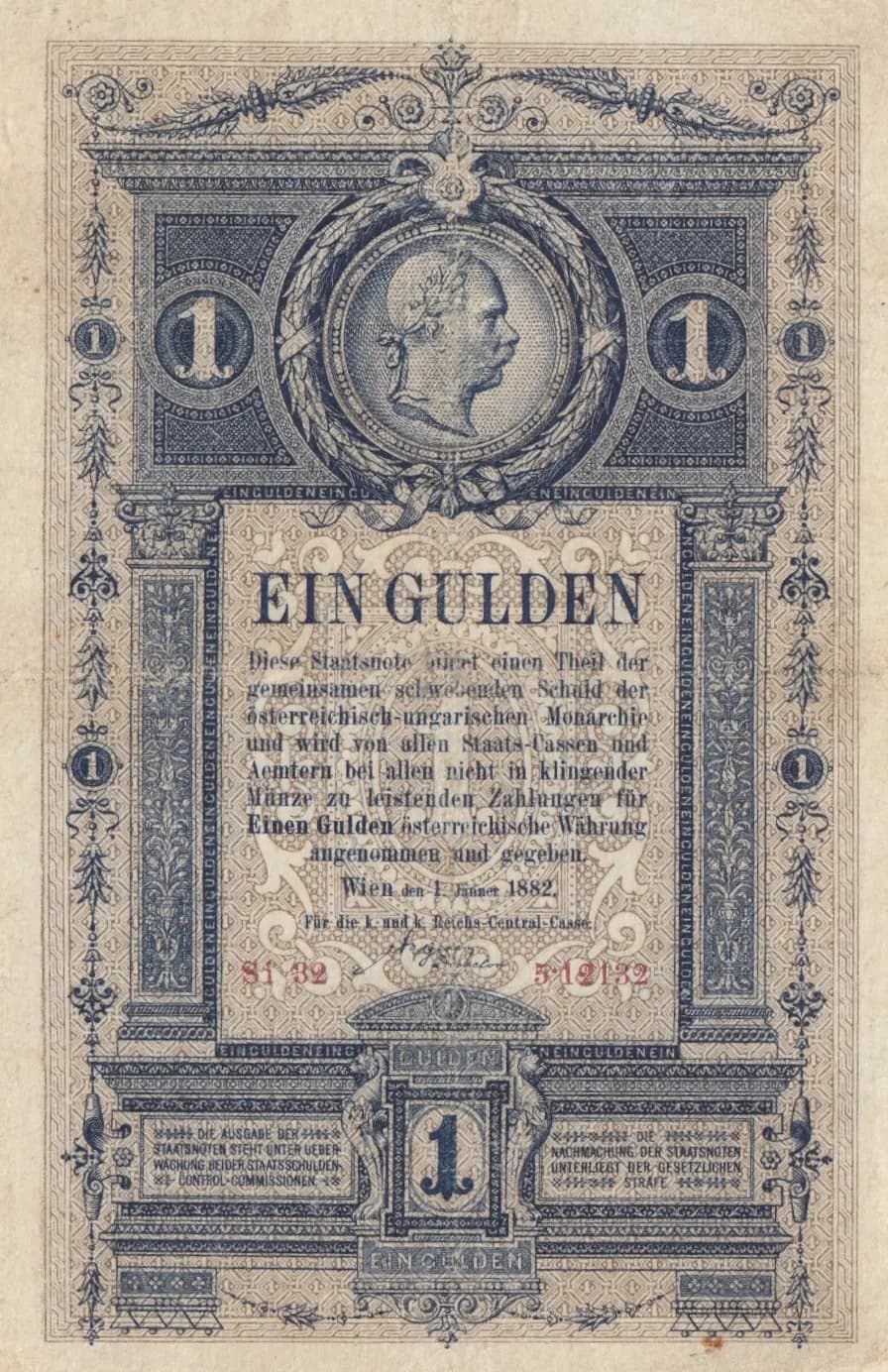
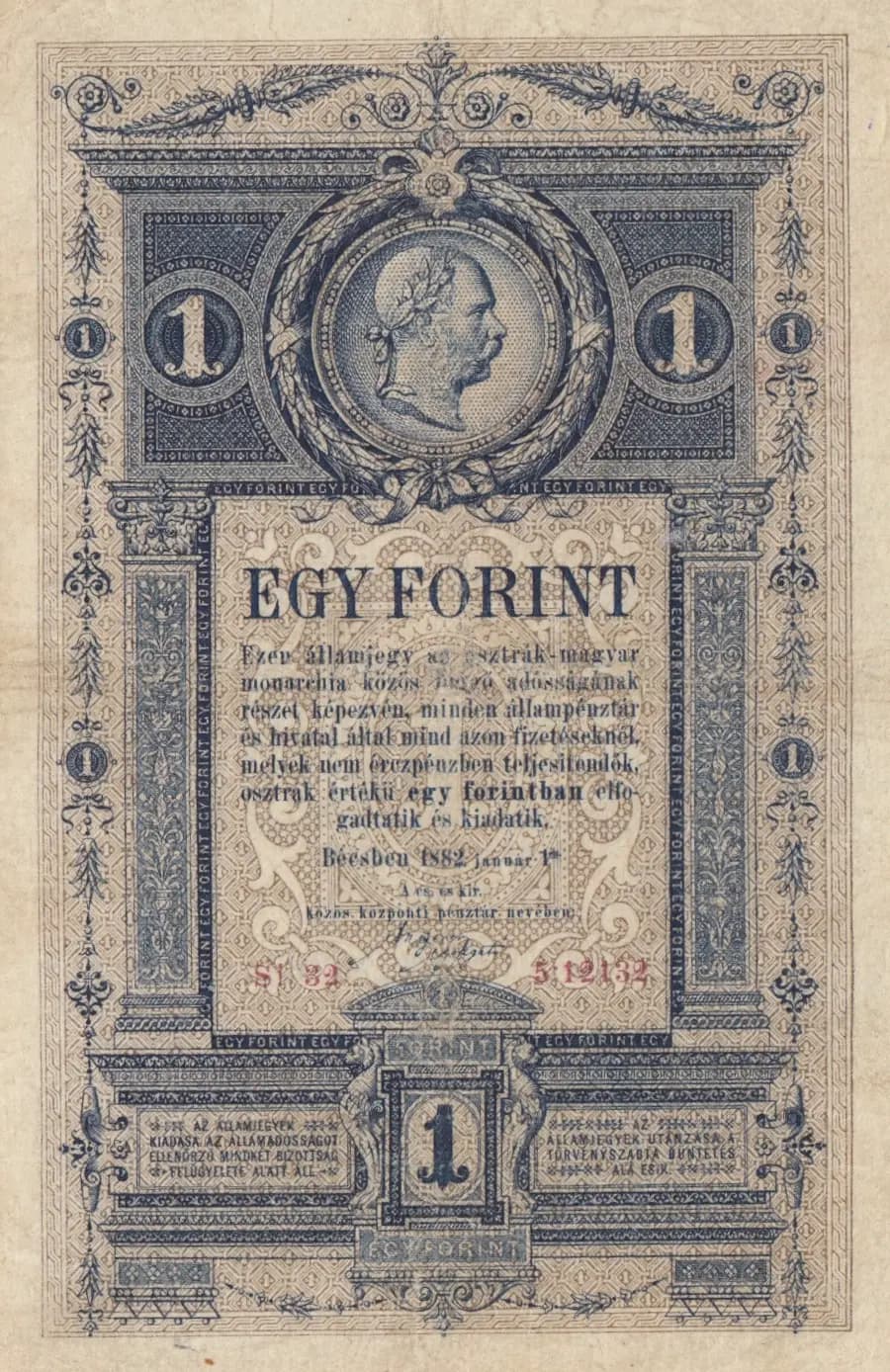
This is an exceptional example of the 1882 Austria 1 Gulden (Pick A153), a bilingual Austro-Hungarian state note issued by the Reichs-Central-Casse. The note displays the characteristic dual-language design with German obverse and Hungarian reverse, featuring a classical portrait medallion of Emperor Franz Joseph I surrounded by an ornate laurel wreath within nested geometric frames. In VF condition, the note shows appropriate age-related patina with visible foxing in the cream areas and minor creasing, consistent with careful storage of a 140+ year old banknote, while the fine engraved decorative elements and security printing remain well-preserved.
Common. The eBay price tracking data shows consistent sales in the $20-50 range across multiple condition grades (VG, F, EF) over the past decade, with typical auction prices clustering around $25-35 for Fine condition examples. The 2016 catalog valuation of $15 for F-grade further confirms this is a standard, regularly-traded issue. With no evidence of limited print runs, recall, or short-lived issuing authority, and given robust market liquidity at modest prices, this note is definitively common in the numismatic market.
Issued on January 1, 1882, this note represents the monetary union of the Austro-Hungarian Monarchy during the later reign of Emperor Franz Joseph I. The bilingual design—with parallel German and Hungarian text and equivalent denominations (1 Gulden/1 Forint)—reflects the Compromise of 1867 that established the dual monarchy and its shared financial obligations. The imperial crown emblem and classical portraiture convey the authority and stability of the central treasury during a period of relative economic consolidation in the multi-ethnic empire.
This bilingual note features a classical engraved design centered on paired portrait medallions of Emperor Franz Joseph I in profile facing right, rendered in the medallic style typical of imperial coinage and state paper money. Each portrait is enclosed within concentric circular frames with geometric micropattern backgrounds and surrounded by a laurel wreath—a symbol of imperial authority and legitimacy. The decorative architectural framework includes ornamental pilasters flanking the design, crowned imperial emblems at top center, and classical finials with scrollwork throughout. Corner circles display the denomination '1' in each corner. The bottom sections contain substantial text cartouches detailing the note's legal status as a shared debt instrument of the Austro-Hungarian Monarchy. The color scheme of blue-gray on cream/beige underprint with dark navy text and ornamental work creates a sophisticated, authoritative appearance befitting a state treasury note.
FRONT (German): 'Ein Gulden' (One Gulden) / 'Diese Staatsnote wird einen Theil der gemeinsamen sel.w.endenden Schuld der österreichisch-ungarischen Monarchie und wird von allen Staats-Cassen und Aemtern bei allen nicht in klingender Münze zu leistenden Zahlungen für Einen Gulden österreichische Währung angenommen und gegeben.' (This state note forms part of the debt commonly owed by the Austro-Hungarian Monarchy and will be accepted and given by all state treasuries and offices for one gulden of Austrian currency in all payments not required to be made in specie.) / 'Wien, den 1. Jänner 1882' (Vienna, January 1, 1882) / 'Für die k. und k. Reichs-Central-Casse' (For the k. and k. Imperial and Royal Central Treasury) / BACK (Hungarian): 'Egy Forint' (One Forint) / 'Ezen államjegy az osztrak magyar monarchia közös pénze, adosságának részét képezven, minden állampenztár és hivatali allat, mind azon fizetéseknél, melyek nem keresztpénzben teljesitendök, osztrak értékü egy forintban elfogadtatik és kiadatik.' (This state note forms part of the debt commonly owed by the Austro-Hungarian Monarchy and will be accepted and given by all state treasuries and offices for one forint of Austrian currency in all payments not required to be made in specie.) / 'Bécsben 1882 januar 1' (Vienna, January 1, 1882) / 'A k. és k. Központi pénztár nevében' (For the k. and k. Central Treasury)
Intaglio engraving (copper plate engraving) was the primary printing method, as evidenced by the fine line work, intricate geometric patterns, and detailed portrait rendering visible throughout both sides. The depth and precision of the border ornamentation, the micropattern background in the portrait medallion, and the crisp serif typography are characteristic of high-quality 19th-century intaglio work. This note was printed by the Austro-Hungarian state printing authority; for this period, such state notes were typically produced under contract by Austria's official printers, likely the Staatsdruckerei (State Printing Office) in Vienna.
The primary variety identifier for this issue would be signature or authorization line variations typical of multi-year currency emissions. The observed date of 'Wien/Bécsben, den 1. Jänner 1882' (Vienna, January 1, 1882) confirms this is from the initial 1882 emission. No serial number or printer's mark details are visible in the provided images to identify additional sub-varieties. Austro-Hungarian state notes of this denomination typically exist with minor variations in typography, spacing, and authentication marks across different printings; further examination of serial number prefixes or signature variants would be required to determine specific variety classification within Pick A153.