5000 rublei 1919
Market Prices
3 salesAbout This Note
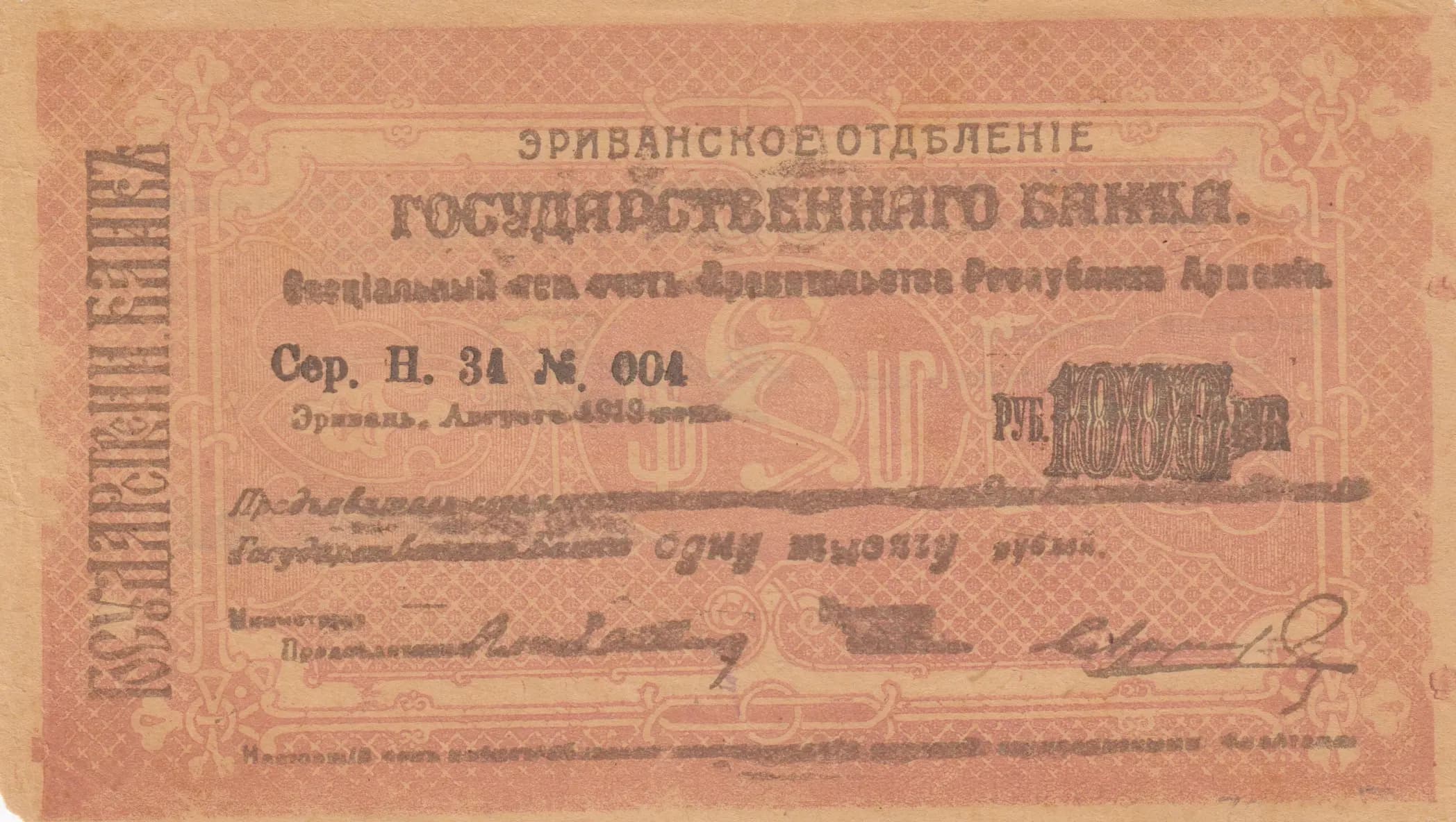
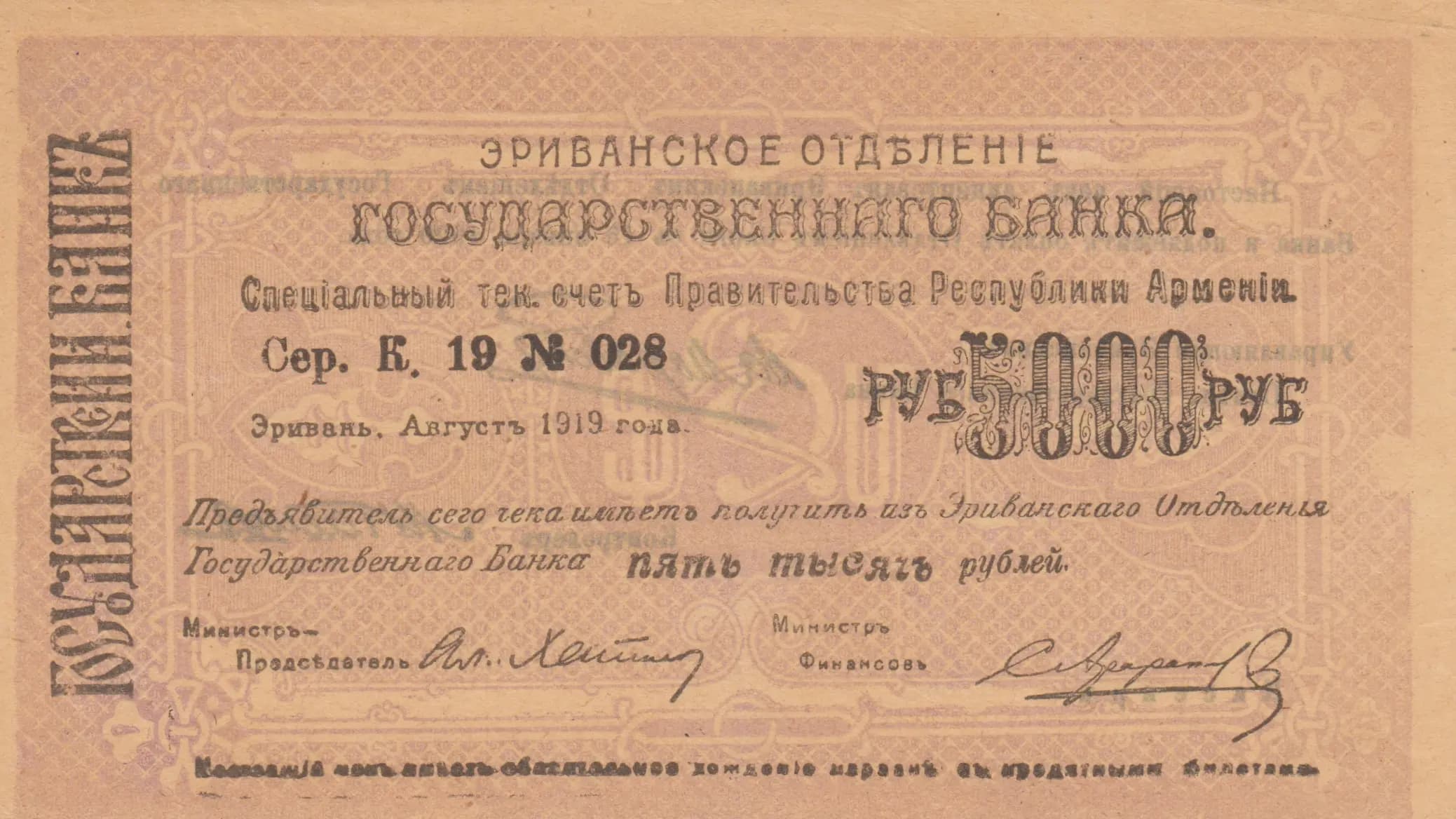
This is an exceptional example of Armenia's 5000 Rublei note from August 1919, issued by the Erivan Branch of the State Bank during a pivotal moment in Armenian independence. The note displays the characteristic tan and beige coloration of early 20th-century Russian currency paper, with ornamental geometric border patterns and dual signatures of ministerial officials. In EF condition, this specimen shows age-appropriate patina and creasing consistent with period handling, making it a desirable collectible representing Armenian monetary sovereignty.
Common. The eBay market data provided indicates regular sales activity with multiple specimens grading PMG 58 selling for $30-$32 in recent years, and historical AUNC examples reaching $46. The 2016 catalog valuation of $125 for EF specimens is consistent with pricing for historically significant but readily available notes. The Erivan Branch notes from 1919 were issued in substantial quantities to support Armenian governmental operations and were in circulation or archived during the brief independence period. While historically important, the note is not scarce in the market and specimens in various grades appear with reasonable frequency in numismatic channels.
Issued in August 1919 during the brief independence of the Democratic Republic of Armenia (1918-1920), this banknote represents the Armenian government's attempt to establish financial autonomy following the collapse of Imperial Russia. The note's dual designation as both a check (чек) and a bearer instrument, payable from January 15, 1920, reflects the transitional and uncertain nature of Armenian governance during this period. The Russian-language inscriptions and reliance on the pre-existing State Bank infrastructure underscore how newly independent Armenia initially built upon Russian institutional frameworks before the Soviet takeover in December 1920.
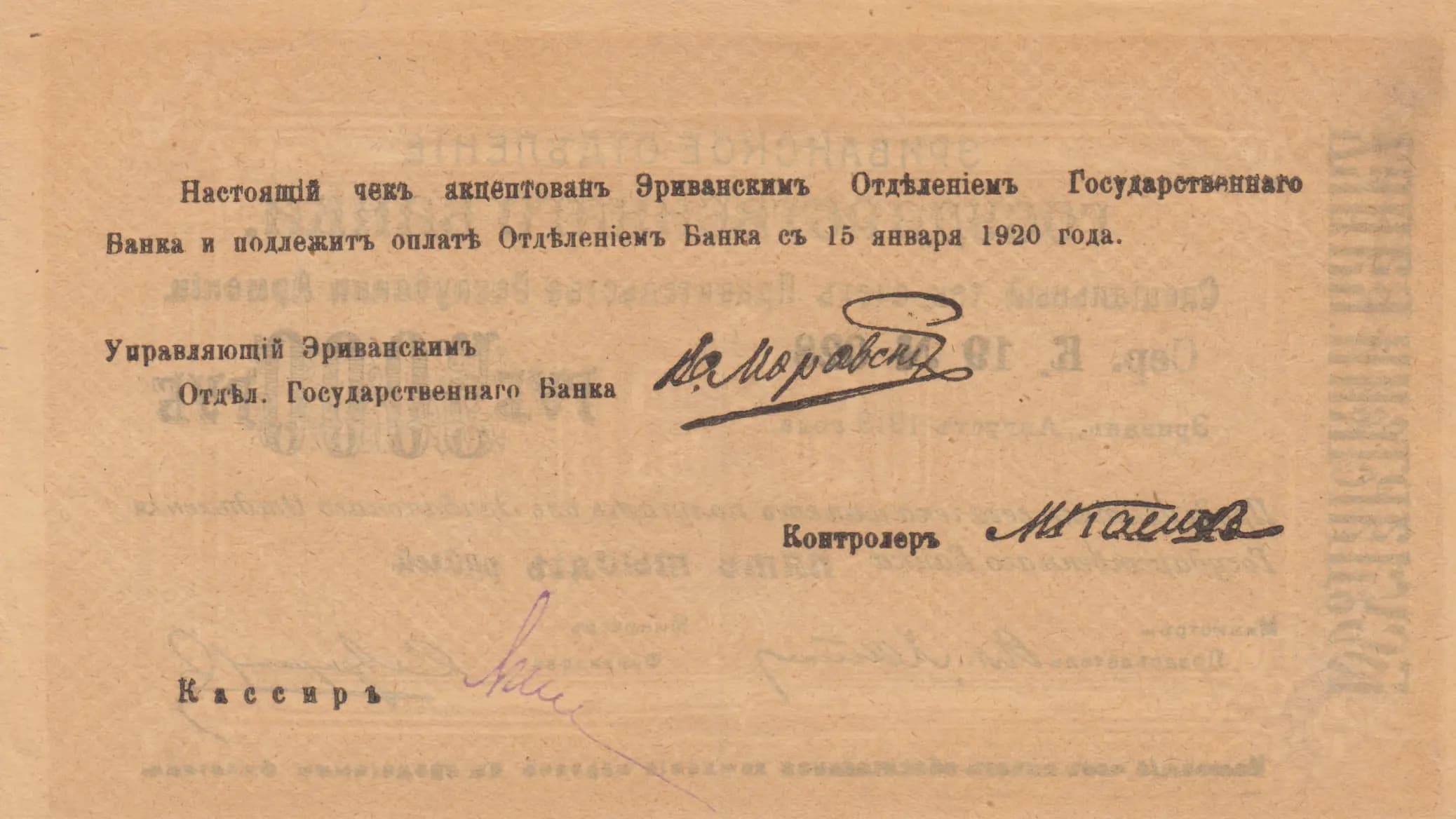
This banknote features a classically styled design emphasizing administrative authority and financial legitimacy. The obverse is dominated by an ornamental border composed of repeated diamond and cross-hatch geometric patterns in the Art Nouveau manner popular during the early 1900s, providing both aesthetic appeal and rudimentary anti-counterfeiting protection. The layout centers Russian Cyrillic text in a hierarchical arrangement, with the denomination '5000 РУБ' prominently displayed on the right margin. Two handwritten signatures are present in the lower portion—representing the Minister Chairman and Minister of Finance—providing individual authentication. The reverse presents a more austere administrative format with sparse text layout, lighter print impression, and three additional signature spaces for the Branch Manager, Controller, and Cashier, emphasizing the institutional verification chain required for payment. The overall design reflects Russian Imperial monetary tradition adapted for Armenian national purposes, with no portraits, national symbols, or pictorial landmarks depicted, focusing instead on textual authority and ornamental geometry.
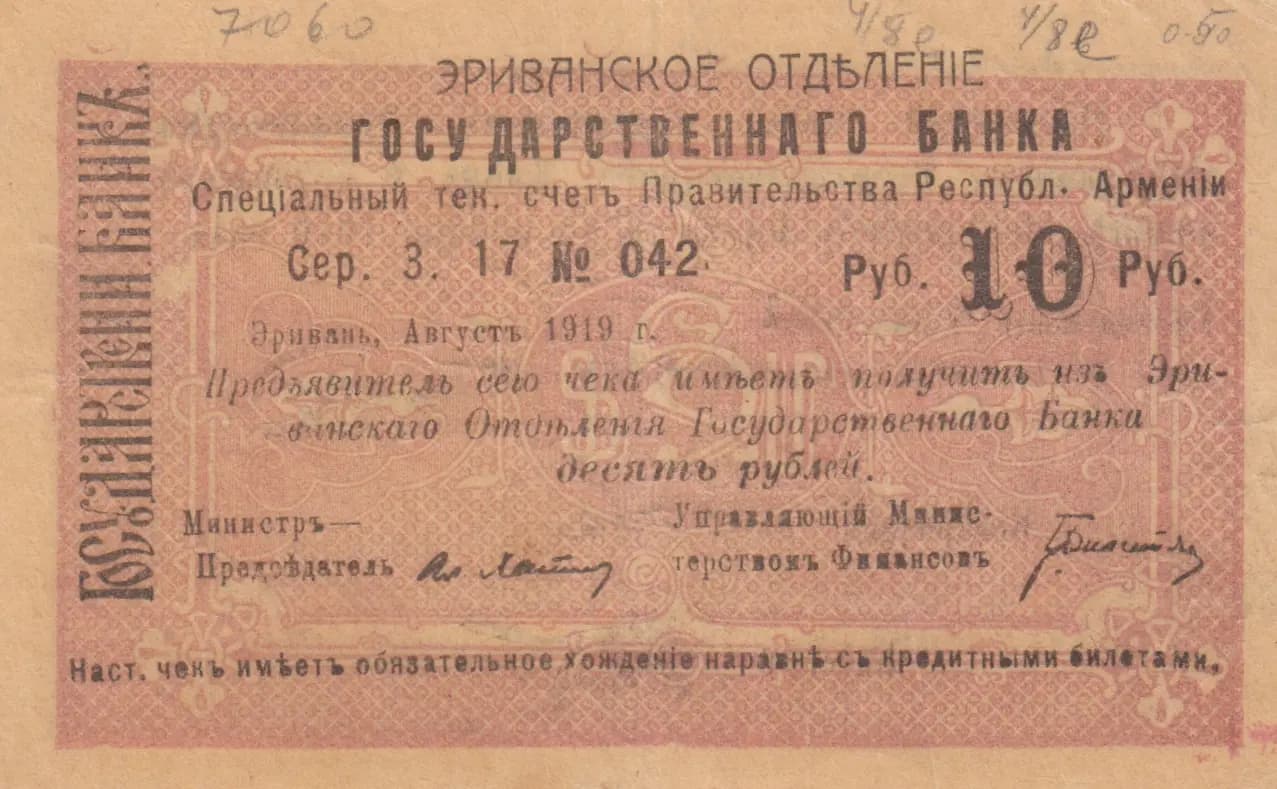
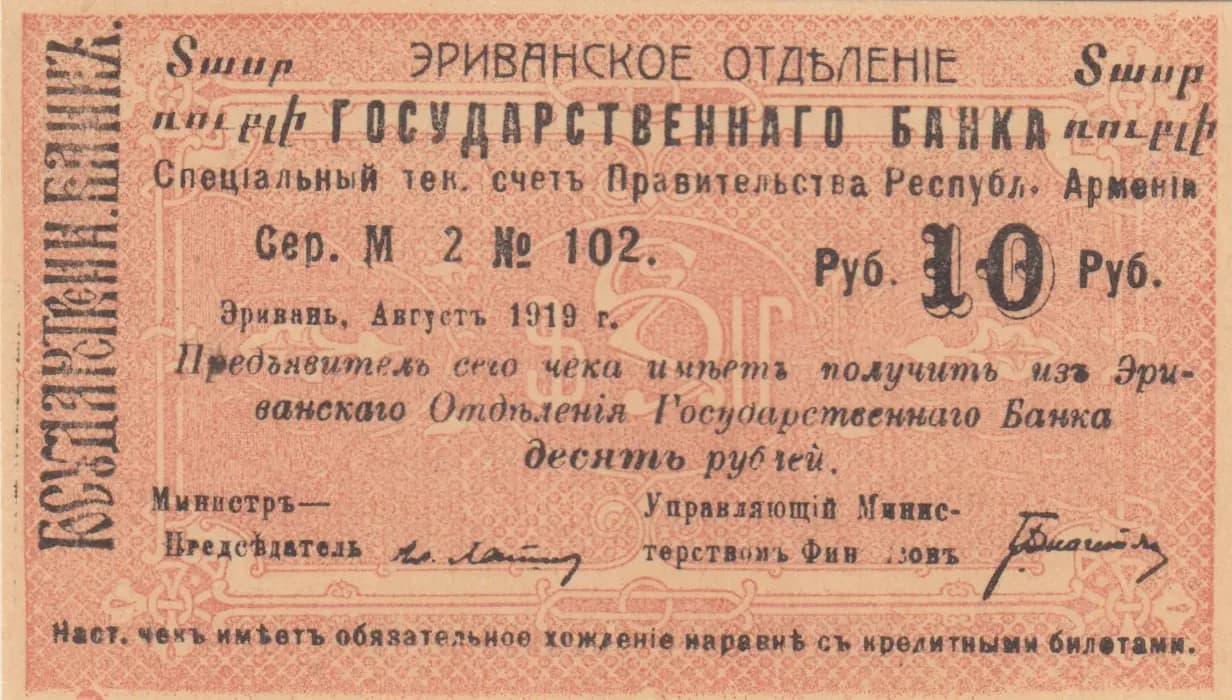
FRONT SIDE: 'Erivan Branch of the State Bank' (Эриванское Отделение Государственного Банка); 'Special current account of the Government of the Republic of Armenia' (Специальный тек. счет Правительства Республики Армении); 'Series B. 19 No. 028' (Сер. Б. 19 № 028); '5000 RUB' (5000 РУБ); 'Erivan, August 1919' (Эривань, Август 1919 года); 'Bearer of this note has the right to receive five thousand rubles from the Erivan Branch of the State Bank' (Предъявитель сего текса имеет право получить из Эриванского Отделения Государственного Банка пять тысяч рублей); 'Minister Chairman' (Министр Председатель); 'Minister of Finance' (Министр Финансов). BACK SIDE: 'This check is accepted by the Erivan Branch of the State Bank and is subject to payment by the Bank's Branch from January 15, 1920' (Настоящий чек акцептован Эриванским Отделением Государственного Банка и подлежит оплате Отделением Банка с 15 января 1920 года); 'Manager of the Erivan Branch of the State Bank' (Управляющий Эриванским Отдел. Государственного Банка); 'Controller' (Контролер); 'Cashier' (Кассир).
This note was produced using letterpress printing (relief printing), evidenced by the sharp definition of textual elements, the crisp borders of decorative patterns, and the consistent ink impression throughout. The ornamental border's geometric precision and the fine hairline details of the scrollwork indicate skilled application of engraved plates or type. The lighter impression on the reverse side and the visible variation in ink saturation between front and back suggest sequential press runs or printing from different plates. The handwritten signatures were applied post-printing using standard fountain pen or official ink, a common practice for Armenian and Russian government notes of this era. No security printer attribution is documented in standard catalogs for this specific issue.
This specimen represents Pick-28a (Yerevan variant) based on the 'Erivan/Yerevan' Branch designation. The visual analysis confirms Series B with serial number format 'Сер. Б. 19 № 028'. PMG has catalogued three recognized variants (P-28a, P-28c, P-28x) for this Pick number, though distinguishing characteristics between them are not detailed in available references. The specific date of August 1919 (Август 1919 года) and the maturity date of January 15, 1920 (15 января 1920) are consistent across known examples, as these reflect the government's intended payment schedule. The handwritten signatures present on this specimen are unique to individual notes and do not constitute a cataloged variety.