10 rublei 1919
Market Prices
3 salesAbout This Note
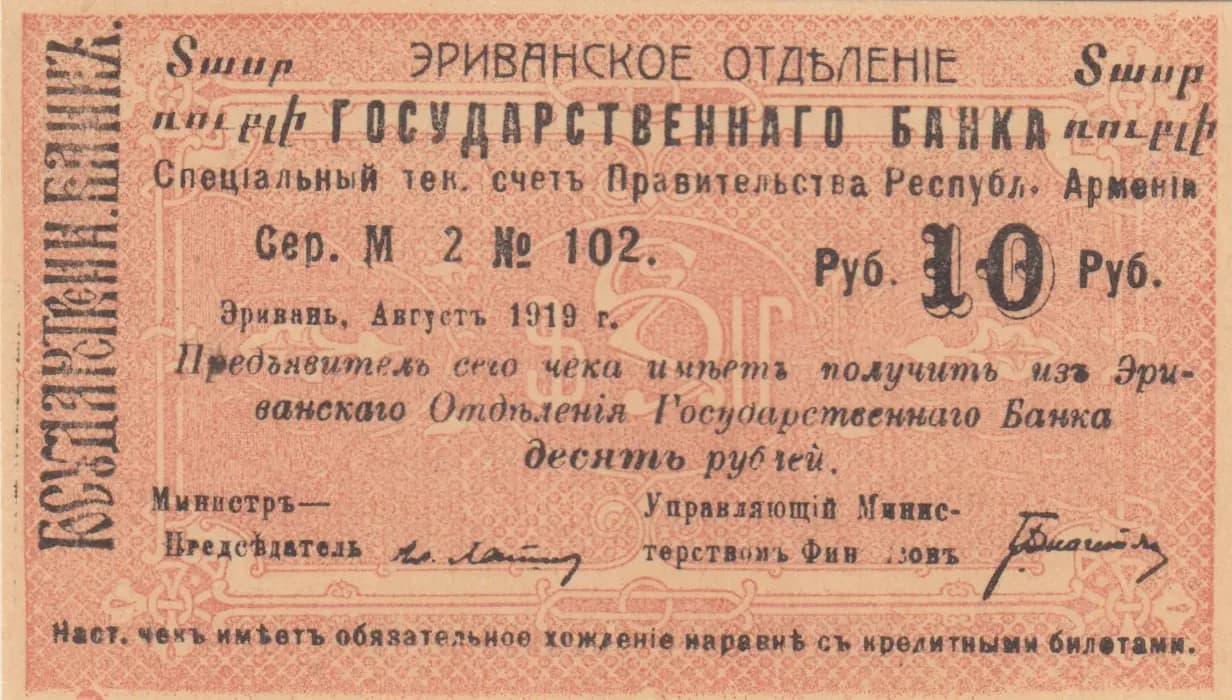
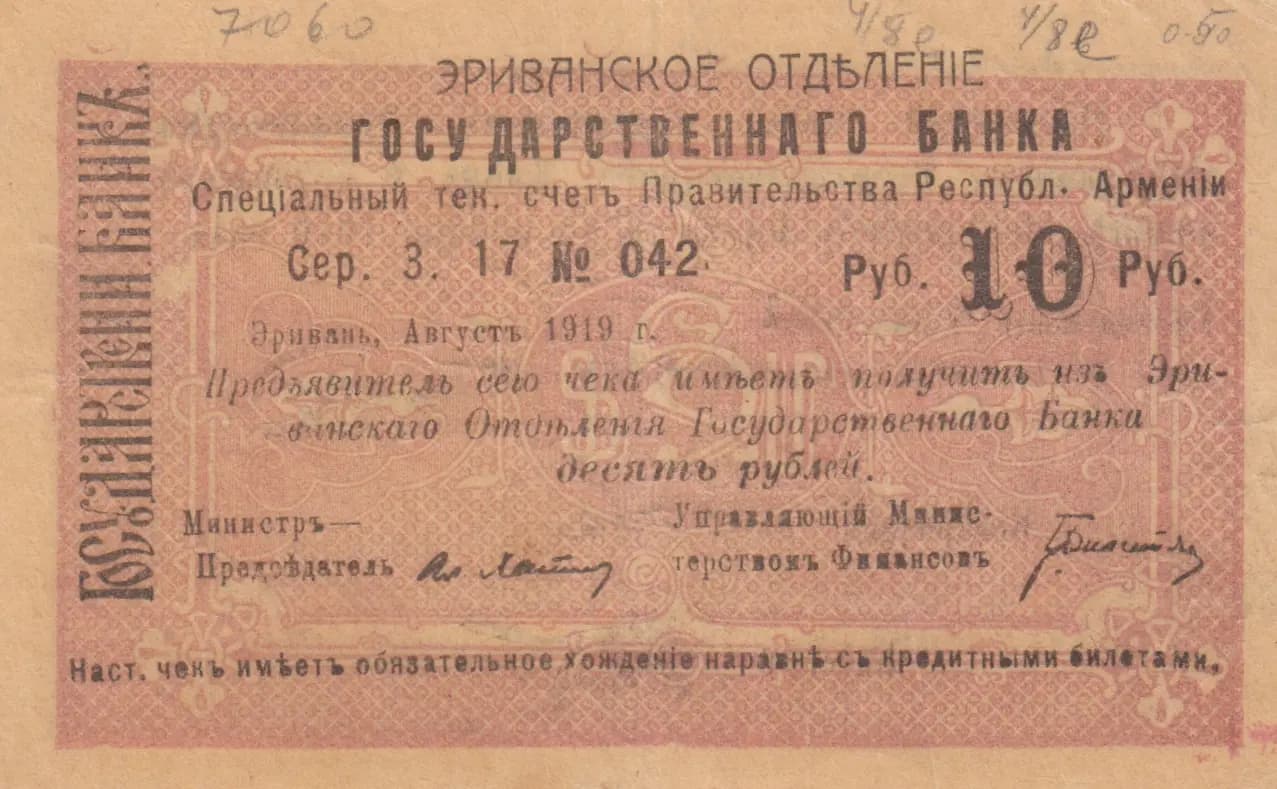
This Armenian 10 Rubles note from August 1919 represents a fascinating transitional currency issued by the Erevan Branch of the Government Bank during the brief period of Armenian independence following World War I. The note displays characteristic aging with foxing and brown spotting consistent with over a century of storage, and features handwritten signatures of multiple officials authenticating the denomination. In VF condition, this example shows the pink-beige color scheme and decorative geometric patterning on the obverse that collectors recognize as typical of this issue, making it a solid representative specimen of early 20th-century Armenian numismatics.
Common. The eBay price tracking data provided shows comparable grades (VG at $11.63, F at $10, EF at $30) consistently trading at modest prices, with the 2016 catalog valuation at $10 for F grade and $30 for EF grade. The fact that multiple examples appear regularly in the market, combined with the modest prices realized even for better grades (highest recorded price $70 for PMG 62), indicates this is a regularly encountered issue without significant scarcity. The eight cataloged variants documented by PMG further suggest adequate survival of multiple varieties. While historically significant as an Armenian independence-period note, the print run was apparently sufficient to ensure current collector availability at affordable price points.
This check-style banknote was issued during August 1919, a pivotal moment when the newly independent Armenian Republic was establishing its financial infrastructure separate from the collapsing Russian Empire. The note's designation as a 'special current account' instrument for the Government of the Armenian Republic, combined with its dual-language Russian text and official banking language, reflects the complex transitional period when Armenia was attempting to stabilize its economy while navigating Soviet and Turkish pressures. The validity date extending only to November 15, 1919—a mere three months of circulation—underscores the extreme instability of this period, as Armenia's independence would be short-lived before Soviet incorporation.
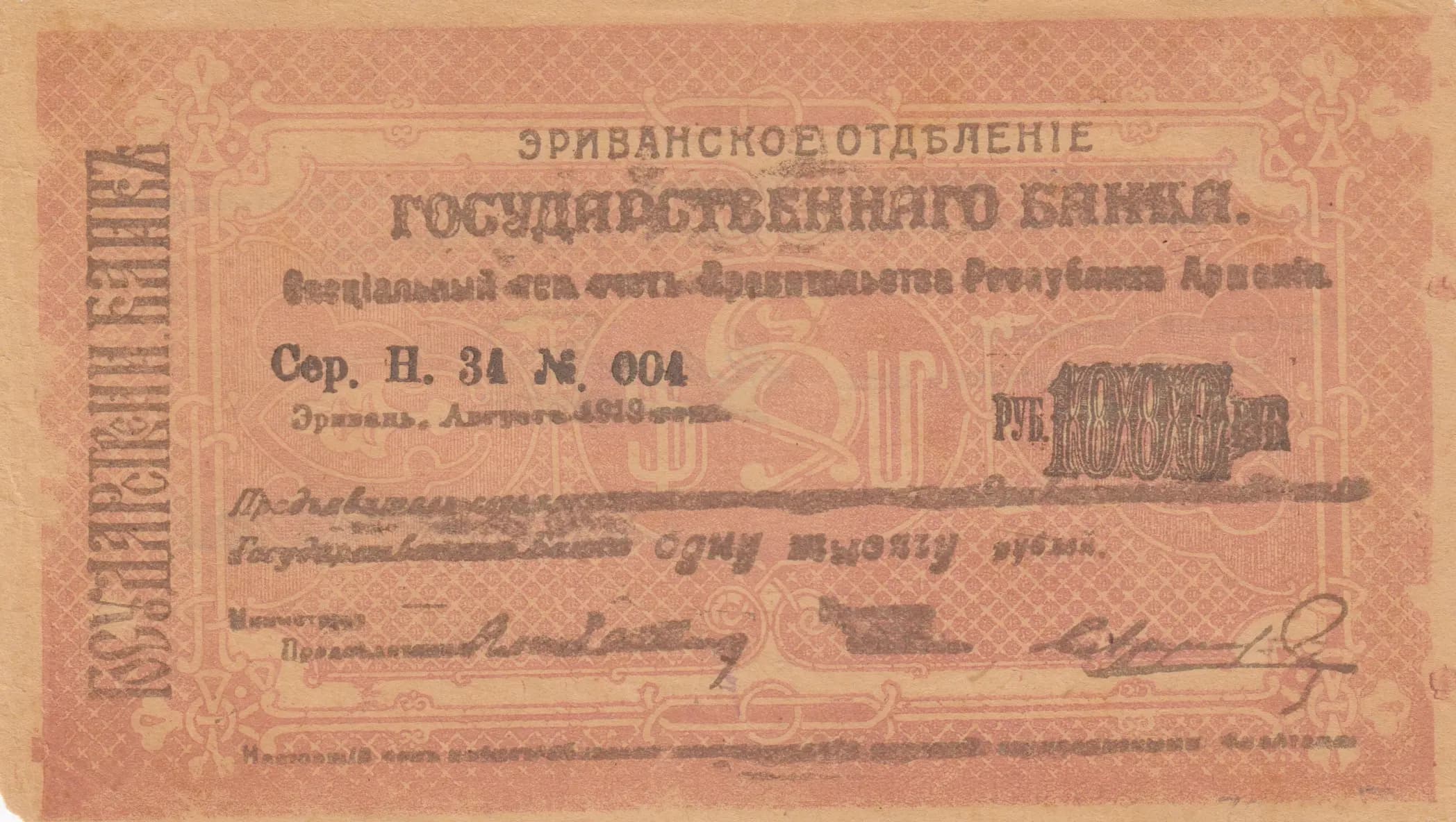
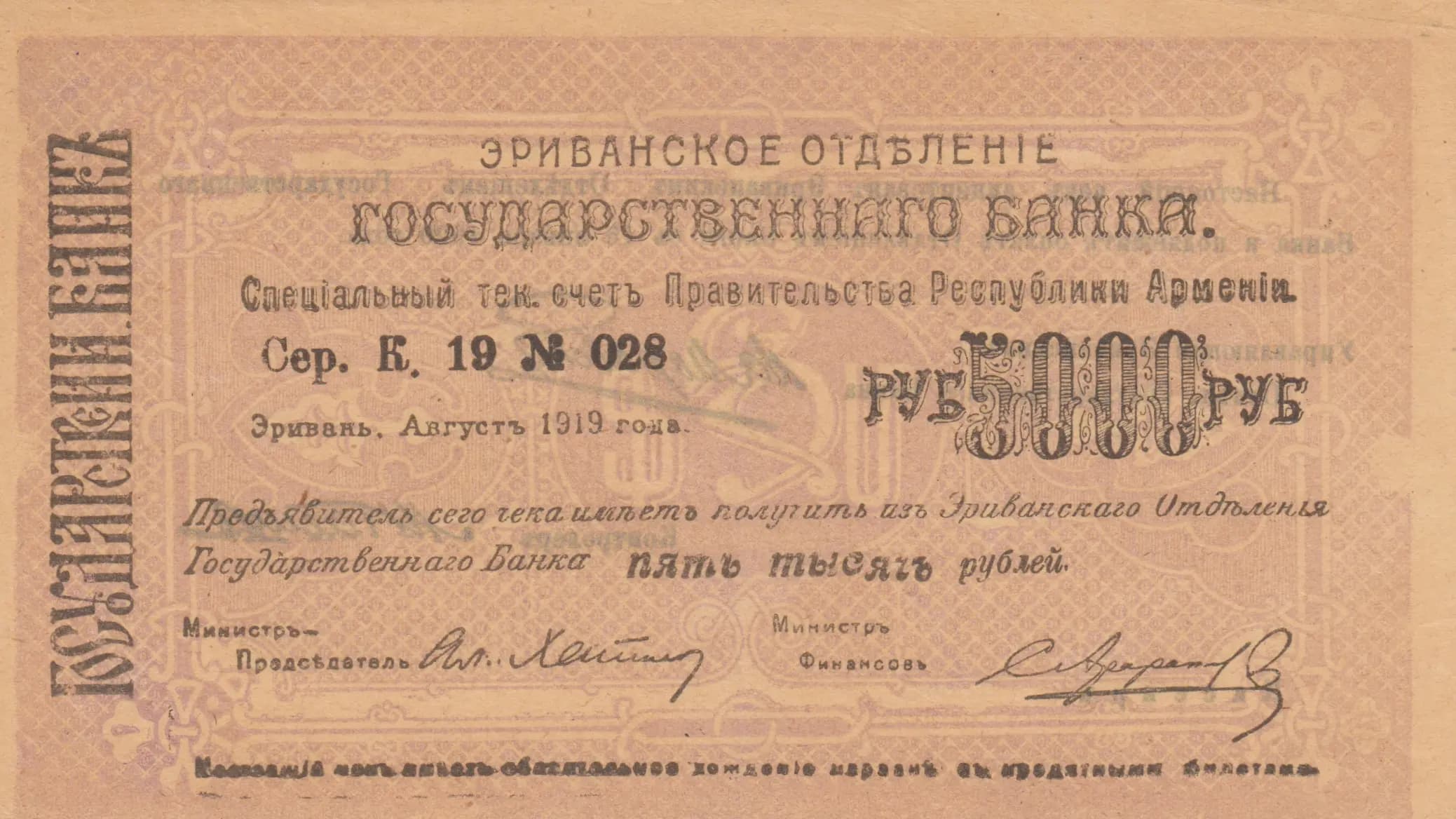
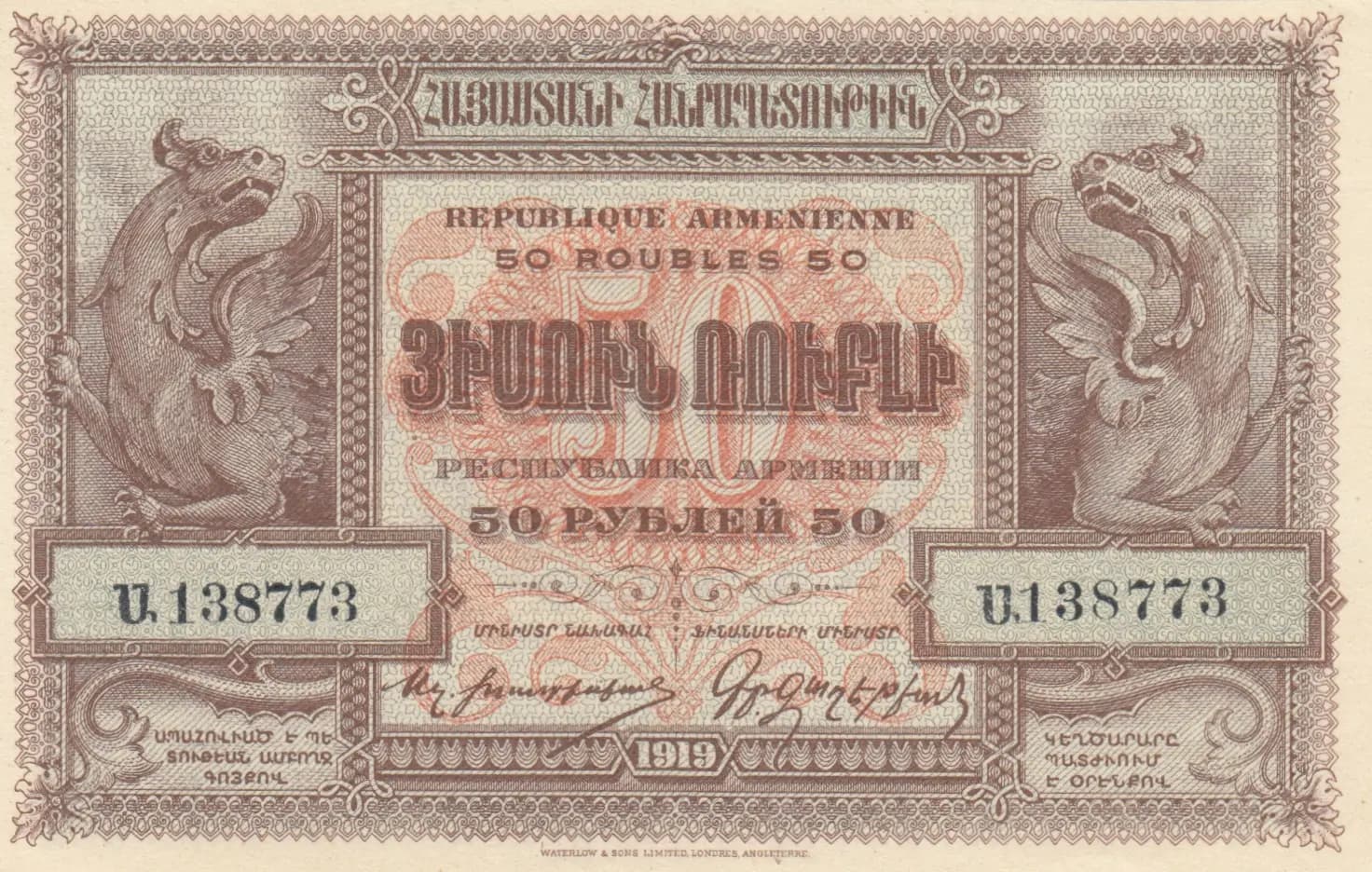
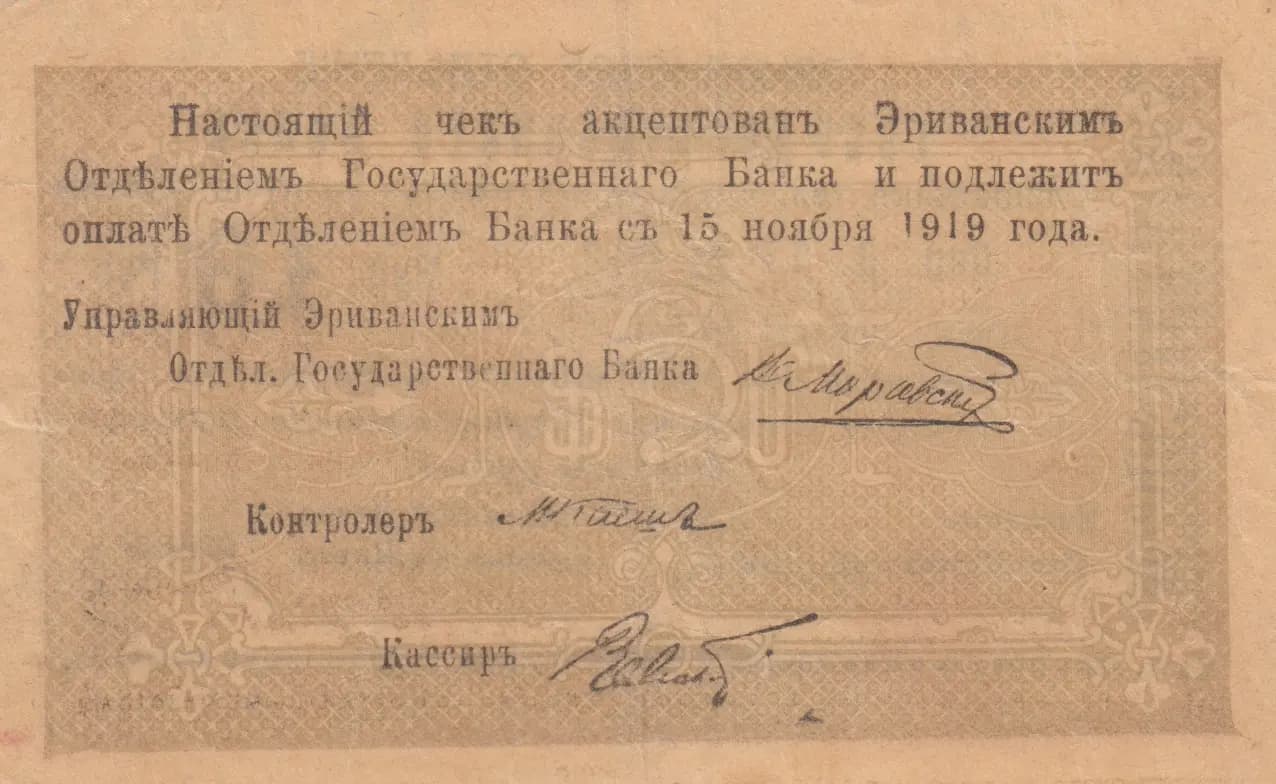
This is a check-style emergency currency note lacking portrait imagery, instead featuring purely textual and decorative elements characteristic of temporary war-period financial instruments. The obverse displays a pink-beige background with geometric mesh or crosshatch decorative patterning throughout, providing visual security and aesthetic distinction. The left side bears a partial coat of arms or seal featuring a vertical striped design, representing Armenian governmental authority. The note measures in standard check dimensions and relies entirely on typography and official banking language for its authentication, with spaces for multiple handwritten signatures from the Minister, Administrator, Controller, and Cashier. The back side presents a cleaner appearance with tan/beige coloring and focuses on the critical acceptance and payment validity information, emphasizing the instrument's dual nature as both a government check and temporary legal tender during the acute financial crisis.
FRONT SIDE: 'Erevan Department / State Bank' — main issuing authority identification. 'Special current account of the Government of the Armenian Republic' — designation of the instrument's purpose. 'Series 3, 17 No. 042' — catalog and serial numbering. 'Rub. 10 Rub.' — denomination in rubles. 'Erevan, August 1919' — place and date of issue. 'The holder of this check is entitled to receive ten rubles from the Erevan Department of the State Bank' — main promise to pay. 'Minister,' 'Administrator/Head,' 'Designated by the Ministry of Finance' — signature lines for officials. 'This check has obligatory circulation equal to credit notes' — declaration of legal tender status. BACK SIDE: 'This check is accepted by the Erevan Department of the State Bank and is payable by the Bank's Department from November 15, 1919' — acceptance and payment validity date. 'Manager of the Erevan Department of the State Bank,' 'Controller,' 'Cashier' — signature authorization lines for banking officials.
This note was produced using letterpress or typography printing methods, evident from the crisp, regular Russian Cyrillic text throughout both sides. The decorative geometric background pattern on the obverse was likely created through standard line-cut or screen printing techniques common to government security printing of the period. The overall appearance is consistent with emergency printing by a regional government printing facility rather than a specialized security printer, reflecting the improvised nature of Armenian financial instruments during 1919. No advanced security features beyond the geometric pattern are evident, indicating the pragmatic, utilitarian approach to currency production during this period of national crisis.
This example is identified as Pick P-2, Series 3, serial number 17 No. 042, representing the base variety (P-2a is recorded in PMG population data). The note displays handwritten signatures from officials in their designated positions, with specific individual signatures potentially identifying this as a distinct administrative variant, though such variations are typical across the series rather than cataloged separately. The August 1919 issue date and November 15, 1919 validity date are consistent with the standard P-2 specification. No overprints, color variations beyond the standard pink-beige underprint, or other distinguishing marks are evident that would indicate a distinct cataloged variety beyond the base P-2 designation.