10 rublei 1919
Market Prices
4 salesAbout This Note
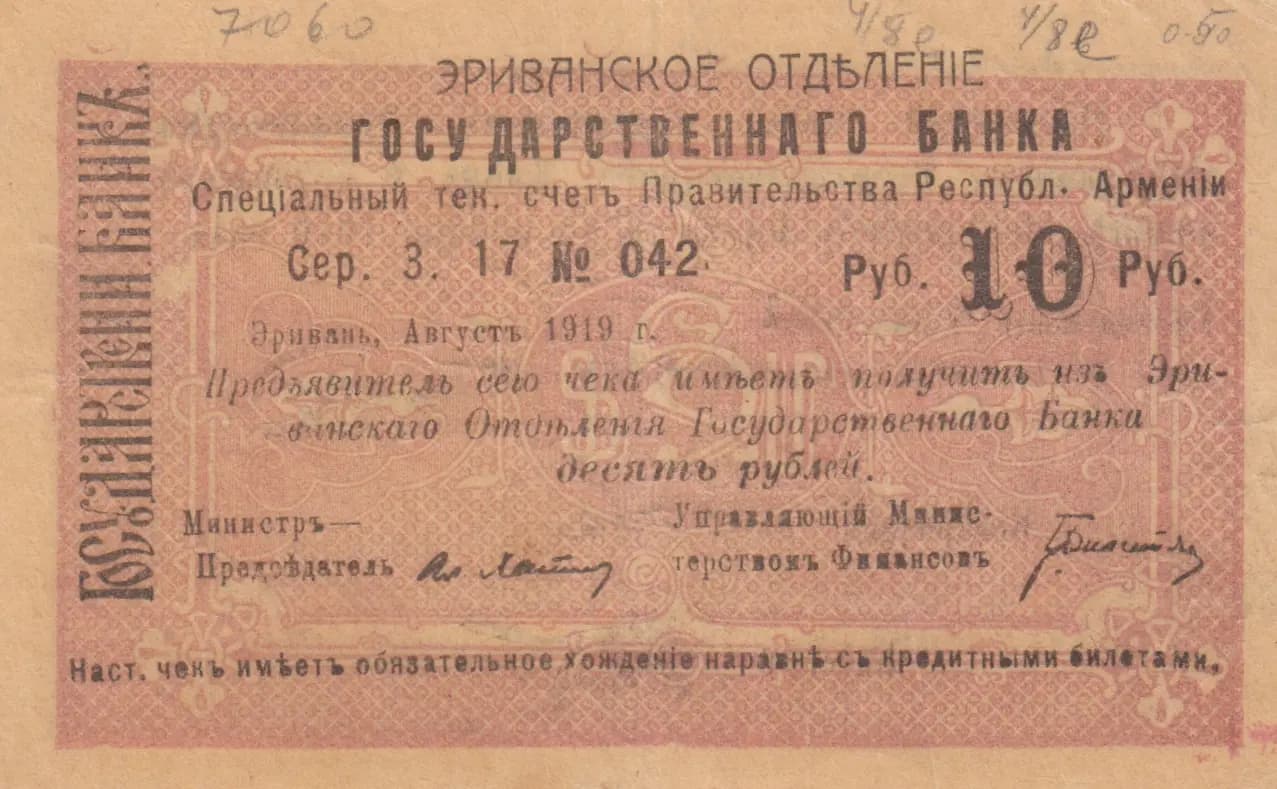
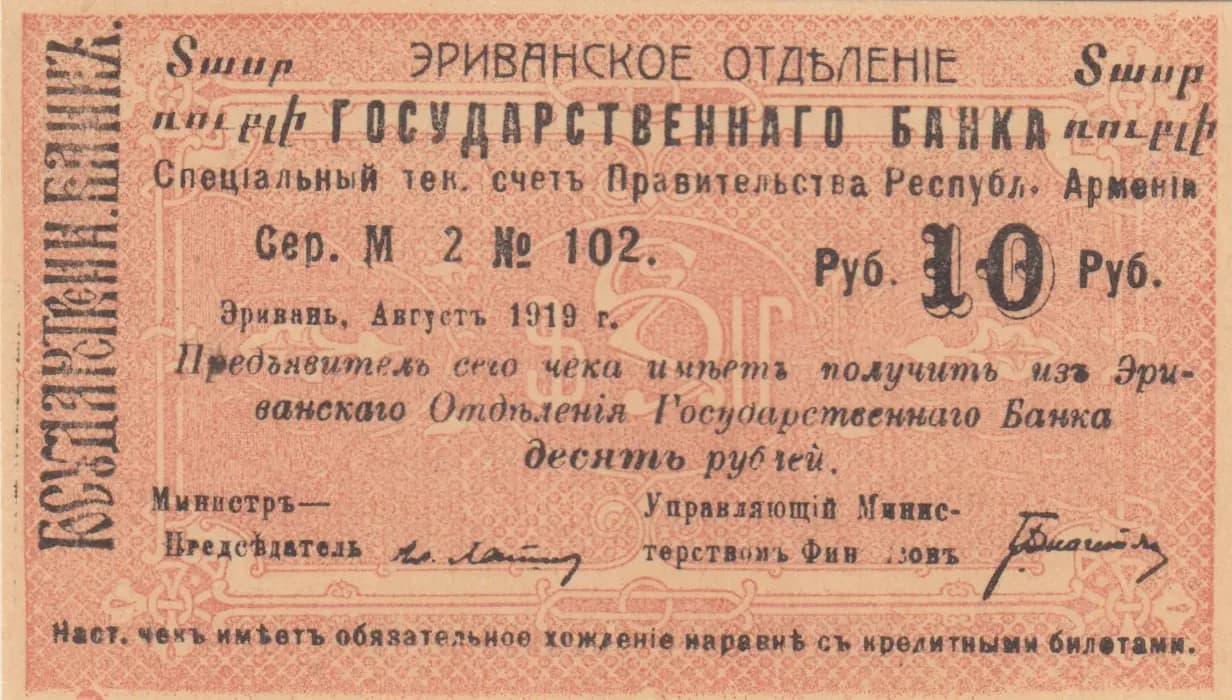
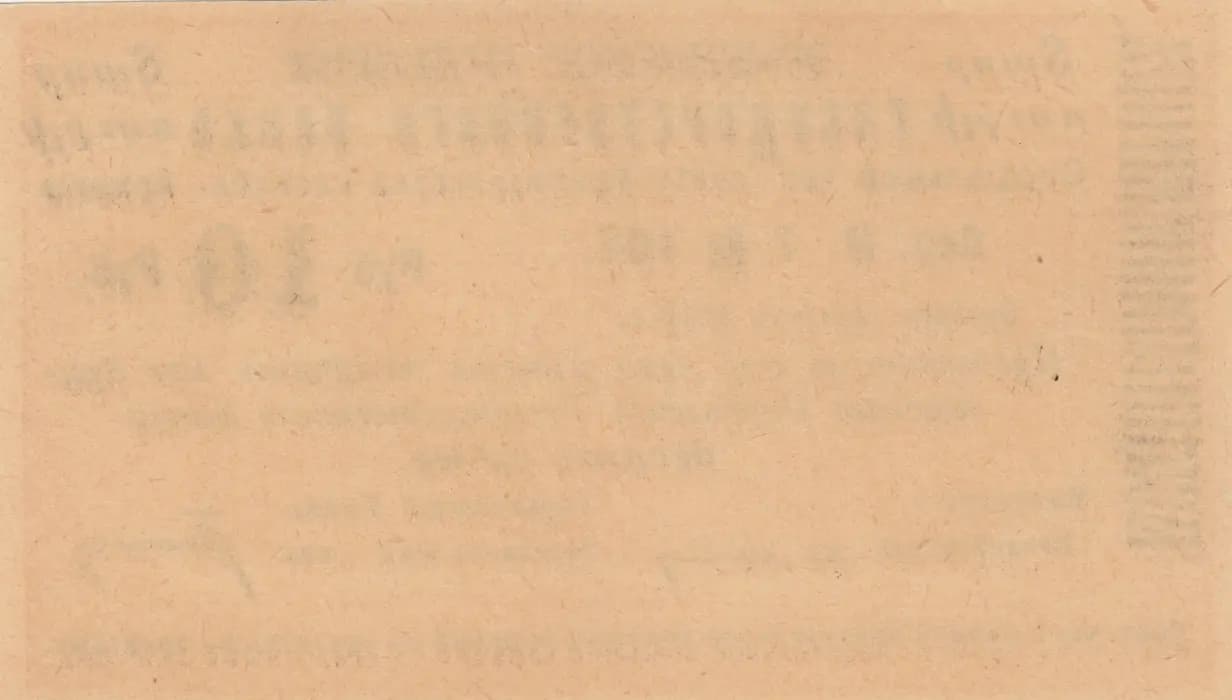
This is an exceptionally well-preserved example of Armenia's 1919 10 Ruble banknote issued by the Erivan Branch of the Government Bank, graded UNC. The note features a distinctive pinkish-red ornamental design on a cream background with full Cyrillic text identifying it as a special government account check with obligatory circulation status. The front displays clear printing with a visible circular seal impression in the center, while the reverse is blank, and the overall appearance shows minimal wear consistent with uncirculated preservation.
Common. The eBay market data shows recent sales ranging from $5.50 (VG) to $15.90 (EF), with catalog values at $15-60 depending on condition. The availability of multiple sales across a decade-long period and the existence of PMG-graded examples indicate adequate surviving population. While these Armenian Soviet-era notes have collector interest, this particular Pick number does not show the scarcity indicators (small print runs, violent recall, or extreme price appreciation) that would classify it as rare.
This banknote was issued during the tumultuous period following the Russian Revolution and the collapse of the Russian Empire, when Armenia briefly attempted to establish independent monetary control through the Erivan Branch of the Russian State Bank in August 1919. The note's designation as a 'special current account of the Government of the Republic of Armenia' and its statement that it has 'obligatory circulation equal to credit notes' reflect the transitional political and financial chaos of the post-WWI period in the Caucasus, when multiple currencies and governmental authorities competed for legitimacy.
The obverse features an ornamental geometric and floral border design in pinkish-red ink surrounding a cream-colored central field. The primary security element is a circular seal or watermark impression positioned in the center of the note, which served both as an authentication device and a design focal point. The note contains no portraits or named landmarks, instead relying on formal governmental typography and the official seal for its authority. The design is relatively austere compared to contemporary Russian Imperial notes, reflecting the provisional nature of Armenia's financial institutions during this period. The reverse is blank, a characteristic of Russian provisional currency of this era.
FRONT: 'Erivan Branch / State Bank' (header) | 'Special current account of the Government of the Republic of Armenia' (formal designation) | 'Series M 2 No. 102' (serial identification) | 'Rub. 10 Rub.' (denomination) | 'Erivan. August 1919' (place and date of issue) | 'The bearer of this check shall receive ten rubles from the Erivan Branch of the State Bank' (promise to pay clause) | 'Minister' and 'Head of the Ministry of Finance' (signature lines) | 'This check shall have obligatory circulation equal to credit notes' (legal tender declaration). BACK: No inscriptions present.
Letterpress (relief) printing on laid paper, utilizing black ink for text and pinkish-red ink for the ornamental border and background tinting. The visible circular impression and the sharp definition of the Cyrillic text are consistent with high-pressure letterpress technology employed by Russian State Bank printing facilities. The ornamental borders show the characteristic crisp registration typical of this period's security printing standards.
This example is cataloged as Pick 15a, the standard variety for this denomination and issuer. The serial number observed is Series M 2 No. 102, indicating it falls within the M series printing. No overprints, signatures, or other distinguishing markings beyond standard printing are visible that would indicate a sub-variety. The August 1919 date confirms it is from the initial issuance period of this note type.