50 rublei 1919
Market Prices
25 salesAbout This Note
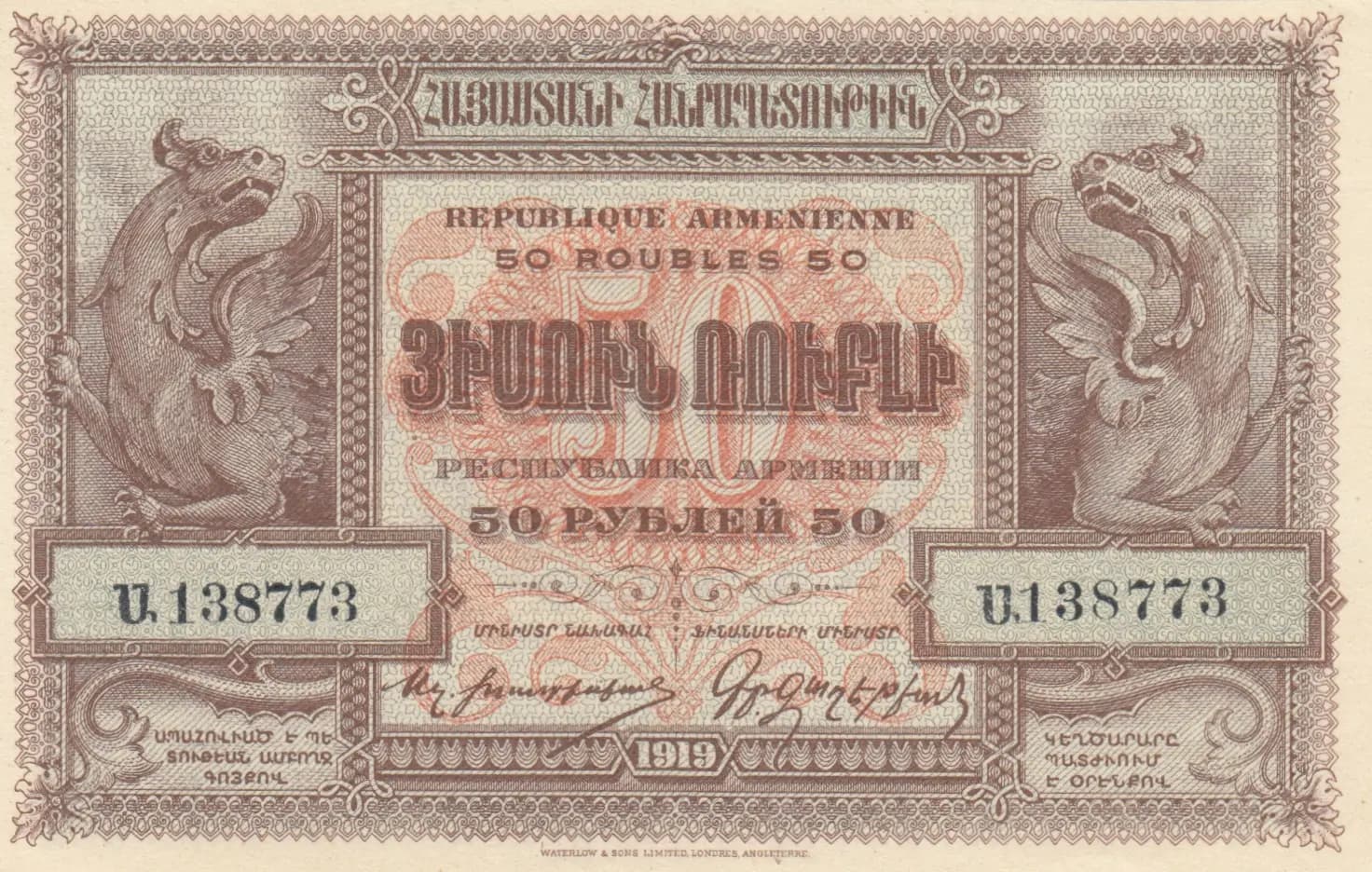
This is an Armenian Republic 50 Roubles banknote from 1919, presented in uncirculated condition with exceptional preservation. The note features a striking design with two facing winged griffins or mythological creatures flanking ornate central text panels, printed in warm brown and tan tones on cream underprint. The pristine condition, complete with sharp margins and no visible handling marks, combined with the historically significant bilingual/trilingual inscriptions (Armenian, French, and Russian), makes this an attractive example of early 20th-century Armenian currency from the brief period of independence.
Common. The eBay price history provided shows consistent sales across a wide range of grades from 2009 to 2025, with typical realized prices ranging from $12.99 to $122.52 depending on condition grading. Even exceptional grades (PMG 65) average around $83-122, indicating steady collector demand but no scarcity premium. The 2016 catalog valuation of $90 for UNC examples aligns with observed market prices. While this note represents historically significant currency from a short-lived republic, the Armenian Republic 50 Roubles 1919 (Pick-30) appears to have been produced in sufficient quantities that examples remain accessible to collectors at modest prices. No evidence of small print runs, recalls, or extreme rarity exists in the available data.
This note was issued during the tumultuous period following World War I and the Armenian Genocide, when the First Armenian Republic (1918-1920) briefly achieved independence before Soviet annexation. The deliberate choice to inscribe the note in Armenian, French, and Russian reflects the geopolitical complexity of the era—Armenian nationalism, Western recognition, and the looming Soviet influence. The winged griffins and elaborate Art Nouveau-style borders evoke classical Armenian iconography, representing the nation's attempt to assert cultural identity during its fleeting independence.
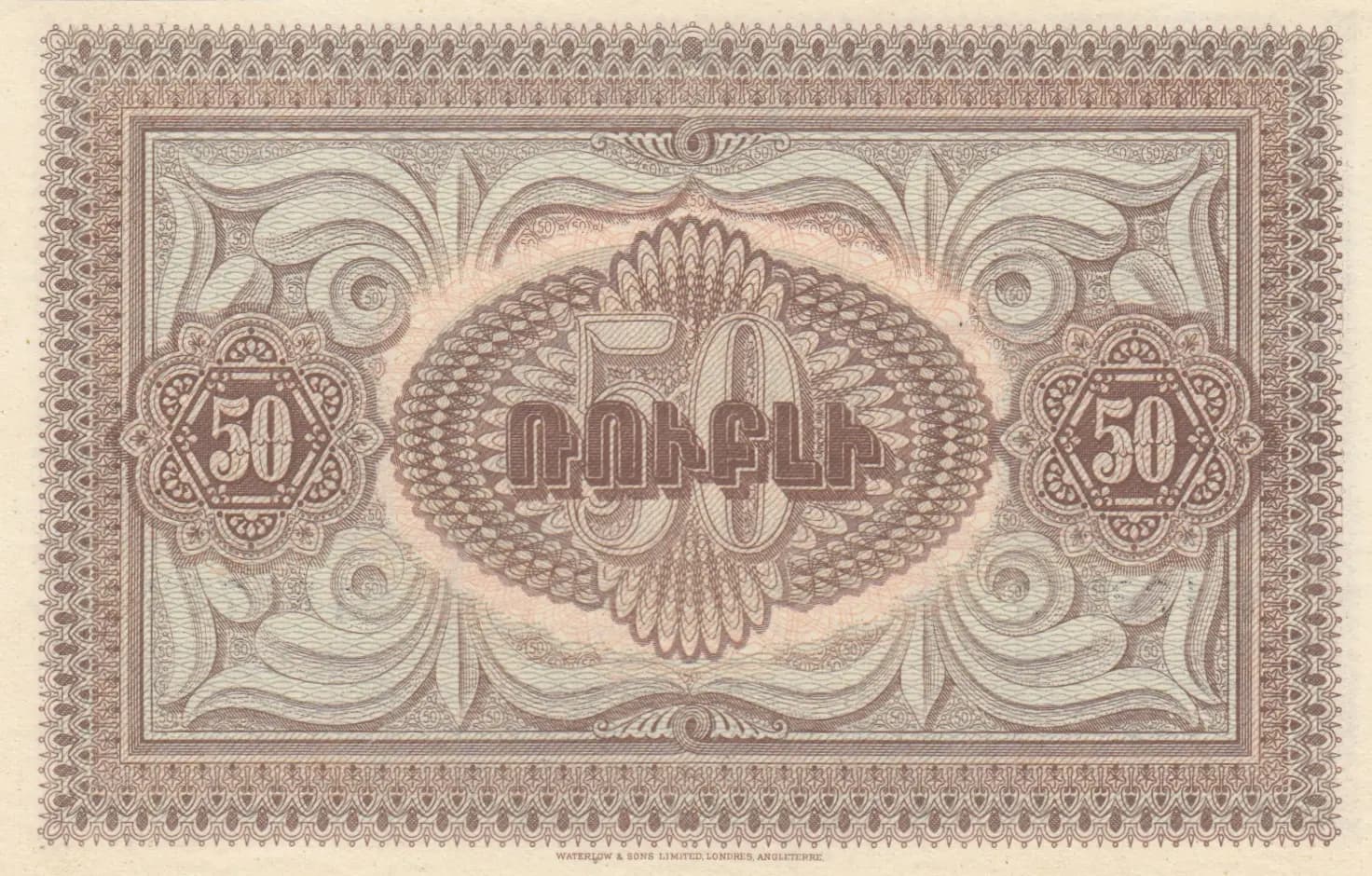
The obverse displays a symmetrical, highly ornamental design centered on two winged griffins (mythological creatures with eagle wings and lion bodies, or similar heraldic beasts) positioned in profile facing each other, one on the left and one on the right side of the note. These griffins are characteristic of classical Armenian heraldic traditions. The central area is divided into rectangular framed panels containing the trilingual text identifying the issuer and denomination, all surrounded by elaborate Art Nouveau-style floral scrollwork and geometric borders. Fine-line engraved corner flourishes and a repeating geometric pattern border at top and bottom complete the front design. The reverse features a large circular medallion with intricate radiating geometric and floral patterns in the center, with the denomination '50' prominently displayed within stylized numerals at the medallion's center. The entire reverse margin is enclosed by an ornate repeating decorative border pattern. The color palette throughout is warm and harmonious—rich browns and reddish-browns on a cream/tan underprint.
FRONT: 'ՀԱՅԱՍՏԱՆ ԴՐԱՄ ԲԱՆԿ' (Armenian) = 'Bank of Armenia'; 'REPUBLIQUE ARMENIENNE' (French) = 'Armenian Republic'; '50 ROUBLES 50' (French/English) = 'Fifty Roubles'; 'ՀԱՇՏԱԿԱՆ ԹՂՏ' (Armenian) = 'Peace Note' or 'Bank Note'; '50 РУБЛЕЙ 50' (Russian) = 'Fifty Roubles'; '1919' (date of issue); 'U138773' (serial number, printed twice); 'WATERLOW & SONS LIMITED LONDRES, ANGLETERRE' (French) = 'Waterlow & Sons Limited, London, England'. BACK: '50' (denomination numeral); 'WATERLOW & SONS LIMITED, LONDRES, ANGLETERRE' (French) = 'Waterlow & Sons Limited, London, England'.
Intaglio engraving (steel plate engraving), as evidenced by the fine line work, complex pattern fills, and multi-layered decorative borders visible throughout both sides. This is further confirmed by the printer attribution to Waterlow & Sons Limited (noted as 'W&S' in some catalogs), a prestigious London-based security printer renowned for intaglio banknote production. The security features include intricate engraved patterns, fine-line cross-hatching, and ornamental complexity designed to deter counterfeiting.
Serial number 'U138773' is visible in the visual analysis. The PMG Population Report indicates one cataloged variant for Pick-30. No specific overprints, signature varieties, or notable sub-types are apparent from the visual analysis. The note's date of 1919 is standard for this issue. Waterlow & Sons Limited, London is confirmed as the printer (consistent with the 'W&S' notation in alternate catalogs). Collectors should note that some sources describe the design as featuring 'dragons' rather than 'griffins,' but the visual analysis and heraldic tradition support the griffin interpretation.