100 rublei 1919
Market Prices
25 salesAbout This Note
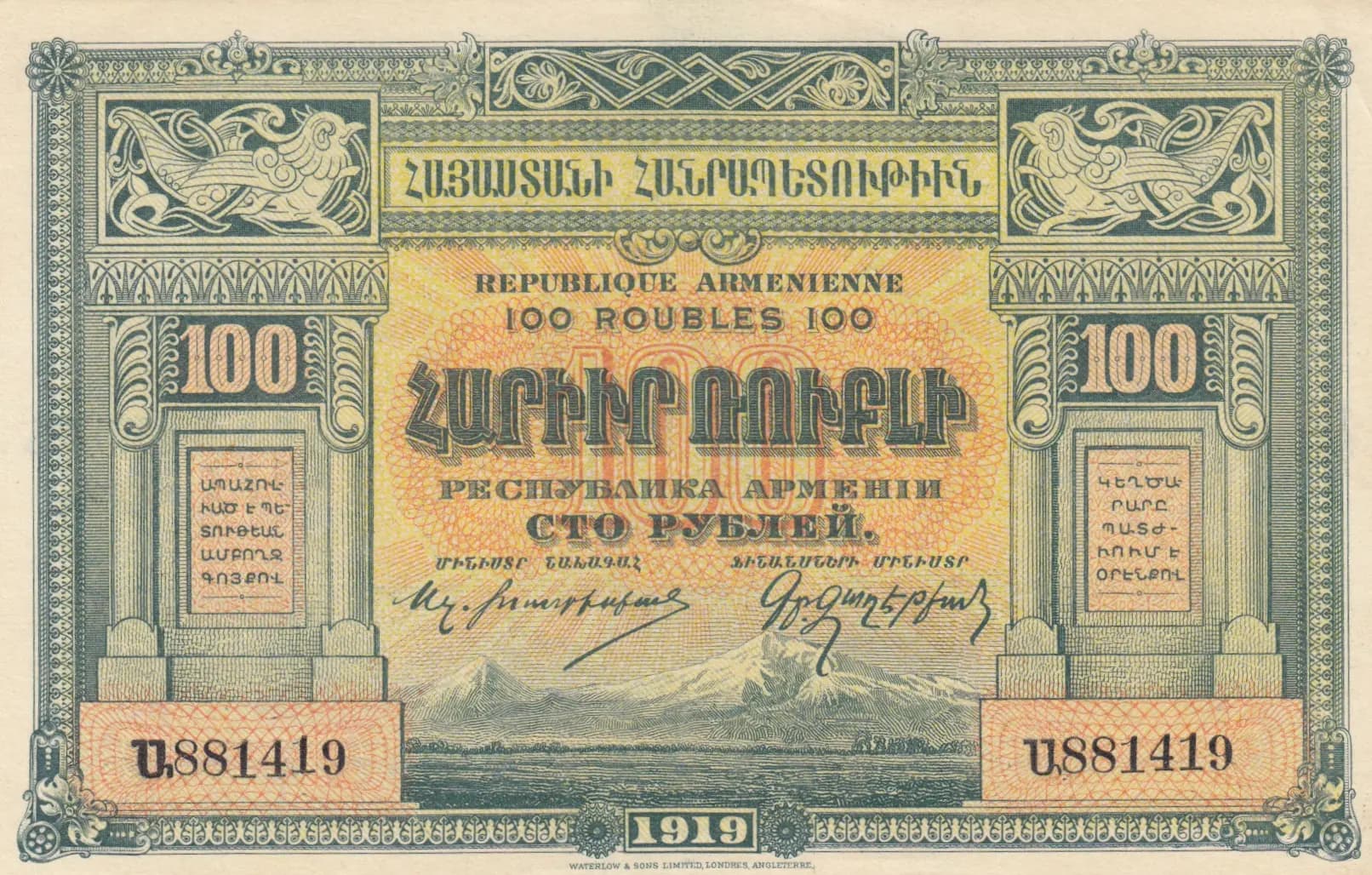
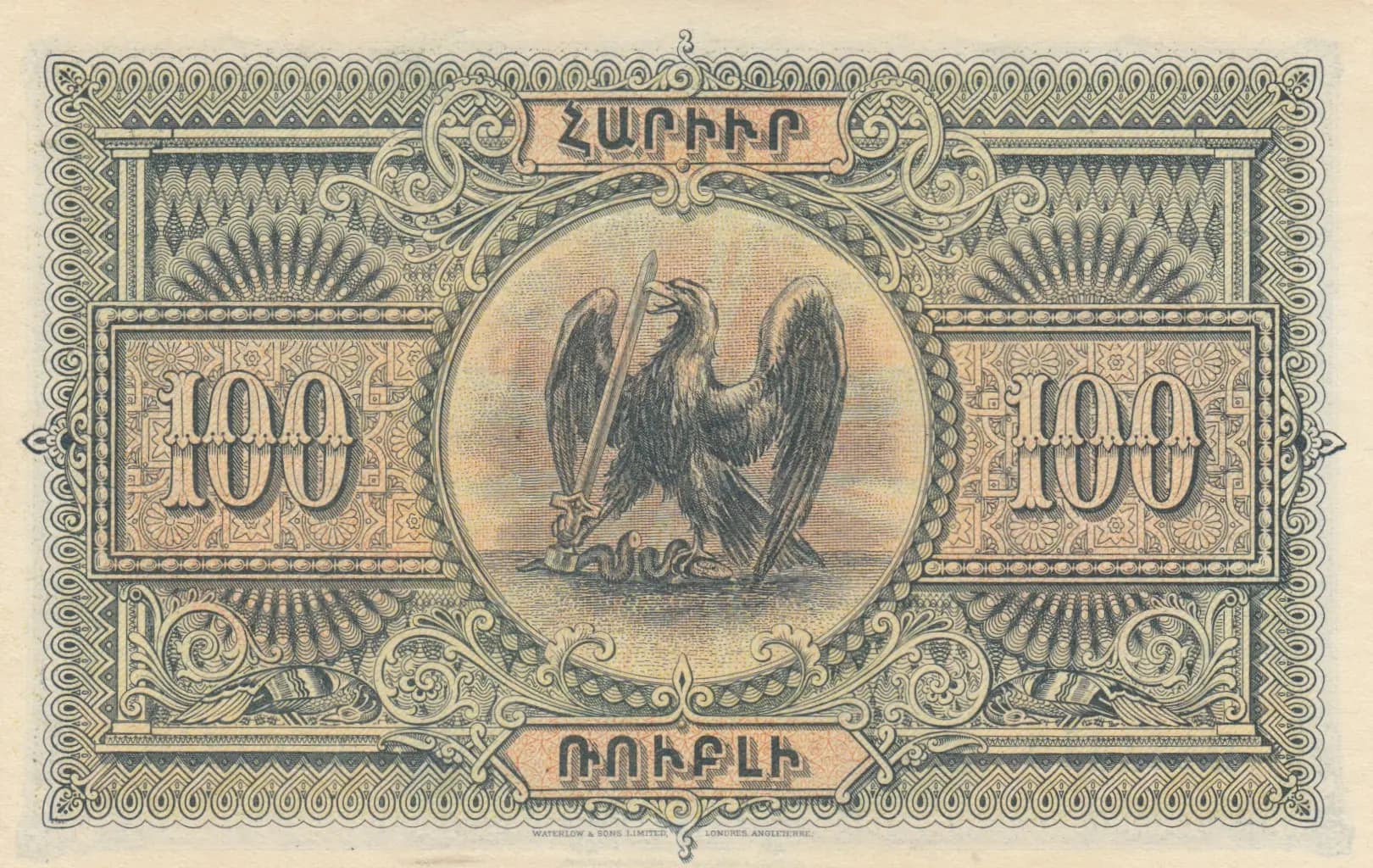
This is an Armenian Republic 100 Roubles banknote from 1919, graded AU, showcasing exceptional preservation with crisp printing throughout and no visible wear or circulation marks. The note features a striking landscape vignette of Mount Ararat on the obverse with an ornate decorative border, and a detailed eagle medallion on the reverse, both printed by the prestigious London security printer Waterlow & Sons. The multilingual inscriptions in Armenian, Russian, and French reflect the complex political and cultural context of the newly independent Armenian Republic during the Russian Civil War period.
Common. Secondary market pricing from eBay auction records shows consistent sales ranging from $14.49 to $80 USD, with most sales in the $20-$50 range. UNC specimens have sold for $28-$100, with $42-$57 being typical. The AU condition grade in this case aligns with catalog values of $50 for VF condition, suggesting steady, regular collector demand without scarcity premiums. The Armenian Republic's brief existence (1918-1920) and limited note circulation do not appear to have resulted in exceptional rarity for this denomination in the modern collector market.
The Armenian Republic issued this note in 1919 during a brief period of independence following the collapse of the Russian Empire and Ottoman rule. The depiction of Mount Ararat (Masis) on the obverse is deeply symbolic, representing Armenian national identity and sovereignty, as the mountain holds sacred significance in Armenian Christianity and culture. The eagle on the reverse likely represents the state emblem, while the use of three languages reflects Armenia's position at the crossroads of European, Russian, and Middle Eastern spheres during this tumultuous post-World War I period.
The obverse features a panoramic mountain landscape vignette depicting Mount Ararat (Masis), Armenia's most iconic geographical and spiritual symbol, with snow-capped peaks rising above a body of water, rendered in fine engraving. The entire note is framed by an ornate classical border with elaborate floral scrollwork, geometric patterns, and decorative cartouches at top and bottom. Two signatures appear in the center-lower portion of the obverse. The reverse displays a central circular medallion containing a finely engraved eagle with spread wings standing on a pedestal, surrounded by repeating geometric and floral motifs in the outer border, with the denomination '100' prominently displayed in decorative rectangular panels on both sides. The color scheme combines greens, creams, yellows, and orange/rust tones on the obverse with a lighter palette of cream, tan, and black on the reverse.
FRONT SIDE: 'ՀԱՅԱՍՏԱՆ ՀԱՅԱՍՏԱՆԵԱՅ' (Armenia Armenian Republic); 'REPUBLIQUE ARMENIENNE' (Armenian Republic - French); '100 ROUBLES 100' (denomination); 'РЕСПУБЛИКА АРМЕНИИ' (Republic of Armenia - Russian); 'СТО РУБЛЕЙ' (One Hundred Rubles - Russian); Serial number 'U881419' (appears twice, bottom corners); '1919' (issue year); 'WATERLOW & SONS LIMITED, LONDON & ANGLESEA' (printer). BACK SIDE: 'ՀԱՅԱՍՏԱՆ' (Armenia - Armenian); '100' (appears left and right in decorative cartouches); 'ՏԱՐԱԾԵԼ' (spread/circulation - Armenian); 'WATERLOW & SONS LIMITED, LONDON & ANGLESEA' (printer).
Intaglio engraving (line engraving), executed by Waterlow & Sons Limited, a leading London-based security printer. The fine line work visible throughout both sides, the crisp detail in the eagle engraving, the intricate border patterns, and the sharp reproduction of multiple languages and security elements are all characteristic of high-quality intaglio production. The printer's imprint is prominently displayed on both obverse and reverse.
This is Pick-31, the standard 100 Roubles issue of the Armenian Republic from 1919. The observed serial number is U881419. No overprints, color variations, or signature varieties are noted in the visual analysis. PMG population data indicates minimal professional grading activity for this Pick number (1 variant catalogued), suggesting most surviving examples remain in the collector/raw state. The specific signature varieties, if they exist for this issue, cannot be definitively determined from the provided imagery.