20 dinara 1944
Market Prices
17 salesAbout This Note
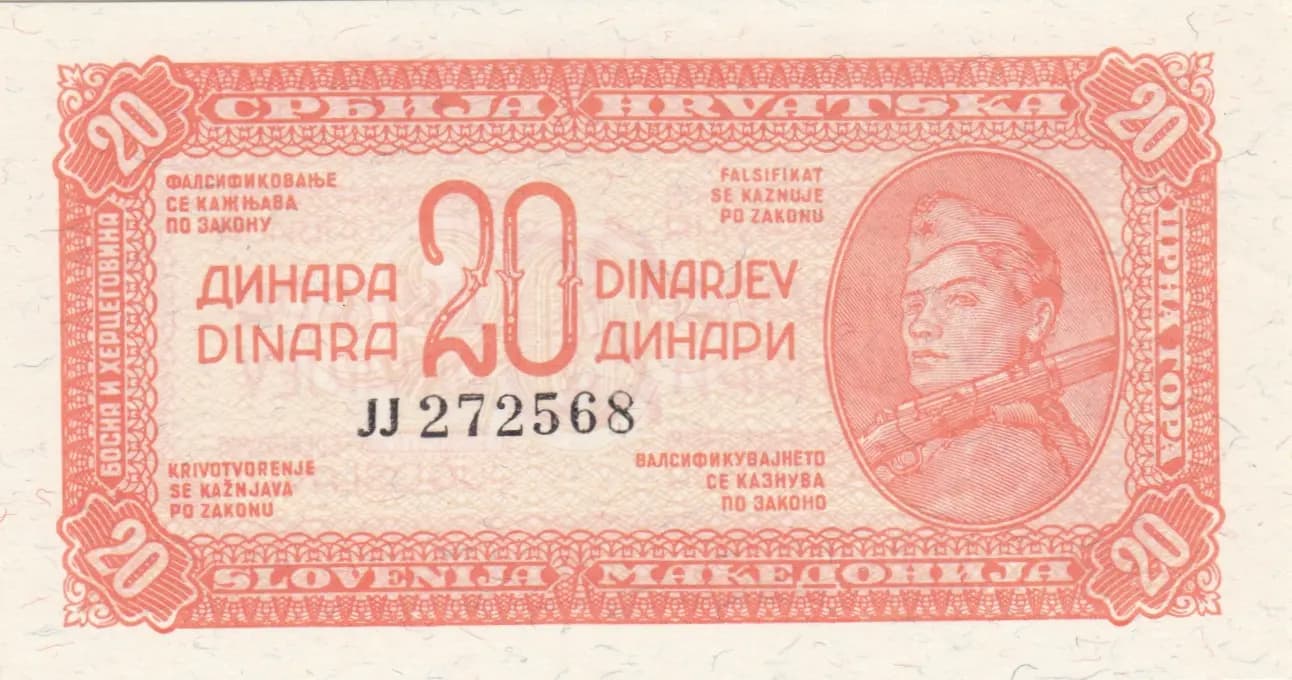
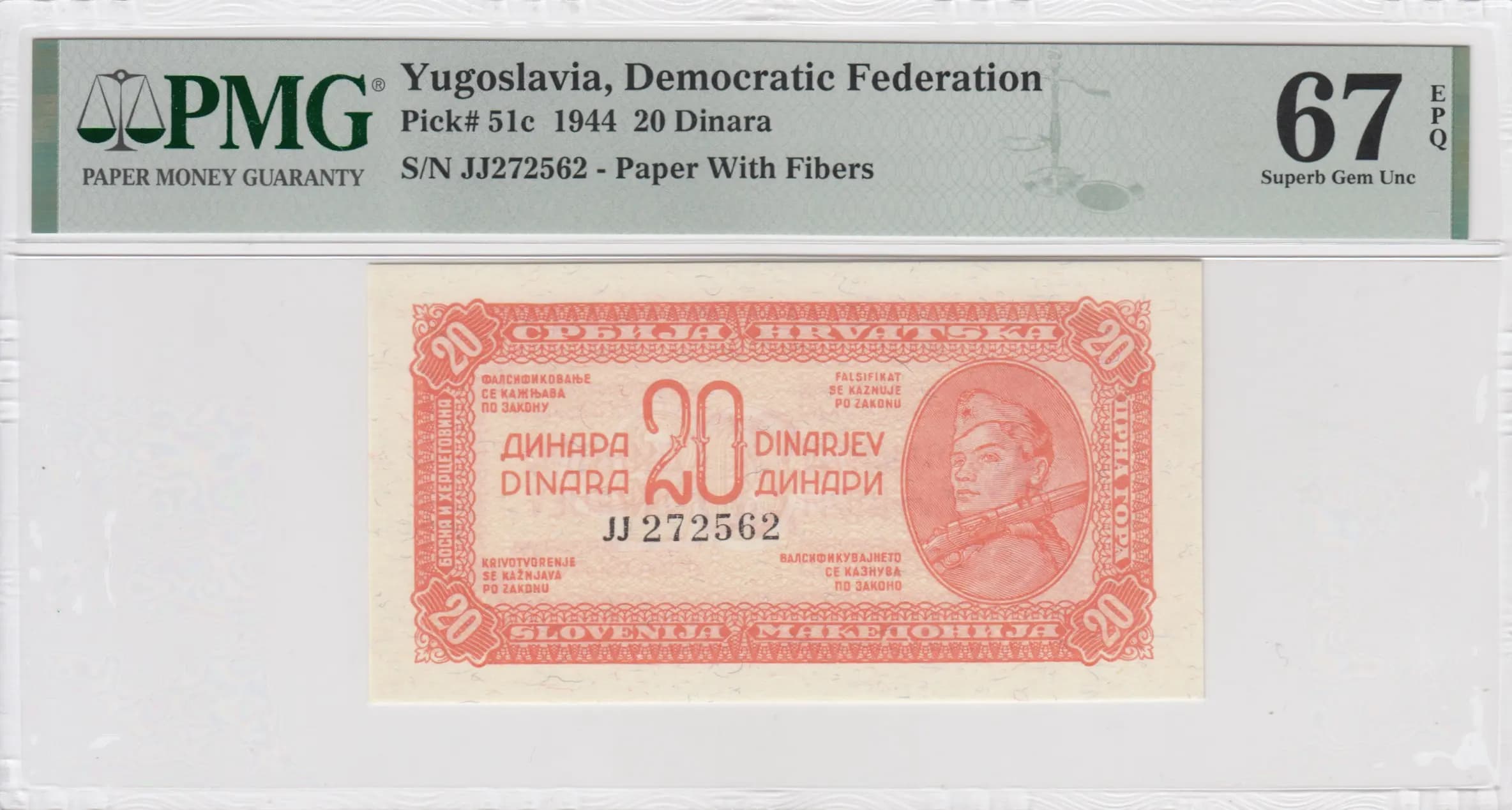
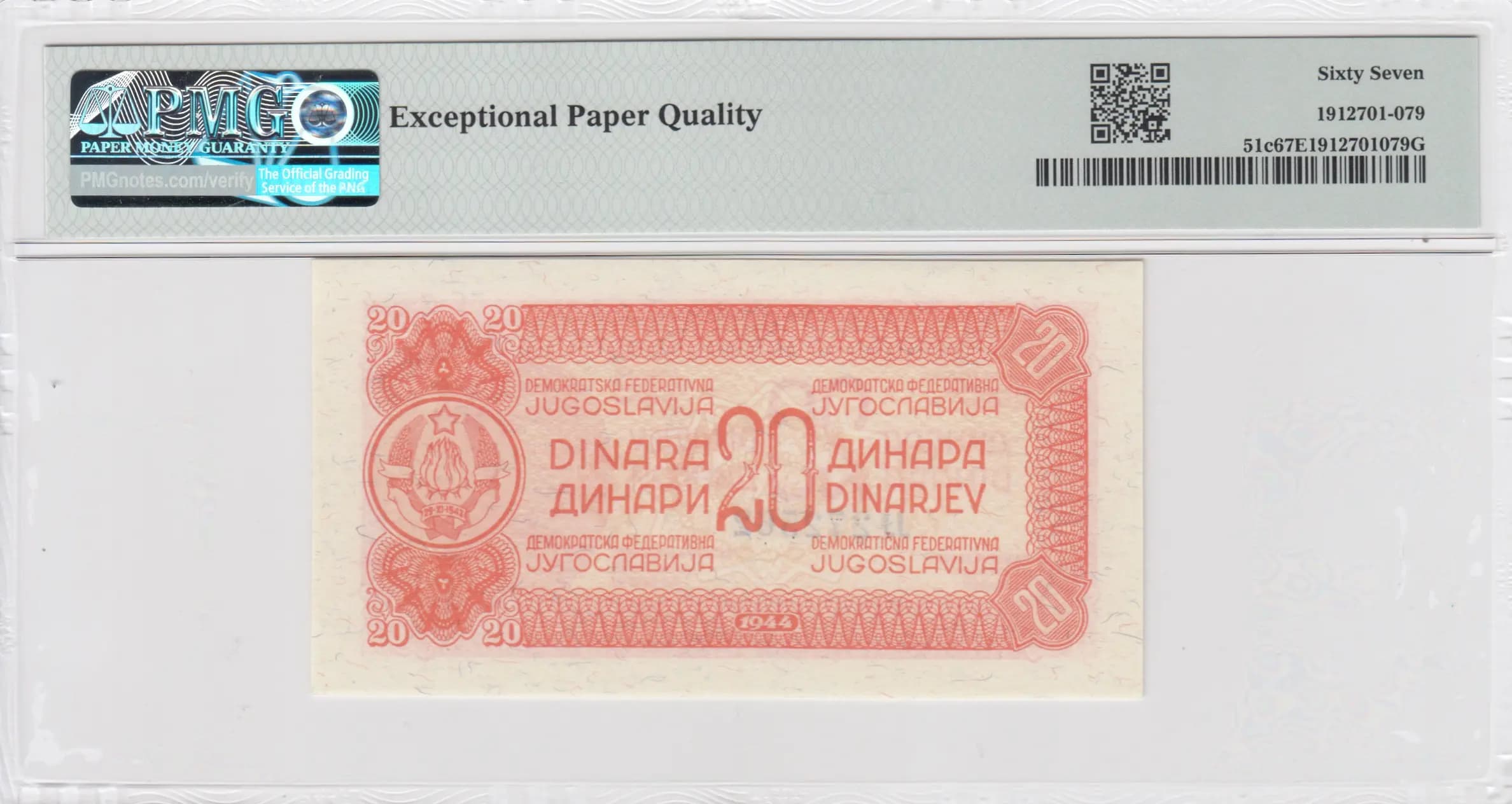
An exceptional example of Yugoslavia's 1944 20 Dinara note in PMG 67 EPQ condition, featuring a striking red/coral color scheme with ornate decorative borders and a portrait of a partisan soldier in military uniform on the obverse. The reverse displays the Democratic Federal Republic coat of arms with a prominent star emblem, rendered in crisp intaglio printing on paper with visible security fibers. This particular specimen exemplifies the high-quality production standards of the WWII-era Yugoslav government currency, with pristine paper quality and sharp printing showing no wear or damage.
Common. The eBay price history demonstrates consistent market availability across multiple condition grades, with specimens in various grades (F through UNC) selling regularly from 2009 through 2024. A PMG 67 example sold for $97 in July 2018, while PMG 68 examples have reached $237.50, but the consistent appearance of this note across grades and years indicates substantial surviving population. The 1944 20 Dinara was part of the DFRJ's initial currency series with reasonable print run quantities. Current catalog values (2016) list UNC at $50, consistent with a common note in the international market.
Issued in 1944 during the partisan resistance against Axis occupation, this banknote represents the nascent Democratic Federal Republic of Yugoslavia's assertion of sovereignty. The obverse portrait depicts a partisan combatant—identified as Milivoje Rodić, who later became a colonel in the Yugoslav army—symbolizing the armed struggle for liberation that defined the period. The reverse's prominent star emblem in the circular coat of arms became the enduring symbol of communist Yugoslavia, marking this note as a transitional currency bridging the wartime partisan movement and the postwar socialist federation.
The obverse features a three-quarter profile portrait of Milivoje Rodić, a Yugoslav partisan commander, depicted in military uniform with head covering, positioned on the right side of the note. The denomination '20' is prominently displayed in the center with bilingual (Latin and Cyrillic) text reading 'DINARA' and 'DINARJEV'/'ДИНАРА' and 'ДИНАРИ'. Ornamental corner decorations with geometric patterns and decorative border frames in red and coral tones frame the entire design. The reverse maintains the same decorative border aesthetic and features a circular coat of arms centered with a prominent star emblem—the emblem of Yugoslav communist symbolism—positioned on the left side, with denomination repeated and the text 'DEMOKRATSKO FEDERATIVNA JUGOSLAVIJA' spanning the width of the note. Both sides employ bilingual inscriptions reflecting the multi-ethnic federation's inclusive design approach.
FRONT SIDE: '20' and 'DINARA' (Latin: Dinara); 'ДИНАРА' (Cyrillic: Dinara); 'DINARJEV' (Latin: Dinars); 'ДИНАРИ' (Cyrillic: Dinars); 'JJ 272562' (Serial number); 'ФЕДЕРАТИВНА ЈУГОСЛАВИЈА' (Cyrillic: Federal Yugoslavia); 'FALSIFIKAT SE KAZNJUJE PO ZAKONU' (Latin/Mixed: Counterfeiting punishable by law); 'КРИВОТВОРЕЊЕ СЕ КАЗЊАВА ПО ЗАКОНУ' (Cyrillic: Counterfeiting punishable by law). BACK SIDE: '20' (Denomination); 'DINARA' and 'ДИНАРА' (Dinara in both scripts); 'DINARJEV' and 'ДИНАРИ' (Dinars in both scripts); 'DEMOKRATSKO FEDERATIVNA JUGOSLAVIJA' (Latin: Democratic Federation Yugoslavia); 'ДЕМОКРАТСКО ФЕДЕРАТИВНА ЈУГОСЛАВИЈА' (Cyrillic: Democratic Federation Yugoslavia); '1944' (Issue year).
Intaglio engraving, evidenced by the fine line work, sharp impression, and crisp detail visible throughout the design. The note exhibits the deep, dimensional quality characteristic of professional intaglio production, with ornate border patterns and portraiture rendered with precision typical of security printing. The paper contains visible security fibers integrated during manufacture. While specific printer attribution for the DFRJ 1944 issues is not definitively documented in standard catalogs, Yugoslav wartime currency production involved multiple facilities; the quality and execution suggests professional government security printing operations.
This specimen is cataloged as Pick P-51c (one of two variants for the 20 Dinara denomination; P-51d also exists in the Pick catalog system). The observed serial number 'JJ 272562' is consistent with the expected serial numbering format for this issue. No overprints, signatures, or date variations are evident in the visual analysis. The red/coral color scheme and design elements are standard for the P-51c variety.