500 fils 1965
Market Prices
11 salesAbout This Note
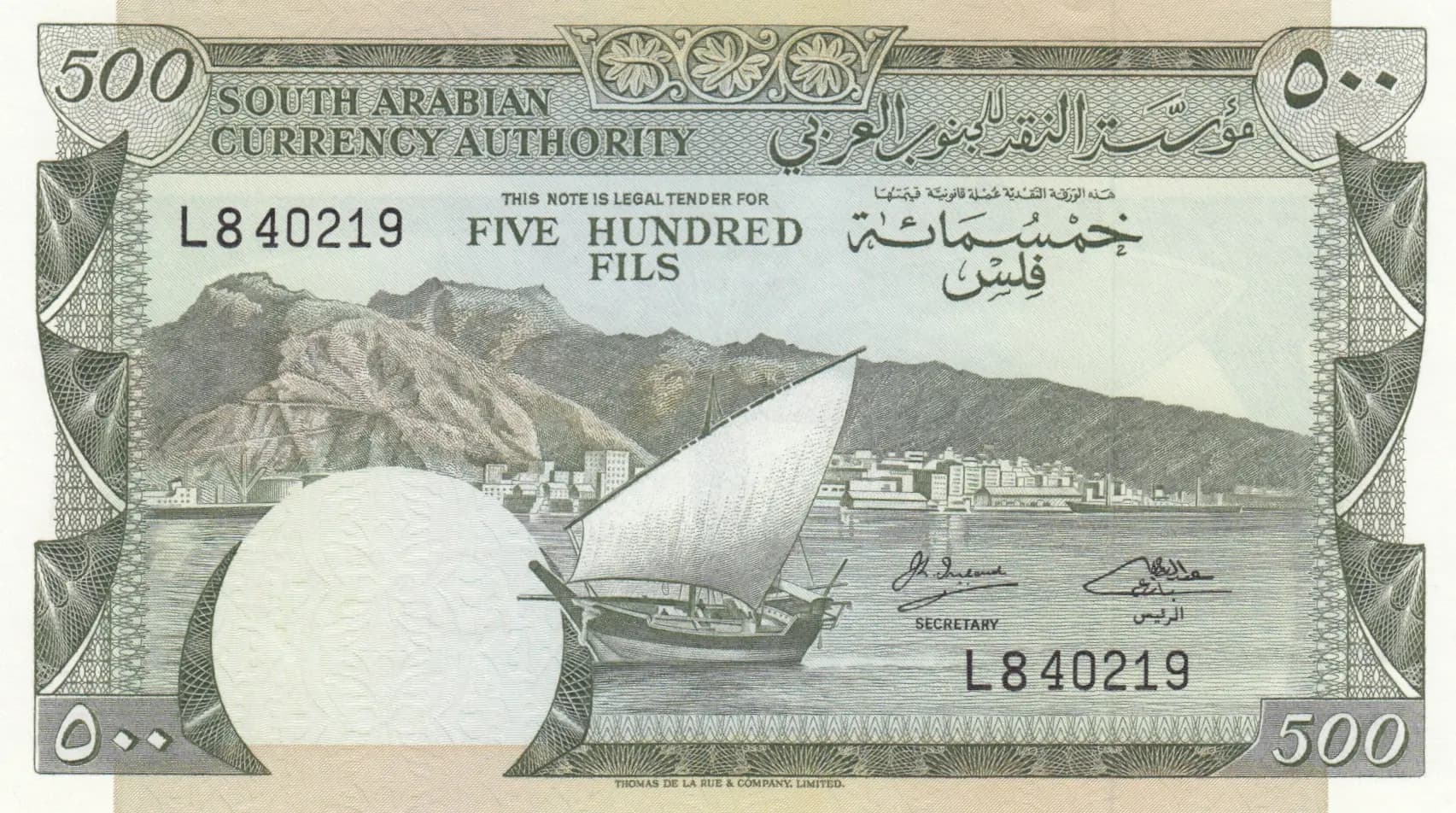
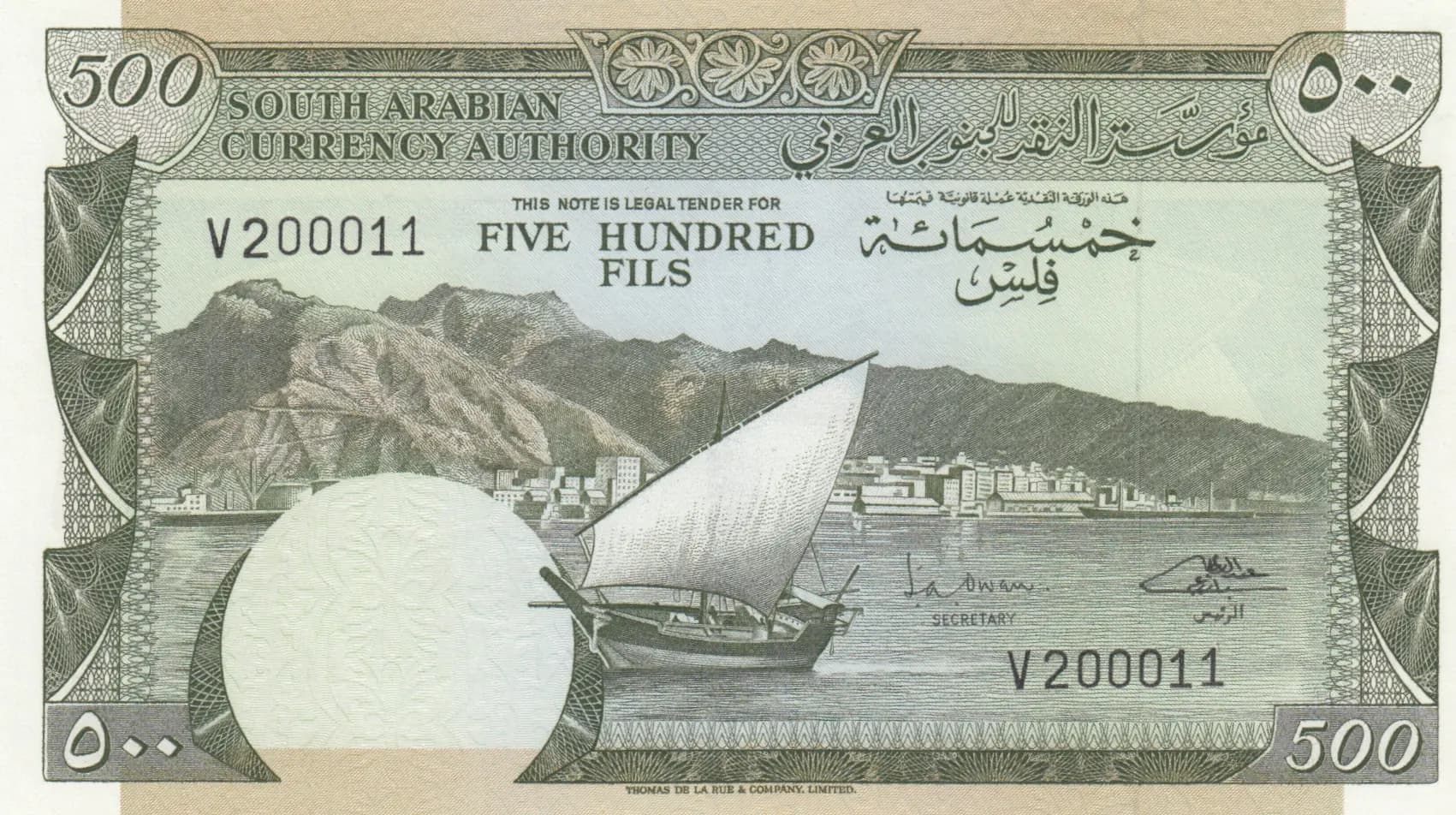
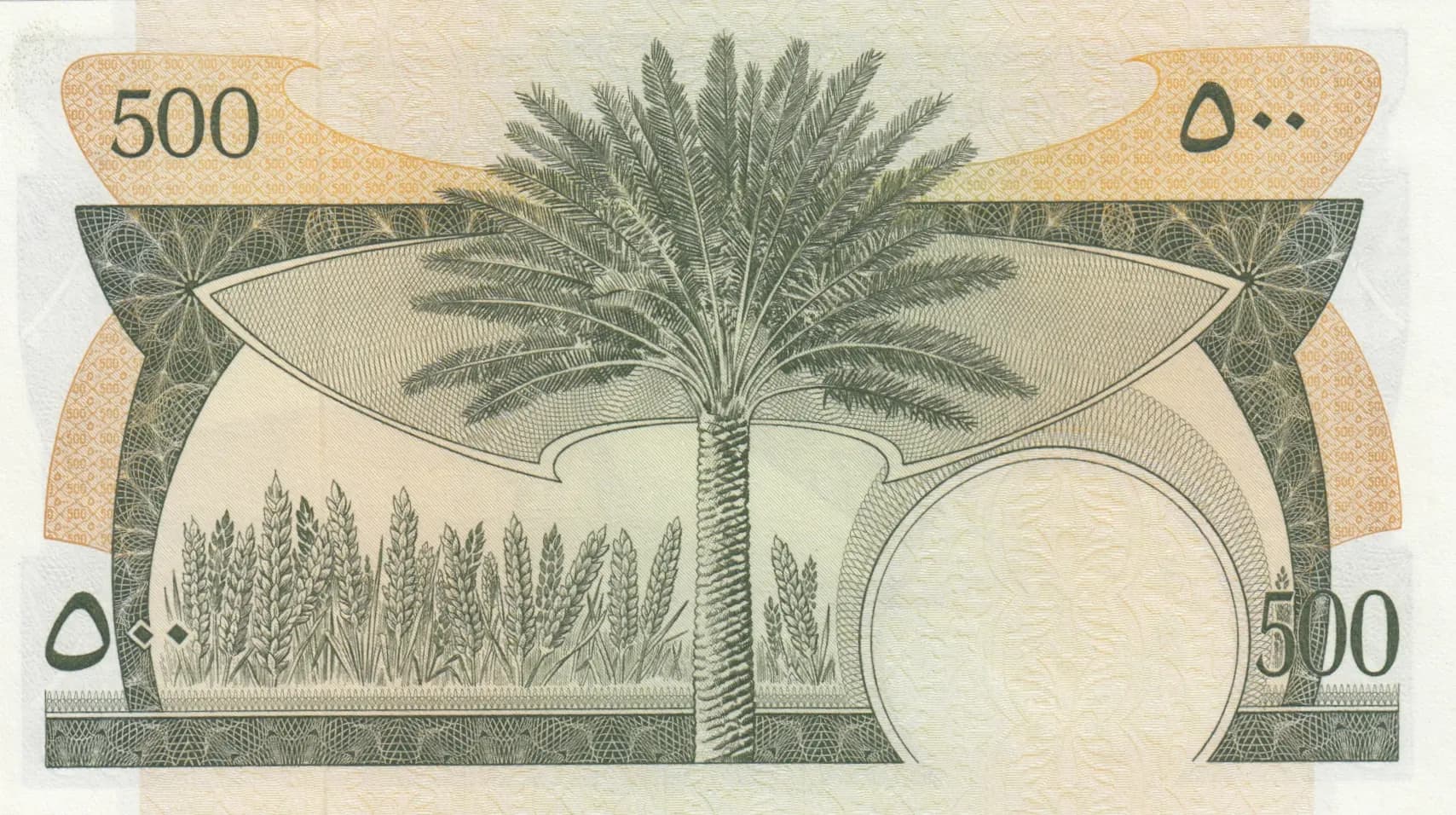
This is a stunning example of the 1965 South Arabian Currency Authority 500 fils note (Pick P-2a) in uncirculated condition. The obverse features a beautifully engraved coastal harbor scene with a traditional dhow sailing vessel, mountains, and a cityscape rendered in greens and blues, while the reverse showcases agricultural imagery with a date palm tree and wheat bundles symbolizing the region's economy. The crisp printing, sharp engraving details, and pristine condition make this an excellent specimen of early South Arabian currency design.
Common. Despite the brief existence of the South Arabian Currency Authority and the region's political transitions, this denomination and Pick number were produced in sufficient quantities to remain readily available to collectors. The eBay market data shows consistent sales activity at modest prices ($3.51 to $21.50 for circulated grades), with UNC specimens catalog-valued at $275 but representing standard collector interest rather than scarcity premium. The note was not recalled or withdrawn from circulation in significant quantities, and examples in all grades remain accessible to collectors.
Issued during the transitional period of South Arabia's political development, this note reflects the region's maritime heritage and agricultural foundation through its carefully chosen imagery. The South Arabian Currency Authority operated during a pivotal era before the eventual unification with North Yemen, and this currency represents a brief but significant chapter in the Arabian Peninsula's monetary history. The integration of traditional dhow vessels and date palms on the note symbolizes the sultanates' economic reliance on trade and agriculture during the mid-1960s.
The obverse depicts a scenic coastal harbor landscape representing South Arabia's maritime economy, featuring a traditional wooden dhow under full sail on blue-green waters, with fortified harbor structures and a mountainous shoreline visible in the background. The reverse showcases the region's agricultural wealth through detailed engraving of a tall date palm tree—a staple crop of the Arabian Peninsula—with bundled wheat or grain beneath it. Both sides are framed with ornamental geometric and floral border patterns in tan and green, with circular watermark designs positioned symmetrically on the left and right margins. The denomination appears in both English numerals and Arabic script, reflecting the bilingual nature of the South Arabian administration. The fine line work and cross-hatching throughout demonstrate the high quality of Thomas De La Rue's engraving.
Front side: '500' (denomination in English numerals); 'SOUTH ARABIAN CURRENCY AUTHORITY' (English); 'سلطة الجنوب العربية للعملة' (Arabic equivalent: South Arabian Currency Authority); 'THIS NOTE IS LEGAL TENDER FOR' (English legal declaration); 'FIVE HUNDRED FILS' (denomination in English); 'خمسمائة فلس' (Arabic: Five Hundred Fils); 'V200011' (serial number); 'SECRETARY' / 'الأمين' (signature line designation in English and Arabic); 'THOMAS DE LA RUE & COMPANY, LIMITED.' (printer attribution). Back side: '500' (English numerals); '٥٠٠' (Arabic numerals, Five Hundred Fils).
Intaglio/engraving printing method, executed by Thomas De La Rue & Company, Limited, the renowned British security printer. The visual evidence of fine line work, detailed cross-hatching, sharp borders, and complex color registration across multiple plates indicates traditional engraved steel plate printing, the standard security printing technology of the period. The multicolored underprint and layered color application are consistent with the multi-pass intaglio printing processes De La Rue employed for Commonwealth and international currency during the 1960s.
This example bears the serial number V200011, indicating it is from the early production run with the 'V' prefix series. The South Arabian 500 fils Pick P-2a was issued in 1964-1965 and does not have widely documented sub-varieties in the standard catalogs, though serial number prefixes and signature variations may exist. The 'SECRETARY' signature line appears blank or minimally signed, which is consistent with issues from this printing run. No overprints or date variations are evident on this specimen.