1000 francs 1959
“Senegal”
About This Note
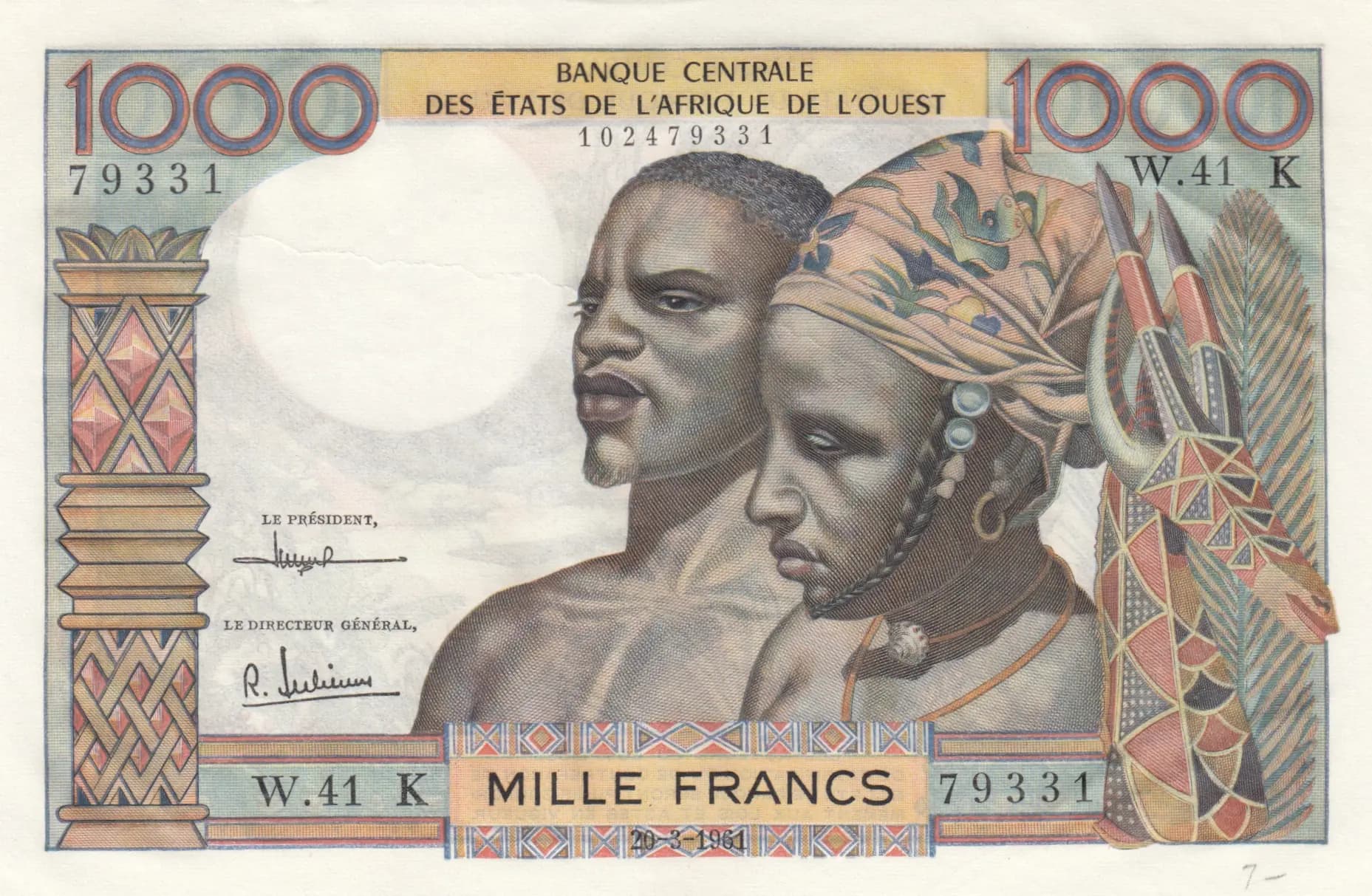
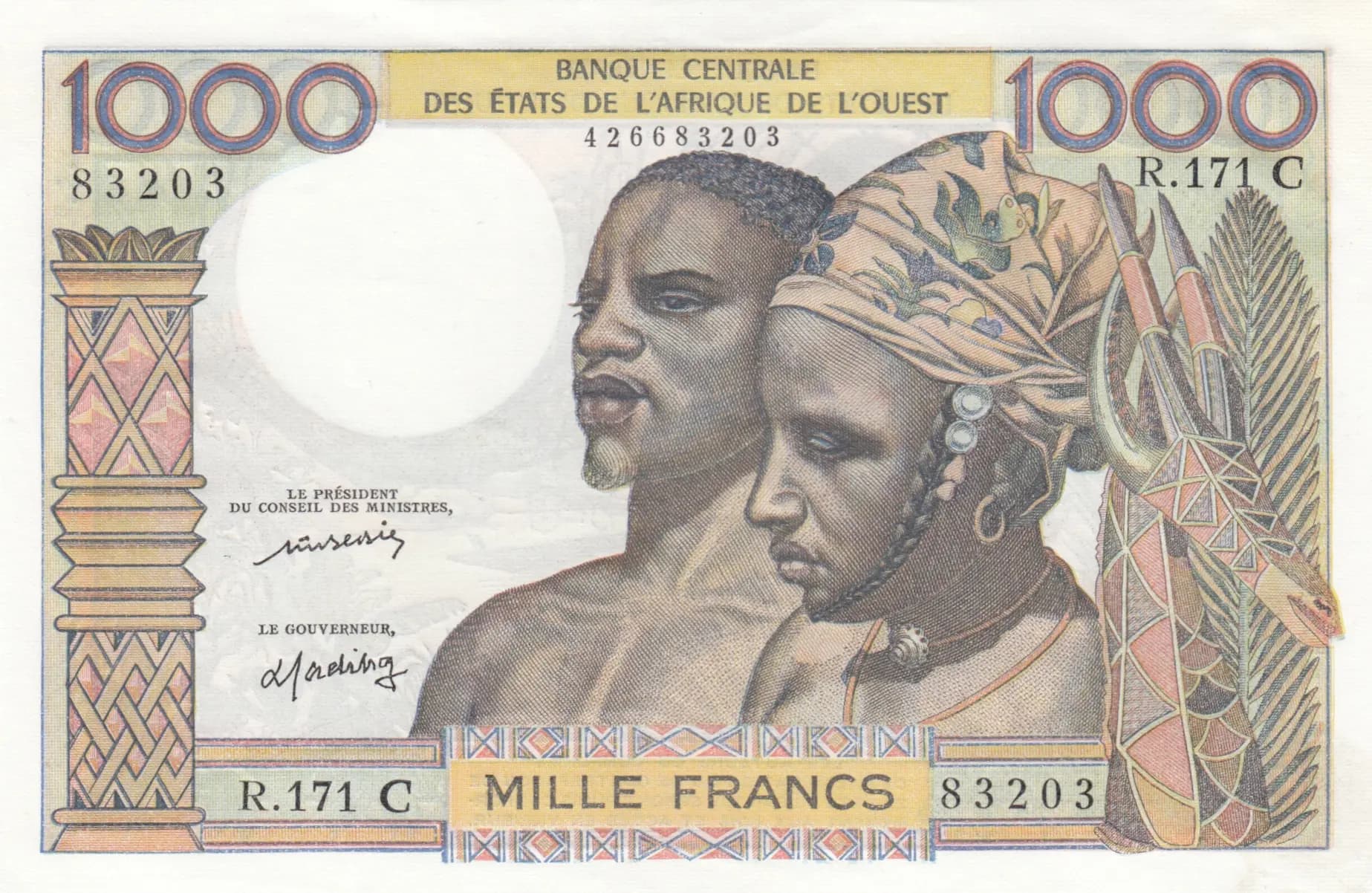
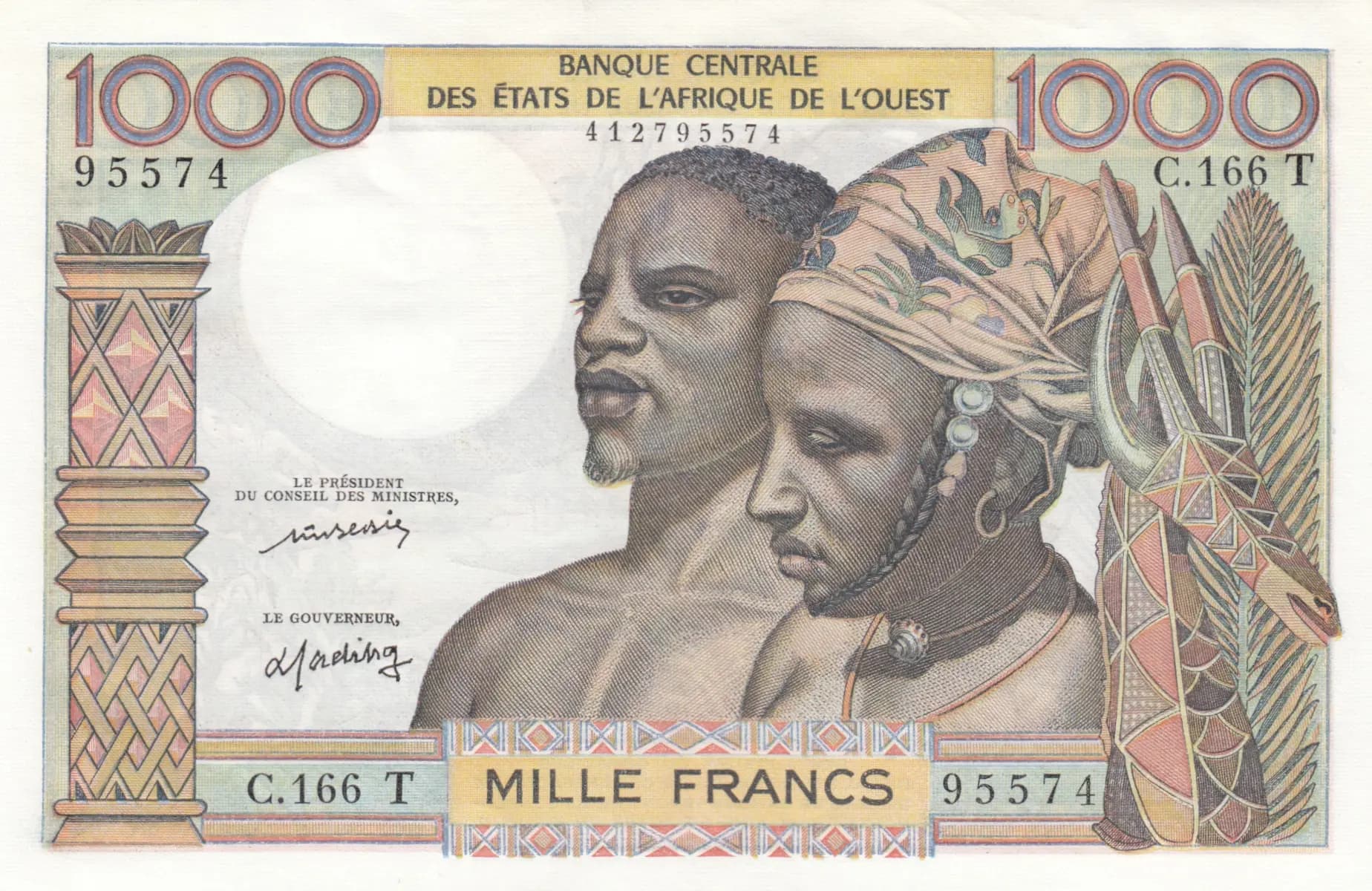
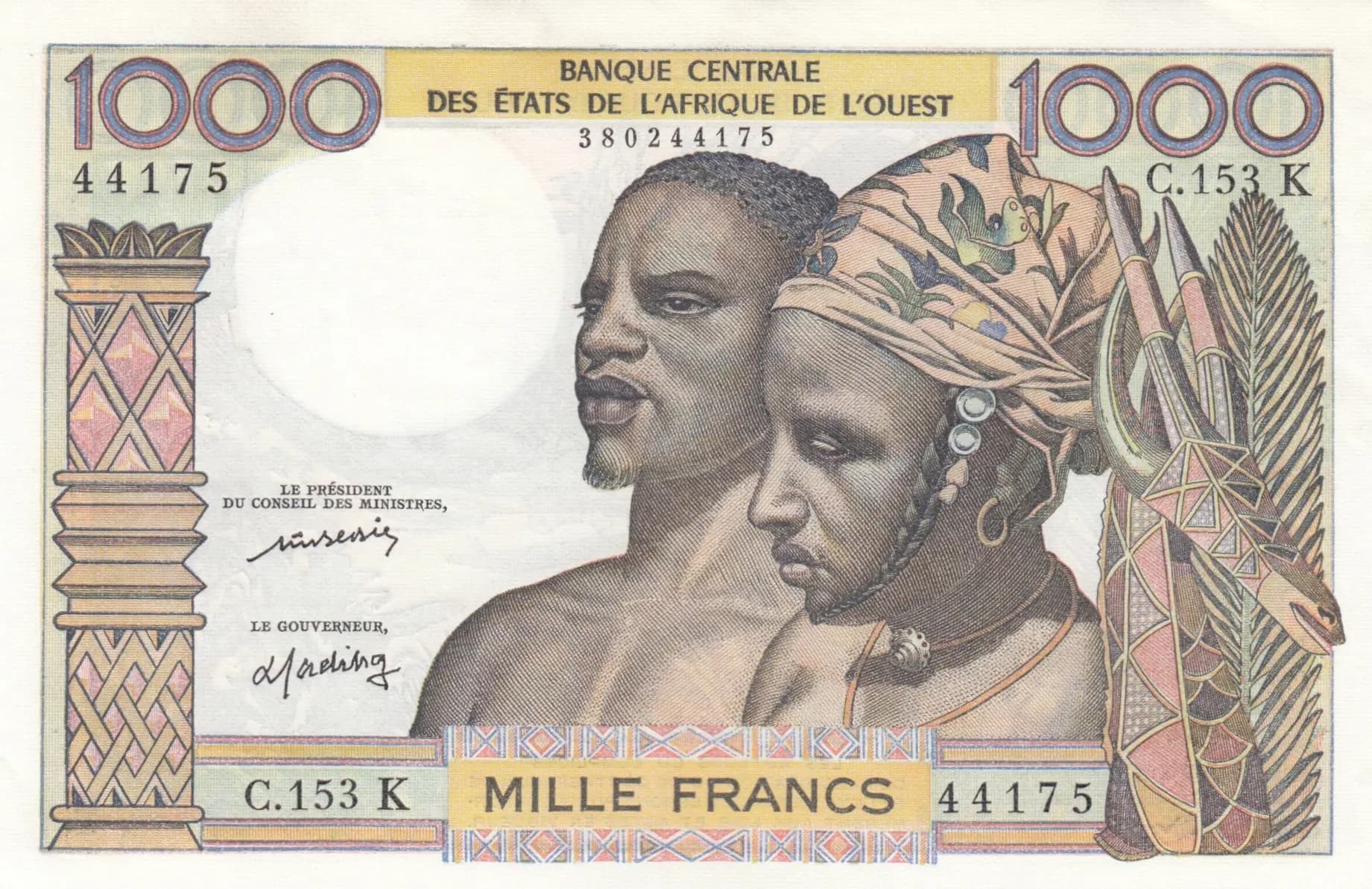
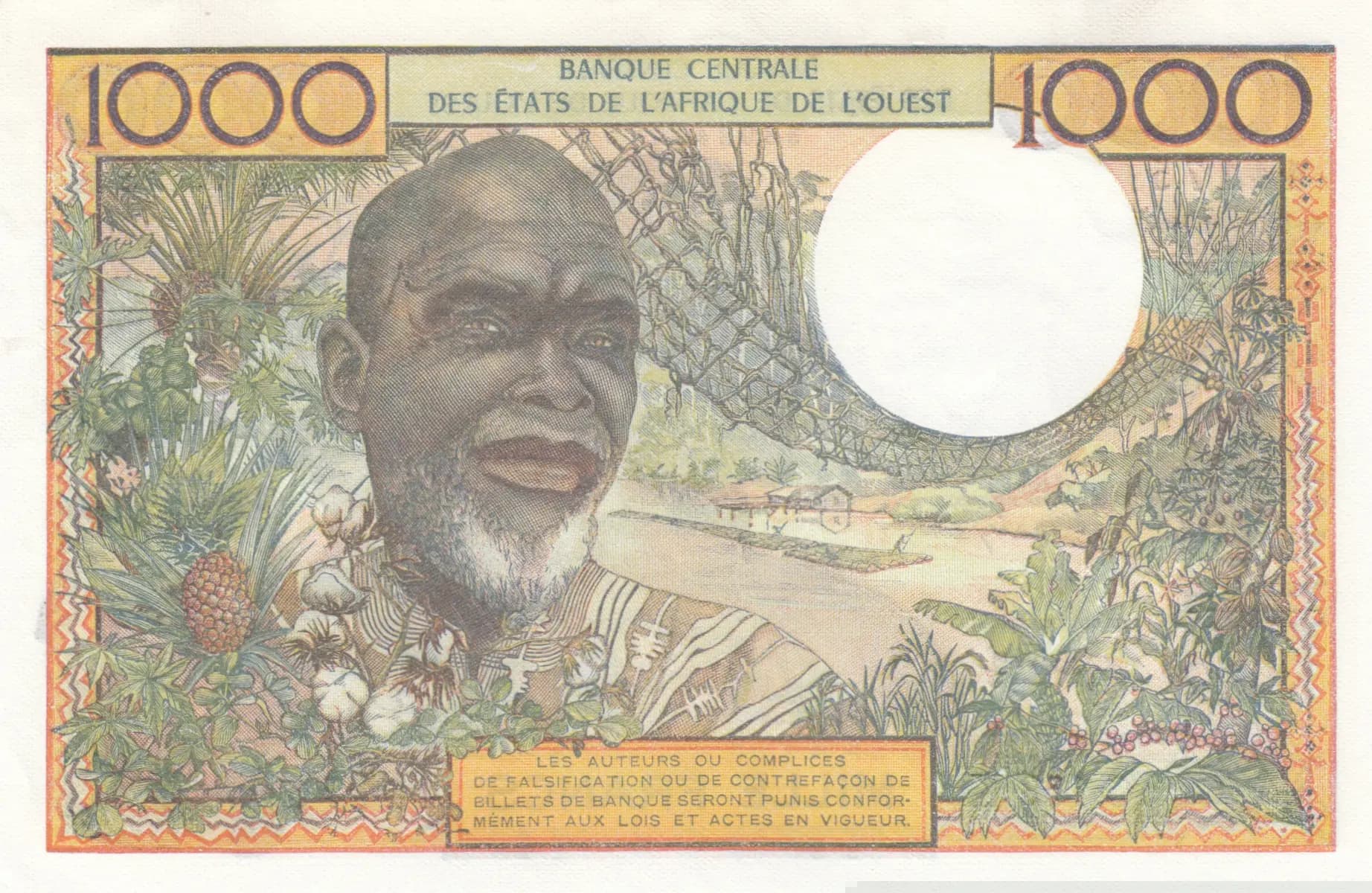
This is an exceptional example of the 1959 West African States 1000 Francs banknote (Pick P-703Km), graded UNC and likely representing Senegal's currency during the early post-independence era. The note features striking dual portraiture on the obverse—a male and female bust in profile—complemented by rich decorative elements including an ornamental geometric vessel and tropical vegetation rendered in warm earth tones and greens. The reverse depicts an agricultural landscape with cotton plants and a bearded male portrait, reflecting the economic importance of agriculture to the region during this formative period.
Common. This is a standard-issue banknote from a major regional central bank with substantial print runs to serve multiple West African nations including Senegal. The Pick catalog lists six known letter variants (Ka, Ke, Kk, Km, Kn, Ko) for the base number, indicating widespread circulation and multiple production runs. An UNC example, while desirable, is not exceptionally rare as these notes were issued in significant quantities and have survived in reasonable numbers. The absence of recall notices, short-lived status, or documented low print runs indicates this represents standard collector material rather than a scarce issue.
This 1000 francs note was issued by the Banque Centrale des Etats de l'Afrique l'Ouest (Central Bank of West African States) in 1959, marking the transitional period following French West African independence. The dual portraiture on the obverse and the prominent agricultural imagery on the reverse—particularly the cotton plants and tropical vegetation—commemorate the region's colonial economic heritage while celebrating the emerging post-colonial identity of the newly independent West African nations, of which Senegal was a founding member.
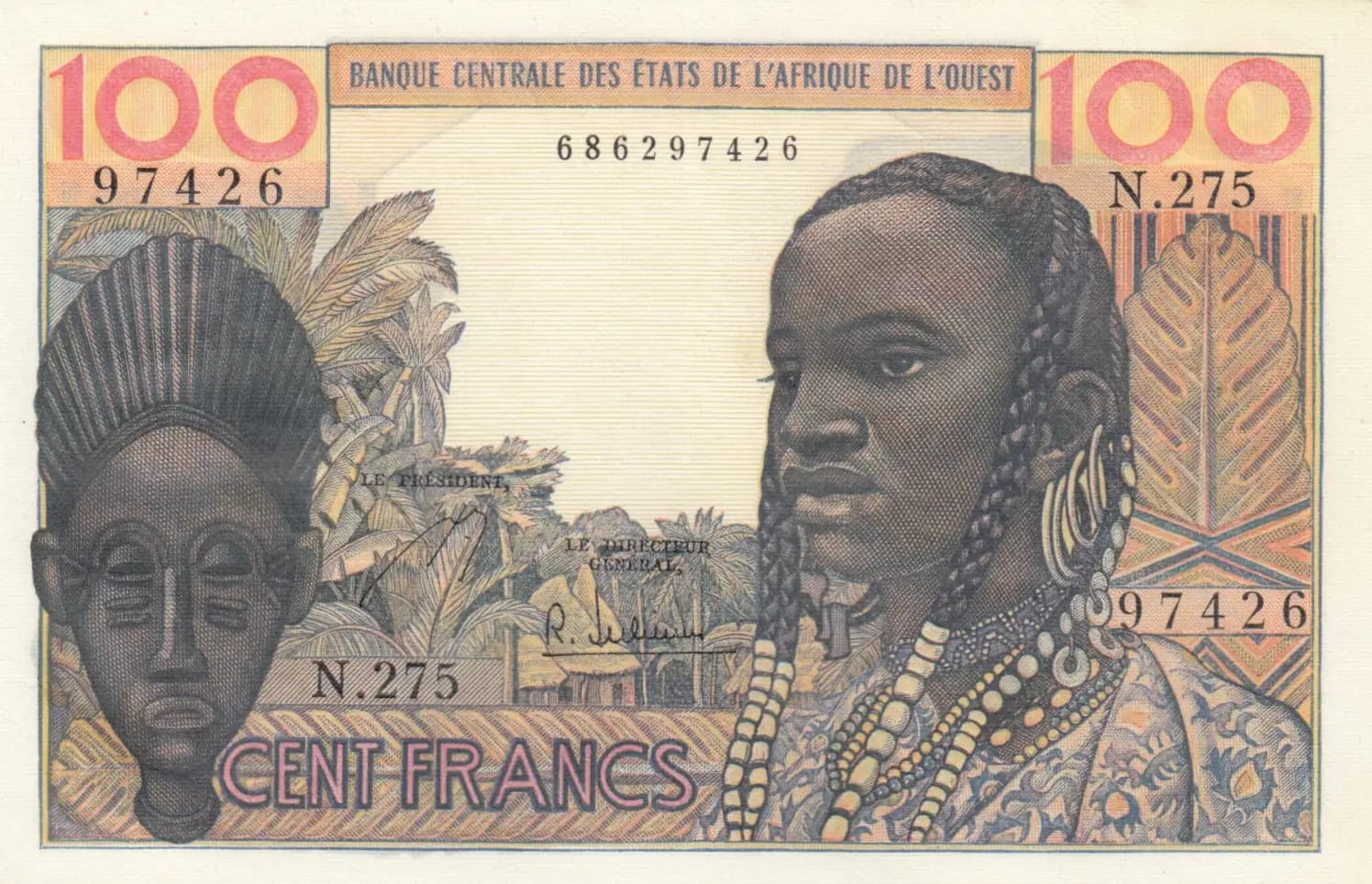
The obverse features two allegorical portrait busts in left profile—a male figure in the foreground and a female figure wearing a traditional head wrap with circular earrings, positioned in the background. To the left stands an ornamental urn or ceremonial vessel with geometric diamond and triangular patterns rendered in pink and gold, symbolizing cultural heritage. The right side displays stylized tropical vegetation including palm fronds and botanical elements in tan and green. Large denomination numerals '1000' appear in the top corners. The reverse depicts a single bearded male portrait in left profile, wearing traditional wrapped clothing, positioned in the upper left quadrant. The dominant composition showcases an elaborate agricultural landscape featuring cotton plants with visible bolls, palm trees, and a river or waterway scene with lush vegetation on the banks, rendered in naturalistic greens, tans, and blue-green tones. Both sides feature decorative geometric borders in earth tones (orange, brown) and cream. The overall palette combines warm earth tones, greens, golds, and purples, creating a visually harmonious design celebrating West African culture and economic resources.
FRONT SIDE: 'BANQUE CENTRALE DES ÉTATS DE L'AFRIQUE DE L'OUEST' (Central Bank of the States of West Africa); 'LE PRÉSIDENT DU CONSEIL DES MINISTRES' (The President of the Council of Ministers); 'LE GOUVERNEUR' (The Governor); 'MILLE FRANCS' (One Thousand Francs); Serial number format: C.153 K and 380244175. BACK SIDE: 'BANQUE CENTRALE DES ÉTATS DE L'AFRIQUE DE L'OUEST' (Central Bank of the States of West African States); 'LES AUTEURS OU COMPLICES DE LA FALSIFICATION OU DE CONTREFAÇON DE BILLETS DE BANQUE SERONT PUNIS CONFORMÉMENT AUX LOIS ET ACTES EN VIGUEUR' (The authors or accomplices of the falsification or counterfeiting of banknotes will be punished in accordance with the laws and acts in force).
This note employs multicolor intaglio (engraved) printing, a standard security printing technique for currency of the era. The intricate detail work, fine line patterns, geometric security elements, and the presence of watermark areas visible as blank spaces indicate professional bank note engraving. The complex background patterns and layered color applications are characteristic of high-security intaglio production by a specialized currency printer, likely produced by a European security printing firm contracted by the Banque Centrale des Etats de l'Afrique l'Ouest.
This specific note is cataloged as P-703Km, indicating code letter 'K' variant with the letter suffix 'm'. The Pick catalog identifies six letter variants for this base number: P-703Ka, P-703Ke, P-703Kk, P-703Km, P-703Kn, and P-703Ko, all sharing code letter 'K'. The serial number visible as 'C.153 K' and '380244175' corresponds to this variant designation. The 'K' code letter and 'm' suffix designation are the identifying characteristics distinguishing this note among the cataloged variants.