1000 francs 1959
“Senegal”
About This Note
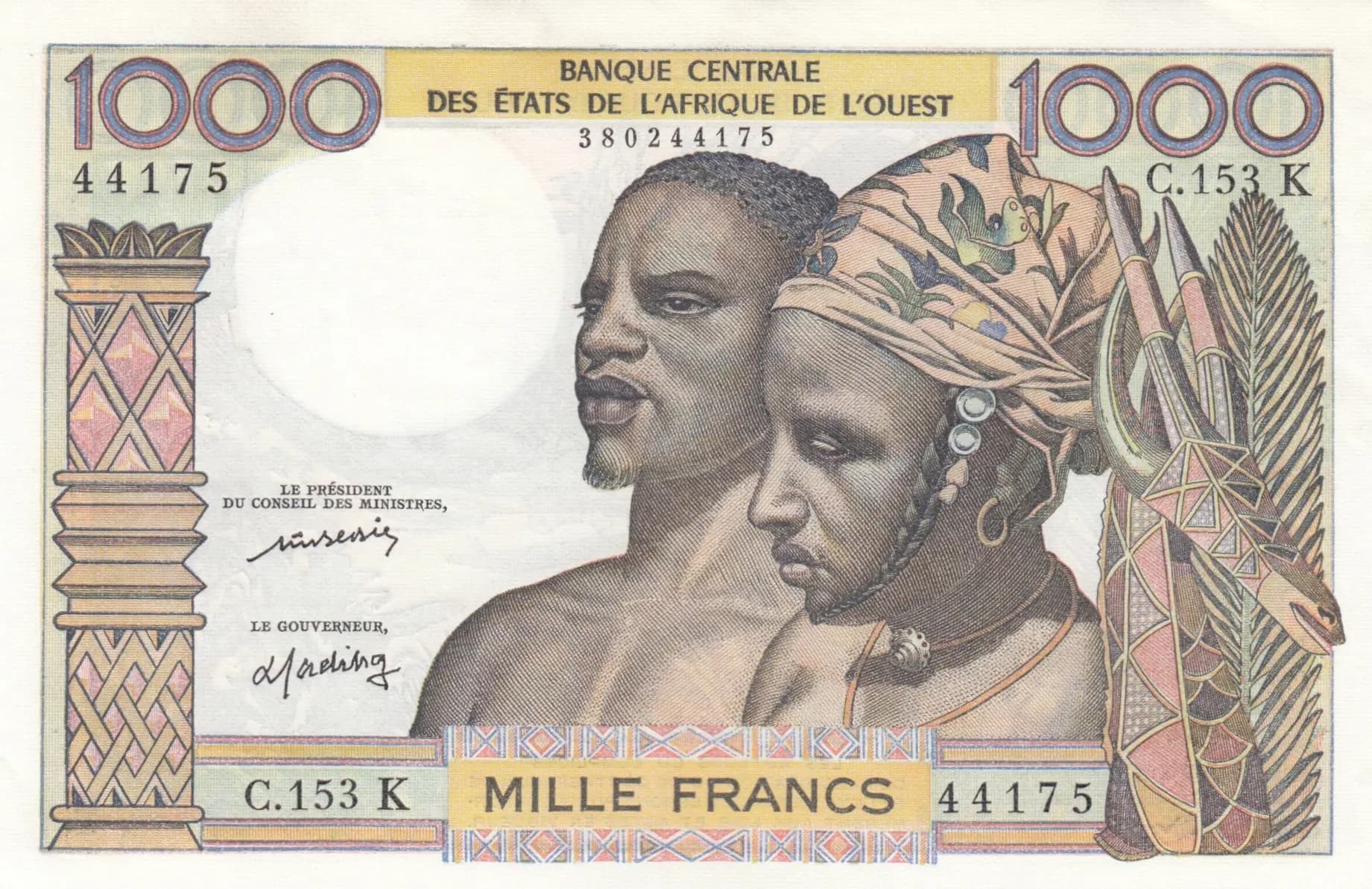
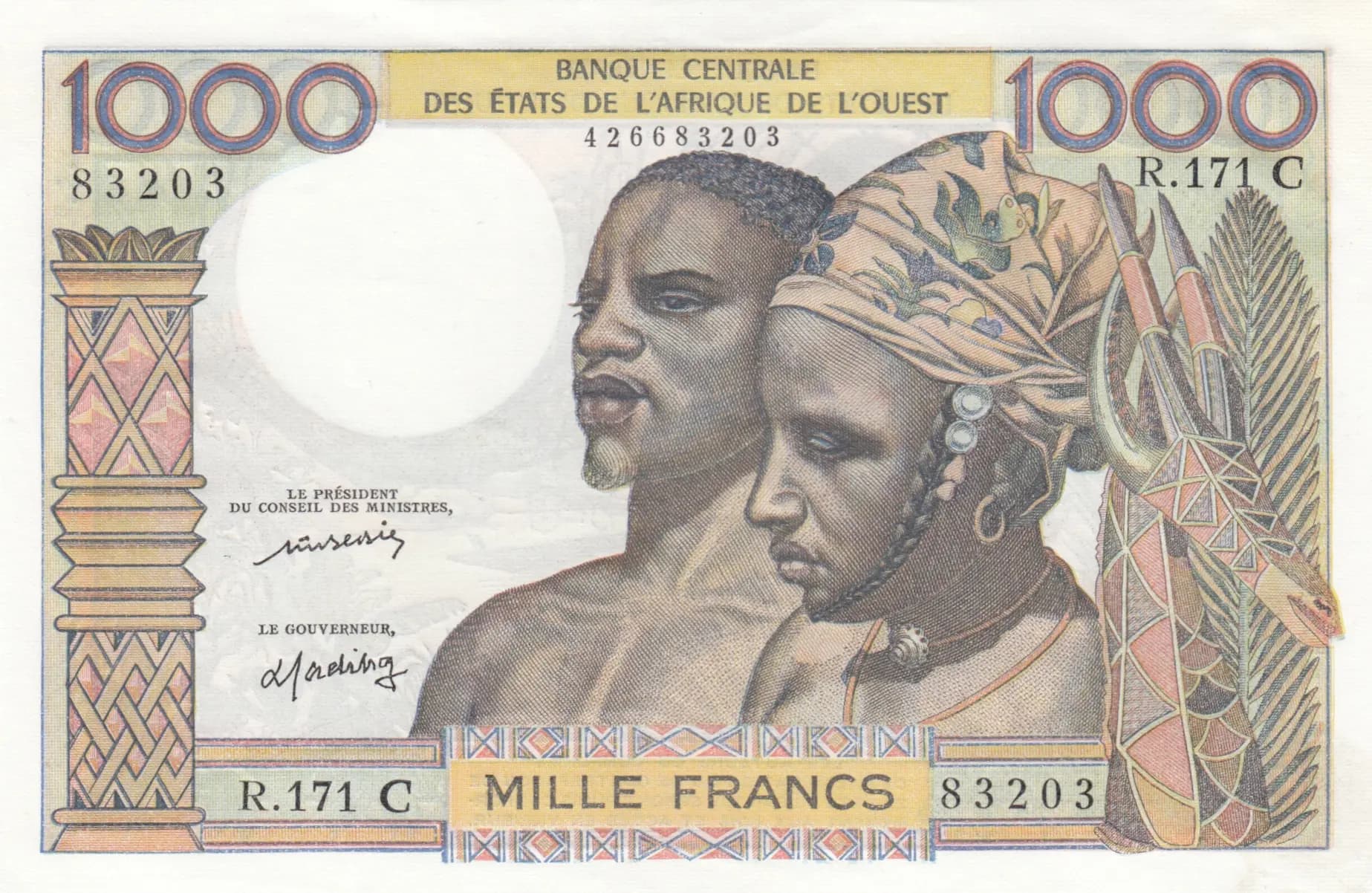
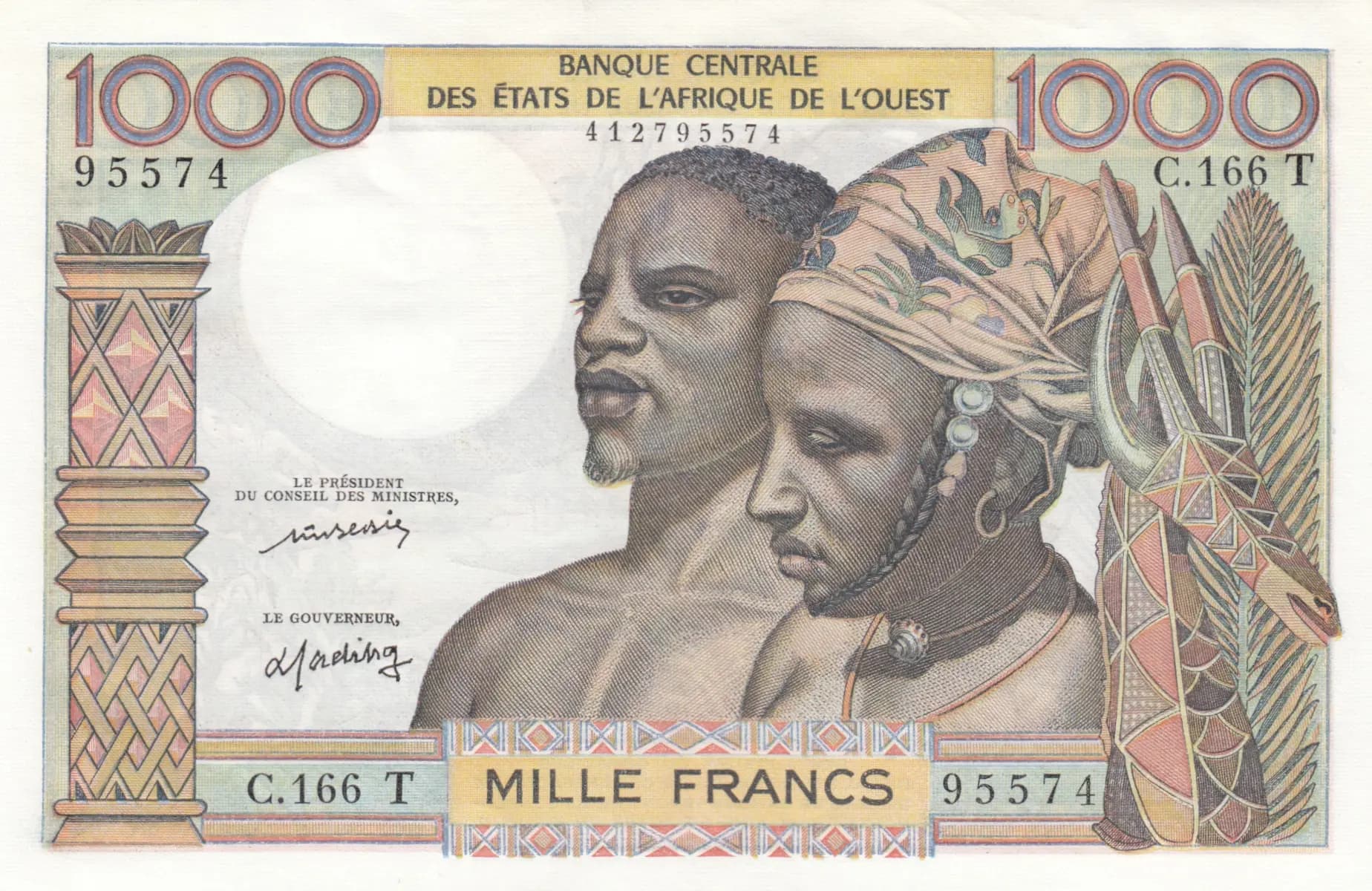
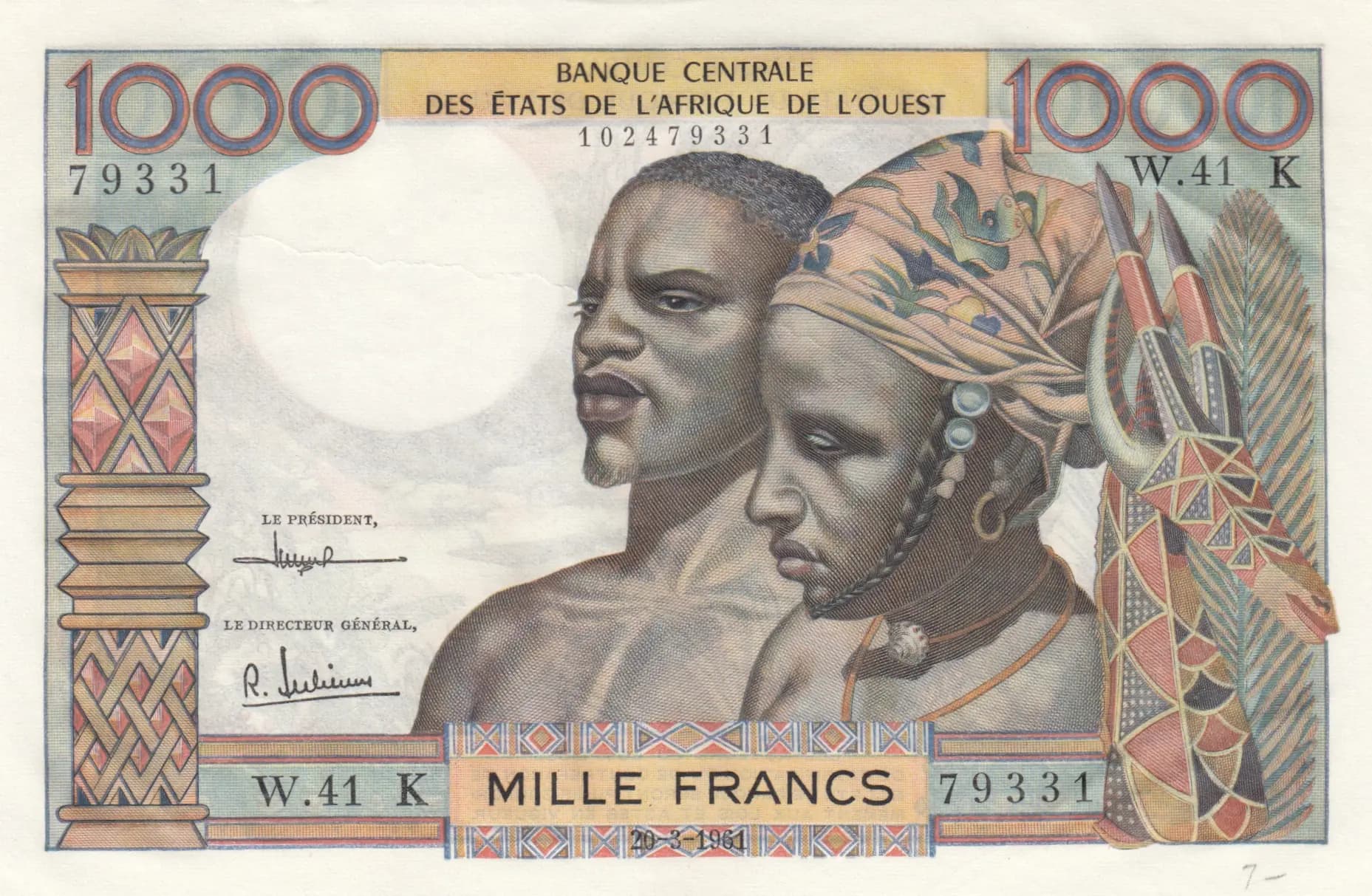
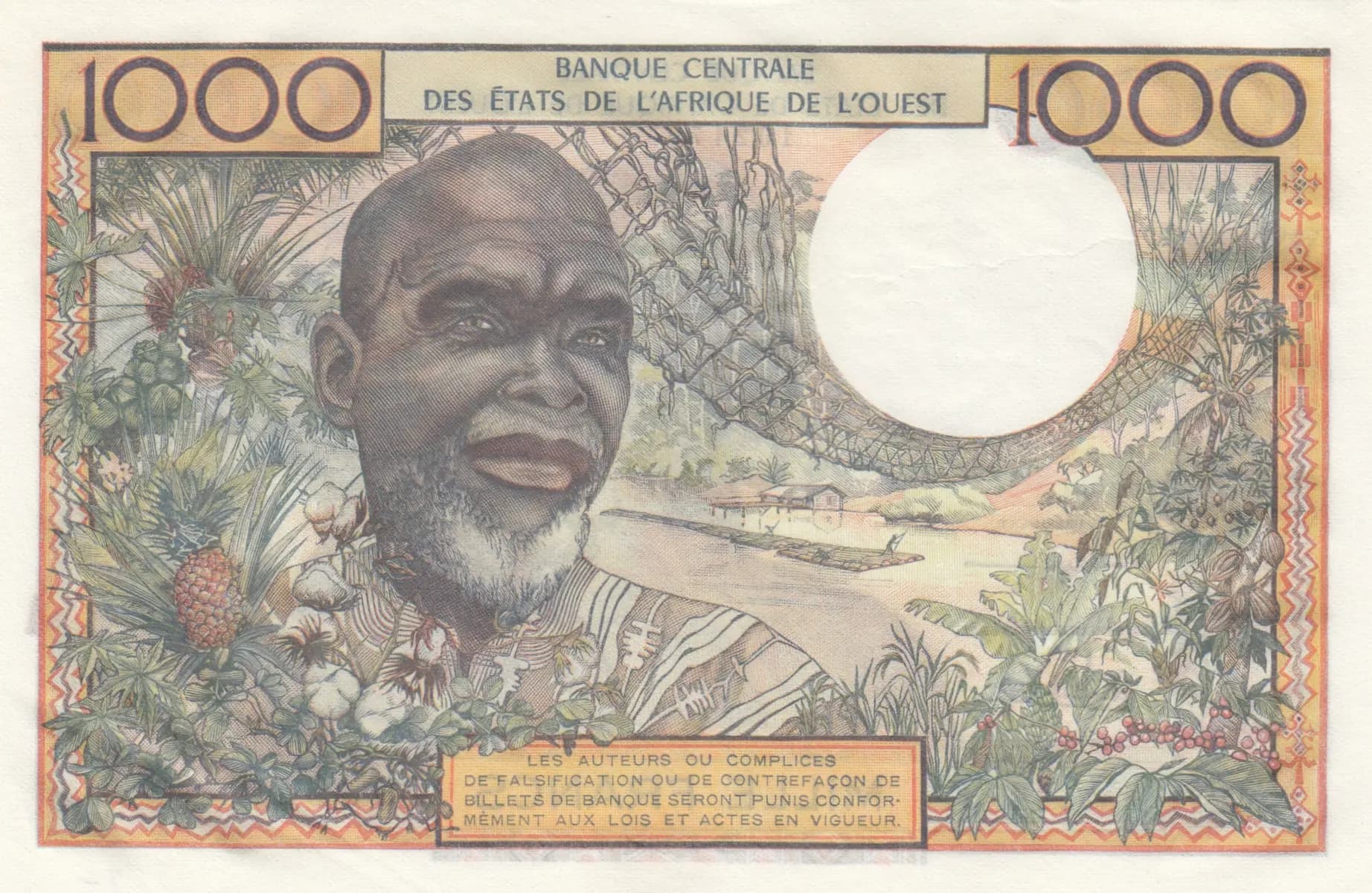
This is an exceptionally well-preserved example of the 1000 Francs banknote issued by the Banque Centrale des États de l'Afrique de l'Ouest in 1959, graded AU. The note features dual male portraits in profile on the obverse and a third portrait surrounded by West African flora on the reverse, with intricate geometric and botanical ornamentation throughout. The specimen exhibits no visible wear, creases, or imperfections, making it an attractive example for collectors of early West African currency or French colonial-era issues.
Common. This note was issued by a major regional central bank (BCAO) serving multiple West African states with substantial populations and circulations. The 1959-1961 series had significant print runs to supply the monetary needs of Senegal, Côte d'Ivoire, Mali, and other member states. No evidence of short print runs, recalls, or scarcity factors is apparent. AU condition examples are readily encountered in the collector market at modest valuations.
Issued in 1959 (with a 1961 print date noted), this banknote represents the early monetary independence of French West African colonies following decolonization. The dual portraiture on the obverse and the prominent botanical imagery—including pineapples and tropical vegetation—reflect the region's natural wealth and the aspirations of the newly sovereign West African states. The Banque Centrale des États de l'Afrique de l'Ouest served as the common central bank for member states including Senegal, Côte d'Ivoire, Mali, and Burkina Faso during this transitional period.
The obverse features two male profiles facing left in portrait medallions: a younger bearded figure on the left and an older distinguished gentleman on the right, separated by compositional elements. The left margin displays a vertical decorative geometric pattern in gold and red tones, while the right side showcases elaborate botanical designs typical of West African flora. A circular watermark area appears center-left. The reverse presents a single male profile surrounded by intricate engraved botanical elements including tropical plants, pineapples, and flowering vegetation, with a landscape vignette behind depicting water, vegetation, and a colonial-era structure. Both sides employ ornamental borders with geometric patterns in gold and red. The color palette emphasizes blue, green, gold, and red tones against cream-colored paper.
FRONT: 'BANQUE CENTRALE / DES ÉTATS DE L'AFRIQUE DE L'OUEST' (Central Bank of the States of West Africa); 'MILLE FRANCS' (One Thousand Francs); 'LE PRÉSIDENT' (The President); 'LE DIRECTEUR GÉNÉRAL' (The General Director); Serial number '102479331' with suffix '79331'; Code 'W.41 K'; Date '20 3 1961' (20 March 1961). BACK: 'BANQUE CENTRALE / DES ÉTATS DE L'AFRIQUE DE L'OUEST' (Central Bank of the States of West Africa); 'LES AUTEURS OU COMPLICES DE LA FALSIFICATION OU DE CONTREFACON DE BILLETS DE BANQUE SERONT PUNIS CONFORMÉMENT AUX LOIS ET ACTES EN VIGUEUR' (The authors or accomplices of the falsification or counterfeiting of banknotes will be punished in accordance with laws and acts in force).
Intaglio (engraved) printing on banknote paper, characteristic of high-security banknote production of the 1959-1961 period. The fine line work evident in the portraiture, geometric patterns, and botanical designs, combined with the detailed landscape vignette on the reverse, indicates professional security printing by a major international banknote printer. The BCAO notes of this era were typically produced by Thomas De La Rue or similar European security printers contracted by the French colonial authorities.
This specific note is identified as Pick 703Kc based on the code letter 'K' visible on the obverse (W.41 K). The PMG population report indicates six cataloged variants for the base Pick 703K number (Ka, Ke, Kk, Km, Kn, Ko), suggesting these represent different signature combinations or minor print varieties within the 'K' code series. The observed serial number 102479331 with the W.41 K designation confirms this as a 703Kc variant (the 'c' suffix typically denoting a specific signature or administrative combination within the K-series).