50 pesos 1872
Market Prices
About This Note
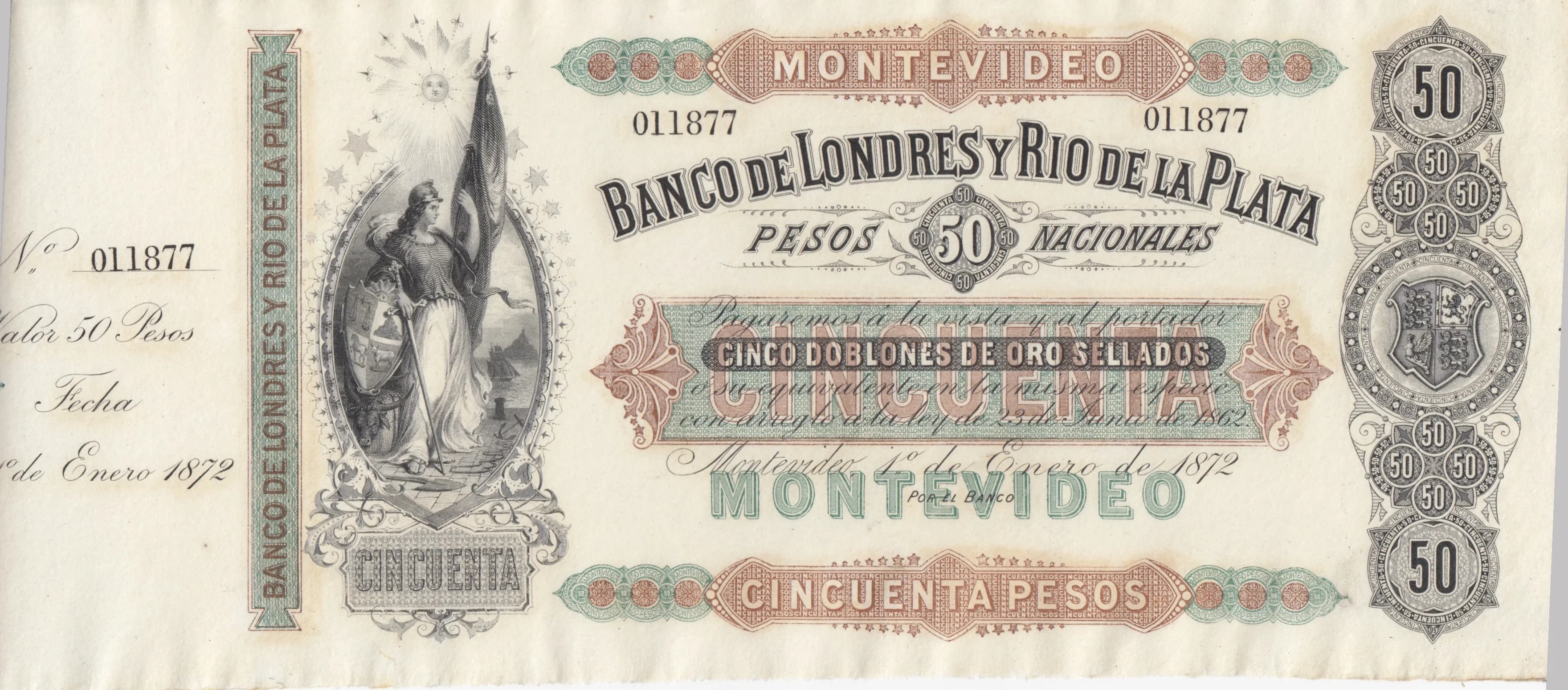
This is a scarce 1872 remainder banknote from the Banco de Londres y Rio de la Plata, denominated 50 pesos (equivalent to 5 gold doubloons), issued in Montevideo. The note displays beautiful 19th-century engraved artistry with an allegorical female figure holding a national flag, surrounded by decorative medallions and classical ornamentation in green and brown tones. Despite showing expected aging characteristics including foxing, yellowing, and a notable crease, the note remains in AU condition with strong impression quality, making it a desirable example of early Uruguayan banking currency.
Uncommon. While the eBay price data shows significant price variation ($95–$439.99 USD with most UNC examples trading in the $150–$350 range), the prevalence of multiple UNC sales suggests this is not exceedingly rare. However, the 'remainder' designation (unissued/unvalidated notes) and AU condition grade place this specific example at the scarcer end of the common-to-uncommon spectrum. Remainder notes from this issuer tend to be scarcer than circulated specimens, and the 1872 date is early enough to have limited surviving population. The AU grade with visible aging characteristics is notably more difficult to find than the UNC specimens dominating market listings, supporting an 'uncommon' rather than 'common' assessment.
The Banco de Londres y Rio de la Plata was a significant financial institution in 19th-century South America, and this January 1872 issue represents an important period in Uruguayan monetary development. The note's imagery—featuring Liberty as an allegorical female figure with national symbols and stars—reflects the republican ideals of the post-independence era in Uruguay. The dual denomination marking (50 pesos and 5 doblones de oro) illustrates the transitional monetary system of the period, bridging traditional Spanish colonial currency standards with modernizing national peso-based systems.
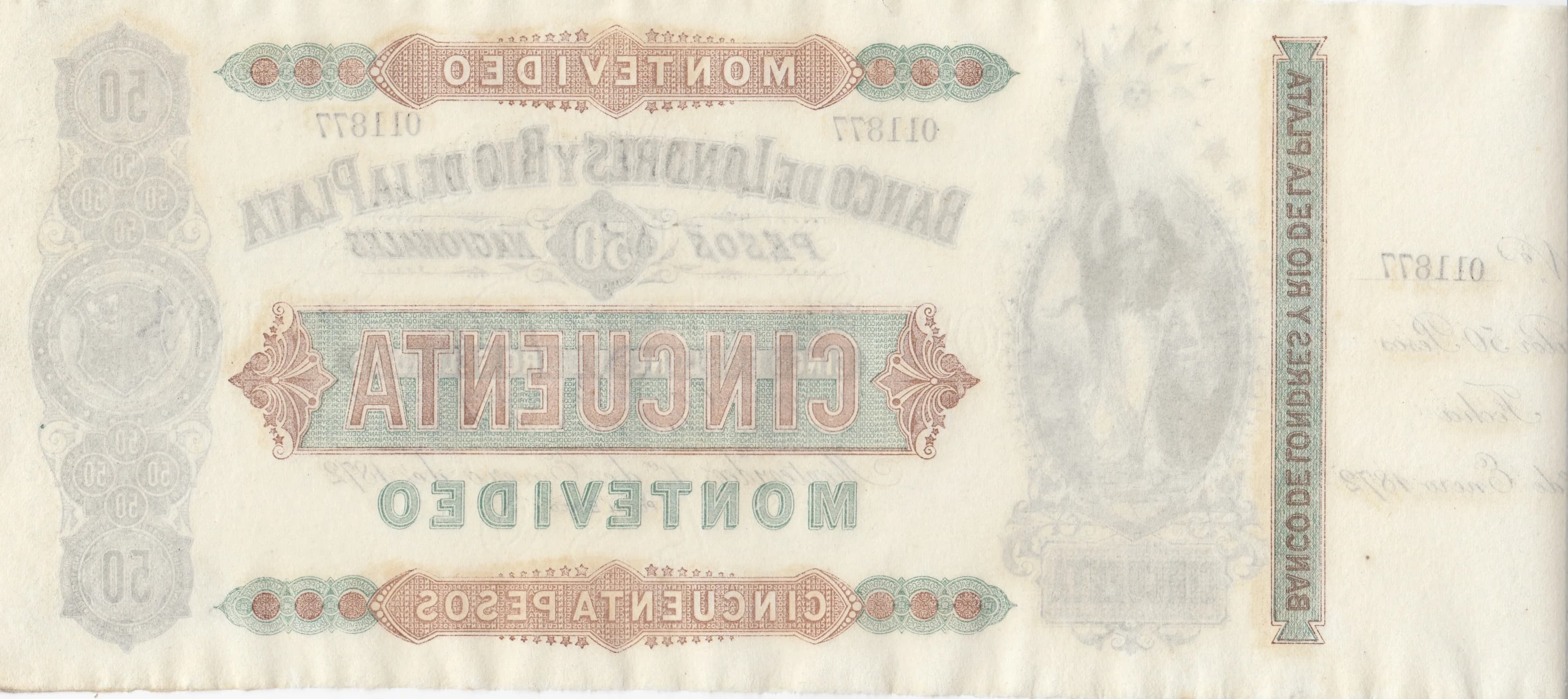
The obverse features a central allegorical representation of Liberty as a classical female figure in draped clothing, holding what appears to be a national flag or banner—a common iconographic element in 19th-century republican currency design. The figure is surrounded by a stellar halo and ornamental flourishes emphasizing patriotic symbolism. The composition is framed by elaborate engraved borders containing circular medallions with repeated denomination numerals (50), geometric interlace patterns, and ornamental corner devices. A heraldic shield or coat of arms (likely representing the Republic of Uruguay or the issuing bank) is positioned on the right side. The reverse presents a harmoniously balanced mirror design with the same ornate framework and repeated text bands, typical of bilateral security design in bank-note printing of the period. The color scheme employs green/teal and brown inks on a cream-colored security paper, creating visual depth through tonal contrast.
FRONT SIDE: 'BANCO DE LONDRES Y RIO DE LA PLATA' (Bank of London and Rio de la Plata) — institutional issuer name; 'MONTEVIDEO' — place of issue; 'CINCUENTA PESOS' / 'PESOS 50 NACIONALES' (Fifty National Pesos) — primary denomination; 'CINCO DOBLONES DE ORO SELLADOS' (Five Sealed Gold Doubloons) — equivalent specie value; 'Valor 50 Pesos' (Value 50 Pesos); 'Fecha de Enero 1872' (Date of January 1872) — issue date; '011877' — serial number. BACK SIDE: Reverse displays mirrored/symmetrical versions of primary institutional and denominational text: 'BANCO DE LONDRES Y RIO DE LA PLATA', 'MONTEVIDEO', 'CINCUENTA PESOS', and repeated circular medallion inscriptions containing denominational security markings.
Steel engraving (intaglio printing), the dominant security printing method for high-value banknotes during the 1870s. The fine line work, precise circular medallions, intricate border ornamentation, and delicate cross-hatching observed throughout the design are characteristic signatures of engraved plate production. The symmetrical mirror design on the reverse and the consistent registration of multiple colors suggest professional bank-note security printing, likely executed by a European or established regional security printer specializing in South American currency—the Banco de Londres y Rio de la Plata typically contracted with reputable international security printers for such issues.
This specimen is catalogued as P-S238r (Montevideo variant), with PMG noting a second variant P-S238a. The 'r' designation specifically identifies this as the Montevideo printing/issuing variant. The serial number '011877' appears to be a remainder-series number rather than a circulated issue serial, consistent with the 'Remainder Banknote' issue type designation. No visible signatures or overprints are discernible in the images provided; the design appears clean and consistent with the base design specification for this variant, with no known secondary overprints or signature variations noted for this particular Pick number.